Trupanion puts no annual, lifetime or per-incident cap on what it pays. Healthy Paws pays approved claims in about two business days on average. Fetch covers accidents from the day after signup. Pumpkin and Figo pay the exam fee on a sick visit, which Healthy Paws does not. No single company wins on every term, so the best pet insurance plan in the USA is the one whose fine print matches your pet and your budget.
For most young dogs, Trupanion and Pumpkin stand out: Trupanion for its uncapped payouts and direct payment to vets, Pumpkin for exam-fee coverage and choice of limits. Healthy Paws suits owners who want fast reimbursement. Fetch and Lemonade suit owners who want to tune the price. Nationwide and ASPCA give the widest range of plan types. We compared nine insurers using only the terms each company publishes on its own site, as of November 2026.
Deductible Structure, Exam Fees and Waiting Periods at Nine Insurers
- Compare structure before price. Trupanion uses a lifetime per-incident deductible, while the other eight insurers use an annual deductible that resets every policy year.
- Exam fees for sick visits are covered by Pumpkin, Nationwide and Figo, optional at Embrace and not covered at Healthy Paws.
- Waiting periods range widely: Fetch has none for accidents, Trupanion waits 5 days for injuries, Pumpkin 14 days and Healthy Paws 15 days in most states.
- Healthy Paws, Pumpkin, ASPCA and Figo all offer an unlimited annual limit option, and Lemonade lets you pick from $5,000 to $100,000.
- Fetch publishes real sample quotes: $22 to $42 a month for a puppy in Georgia, depending on deductible, reimbursement and limit.
Deductibles, Annual Limits and Illness Waits by Insurer
This table lists the plan terms each insurer states on its official pages. Many options also vary by state, so treat it as a shortlist tool and confirm the details in the sample policy for your state before you buy.
| Insurer | Deductible | Annual limit options | Illness waiting period | Best for |
|---|---|---|---|---|
| Trupanion | Lifetime, per incident | No caps | 30 days in most states | Owners who want no payout limits and direct vet pay |
| Healthy Paws | Annual, $100 to $1,000 | $5,000, $7,000 or unlimited | 15 days | Fast reimbursement |
| Pumpkin | Annual, $100, $250, $500 or $1,000 | Dogs $5,000 to $20,000 or unlimited; cats $5,000 to $15,000 or unlimited | 14 days in most states | Exam fees and older pets |
| Nationwide | Annual, $250, $500 or $1,000 | Set by plan; $5,000 in its sample quote | 14 days | Accident-only on a budget |
| Embrace | Annual | $10,000 shown in its example | 14 days | Owners who want to choose each piece |
| ASPCA Pet Health Insurance | Annual, $100, $250 or $500 | $2,500 to unlimited | Set in each state’s policy | Widest limit range |
| Lemonade | Annual, $100, $250, $500 or $750 | $5,000 to $100,000 | Set in each state’s policy | Digital-first owners who want add-ons |
| Fetch | Annual, $300 to $700 in its examples | $5,000 to $15,000 in its examples | 15 days | No accident waiting period |
| Figo | Annual | $10,000 (Preferred) or unlimited (Ultimate) | Set in each state’s policy | Up to 100% reimbursement |
Prices are left out of the table on purpose. Insurers do not publish one premium that fits every pet, and the few sample quotes we found appear in their own section below. For national average premiums and a break-even calculation, see our separate guide on whether pet insurance is worth it.
The Best Pet Insurance Plans in the USA, Insurer by Insurer
Trupanion
Trupanion is built differently from almost every rival. Instead of an annual deductible, it uses a lifetime per-incident deductible. You pay the deductible once for each new condition, and then never again for that condition for the life of the policy. Trupanion also says it has no annual, lifetime or per-incident payout caps.
Its other strength is speed at the front desk. Trupanion’s VetDirect Pay system pays eligible claims straight to the vet at checkout, and the company says it works at more than 11,000 veterinary hospitals across North America. That means you pay only your share on the day, not the whole bill. Claims can be filed within one year.
The trade-off sits in the waiting periods. Trupanion waits 5 days for injuries and 30 days for illnesses in most states, which is longer than most rivals on illness.
Who it suits: owners of breeds prone to long-term conditions such as allergies or joint disease, where paying one deductible per condition can save money over many years.
Healthy Paws
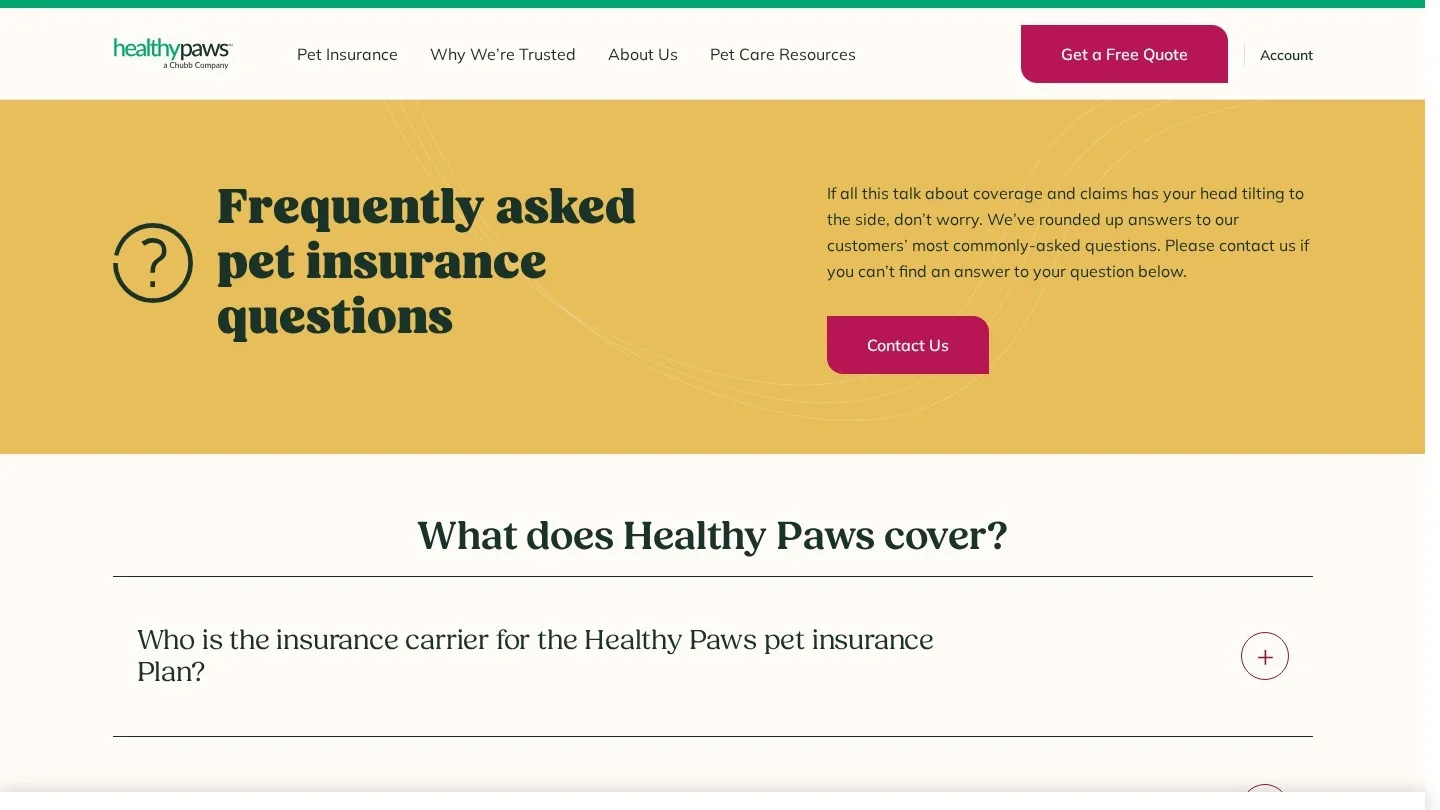
Healthy Paws is known for speed on the back end. Its FAQ says approved reimbursements are issued in about two business days on average, by check or direct deposit. Owners can also ask for direct payment to any licensed US vet, as long as they request it before treatment.
The insurer now offers three annual limits: $5,000, $7,000 or unlimited. You cannot raise the limit after enrollment, so choose carefully at the start. Reimbursement runs from 50% to 90% and the deductible from $100 to $1,000, depending on your pet’s age and breed, according to Pumpkin’s published comparison.
Two gaps are worth knowing. Healthy Paws does not cover the exam fee for a vet visit, and it sells no wellness add-on. Hip dysplasia coverage also has strict rules: the pet must be under 6 at enrollment, and in most states there is a 12-month waiting period.
Who it suits: owners of young dogs who want a simple accident and illness plan and quick claim payments.
Pumpkin
Pumpkin covers the exam fee for accident and illness visits, both in clinic and on virtual vet calls, according to its comparison page. That single line can add up over a year of ear infections or stomach upsets.
You choose 80% or 90% reimbursement and an annual deductible of $100, $250, $500 or $1,000. Annual limits differ by species. Dogs can have $5,000, $10,000, $20,000 or unlimited coverage, and cats can have $5,000, $7,000, $15,000 or unlimited. Pumpkin states no upper age limit, pets can enroll from 8 weeks, and hip dysplasia is covered at all ages. The waiting period is 14 days for both accidents and illness in most states. A 10% discount applies to each additional pet.
Pumpkin also sells Preventive Essentials, a wellness package for vaccines and routine tests. Pumpkin is clear that this package is not insurance, and it is not sold in California, Maine, Missouri, Montana, Rhode Island, Vermont or Washington.
Who it suits: owners of older pets, multi-pet homes and anyone who expects frequent sick visits.
Nationwide
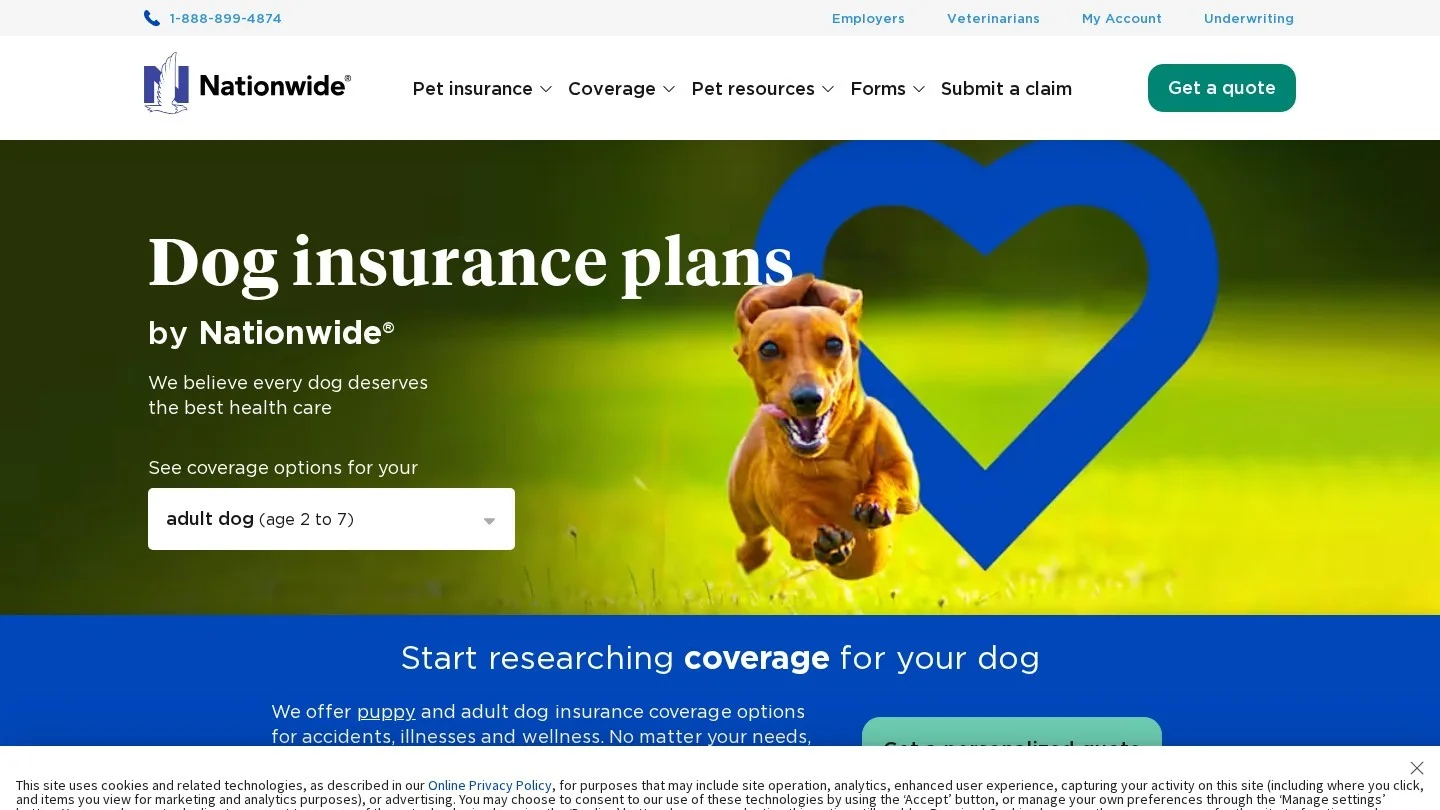
Nationwide is one of the few insurers that prints a price on its main page. Its dog insurance page says plans start at $13 a month. Read the footnote, though. That price is for a 2-year-old medium mixed-breed dog in Chicago on an accident-only plan, with a $5,000 annual limit, 70% reimbursement and a $250 deductible.
Deductibles come in $250, $500 or $1,000 steps per year, and Nationwide says most pet families pick $250. Exam fees are covered, the waiting period is 14 days, and a preventive care add-on is sold where state rules allow for annual exams, vaccines and flea and tick prevention. Nationwide sells coverage for pets at every life stage.
Who it suits: budget-minded owners who want a low-cost accident-only plan, and households that want wellness and insurance from one company.
Embrace

Embrace lets you build the policy piece by piece. Reimbursement is usually set between 70% and 90%, with an annual deductible paid once per year. Every policy has a two-week illness waiting period, and accident waiting periods are shorter, according to Embrace’s guide to how its coverage works. Embrace may shorten some waiting periods after a vet exam.
Exam fees are not included by default. You add them at enrollment, and Embrace says that option can save $50 to $200 per visit. Wellness Rewards, its routine care program, is a separate membership, is not insurance and is not sold in Rhode Island.
Embrace shows two real claims as examples. A dog’s bloat emergency cost $2,623.64, and Embrace reimbursed $2,092.29 after a $100 deductible. A cat hit by a car ran up a $12,169 bill, and Embrace paid $10,000, the annual limit used in that example. The second case shows why the annual limit matters as much as the reimbursement rate.
Who it suits: owners who want control over each part of the policy and are happy to pay extra for exam fee coverage.
ASPCA Pet Health Insurance
ASPCA Pet Health Insurance offers the widest spread of annual limits in this list, from $2,500 up to unlimited. Reimbursement is 70%, 80% or 90%, and the annual deductible is $100, $250 or $500, according to its plan overview.
Preventive care comes in two optional add-ons that pay set amounts from a schedule, with no deductible. ASPCA also sells an accident-only plan alongside its Complete Coverage accident and illness plan. Policies are underwritten by Independence American Insurance Company or United States Fire Insurance Company, the same insurers behind Pumpkin’s policies.
Who it suits: owners who want to dial the annual limit down to save money, or up to unlimited for peace of mind.
Lemonade

Lemonade insures dogs and cats only, and it gives you one of the broadest limit ranges: $5,000 to $100,000 a year. Reimbursement is 70%, 80% or 90%, and the annual deductible is $100, $250, $500 or $750. Lemonade publishes its payout formula plainly on its pet insurance terms page: the eligible claim amount times the reimbursement rate, minus whatever deductible is left for the year.
Preventive care packages can cover wellness exams, vaccines, spay or neuter surgery, routine tests and microchipping, depending on the state.
Who it suits: owners who like managing insurance in an app and want a high limit without paying for unlimited coverage.
Fetch
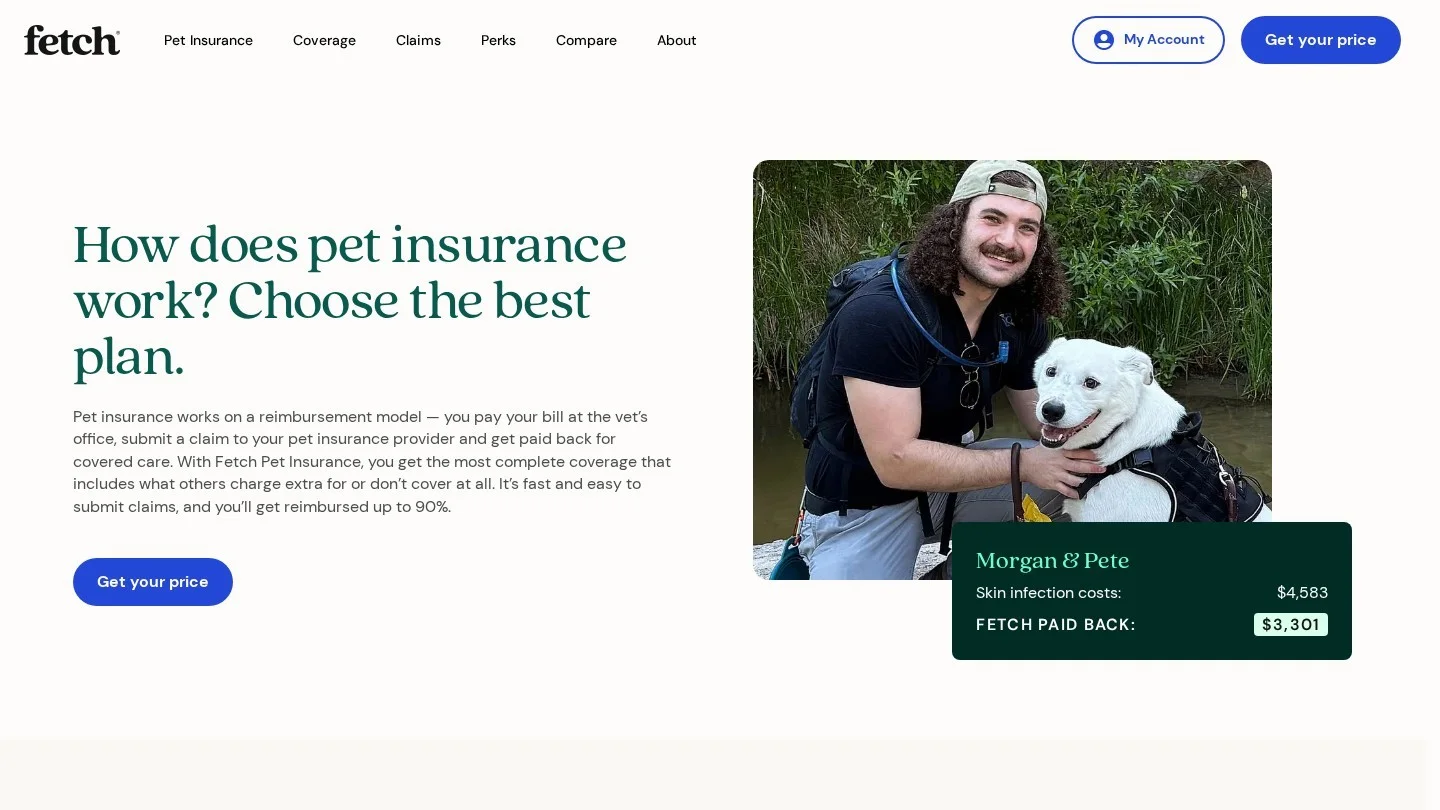
Fetch has no waiting period for accidents. Coverage starts the day after signup. Illness coverage begins after 15 days, and orthopedic problems such as hip dysplasia and knee ligament injuries have a 6-month wait, according to Fetch’s coverage guide. Its optional wellness plan has no waiting period.
Fetch reimburses up to 90% of eligible bills. Claims must be submitted within 90 days, and Fetch says they are typically processed in under 10 days. Policies are underwritten by AXIS Insurance Company.
Who it suits: owners of active dogs who want accident coverage right away, and owners who want to see how price changes with each setting before they buy.
Figo
Figo is one of the few insurers that offers up to 100% reimbursement, which means no co-pay after the deductible. Its dog insurance page lists a Preferred plan with up to $10,000 a year and an Ultimate plan with unlimited annual coverage, with no per-incident caps on either.
Figo covers the exam fee for accident and illness visits. It sets no upper age limit, coverage can start at 8 weeks, and policyholders get free 24/7 access to a licensed veterinary professional through its Live Vet service. Routine care is a separate Wellness Powerup add-on. A group discount of up to 10% is available in some states, according to Figo’s policy FAQ.
Who it suits: owners who want to pay nothing beyond the deductible on a covered claim, and are willing to pay the higher premium that 100% reimbursement brings.

Exam Fees: The Line Item Many Comparisons Skip
The exam fee is what the vet charges just to see your pet, before any test or treatment. Embrace puts that cost at $50 to $200 per visit. A dog with a chronic skin problem might need several sick visits a year, so the gap between a plan that pays the exam fee and one that does not can reach hundreds of dollars.
Of the nine insurers, Pumpkin, Nationwide and Figo say they cover exam fees for accident and illness visits. Embrace sells exam coverage as an add-on. Healthy Paws states that the exam fee is the owner’s cost. Note that this is about sick visits. Routine checkups are a wellness cost under almost every plan.
Waiting Periods Decide When Coverage Actually Starts
A policy you buy today does not pay for an illness that shows up next week. The list below shows how long each insurer makes you wait, using the terms it publishes for most states.
| Insurer | Accidents | Illness |
|---|---|---|
| Fetch | None | 15 days |
| Trupanion | 5 days | 30 days |
| Pumpkin | 14 days | 14 days |
| Nationwide | 14 days | 14 days |
| Embrace | A few days | 14 days |
| Healthy Paws | 15 days | 15 days |
Orthopedic problems often carry their own, longer wait. Fetch waits 6 months for hip dysplasia and knee ligament injuries, and Healthy Paws waits 12 months for hip dysplasia. Pumpkin applies its normal illness wait to hip dysplasia. Healthy Paws also shows how much state rules matter. In 16 states, including California, Florida, Ohio, Pennsylvania and Washington, it has no accident waiting period and a 30-day hip dysplasia wait that a full vet exam can waive. Always read the sample policy for your own state.
Annual vs Per-Incident Deductibles, With an Example
Most insurers use an annual deductible. You pay it once each policy year before reimbursement starts. Trupanion uses a lifetime per-incident deductible, paid once per condition for as long as the policy lasts.
Take a simple illustration with a $250 deductible under both systems. Say a dog develops allergies in year one and needs treatment every year for four years, with no other problems. Under an annual deductible, the owner pays $250 each year, or $1,000 over four years. Under a per-incident deductible, the owner pays $250 once, in year one. Now flip the case. A healthy dog that has a new, unrelated problem each year pays $250 a year under both systems.
The lesson is that per-incident deductibles reward owners of pets with long-running conditions. Annual deductibles are easier to understand and cost the same for pets with one-off problems. To work out what share of a bill you would pay at different reimbursement rates, our percentage calculator does the arithmetic fast.
What Published Sample Quotes Show About Pricing
Most insurers keep prices behind a quote form. Fetch is an exception. Its coverage guide shows three monthly prices for the same 6-week-old small mixed-breed dog in ZIP code 30040 in Georgia, quoted on July 28, 2026.

| Reimbursement | Annual deductible | Annual limit | Monthly premium |
|---|---|---|---|
| 70% | $700 | $5,000 | $22 |
| 80% | $500 | $10,000 | $29 |
| 90% | $300 | $15,000 | $42 |
Moving from the cheapest setup to the richest nearly doubles the price, from $22 to $42 a month. That is $264 a year against $504. Fetch also reports average premiums of $35 a month for dogs and $22 for cats over the year to June 30, 2025, based on a $10,000 limit, $300 deductible and 80% reimbursement.
Nationwide’s starting price of $13 a month is for an accident-only plan, so it is not comparable to a full accident and illness quote. Prices rise with age at most insurers, and every company here says premiums depend on species, breed, age and ZIP code.
Which Pet Insurance Fits Your Situation
| Your situation | Insurers to quote first | Why |
|---|---|---|
| Puppy from a breed prone to joint or skin problems | Trupanion, Pumpkin | Per-incident deductible or broad hip coverage at all ages |
| Senior dog or cat | Pumpkin, Figo | No upper age limit stated |
| Pet that sees the vet often for minor illness | Pumpkin, Nationwide, Figo | Exam fees covered on sick visits |
| Very active dog that could get hurt any day | Fetch | No accident waiting period |
| Tight budget, mainly fears a sudden injury | Nationwide, ASPCA | Accident-only plans |
| Wants the fastest money back after paying the vet | Healthy Paws, Trupanion | Two-day average payment or direct vet pay |
| Wants to pay nothing after the deductible | Figo | Up to 100% reimbursement |
| Multi-pet household | Pumpkin | 10% off each additional pet |
Large breeds deserve extra care with knee and hip clauses. If you own a German Shepherd, the health issues in our Alsatian dog breed guide show why the orthopedic waiting period matters as much as the price.
How to Compare Pet Insurance Quotes Fairly
Quotes are only comparable when the settings match. Follow these steps.
- Fix one setup: Use the same reimbursement rate, deductible and annual limit for every insurer, such as 80%, $500 and $10,000, before you compare prices.
- Check the deductible type: An annual deductible and a per-incident deductible of the same size behave very differently over a pet’s life.
- Read the sample policy for your state: Every insurer here links state documents. Waiting periods and exclusions often change at the state line.
- Look at the underwriter: Pumpkin, ASPCA and Figo all name Independence American Insurance Company as an underwriter. Different brands can share the same insurer behind the scenes.
- Price the exam fee: Add $50 to $200 per expected sick visit to plans that do not cover it.
- Check the claim process: Note how long you have to file (90 days at Healthy Paws and Fetch, one year at Trupanion) and how fast each company pays.
If you travel with your dog, confirm the policy pays any licensed US vet, not just your local clinic. Our list of dog-friendly hotels in national parks is a reminder of how far from home a pet emergency can happen. And if you end up financing a large bill instead, our guide to calculating monthly installments shows the real cost of the payments.

This article is for information and education only and is not investment, tax or financial advice. Figures were checked on November 1, 2026; confirm current details with the official source or a registered adviser before acting.
Age Limits, Direct Vet Pay and Trupanion vs Healthy Paws
Which Pet Insurance Has No Upper Age Limit?
Pumpkin and Figo both state no upper age limit for enrollment, and both accept pets from 8 weeks old. Premiums still rise as pets age, and conditions that existed before coverage are excluded.
Which Pet Insurance Covers Vet Exam Fees?
Pumpkin, Nationwide and Figo cover exam fees for accident and illness visits. Embrace offers exam fee coverage as an optional add-on. Healthy Paws does not cover the exam fee.
Which Pet Insurance Pays the Vet Directly?
Trupanion pays eligible claims at checkout through VetDirect Pay at more than 11,000 hospitals in North America. Healthy Paws can also pay a vet directly if you request it before treatment.
Which Pet Insurance Has the Shortest Waiting Period?
Fetch has no waiting period for accidents, with coverage starting the day after signup. Trupanion’s accident wait is 5 days. For illness, Pumpkin and Nationwide wait 14 days, which is shorter than Healthy Paws at 15 days and Trupanion at 30 days.
Is Trupanion Better Than Healthy Paws?
It depends on your pet. Trupanion’s per-incident deductible and direct vet payment help owners of pets with long-term conditions. Healthy Paws suits owners who want an annual deductible and fast reimbursement, averaging about two business days.
Does Pet Insurance Cover Cats and Dogs the Same Way?
Most insurers here cover both under the same policy rules, but limits and prices can differ. Pumpkin, for example, offers cats limits of $5,000, $7,000, $15,000 or unlimited, compared with $5,000, $10,000, $20,000 or unlimited for dogs.
Insurers’ Own Coverage Guides and Policy Basics
- Trupanion: How Pet Insurance Works
- Healthy Paws: Frequently Asked Questions
- Pumpkin: Pumpkin vs Healthy Paws Comparison
- Nationwide: Dog Insurance
- Embrace: How Does Pet Insurance Work
- ASPCA Pet Health Insurance: How Does Pet Insurance Work
- Lemonade: Pet Insurance Terms Explained
- Fetch: How Does Pet Insurance Work
- Figo: Dog Insurance
- Figo: Policy Basics FAQ