Postman’s free plan stopped working for teams in March 2026. Under the new plans it covers one user and cannot create a team, where it once let a free team invite up to three people. That change made local, git-based API clients look a lot more attractive, and Bruno is the best known of them. Bruno is not the right fit for every team, though, and the open-source client has some real rivals.
The best Bruno alternatives are Yaak, the closest match for a local, file-based workflow, and Insomnia, which offers local, cloud and git storage plus a free plan that covers git sync for up to three users. Hoppscotch is the pick for a browser-first, self-hosted open-source client. Postman is still the most complete platform if you will pay per seat. Thunder Client suits developers who never want to leave their code editor. HTTPie is the friendliest tool for quick requests, Kreya is built around gRPC, and Apidog fits teams that design, document and test APIs in one place.
Which API Client to Pick Instead of Bruno
- Bruno stores collections as plain-text files in your repository and supports REST, GraphQL, gRPC and WebSocket. Its homepage claims 4 million users and 46,000 GitHub stars.
- Yaak, from the developer who created Insomnia, is the most Bruno-like option: local only, one YAML file per request and a built-in git screen. Personal use is free; work use costs $79 a year for an individual license.
- Insomnia’s free Essentials plan includes git sync for up to three users, unlimited collection runs and the Inso CLI, and it lists the widest protocol range here, including SOAP and Socket.IO.
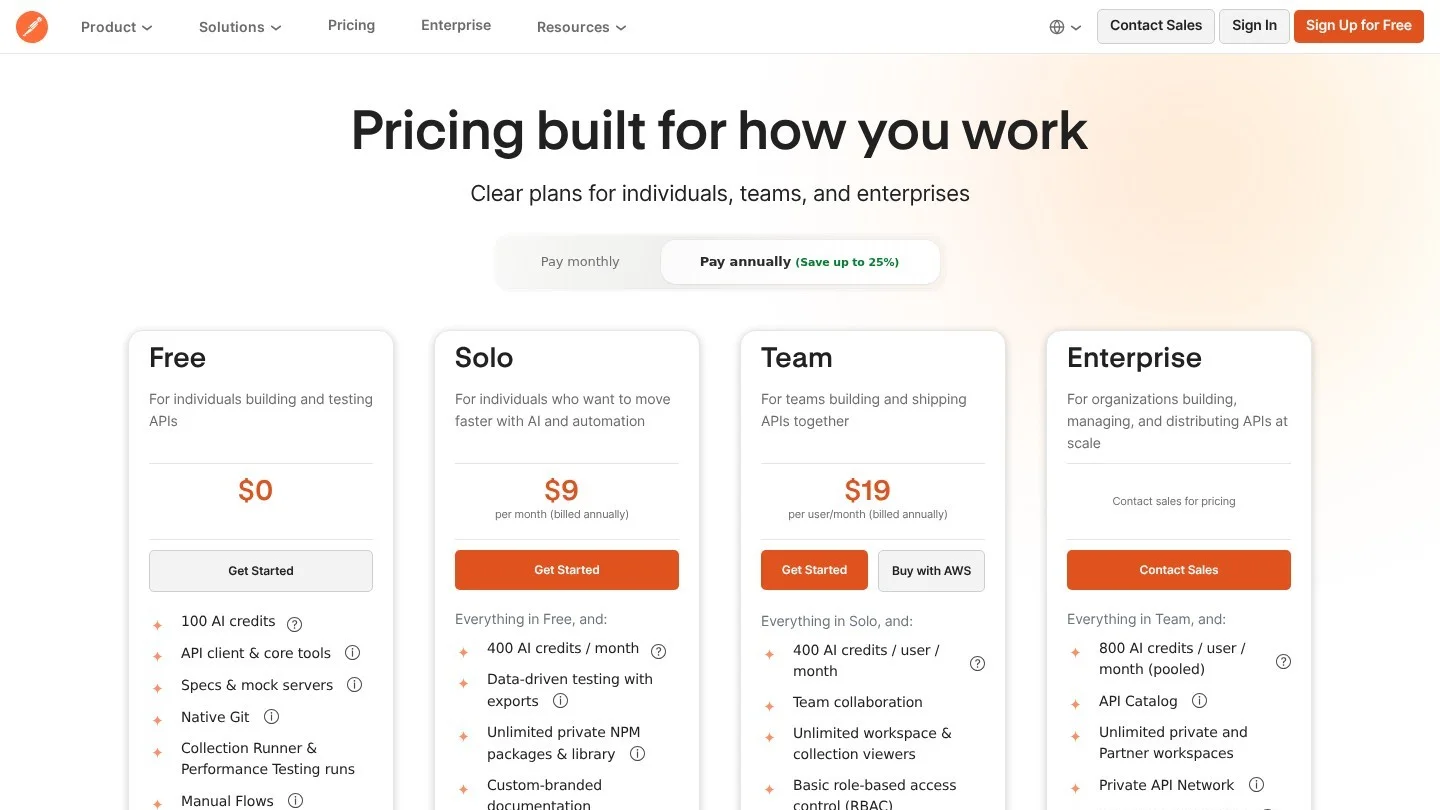
- Postman’s free plan is now limited to one user. Solo costs $9 and Team costs $19 per user per month on annual billing.
- RapidAPI for Mac, the app once called Paw, has been discontinued by Nokia, so it is no longer a safe place to move your collections.
Why Teams Look Beyond Bruno
Bruno earned its following by doing one thing differently. It keeps every request as a file in your repository, so API collections travel with the code, show up in pull requests and need no vendor cloud. Collections are written in OpenCollection YAML, a readable, diff-friendly format, and the app handles REST, GraphQL, gRPC and WebSocket. The core app is free and open source. Paid tiers start with Pro at $6 per user per month on annual billing, followed by Ultimate at $11 and a custom-priced Enterprise plan.
So why switch? The reasons usually fall into a few groups.
- Not everyone on the team uses git: product managers, support staff and some QA testers want a shared workspace that updates on its own. A git-first tool asks them to clone, pull and commit before they can see a new request.
- No scheduled checks: Bruno collections run when someone opens the app, starts the CLI or triggers a CI pipeline. There is no built-in scheduler or alert channel for an endpoint that breaks at 3 a.m.
- Protocol gaps: teams that still test SOAP services, Socket.IO servers or Server-Sent Events streams may want a client that lists them by name.
- Working inside the editor: some developers would rather send requests from a VS Code or JetBrains panel than switch to a separate desktop app.
- Design-first work: teams that write the API spec first, then mock and document it, often want those steps in the same product as testing.
None of these are flaws in Bruno so much as limits of its design. The right alternative depends on which limit is costing you time.
Bruno Alternatives by Price, Storage and Protocol Support
| Tool | Open source | Where collections live | Git-friendly | Protocols | Scripting and tests | CLI for CI | Free tier | Paid price |
|---|---|---|---|---|---|---|---|---|
| Bruno (for reference) | Yes | Files in your repo | Yes, plain-text YAML | REST, GraphQL, gRPC, WebSocket | Yes, JavaScript | Bruno CLI | Full desktop app | Pro $6/user/mo |
| Postman | No | Cloud workspaces, Local Vault for secrets | Native Git on all plans | REST, GraphQL, gRPC, WebSocket and more | Yes, JavaScript | Postman CLI, Newman | 1 user | Solo $9, Team $19/user/mo |
| Insomnia | Source on GitHub | Local, cloud or Git Sync projects | Git Sync, free for up to 3 users | REST, GraphQL, gRPC, SOAP, WebSocket, Socket.IO, SSE | Yes | Inso CLI | Unlimited local and cloud projects | Pro $12, Enterprise $45/user/mo |
| Hoppscotch | Yes, MIT (Community Edition) | Browser, desktop app or your own server | Workspaces, not repo files | REST, GraphQL, real-time protocols | Pre-request scripts and tests | Hoppscotch CLI | Free, self-hostable | Enterprise Edition $19/user/mo |
| Yaak | Yes, MIT source code | Local only | Yes, one YAML file per request | HTTP, GraphQL, gRPC, WebSocket, SSE | Request chaining, plugins | Yaak CLI | Free for personal use | $79/yr individual, $149/user/yr business |
| HTTPie | CLI is open source | Local, optional account sync | Exports to HTTPie CLI or cURL | HTTP, GraphQL | Postman and Insomnia scripts not imported | HTTPie CLI | Free app | Free |
| Thunder Client | No | Inside VS Code or JetBrains | Git-Sync feature | REST, gRPC, WebSocket, SSE | Custom scripting | CLI and CI/CD on all plans | 3 collections, 50 requests each | Starter $3, Business $7/user/mo |
| Kreya | No | Local JSON files | Yes, built for git sharing | gRPC, REST, GraphQL, WebSocket, SSE | Scripting and tests on Pro | CLI on Pro | Free with limits | Pro subscription, 10-day trial |
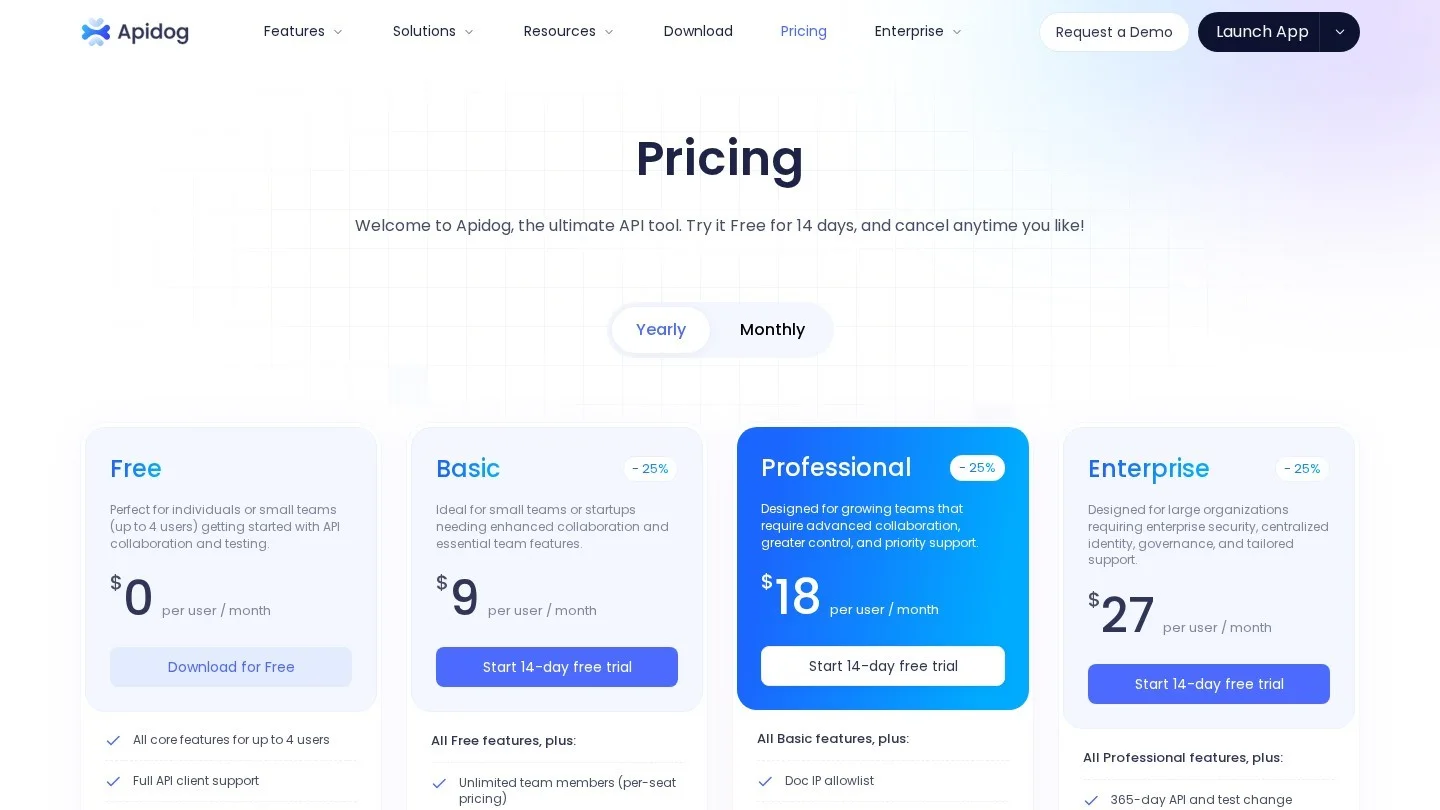
| Apidog | No | Cloud, on-premises for Enterprise | Branches inside Apidog | HTTP, GraphQL, gRPC, WebSocket | Visual assertions and scripts | Apidog CLI | Up to 4 users | Basic $9, Professional $18/user/mo |
Prices are in US dollars per user per month on annual billing where the vendor shows both. Yaak bills only yearly. Confirm the figure at checkout, because developer tools change their plans often.
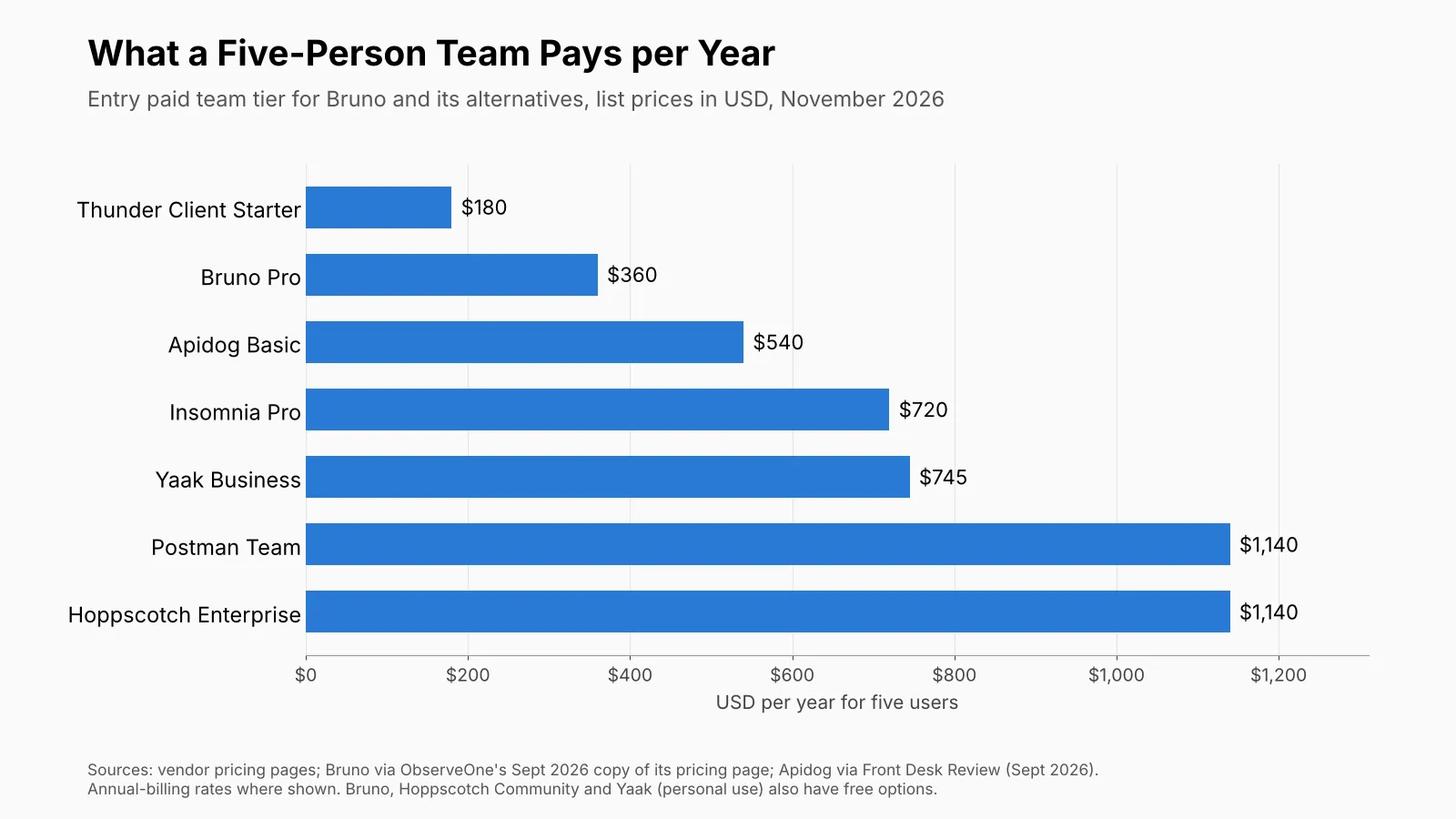
The chart puts those rates on a common footing: five people for a year. Two points matter most. Bruno itself is one of the cheapest paid options, so price is rarely the reason to leave it. And Postman, which used to be the free default, now ties with self-hosted Hoppscotch Enterprise as the most expensive way to equip a small team with a shared workspace.
Eight API Clients Worth Testing in Place of Bruno
Yaak
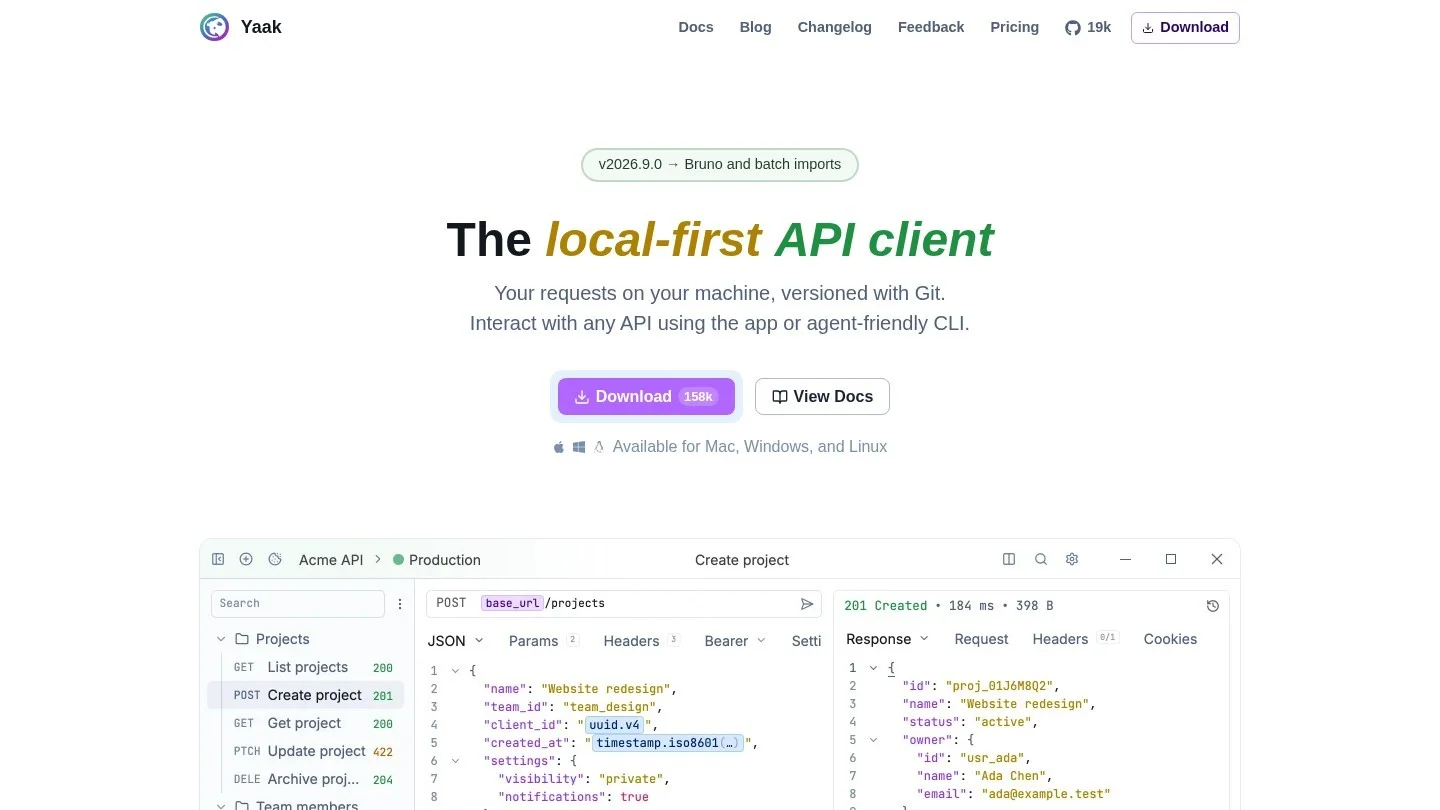
Yaak is the alternative that feels most like Bruno, which makes sense given its author. It was built by Greg Schier, who created Insomnia and sold it in 2019. Yaak is a local-first desktop app for macOS, Windows and Linux written in Rust and Tauri. There is no required account and no automatic cloud sync.
The storage model is the main draw for Bruno users. Each request, folder and environment is saved as its own YAML file, and the app ships with a built-in git screen, so you can commit and review changes without leaving it. Secrets are encrypted with keys held in your operating system’s keychain. Protocol support covers HTTP, GraphQL, gRPC, WebSocket and Server-Sent Events.
Yaak also leans hard into AI coding agents. A CLI lets tools such as Claude Code, Codex and Cursor create and send the same requests you see in the app, and the changes appear in the interface. If your team plans to let agents touch live endpoints, agree on ground rules first; our guide to writing an AI acceptable use policy covers the basics.
The problem is licensing. The source code is MIT-licensed, but the prebuilt app needs a commercial license for any work use after a 30-day trial. An Individual license costs $79 a year or $399 once for life, and Business costs $149 per user per year. Each license covers three devices. Freelancers can weigh that against their own billing rate with our freelance hourly rate calculator.
Best for: developers who like Bruno’s files-in-git approach but want a faster, more polished app and agent-friendly tooling.
Insomnia
Insomnia, now owned by Kong, is the most flexible choice on storage. You can keep a project local, sync it through Kong’s cloud or connect it to a git repository, and you can mix those modes across projects. That makes it a sensible middle ground for teams where developers want git and everyone else wants a shared workspace.
The free Essentials plan is generous. It includes unlimited local and cloud projects for all users, unlimited Git Sync projects for up to three users, unlimited collection runs, the Inso CLI for CI/CD pipelines, 1,000 mock server requests a month, end-to-end encryption and plugins. Pro costs $12 per user per month with no user cap, and Enterprise is $45 per user per month, self-serve up to 50 users.
Protocol coverage is the widest in this list. Insomnia lists REST, GraphQL, gRPC, SOAP, WebSocket, Socket.IO and Server-Sent Events clients, which matters if you still maintain an older SOAP service next to newer APIs.
The trade-off is complexity. With three storage modes, it is easy for a team to end up with some projects in git and others in the cloud. Agree on one mode per project before you import anything, and the setup stays tidy.
Best for: mixed teams that need git for developers, a cloud workspace for others and the broadest protocol support.
Hoppscotch
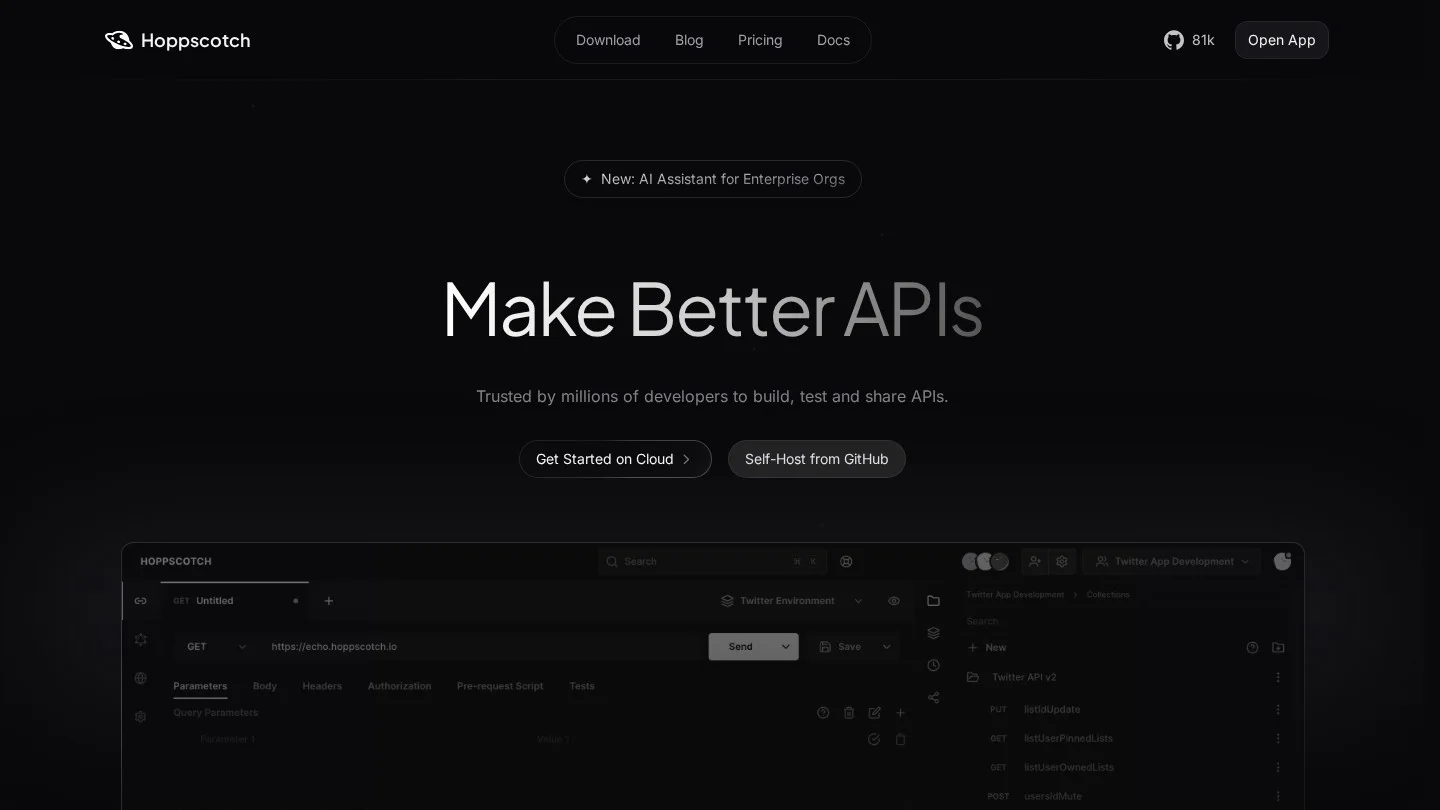
Hoppscotch started as a fast web app and still feels like one. You can open it in a browser tab and fire off a request in seconds, which makes it handy on a locked-down work laptop where installing desktop software takes a ticket. There is also a desktop app for people who prefer one.
Its biggest strength for privacy-minded teams is self-hosting. Hoppscotch comes in two editions. The Community Edition is open source under the MIT License and can be used for personal and commercial projects at no cost. The Enterprise Edition, a self-hosted version of Hoppscotch Cloud, costs $19 per user per month and adds the controls larger companies ask for.
That model gives you a shared, always-current workspace that never leaves your network, which is something Bruno does not try to offer. What you give up is Bruno’s file-per-request layout: Hoppscotch collections live in workspaces rather than as plain files beside your code.
Best for: teams that want a shared, browser-based client on their own servers, with an open-source license.
Postman
Postman is what most Bruno users were running before, and it is still the most complete API platform. Beyond sending requests, it covers API design, mock servers, monitors, documentation, flows and a large public API network. If your problem with Bruno is the missing scheduler and alerts, Postman’s monitors solve it directly.
The cost picture changed in 2026. Postman reworked its plans in March 2026: Free is now limited to one user and cannot create a team, Team replaced the old Basic plan, and Solo was added for individuals. The same change made collection runs and mock server usage unlimited on every plan. Solo costs $9 a month and Team costs $19 per user per month on annual billing, with Enterprise priced by sales. Each plan comes with AI credits, from 400 a month on Solo to 800 per user on Enterprise.
Postman has also moved toward Bruno’s ground. Its pricing page lists Native Git and a Local Vault for secrets on every plan, including Free. That narrows the gap for teams that wanted collections in a repository but did not want to give up Postman’s other tools. If you are comparing per-seat costs across your software stack, our explainer on SaaS pricing models shows why seat-based plans grow quickly with headcount.
Best for: teams that need monitoring, mocks, documentation and governance in one product, and have the budget for seats.
Thunder Client
Thunder Client lives inside your code editor. It started as a VS Code extension and now also runs in JetBrains IDEs, with Cursor, VSCodium and other editors listed on its site. For developers who find a separate desktop app one window too many, that is the whole pitch.
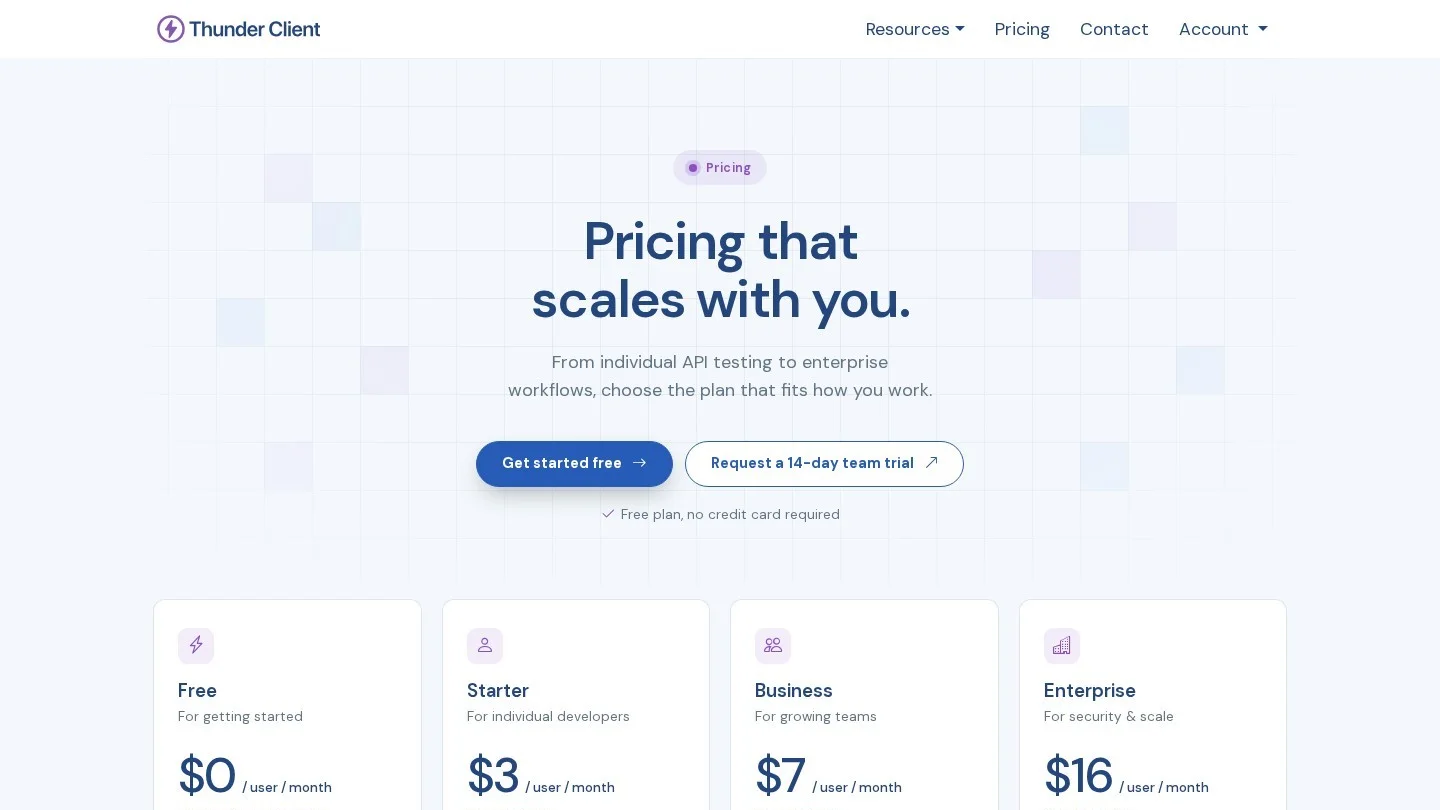
The free plan has firm limits. Thunder Client caps it at 3 collections, 50 requests per collection, 5 collection imports a month and 30 local collection runs per user each month, though CLI and CI/CD runs are not limited. Paid plans are cheap: Starter is $3, Business is $7 and Enterprise is $16 per user per month, all billed annually. Starter removes the collection and request caps. WebSocket, Server-Sent Events and gRPC are available on every plan.
The low price makes Thunder Client the cheapest paid team option in our comparison. The limits on the free tier, though, mean a busy developer will hit the 50-request ceiling quickly.
Best for: developers who want API testing in the same window as their code and are happy to pay a few dollars a month.
HTTPie
HTTPie is best known for its open-source command-line tool, which made sending HTTP requests from a terminal readable. The company now makes three clients: Terminal, Web and Desktop. The desktop app always stores data locally and works offline, while a free account adds cloud backup, sync across devices and unlimited spaces.
The app is deliberately simple. It handles REST requests with common auth types and body formats, plus dedicated GraphQL support with schema auto-fetch and autocomplete. Any request can be exported as an HTTPie CLI or cURL command, which is useful when you want to paste a working call into a script or a bug report. An AI assistant can build a request from a plain-English description and is free during its preview period for signed-in users.
Do not expect a full test runner. The docs say pre-request scripts and tests from Postman and Insomnia are not imported, and WebSocket and gRPC requests are not either. HTTPie is a pleasant tool for exploring APIs, not a replacement for Bruno’s scripted test suites.
Best for: quick, readable API exploration, especially for people who already use the HTTPie CLI.
Kreya
Kreya comes from riok GmbH in Switzerland and began as a gRPC client before adding REST. Its gRPC tooling is the reason to look at it. Kreya supports gRPC, REST, GraphQL, WebSocket and Server-Sent Events, along with HTTP/2 and HTTP/3, and imports from OpenAPI, gRPC server reflection, Protobuf files, Postman and Insomnia.
Kreya also shares Bruno’s view on storage. Projects are saved locally in a JSON format designed for sharing through git. That means the move from Bruno does not force your team into a vendor cloud.
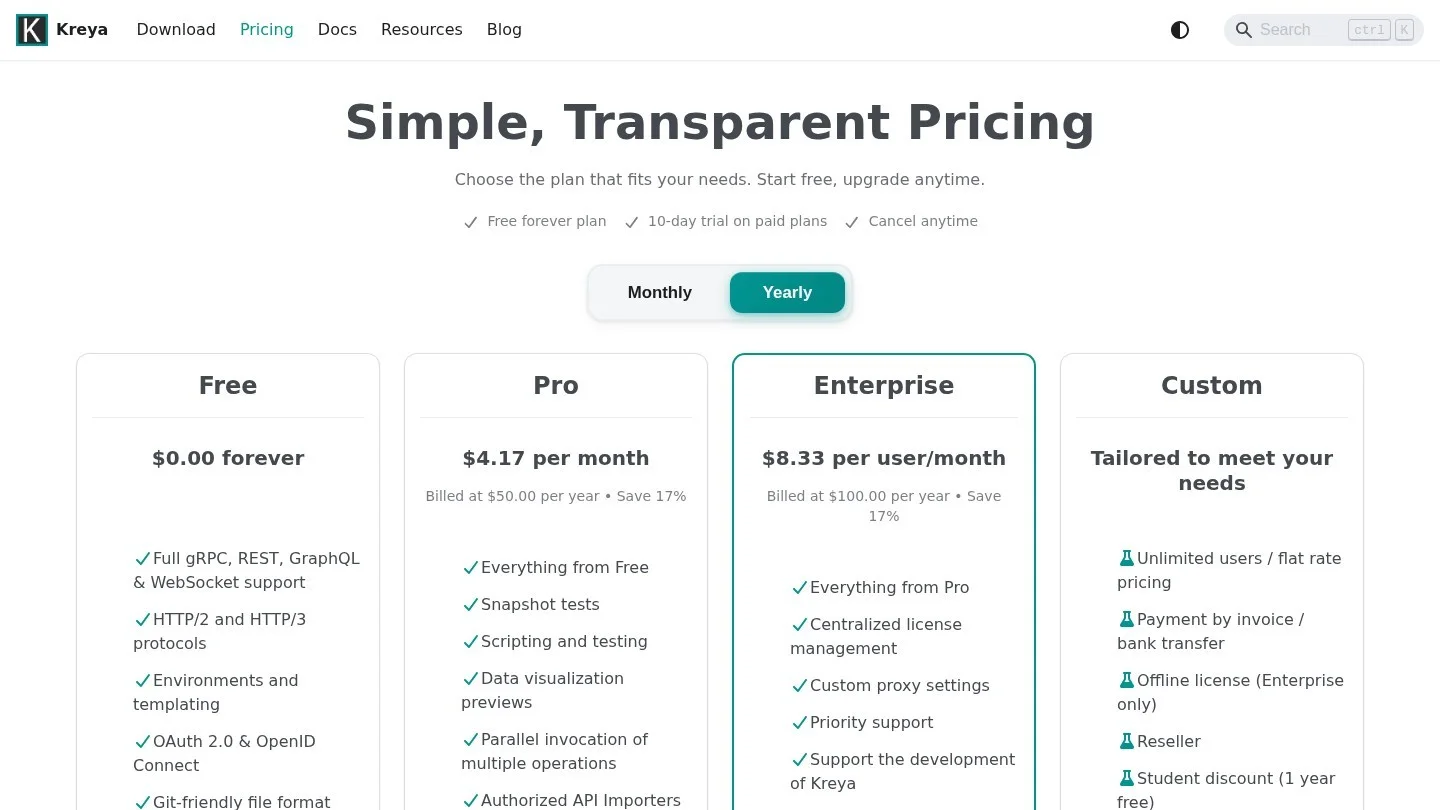
The free version is limited. It keeps only the latest request in history, and scripting, tests, snapshot testing, collections and the CLI belong to the paid Pro plan, which comes with a 10-day trial. Enterprise adds offline licensing, flat-rate pricing through sales and 24-hour support on business days.
Best for: teams that live on gRPC and Protobuf and want git-friendly local files.
Apidog
Apidog takes the opposite approach to Bruno. Instead of a lean client, it bundles API design, documentation, mock servers, automated tests and debugging into one product. Teams that write an OpenAPI spec first and want tests, mocks and docs to follow from it will find that appealing.
Pricing is per user. Apidog has a free plan for up to four users, Basic at $9 per user per month on annual billing ($12 monthly), Professional at $18 ($24 monthly) and Enterprise at $27, with on-premises hosting available on Enterprise by quote. The free plan includes the API client, mocking and collection runs.
For Bruno users the main question is storage. Apidog keeps projects in its own cloud and uses branches inside the product rather than files in your repository. If git-native collections were the reason you chose Bruno, Apidog will feel like a step back. If documentation and mocks were the gap, it may be a step forward.
Best for: design-first teams that want specs, mocks, docs and tests in a single workspace.
What Happened to Paw and RapidAPI for Mac
Older lists of Bruno alternatives still recommend Paw, the native Mac client later renamed RapidAPI for Mac. Skip it. Nokia, which owns the product, announced in September 2026 that RapidAPI for Mac is discontinued. The app still opens, but it will get no fixes, and macOS 27 is not on its supported list. Anyone still using it should export collections now, while the app still runs cleanly.
How to Choose a Bruno Alternative for Your Team
Start with the reason you are leaving, not with feature lists. Most teams fall into one of these situations.
- You want Bruno’s model, done differently: choose Yaak. It keeps requests as files in git, runs fully offline and adds a CLI built for coding agents. Budget $79 to $149 per person a year for work use.
- Non-developers need to see and edit requests: choose Insomnia if you want both git and a cloud workspace, or self-hosted Hoppscotch if the workspace must stay on your own servers.
- You need monitoring, mocks and docs: Postman covers all three in one place. Apidog is the cheaper choice if your team is design-first.
- Your APIs are mostly gRPC: Kreya’s Protobuf and server-reflection support is the deepest here, and it also stores projects as git-friendly files.
- You never want to leave the editor: Thunder Client runs inside VS Code and JetBrains for as little as $3 per user per month.
- You just need to poke at an endpoint: HTTPie’s desktop or web app is the quickest way to do it, with cURL export when you need it.
Whatever you pick, run a two-week trial on a real project. Import one full collection, wire it into one CI job and ask the least technical person on the team to make a change. Those three tests show more than any comparison table.

Moving Your Collections Out of Bruno
Bruno makes leaving fairly painless. It exports to three formats: a Bruno collection, a Postman collection and an OpenAPI specification. To export, hover over a collection, open the three-dot menu, choose Share, pick a format and save the file.
- Export as a Postman collection first. It is the format most rivals import. Insomnia, Kreya and HTTPie all list Postman imports, and Postman reads it natively.
- Export an OpenAPI file as well. Design-first tools such as Apidog work best from a spec, and the spec is a useful record of every endpoint even if you never import it.
- Rewrite scripts and tests by hand. Pre-request scripts and assertions rarely convert cleanly between tools. HTTPie, for one, says it does not import scripts at all. List every script before you migrate, then rebuild and run each one in the new client.
- Move secrets separately. Do not paste API keys into a shared cloud environment just to get running. Keep them in the new tool’s local vault or a secrets manager, and never commit them to the repository.
- Swap the CI step last. Keep the Bruno CLI job running until the new tool’s CLI (Postman CLI, Inso, Hoppscotch CLI, Thunder Client CLI or Apidog CLI) passes the same tests on the same branch.
The secrets step is where migrations go wrong. A stray token in a committed environment file can live in git history for years. Our small business cybersecurity checklist covers secret handling for small teams, and a good password manager is a reasonable home for shared API keys if you do not run a dedicated vault.
Bruno Questions Developers Ask
Is Bruno Better Than Postman?
It depends on what you need. Bruno is free, open source and stores collections as files in git, which suits developer teams that review API changes in pull requests. Postman offers far more beyond requests, including monitors, mocks and documentation, but its free plan now covers only one user and Team costs $19 per user per month on annual billing.
What Is the Best Free Alternative to Bruno?
For teams, Insomnia’s free Essentials plan is the most generous, with git sync for up to three users and unlimited local and cloud projects. For a fully open-source option you can self-host, choose the Hoppscotch Community Edition. Yaak is free only for personal use.
Can I Import Bruno Collections Into Postman or Insomnia?
Yes, by exporting first. Bruno can export a collection as a Postman collection or an OpenAPI specification, and both Postman and Insomnia import those formats. Scripts and tests may need manual fixes after the import.
Does Bruno Work Offline?
Yes. Bruno is a desktop app that saves collections as plain-text files on your machine or in your repository, so it does not need a cloud account to send requests. Yaak, Kreya and the HTTPie desktop app also work offline.
Which API Client Is Best for gRPC Testing?
Kreya is the specialist pick, with gRPC server reflection, Protobuf imports and HTTP/2 and HTTP/3 support. Insomnia, Postman, Yaak and Bruno itself also handle gRPC requests if you prefer a general client.
Pricing Pages and Docs We Checked
- Bruno: Homepage
- Bruno Docs: Export Collections
- ObserveOne: Bruno Alternatives and Pricing (September 2026)
- Postman: Plans and Pricing
- Postman Learning Center: About Plans
- Insomnia: Pricing
- Hoppscotch Docs: Getting Started With Self-Hosting
- Yaak: Homepage
- Yaak: License Checkout
- HTTPie: HTTPie for Web and Desktop Docs
- Thunder Client: Pricing
- Kreya: Pricing
- AlternativeTo: Kreya
- Front Desk Review: Apidog Pricing (September 2026)
- MacGeneration: Nokia Ends RapidAPI for Mac (September 2026)