A cubic meter of cross-laminated timber from the Swedish forest group Södra leaves the factory with a carbon footprint of minus 704 kg of CO2 equivalent. If that same panel is burned at the end of its life, the declaration that reports the minus 704 also books plus 754 kg. Both numbers are true, and the gap between them is the most important thing to understand about carbon-negative building materials.
The best carbon-negative building materials available today are straw panels, cross-laminated timber, cork insulation board, hempcrete blocks, hemp fiber insulation and synthetic limestone aggregate made from captured CO2. We compared them on one test a buyer can check: whether the maker publishes a verified environmental product declaration (EPD) or a clear figure showing that the product stores more carbon than its production emits. Then we did our own math on what each one stores in a real wall or floor, and when that storage can be lost.
Carbon-Negative Materials by the Numbers
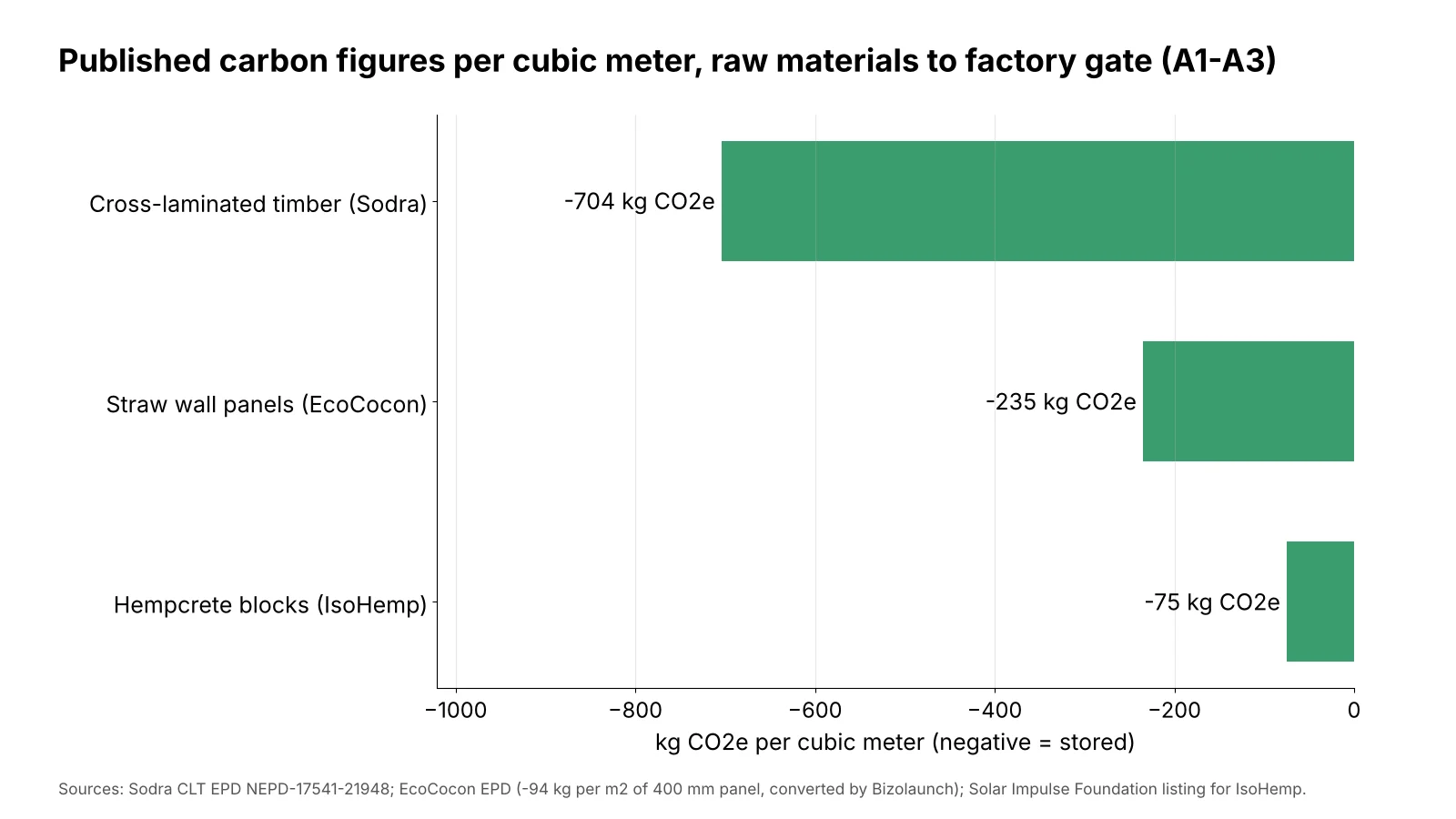
- Cross-laminated timber (Södra): -704 kg CO2e per cubic meter from raw material to factory gate, with +754 kg booked if burned at end of life.
- Straw wall panels (EcoCocon): about -94 kg CO2e per square meter of 400 mm panel, which our math puts at about -235 kg per cubic meter.
- Hempcrete blocks (IsoHemp): -75 kg of CO2 per cubic meter.
- Synthetic limestone aggregate (Blue Planet): Blue Planet says it is 44% CO2 by mass, or a net 40% after production emissions.
- The rule to remember: Plant-based materials hold carbon only as long as they are not burned or left to rot, so design for long life and reuse.
What Makes a Building Material Carbon Negative
A material is called carbon negative when the carbon it locks away is larger than the emissions from making it. For most products on this list, the stored carbon came from plants. Trees, straw and hemp pull CO2 out of the air as they grow and keep the carbon in their fibers. When those fibers become a wall or a floor, the carbon stays in the building.
EPDs, the standard reports that list a product’s environmental impacts, show this with a split. “GWP-fossil” is the warming effect of fossil emissions from making the product. “GWP-biogenic” is the plant carbon, which shows up as a negative number at the start of the product’s life. “GWP-total” adds them up. If the total for the production stages, called A1 to A3, is below zero, the product is carbon negative at the factory gate.
Plant carbon has one weakness: it can go back into the air. European EPD rules make the producer book the stored carbon as released again at end of life, in modules C3 and C4, unless the material is reused. So a fair claim is “carbon negative from cradle to gate, as long as the material is kept in use.” Mineral products such as synthetic limestone are different, because the CO2 is bound into rock and does not escape when the building is torn down.
Carbon-Negative Materials Compared on Published Figures
This table is our own comparison, built from the EPDs and company pages cited in each section. Declared units differ, so compare within a column only when the units match.
| Material and maker | Use in a building | Published carbon figure | Declared unit | Evidence type |
|---|---|---|---|---|
| Cross-laminated timber, Södra | Floors, walls, roofs | -704 kg CO2e (A1-A3); +754 kg CO2e at C3 | 1 cubic meter, about 460 kg | Third-party EPD (NEPD-17541-21948) |
| Straw wall panels, EcoCocon | Prefab walls with insulation | About -94 kg CO2e (A1-A3) | 1 square meter of 400 mm panel, 71 kg | Third-party EPD (EPD International) |
| Hempcrete blocks, IsoHemp | Insulating masonry walls | -75 kg CO2 | 1 cubic meter of blocks | Solar Impulse label listing |
| Cork insulation board, Amorim | Wall and roof insulation, facades | Negative GWP-total (A1-A3) | 1 cubic meter, about 115 kg | Third-party EPD (EPD HUB-0281) |
| Hemp fiber insulation, Hempitecture | Insulation batts | EPD published May 2026 | Available on request | Company EPD summary |
| Synthetic limestone aggregate, Blue Planet | Coarse and fine aggregate in concrete | 440 kg CO2 per tonne; 40% net after production | 1 tonne | Company claim |
Straw Panels: About -94 kg CO2e per Square Meter of Wall
EcoCocon makes prefabricated wall panels from compressed straw in a timber frame. They are 400 mm thick and act as both structure and insulation. Their EPD, published through EPD International and valid until September 2031, gives a GWP-total of about -94 kg CO2e per square meter of panel for stages A1 to A3. That figure is made up of about -101 kg of stored plant carbon and 7.42 kg of fossil emissions from making the panel.

To compare it with other materials, we turned the figure into a per-volume number. A panel 0.4 m thick has 0.4 cubic meters of material in each square meter, so -94 / 0.4 = -235 kg CO2e per cubic meter.
What does that mean for a house? Say a small home has 120 square meters of exterior wall. At -94 kg per square meter, the panels store 120 x 94 = 11,280 kg, or about 11.3 tonnes of CO2e, net of the fossil emissions to make them. The EPD assumes a 60-year service life, so that storage is a long-term commitment as long as the walls stay dry and in use.
The lesson for builders is that straw works best as a wall, not a decorative add-on. It is cheap plant waste, it insulates well at that thickness, and it stores the most carbon in our table per square meter of wall.
Cross-Laminated Timber: Large Storage with a Clear Caveat
Cross-laminated timber, or CLT, is made by gluing layers of boards at right angles into large panels. It can replace concrete or steel in floors, walls and roofs of mid-rise buildings.
Södra’s EPD for CLT, registered with the Norwegian EPD Foundation and valid until December 2030, gives these figures per cubic meter:
| Stage | GWP-total (kg CO2e) | GWP-biogenic (kg CO2e) |
|---|---|---|
| A1-A3, raw materials to factory gate | -704 | -751 |
| C3, end-of-life processing | +754 | +751 |
The numbers tell the whole story. The wood stores 751 kg of plant carbon per cubic meter, and making the panel emits about 47 kg of fossil CO2e, so it leaves the factory at -704. If the panel is later burned for energy, the 751 kg goes back into the air, and the life cycle ends slightly positive.
Our worked example: a building that uses 200 cubic meters of CLT holds 200 x 704 = 140,800 kg, or about 141 tonnes of CO2e, at the factory gate. To keep that benefit, the design should let panels be taken down and reused, or at least kept in service as long as possible.
Cork Insulation Board: Carbon Stored in Bark
Expanded cork board is made from cork oak bark, heated so that its own resins bind the granules with no added glue. The trees are not cut down to harvest it, because the bark grows back.
Amorim’s insulation corkboard has a third-party EPD, EPD HUB-0281, published in February 2023 and valid until February 2028. It shows a negative GWP-total for stages A1 to A3, with a declared unit of one cubic meter at about 115 kg. The board has a thermal conductivity of 0.040 W/m·K.
Because the board is made only from bark and its own resins, it can be taken off a building and reused, which helps keep its stored carbon out of the air. It suits exterior insulation, roofs and facades, where a long service life protects that storage.
Hempcrete Blocks and Hemp Fiber Insulation
Hempcrete is a mix of the woody core of the hemp plant with a lime binder. It is light, insulating and breathable, and it is often cast or laid as blocks inside a structural frame.
IsoHemp is a Belgian maker of hempcrete blocks. Each cubic meter of its blocks has a footprint of -75 kg of CO2, from carbon absorbed while the hemp grew. That is a smaller figure than straw or CLT, because lime production emits CO2. Over time, though, lime slowly reabsorbs some CO2 from the air as it hardens, which is one reason hempcrete fans like it.

In the US, Hempitecture makes HempWool, a batt insulation made of 92% industrial hemp fiber and 8% low-melt polymer binder. The company published an EPD in May 2026, based on a life cycle study by the University of Idaho’s Integrated Design Lab under EN 15804 and ISO 14040 and 14044 rules. The full declaration is available from the company on request.
Synthetic Limestone Aggregate: Carbon Locked in Stone
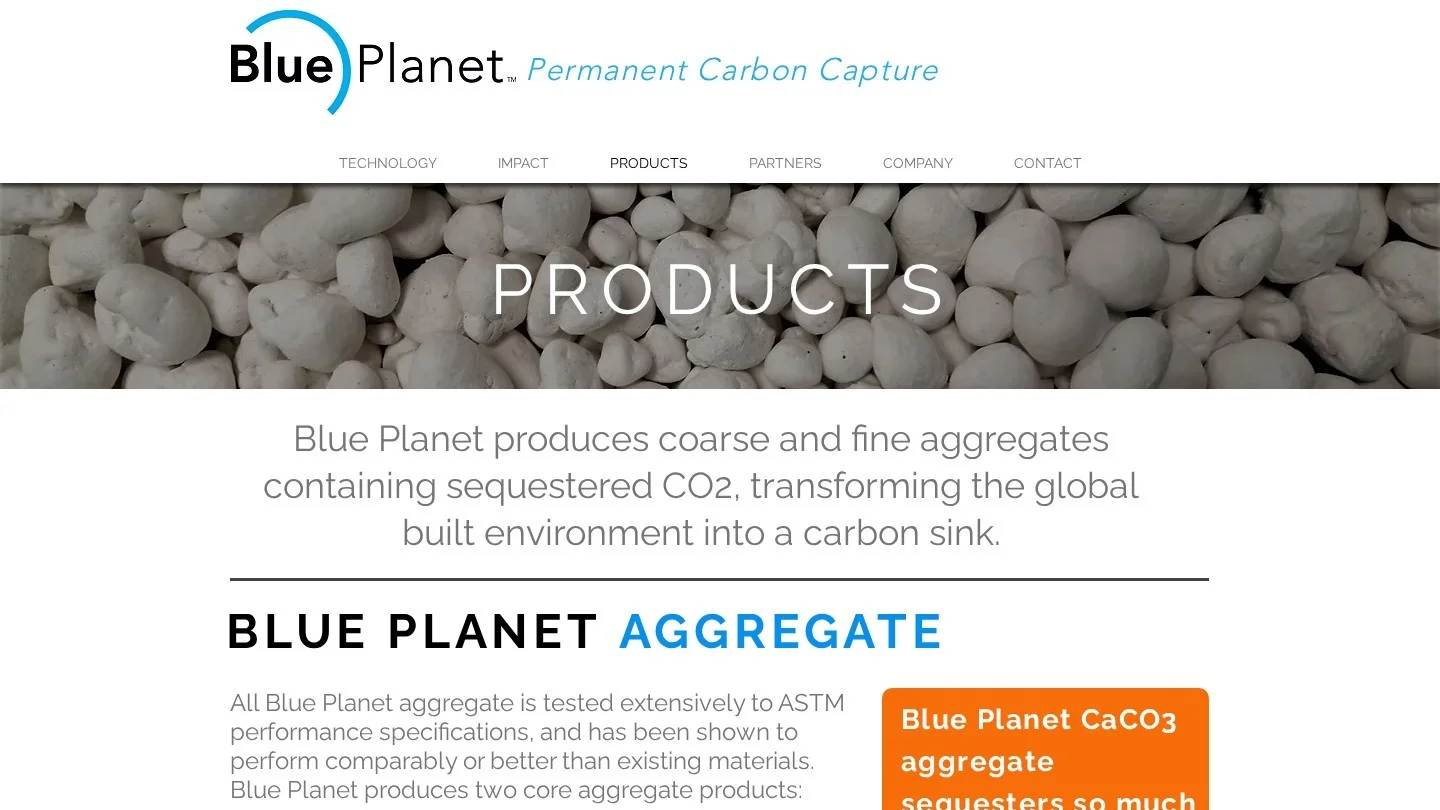
Concrete is mostly aggregate, the sand and gravel that fill the mix. Blue Planet, a California company, makes a synthetic limestone aggregate by combining captured CO2 with calcium.
Blue Planet says the aggregate is 44% CO2 by mass, so each tonne traps 440 kg of CO2. After counting the emissions of making it, the company gives a net figure of 40%, or 400 kg per tonne. Blue Planet says this can make the concrete in a whole building carbon negative without changing the cement.
Here the storage is mineral, not plant-based. Limestone does not burn or rot, so the CO2 stays bound even when the concrete is crushed for reuse. That makes this the most permanent storage in our table, though the volume made today is small compared with the world’s use of gravel. If you are using concrete anyway, it is worth asking local suppliers about it, alongside options such as self-healing concrete that cut the carbon cost of repairs.
Our Ranking for Typical Building Projects
We ranked the materials for the most common jobs, weighing the size of the published carbon figure, the quality of the evidence, and how long the carbon is likely to stay stored.
- Walls in low-rise homes: straw panels. The largest storage per square meter of wall in our data, a current third-party EPD, and a 60-year design life.
- Structure for mid-rise buildings: cross-laminated timber. Very large storage per cubic meter and a clear EPD. Plan for reuse, because burning it reverses the benefit.
- Exterior insulation and facades: cork board. A third-party EPD with a negative total, a binder-free product and good reuse potential.
- Infill walls with good moisture control: hempcrete blocks. A smaller published figure, but a breathable, fire-resistant wall.
- Concrete you cannot avoid: synthetic limestone aggregate. Permanent mineral storage, limited by supply.
- Insulation batts: hemp fiber. A new US EPD backs the product; ask the maker for the full numbers for your project.
How to Check a Carbon-Negative Claim Before You Buy
“Carbon negative” is a marketing phrase as well as a technical one. These checks separate the strong claims from the weak.
- Ask for the EPD: A third-party verified EPD with a program operator and an expiry date is the best evidence. Company web pages are weaker.
- Look at A1 to A3 and C3 to C4: If the product is plant-based, check what the EPD books at end of life. The Södra CLT example shows why.
- Match the declared unit: Compare per square meter of wall or per cubic meter, never across different units.
- Count what else the design needs: A carbon-negative panel may need more fasteners, membranes or steel than another option. Look at the whole wall or floor.
- Plan for long life: Stored carbon is only as permanent as the building. Detailing that keeps materials dry and easy to take apart protects it.
Building size also drives the totals, since a larger home simply needs more material. Our data on average home size by country shows how much floor area differs between markets. Businesses that want the same thinking on a smaller scale can find plant-based options in our list of sustainable packaging suppliers.
Pairing Low-Carbon Materials with On-Site Energy
Materials cover the carbon spent to build. Energy use covers the carbon spent to run the building for decades. Projects that use straw, timber or cork often add on-site solar too, and some are testing glass that makes power. Our explainer on how transparent solar panels work looks at windows that generate electricity, and our guide to smart glass window costs covers glazing that cuts cooling loads.
Builders’ Questions About Carbon-Negative Materials
What Is the Most Carbon-Negative Building Material?
Per cubic meter, cross-laminated timber had the largest figure in our comparison, at -704 kg CO2e for Södra’s panels. Per square meter of wall, straw panels came out ahead at about -94 kg CO2e.
Is Hempcrete Carbon Negative?
IsoHemp blocks have a footprint of -75 kg of CO2 per cubic meter, so yes on that figure. It stores less than straw or timber because the lime binder emits CO2 when it is made.
Does Wood Stay Carbon Negative Forever?
Only while it is kept in use. Södra’s CLT EPD books +754 kg CO2e at end-of-life processing, which cancels the -704 kg stored at the factory gate if the wood is burned.
Can Concrete Be Carbon Negative?
Blue Planet says concrete made with its synthetic limestone aggregate can be, because each tonne of aggregate holds 440 kg of CO2, or a net 40% after production.
Where Can I Find EPDs for Building Materials?
Ask the manufacturer for its EPD and check the program operator named on it, such as EPD International, the Norwegian EPD Foundation or EPD Hub.
EPDs and Company Pages We Compared
- Södra: EPD for cross-laminated timber, NEPD-17541-21948, issued December 10, 2025.
- EcoCocon: EPD for straw panels, EPD International.
- Carbon Leadership Forum British Columbia: expanded insulation corkboard profile, citing EPD HUB-0281.
- Solar Impulse Foundation: Hempcrete block by IsoHemp.
- Hempitecture: HempWool EPD announcement, May 12, 2026.
- Blue Planet: products page.