Self-healing concrete is concrete that seals its own small cracks, usually with bacteria that make limestone or with crystals that grow when water gets in. It costs more up front. In 2015, the year Delft researcher Henk Jonkers was named a European Inventor Award finalist, bacterial self-healing concrete cost €85 to €100 per cubic meter, against about €80 for ordinary concrete. That is a premium of 6.25% to 25%.
Applied to the US ready-mix average of $179.95 per cubic yard for 2025, that same premium would put self-healing concrete at roughly $191 to $225 per cubic yard. That is our own estimate, and the method is shown below. Real quotes for the main commercial products are set project by project, so treat our range as a planning figure and ask suppliers for firm prices.
Self-Healing Concrete Costs and Facts
- Published price point: €85 to €100 per cubic meter for bacterial self-healing concrete versus about €80 for normal concrete, in 2015 European figures.
- Our US estimate: $191 to $225 per cubic yard, applying that 6.25% to 25% premium to the 2025 US average of $179.95.
- Crack sizes: Basilisk’s bacterial healing agent fills cracks up to 1 mm; Kryton’s crystalline admixture self-seals static hairline cracks up to 0.5 mm.
- Offsets: Basilisk says projects can use up to about 40% less shrinkage reinforcement, which cuts steel cost.
- Best uses: Basements, tanks, tunnels, parking decks and marine work, where water and repair access make cracks expensive.
How Self-Healing Concrete Works
All concrete cracks, because it shrinks as it dries, moves with heat and cold, and bends under load. Most of those cracks are small and do not threaten the structure on day one, and the trouble starts only when water gets in. Water carries salts to the steel bars inside, the steel rusts and swells, and the swelling breaks more concrete away, which opens the door to even more water. Self-healing concrete tries to stop that cycle at the first small crack, before the steel is ever exposed.
There are three main ways it does this, and they differ in cost and in how wide a crack they can close.
Bacterial Concrete
This is the version most people mean when they talk about self-healing concrete. Bacteria that can make limestone are added to the mix in a dormant form, along with food for them. When a crack lets water in, the bacteria wake up, eat, and leave limestone behind, which plugs the crack.
Jonkers’ design works like this. Bacterial spores of Bacillus pseudofirmus and B. cohnii are sealed in clay pellets 2 to 4 mm wide and mixed in with nutrients. They reach the food only when water enters a crack, and they can stay dormant for up to 200 years. As a bonus, the bacteria use up oxygen, which helps slow rust on the steel.
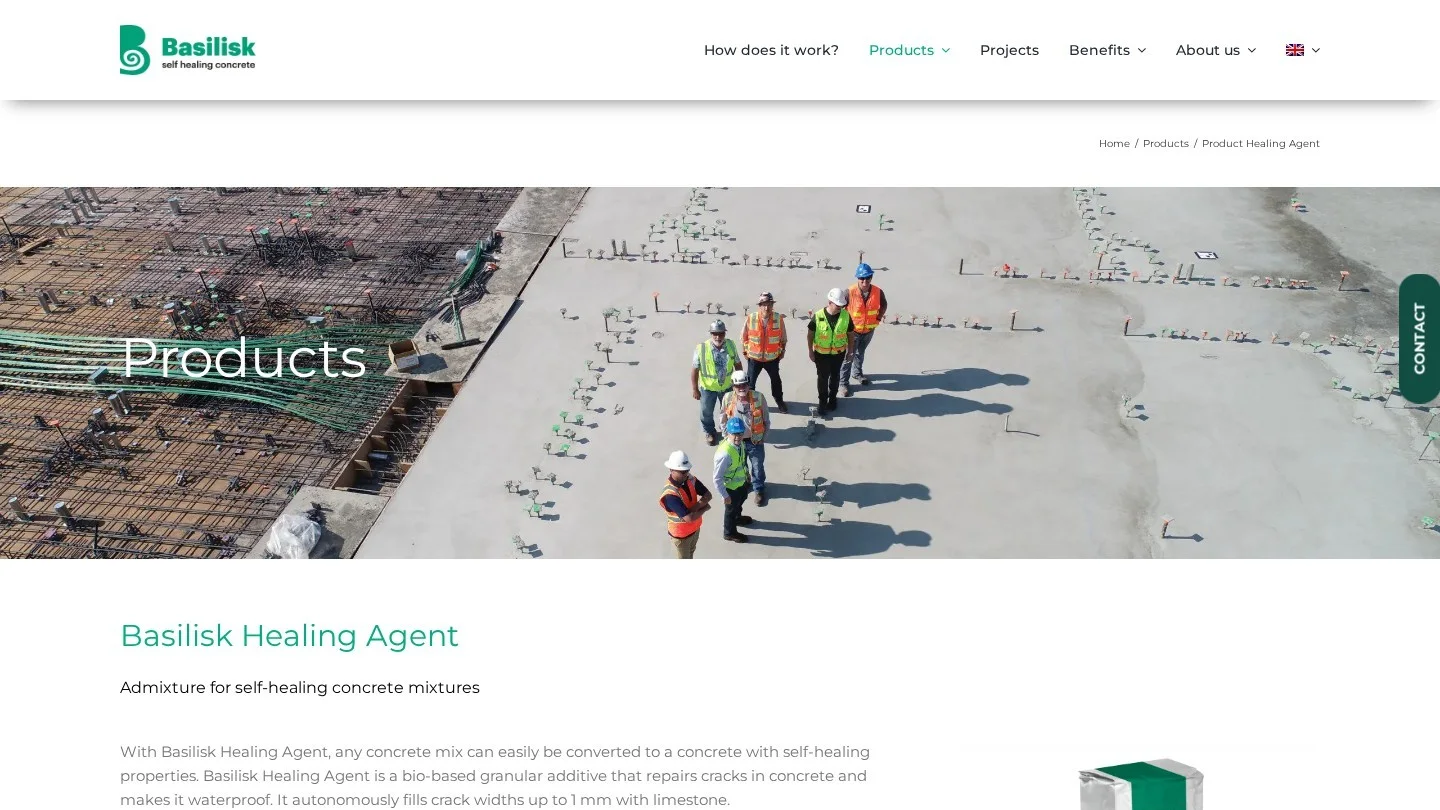
Basilisk, the Dutch company that grew out of this work, sells the idea as a product. Basilisk says its granular Healing Agent fills crack widths up to 1 mm with limestone.
Crystalline Admixtures
These are powders mixed into the concrete that react with water and leftover cement to grow crystals inside pores and cracks. They are sold mainly as waterproofing products for below-grade and water-holding structures, but the same reaction also seals fine cracks that form after the pour.
Kryton says its Krystol Internal Membrane admixture self-seals hairline cracks up to 0.5 mm. The maximum dose is of 8 kg per cubic meter (13.5 lb per cubic yard), and buyers set the dose with an authorized representative. One limit is worth knowing: self-sealing works on static cracks, while cracks that keep moving need a flexible sealant.
Natural Healing in Ordinary Concrete
Plain concrete can close very fine cracks on its own when water reacts with leftover cement and carbon dioxide forms calcium carbonate. This is called autogenous healing. It is free, but it only works on the finest cracks and only when water is present, which is why engineered products exist.
Researchers are also testing capsules that burst and release glue, and polymers that swell when wet. These remain mostly in labs and pilot projects, so the two product types above are what a builder can order today.
Self-Healing Concrete Types Compared
We built this table from the product specs and research covered above. “Published crack width” is the figure each maker or study gives, not a guarantee for every mix.
| Type | How it seals | Published crack width | Example product | Where to get a price |
|---|---|---|---|---|
| Bacterial (encapsulated) | Dormant bacteria make limestone when water enters | Up to 1 mm | Basilisk Healing Agent | Quote-based through Basilisk and its distributors |
| Crystalline admixture | Crystals grow in pores and cracks when wet | Up to 0.5 mm, static cracks only | Kryton Krystol Internal Membrane | Quote-based through Kryton representatives |
| Autogenous (built in) | Leftover cement and carbonation form calcium carbonate | Finest cracks only | Ordinary concrete | No added cost |
What Self-Healing Concrete Costs per Cubic Yard: Our Estimate
The clearest published price comparison dates from the 2015 European Inventor Award: about €80 per cubic meter for conventional concrete and €85 to €100 for self-healing concrete with the encapsulated healing agent.
We turned those figures into a percentage premium, then applied it to a current US price. The US national average for ready-mix was $179.95 per cubic yard in 2025, with a typical range of $160 to $195.
The method:
- Premium = (self-healing price – normal price) / normal price. Low end: (85 – 80) / 80 = 6.25%. High end: (100 – 80) / 80 = 25%.
- Estimated self-healing price = US average x (1 + premium). Low: $179.95 x 1.0625 = $191.20. High: $179.95 x 1.25 = $224.94.
- Per cubic meter, divide by 0.764555, since one cubic yard is 0.764555 cubic meters.
| Concrete | Price per cubic yard | Price per cubic meter | Basis |
|---|---|---|---|
| Standard ready-mix, US 2025 average | $179.95 | $235.37 | Industry price guide |
| Self-healing, low estimate (+6.25%) | $191.20 | $250.08 | Our calculation |
| Self-healing, high estimate (+25%) | $224.94 | $294.21 | Our calculation |

Two cautions about this estimate. The premium comes from 2015 European figures, and prices for additives, cement and freight have all moved since. And the premium depends heavily on dose, because a mix designed to heal wider cracks needs more healing agent. Treat the range as a way to judge whether a quote is in a sensible zone, not as a price list. Our percentage calculator is handy for turning any supplier quote into a premium you can compare.

A Worked Example: Pouring a Basement with Self-Healing Concrete
Basements are one of the places where self-healing concrete makes the most sense, because a leaking crack below ground is hard and costly to reach. The numbers below cover a pour of 40 cubic yards, a size we picked as an example of a basement wall and slab for a mid-size house.
| Line | Standard concrete | Self-healing, low | Self-healing, high |
|---|---|---|---|
| Concrete, 40 cubic yards | $7,198 | $7,648 | $8,998 |
| Extra cost versus standard | $0 | $450 | $1,800 |
We multiplied 40 by each price per cubic yard. The extra cost lands between $450 and $1,800 for the concrete itself. Delivery fees, labor and finishing stay much the same, since the concrete is placed the same way.
Now set that against what a crack can cost. Concrete repair and maintenance runs an estimated $147 per cubic meter. Our 40 cubic yards equals about 30.6 cubic meters, so on that estimate the repair and upkeep bill over time could reach roughly $4,500, well above the $450 to $1,800 premium. That comparison is rough, because repair needs vary hugely from one building to the next, but it shows why owners of hard-to-reach structures are willing to pay more on day one.
House size matters too. Bigger homes need bigger foundations, and our data on average home size by country shows how much the typical footprint changes from one market to another.
Savings That Offset the Higher Price
The price per yard is only part of the story. Basilisk lists two kinds of savings that can make the total project cost closer to normal.
- Less steel for crack control: Basilisk says projects can need up to about 40% less shrinkage reinforcement, the extra steel added mainly to keep cracks narrow. It reports savings of about 35% on a renovation project, the Hulstkamp building.
- Fewer extra layers: Its product page says self-healing concrete can avoid the cost of waterproof membranes and of injection repairs after cracks appear.
- Less downtime: For a parking deck, tunnel or water tank, fewer repairs mean fewer closures, which can matter more than the repair bill.
These figures come from the company, so ask for project data that matches your structure. A structural engineer has to approve any cut in reinforcement, and local code still governs the design.
Where Self-Healing Concrete Pays Off and Where It Does Not
Self-healing concrete earns its premium when cracks are likely, water is present and repairs are hard. It is harder to justify where cracks do little harm.
| Good fit | Why |
|---|---|
| Basements and below-grade walls | Water pressure and costly excavation to repair |
| Water tanks and wastewater plants | Must stay watertight; repairs mean draining |
| Tunnels and bridges | Hard access, traffic closures, long design life |
| Parking decks | Salt and water attack the steel |
| Marine and harbor work | Constant water and salt |
| Weaker fit | Why |
|---|---|
| Dry interior slabs | Few water-driven problems to solve |
| Decorative flatwork | Hairline cracks are mostly a looks issue |
| Joints and cracks that keep moving | Healing products work best on static cracks |
The good-fit list lines up with the uses Basilisk names on its own page: tunnels, bridges, reservoirs, basements, diaphragm walls, marine works, parking decks and wastewater plants. Owners of rental buildings may find the basement and parking cases most relevant, since leaks drive tenant complaints, a theme we cover in our guide to starting a property management business.
The Bigger Maintenance Bill Behind the Idea
The case for self-healing concrete is a case about upkeep. Maintaining bridges, tunnels and retaining walls costs €4 to €6 billion a year in the EU alone. Jonkers’ team argued in 2015 that a higher first cost would pay itself off quickly against bills of that size, and that a newer way to make the capsules could cut production costs of bacterial concrete by a further 50%.
Self-healing products also tie into the push for lower-carbon buildings. Basilisk claims a 30% to 50% smaller carbon footprint for its concrete, partly because longer-lasting structures need fewer rebuilds and less steel. For materials that go further and store more carbon than they emit, see our guide to the best carbon-negative building materials.
Questions to Settle with Your Engineer Before You Specify It
Self-healing concrete is a design decision, not just a purchase, so the conversation with your structural engineer should come before any call to a supplier. The right answers depend on the structure, the soil and water around it, and how long the owner expects it to last without major repair.
Start with the crack you are trying to control. If the engineer expects shrinkage cracks of a few tenths of a millimeter in a basement wall, a crystalline admixture rated for 0.5 mm static cracks may be enough, while a water tank or tunnel lining with wider expected cracks may call for a bacterial product rated for cracks up to 1 mm. Ask whether the cracks are likely to keep moving with temperature or loads, because both product types are designed for cracks that stay still once they form.
Next, ask how the choice affects the rest of the design. If the healing agent lets the engineer reduce crack-control steel, as Basilisk says is possible, the steel saving may cover much of the material premium, but only a licensed engineer can approve that change. Also ask whether an external membrane is still needed, since dropping or thinning it is one of the larger savings the makers point to.
Finally, agree on how you will judge success. Many owners ask for a water test on a sample wall or a period of monitoring after the pour, and a supplier who is confident in the product should be willing to explain how it has performed on similar jobs.
How to Get a Quote for Self-Healing Concrete
Because pricing is set by project, the way you ask matters. These steps help you get comparable numbers.
- Talk to your engineer first. Decide which crack width you need to heal, since that sets the product and dose.
- Ask the maker for a local partner. Basilisk and Kryton both work through distributors or representatives, who know which ready-mix plants can batch their products.
- Get two prices from the ready-mix supplier. Ask for the same mix with and without the healing additive, so the premium is clear.
- Ask about reinforcement changes. If the maker claims you can use less steel, have your engineer check it and price the saving.
- Ask for test data and references. Look for projects similar to yours in size, exposure and climate.
- Check the warranty terms. Find out what the supplier promises about water-tightness and for how long.
Building owners who also care about upkeep above ground may want to compare how other low-maintenance materials are priced, such as in our guide to smart glass window costs.
Questions About Self-Healing Concrete Prices
How Much More Does Self-Healing Concrete Cost?
The published 2015 figures show a premium of 6.25% to 25% over ordinary concrete. Applied to the 2025 US average of $179.95 per cubic yard, our estimate is about $191 to $225 per cubic yard.
Is Self-Healing Concrete Available in the United States?
Yes. Basilisk’s bacterial products and Kryton’s crystalline admixture are both sold through local distributors and representatives, who quote by project.
How Big a Crack Can Self-Healing Concrete Fix?
It depends on the product. Basilisk says its Healing Agent fills cracks up to 1 mm wide, and Kryton says its admixture self-seals static hairline cracks up to 0.5 mm.
How Long Do the Bacteria Last in Concrete?
In Jonkers’ design, the dormant bacterial spores can survive in the concrete for up to 200 years.
Is Self-Healing Concrete Worth It for a Home?
It makes the most sense for basements and other below-ground walls where a leak is hard to fix. For a dry interior slab, the premium is harder to justify.
Research and Product Pages We Used
- Max Planck Institute for Marine Microbiology: Self-healing concrete, May 2, 2015.
- Giatec Scientific: Self-healing bio-concrete, citing the European Patent Office’s April 21, 2015 release.
- Basilisk: Healing Agent product page.
- Kryton: Krystol Internal Membrane technical data sheet.
- Concrete Network: ready-mix concrete prices, updated July 14, 2026.
- University of Chicago Triple Helix: Self-healing concrete, January 2, 2025.