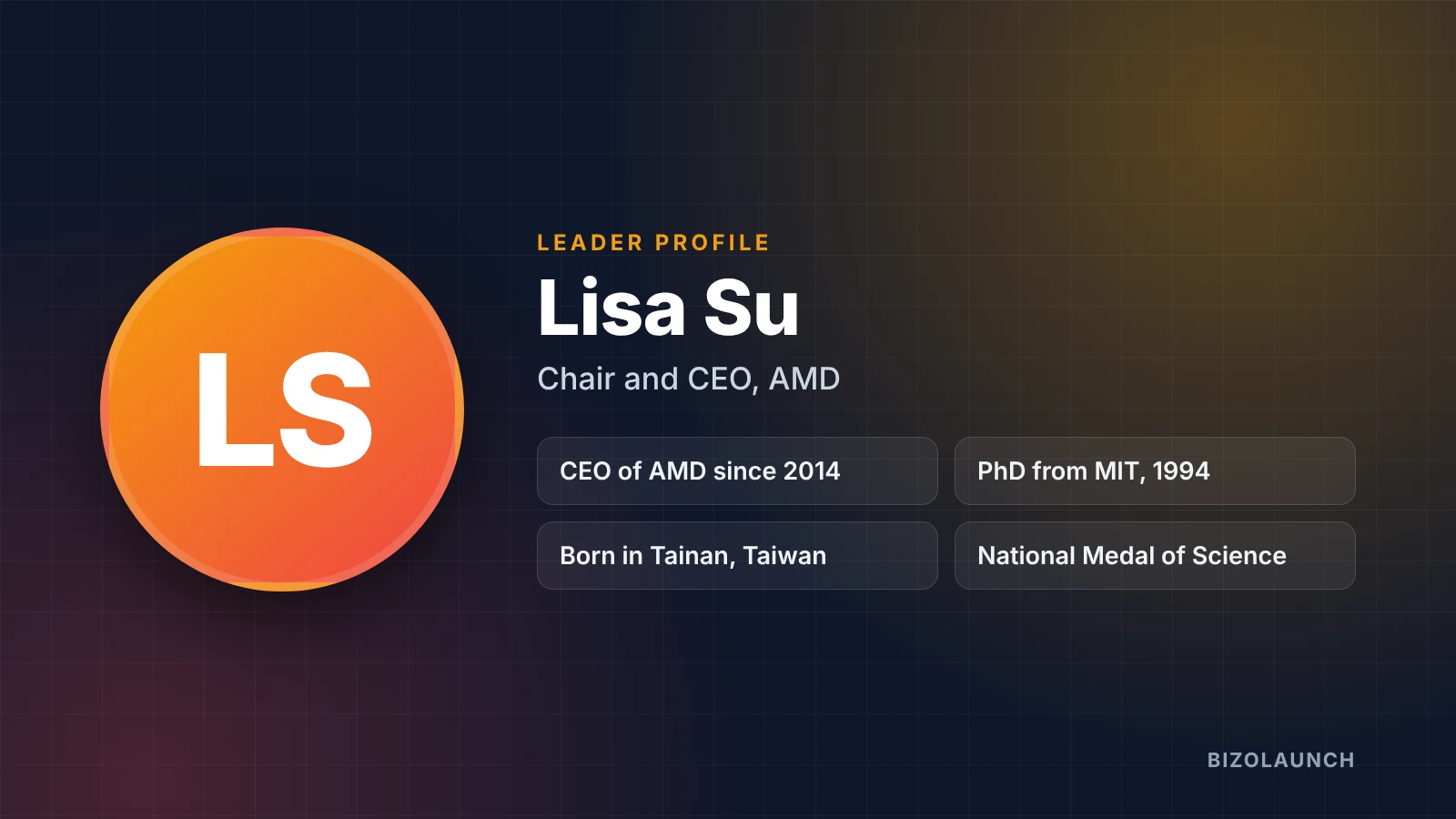
When Lisa Su became chief executive of Advanced Micro Devices on October 8, 2014, the company had just closed a year with $5.51 billion in revenue and a $403 million net loss. Its shares traded around $3. In 2025, AMD reported $34.6 billion in revenue and $4.3 billion in net income, and its Helios AI rack systems are now running at Meta, OpenAI, Microsoft and Oracle. Su, an MIT-trained electrical engineer, is the person most closely tied to that turnaround. This profile follows her path from a Queens childhood to the head of a chipmaker worth more than $1 trillion, and measures what changed under her.
Lisa Su’s Record by the Numbers
- Born in Tainan, Taiwan, in 1969, she holds bachelor’s, master’s and doctoral degrees in electrical engineering from MIT.
- She worked at Texas Instruments, IBM and Freescale before joining AMD in January 2012, and became CEO in October 2014 and chair in February 2022.
- By our calculation from AMD’s annual results, revenue grew about 6.3 times between 2014 and 2025, a compound rate of about 18% a year.
- Data center sales were 58% of AMD’s revenue in the second quarter of 2026, up 107% on a year earlier.
- She received the National Medal of Science on October 8, 2026, and AMD scheduled its third-quarter results for November 3, 2026.
From Tainan and Queens to an MIT Doctorate
Su was born on November 7, 1969, in Tainan, Taiwan. Her family moved to the United States when she was about three, and she grew up in Queens, New York. She graduated from the Bronx High School of Science in 1986 and entered MIT that autumn.
She stayed at MIT for all three degrees in electrical engineering, finishing her PhD in 1994. Her doctoral work was on silicon-on-insulator transistors, a method for making transistors more efficient that was still unproven at the time. That choice set a pattern. Much of her career has been spent on technologies that looked risky early and later became standard. Readers weighing a similar path can compare programs in our list of US universities offering master’s degrees in AI.
Two Decades in Labs Before the Top Job
She spent 1994 to 1995 on the technical staff at Texas Instruments. She then spent about 13 years at IBM, rising to vice president of its Semiconductor Research and Development Center. At IBM she helped make copper wiring work inside chips in place of aluminum, a change that launched in 1998. Her team also proposed the design that became the Cell processor in Sony’s PlayStation 3.
In 2007 she joined Freescale Semiconductor as chief technology officer. She later ran its networking and multimedia business. In January 2012 she moved to AMD as senior vice president and general manager of its global business units. She became chief operating officer in July 2014 and chief executive three months later.
Lisa Su Career Timeline With Measurable Results
We built this timeline from AMD’s board biography, its results releases and dated press coverage. The last column records a result that was published at the time, not a later estimate.
| Year | Role or decision | Published result |
|---|---|---|
| 1994 | PhD at MIT on silicon-on-insulator transistors | Joined Texas Instruments’ technical staff |
| 1998 | Copper interconnects at IBM | Chips up to 20% faster |
| 2007 | Chief technology officer, Freescale | Later ran the networking and multimedia group |
| 2012 | Joins AMD to run global business units | Non-PC share of sales rose from about 10% to about 40% by February 2015 |
| 2014 | Named CEO on October 8 | Year-end revenue $5.51 billion, net loss $403 million, 9,687 staff |
| 2017 | Zen CPU architecture ships in Ryzen chips | CPU market share rose to nearly 11% |
| 2022 | Xilinx deal of about $49 billion closes; Su becomes chair | Revenue $23.6 billion, net income $1.32 billion |
| 2025 | Data center and AI push | Revenue $34.6 billion, net income $4.3 billion |
| 2026 | 6-gigawatt GPU deal with Meta; Helios racks ramp | Q2 revenue $11.5 billion, data center $6.7 billion |
The 2014 Starting Point at AMD
AMD released its 2014 annual results on January 20, 2015, a few months into Su’s tenure. Revenue was $5.51 billion, up 4%. The GAAP net loss was $403 million and gross margin was 33%. Fourth-quarter revenue fell 22% from a year earlier, and headcount shrank to 9,687 from 10,671 a year before.
At the time, the stock traded around $3, and AMD had cut about a quarter of its staff. Su’s plan had three parts: sell only high-quality products, rebuild customer trust, and simplify the company.
Four Decisions That Reshaped AMD
Betting the Company on the Zen Architecture
Rather than spread money across many product lines, AMD focused on a new CPU design called Zen. It reached the market in the second quarter of 2017. Ryzen and Threadripper chips won praise for offering many cores at lower prices, and AMD’s CPU share rose to nearly 11%. Zen later became the base for EPYC server chips, which opened the data center market to AMD.
Diversifying Beyond the PC
Even before she became CEO, Su pushed AMD into custom chips for game consoles, including the Xbox One and PlayStation 4. Non-PC products rose from about 10% of sales when she joined to about 40% by February 2015. That steady console income helped carry AMD through the years when Zen was still in development.
Buying Xilinx for Adaptive Computing
AMD closed its roughly $49 billion acquisition of Xilinx, a maker of programmable chips, in February 2022, and Su added the chair role. That year AMD posted revenue of $23.6 billion, up 44%, and net income of $1.32 billion. AMD also passed Intel in market value that year.
Moving Into AI Data Centers
The latest bet is AI hardware. On February 24, 2026, AMD and Meta announced a multi-year deal for up to 6 gigawatts of Instinct GPUs, starting with a custom chip based on the MI450 design. AMD gave Meta a performance-based warrant for up to 160 million AMD shares that vests as purchases grow. At the OCP Global Summit on October 12, 2026, AMD said its Helios rack systems were installed and running at OpenAI, Meta, Microsoft and Oracle.
What AMD’s Filings Show About Her Tenure
We lined up three annual results releases to measure the change. The method: we took revenue, GAAP gross margin and GAAP net income as AMD reported them, then calculated growth multiples and data center shares ourselves.
| Measure | 2014 | 2022 | 2025 |
|---|---|---|---|
| Revenue | $5.51 billion | $23.6 billion | $34.6 billion |
| GAAP gross margin | 33% | 45% | 50% |
| GAAP net income | $403 million loss | $1.32 billion | $4.3 billion |
| Data center revenue | Not reported as a segment | $6.0 billion | $16.6 billion |
| Data center share of revenue (our calculation) | Not applicable | 25% | 48% |
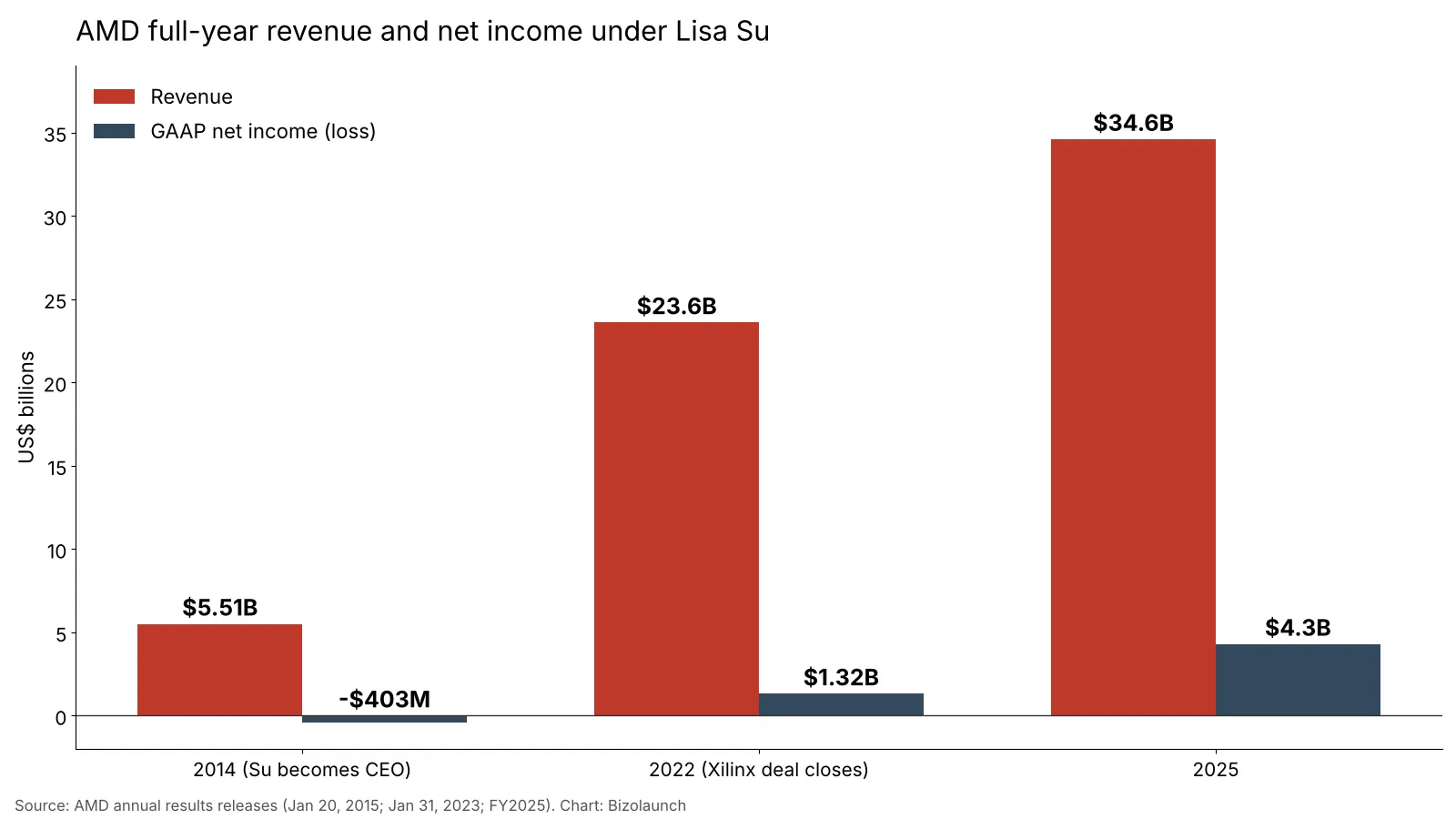
Three findings come out of the numbers. First, revenue rose about 6.3 times from 2014 to 2025, which works out to roughly 18% compound growth a year (34.6 divided by 5.51, taken to the power of one-eleventh). Second, gross margin climbed 17 points, from 33% to 50%, a sign that AMD now sells more valuable chips, not only more of them. Third, the business mix flipped. Data center sales went from a quarter of revenue in 2022 to nearly half in 2025, and the second quarter of 2026 pushed it to 58%.
The market noticed. AMD’s value rose from about $3 billion to more than $1 trillion during her tenure. Its shares closed at $560.26 on October 27, 2026.
How Lisa Su Leads, in Her Words and Others’
The clearest theme in interviews is patience. Su says big investments in new areas take a “five- to 10-year arc”, and she measures success in decades, not quarters. Her shorthand is that “everything takes time.” She also says leaders are trained, not born, and credits her habit early in her career of changing roles about every two years.
Colleagues describe her as a “shrewd strategist”, and analyst Patrick Moorhead says she holds people to high standards. Her engineering training shows in how she speaks about products. At OCP 2026 she framed AI hardware around routing each task to the right chip, saying “You don’t need the same compute for every question.”
We read the record as a lesson for any manager taking over a struggling business. She cut the product list, made one large technical bet, and waited years for it to pay off while steady console sales covered the gap. The filings show the payoff came slowly, then quickly.
Honors Lisa Su Has Received
| Year | Honor |
|---|---|
| 2009 | IEEE Fellow |
| 2018 | Elected to the National Academy of Engineering |
| 2021 | IEEE Robert N. Noyce Medal, the first woman to receive it |
| 2024 | TIME CEO of the Year |
| 2026 | National Medal of Science, presented October 8 |
The National Medal cited her contributions to high-performance and adaptive computing. She also chairs the board of the Semiconductor Industry Association and serves on the President’s Council of Advisors on Science and Technology.
AMD Under Su in October and November 2026
October was busy. At OCP on October 12, AMD said Helios was ramping production. It also previewed Helion, an agentic AI rack planned for November 2026, and Verano, a sixth-generation EPYC chip slated for 2027. On October 27, AMD said it would buy $1 billion of Meta shares in Meta’s equity offering. Our report on Meta’s stock sale to fund AI spending covers that offering. Big cloud buyers are spending heavily on AI hardware, a trend also visible in Microsoft’s latest Azure capital spending.
Next comes the third-quarter report. AMD scheduled its results for after the market close on Tuesday, November 3, 2026, with a call at 5 p.m. Eastern. In August, AMD guided for about $13 billion in third-quarter revenue, plus or minus $300 million. AI chip demand is also drawing new chip plants to other countries, as our guide to semiconductor plants in India shows, and AMD’s customers include AI labs such as Anthropic, whose latest news includes an IPO filing.
Common Questions About AMD’s Chief Executive
When Did Lisa Su Become CEO of AMD?
She was appointed president and CEO on October 8, 2014, after serving as chief operating officer from July 2014. She became chair of the board in February 2022.
Where Did Lisa Su Go to College?
MIT, where she earned a bachelor’s, a master’s and a PhD in electrical engineering. She finished her doctorate in 1994.
What Did Lisa Su Do Before AMD?
She worked at Texas Instruments, spent about 13 years at IBM in semiconductor research, and was chief technology officer and later a business unit head at Freescale Semiconductor.
How Much Has AMD Grown Under Lisa Su?
Annual revenue rose from $5.51 billion in 2014 to $34.6 billion in 2025, about 6.3 times, and a $403 million loss turned into $4.3 billion of net income.
Filings, Profiles and Releases Used for This Profile
- AMD: Board biography of Dr. Lisa T. Su
- AMD: 2014 fourth quarter and annual results (January 20, 2015)
- AMD: Fourth quarter and full year 2022 results (January 31, 2023)
- AMD: Fourth quarter and full year 2025 results
- AMD: Second quarter 2026 results (August 4, 2026)
- AMD and Meta: 6-gigawatt partnership (February 24, 2026)
- AMD: OCP 2026 keynote takeaways
- AMD: Lisa Su receives National Medal of Science (October 8, 2026)
- CNBC Make It via NBC: A decade ago she took over a struggling chipmaker
- Wikipedia: Lisa Su
- CEOWORLD: AMD’s $1 billion Meta investment
- AMD: third-quarter 2026 results date announcement