
An investor puts $10,000 into an S&P 500 index fund, thinking she now owns a little of 500 companies. She does, but not equally. As of October 10, 2026, about $778 of that money sat in a single company, Nvidia, and roughly $3,900 sat in just nine companies. The reason is market cap.
Market capitalization, or market cap, is the total value the stock market places on a company’s shares. It decides how much weight a company carries in most stock indexes, which size category it falls into and how it is described in the news. This guide covers the formula, the current numbers and what market cap does not tell you.
The Formula
Market cap = Share price × Shares outstanding
A company with 500 million shares trading at $80 has a market cap of $40 billion. If the price rises to $90, the market cap becomes $45 billion, even though nothing about the business changed that day.
That last point matters. Market cap is the price investors are paying for the company right now, based on their expectations. It is not a measure of how much the company owns, earns or is truly worth.
The Biggest Companies Right Now
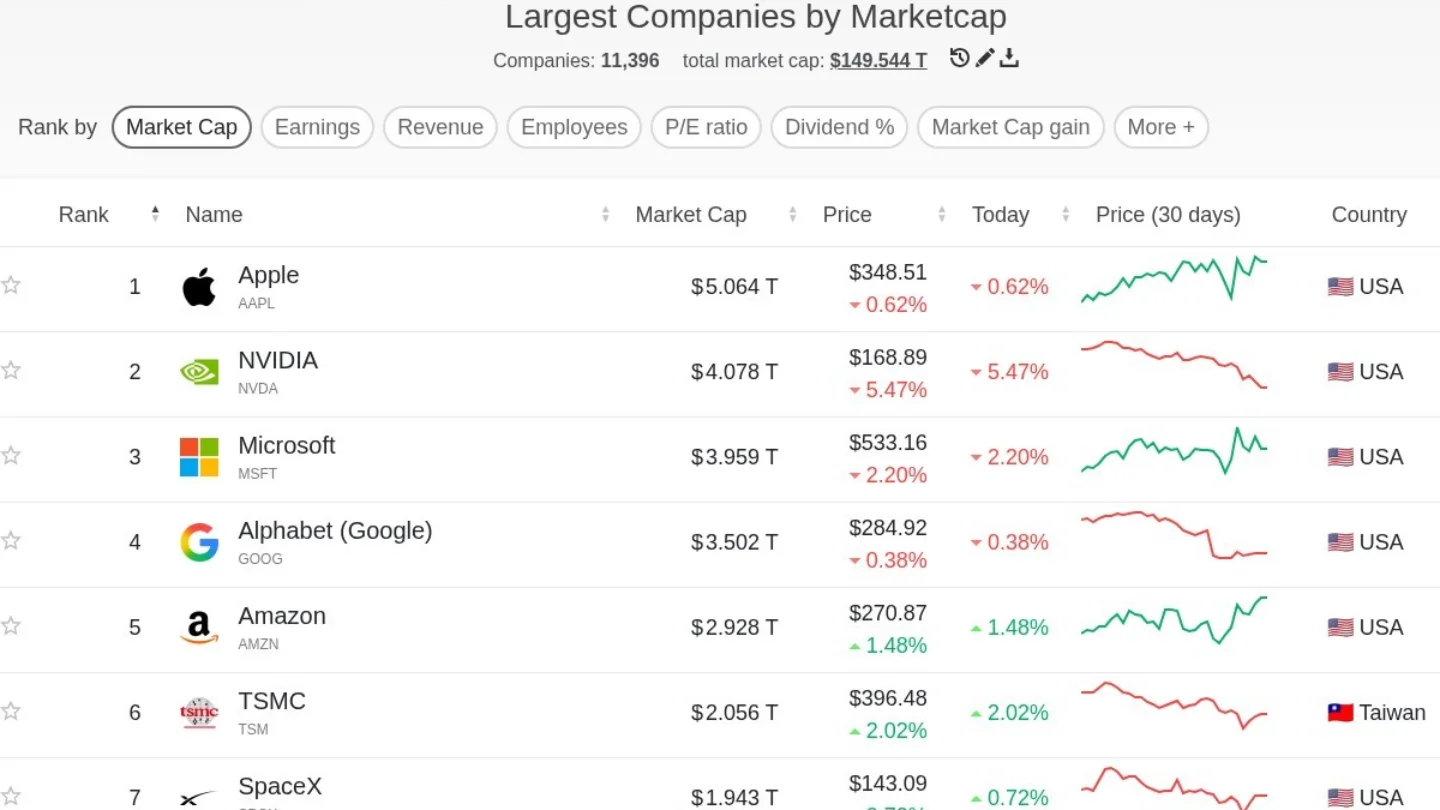
The three largest US companies each passed the size of most national stock markets in 2026. In early October, Nvidia’s market cap was about $5.78 trillion, Apple’s about $4.87 trillion and Microsoft’s about $3.93 trillion.
Index weights show how much those numbers shape everyday portfolios. These weights are from October 10, 2026. The top 10 listings count Alphabet twice, once for each share class, so nine companies appear, when the whole S&P 500 was worth about $71.12 trillion.
| Rank | Company | Weight in the S&P 500 | In a $10,000 index fund |
|---|---|---|---|
| 1 | Nvidia | 7.78% | $778 |
| 2 | Apple | 6.91% | $691 |
| 3 | Microsoft | 5.59% | $559 |
| 4 | Alphabet (Class A and Class C shares combined) | 6.01% | $601 |
| 5 | Amazon | 3.98% | $398 |
| 6 | Meta Platforms | 2.57% | $257 |
| 7 | Broadcom | 2.43% | $243 |
| 8 | Tesla | 2.13% | $213 |
| 9 | Micron Technology | 1.63% | $163 |
| Total, top 10 index listings | 39.03% | $3,903 |
Three companies, Nvidia, Apple and Microsoft, made up more than 21% of the index, the highest share for three stocks on record. An S&P 500 fund is diversified across 500 names, but a large share of its moves now depend on a handful of technology companies.
Dig deeper: If that concentration worries you, an equal-weight S&P 500 fund holds each company at about 0.2%, so Nvidia and a mid-sized utility count the same. Equal-weight funds tend to have higher fees and more trading, and they have lagged when the largest companies lead the market.
Size Categories
No official legal definition exists, but these ranges are widely used by fund companies and brokers.
| Category | Typical market cap | Examples of the type |
|---|---|---|
| Mega cap | Over $200 billion | The largest global technology, energy and health care firms |
| Large cap | $10 billion to $200 billion | Most S&P 500 companies |
| Mid cap | $2 billion to $10 billion | Many S&P MidCap 400 companies |
| Small cap | $300 million to $2 billion | Many Russell 2000 and S&P SmallCap 600 companies |
| Micro cap | $50 million to $300 million | Small companies, often thinly traded |
| Nano cap | Under $50 million | Very small and often highly speculative |
S&P Dow Jones Indices sets its own minimum market caps for the S&P 500, MidCap 400 and SmallCap 600, reviews them each quarter and has raised them several times as markets have grown. A company must also meet profit, liquidity and float rules to join.

What Size Usually Means for Investors
- Large caps: More stable, widely covered by analysts and easy to trade, but often slower-growing.
- Mid caps: Often established businesses still growing; historically a middle ground for risk and return.
- Small caps: More room to grow and more risk. Prices can swing sharply, and some companies are unprofitable.
- Micro and nano caps: Higher risk of large losses, thin trading and, in some cases, fraud. The SEC regularly warns investors about microcap fraud schemes.
What Market Cap Leaves Out
Debt and Cash
Two companies can have the same market cap but very different finances. Enterprise value (EV) adjusts for that:
Enterprise value = Market cap + Total debt − Cash
| Item | Company A | Company B |
|---|---|---|
| Market cap | $20 billion | $20 billion |
| Debt | $1 billion | $12 billion |
| Cash | $4 billion | $1 billion |
| Enterprise value | $17 billion | $31 billion |
A buyer of Company B would take on $11 billion more in net debt. That is why analysts use enterprise value when comparing companies or valuing takeovers.
Profits
Market cap says nothing about whether a company makes money. Compare it with earnings using the price-to-earnings ratio, or with sales using price-to-sales, to see how much investors are paying for each dollar of profit or revenue.
Free Float
Some shares are held by founders, governments or parent companies and rarely trade. Index providers such as S&P use float-adjusted market cap, which counts only shares available to the public. That is why a company’s index weight can be lower than its full market cap suggests.
Frequently Asked Questions
Is a higher market cap better?
Not necessarily. A higher market cap means the market values the company more today, but it does not mean the stock is a better investment. Large companies can be overpriced, and small companies can grow much faster.
Can a company’s market cap be higher than its revenue?
Yes, often. Investors pay for expected future profits, not just this year’s sales. Fast-growing technology companies regularly trade at many times their annual revenue.
How does market cap change?
It changes whenever the share price changes, and when the number of shares changes through new share issues, buybacks or stock-based pay for employees. Buybacks reduce shares outstanding, and new issues increase them.
What is the difference between market cap and net worth?
Market cap is what investors pay for the shares. Book value, sometimes called net worth or shareholders’ equity, is assets minus liabilities on the balance sheet. The two can differ greatly, especially for companies whose value comes from brands, software or patents.