Vitol Is the World’s Largest Private Company by Revenue
The largest private company in the world by revenue is Vitol, the Swiss-based energy trader. Its latest yearly turnover was $343 billion. Trafigura comes second with $240.3 billion. Then comes Schwarz Group, the owner of Lidl and Kaufland, with about $207.9 billion.
We compiled this ranking from each company’s own annual report or results release. In total, we found 16 groups that publish a full-year revenue figure and have no shares on any stock exchange. Together they brought in $1.67 trillion in their latest fiscal years. We also converted every figure into US dollars with one stated method, so the ranking is fair across currencies.
Because private firms report at different times of the year, we refresh this page every month. So when a new annual report lands, the table changes with it.
16 Largest Private Companies by Revenue, Ranked in US Dollars
Each row uses the company’s most recent published fiscal year. The month shows when that year ended. For example, Trafigura’s year ends on September 30, while Schwarz Group’s ends on February 28.
| Rank | Company | Headquarters | Sector | Latest revenue (US$) | As reported | Fiscal year ended | Ownership |
|---|---|---|---|---|---|---|---|
| 1 | Vitol | Geneva, Switzerland | Commodity trading | $343.0B | $343B turnover | Dec | About 600 senior staff partners |
| 2 | Trafigura | Singapore | Commodity trading | $240.3B | $240.3B | Sept 30 | More than 1,400 employee shareholders |
| 3 | Schwarz Group (Lidl, Kaufland) | Neckarsulm, Germany | Retail | $207.9B | €185.6B | Feb 28 | Founder family |
| 4 | Cargill | Minnetonka, US | Agribusiness and food | $164.0B | $164B | May | Cargill and MacMillan families |
| 5 | Huawei | Shenzhen, China | Technology | $126.0B | CNY 880.9B | Dec | Employees, through a trade union plan |
| 6 | Bosch | Gerlingen, Germany | Industrial and technology | $101.9B | €91.0B | Dec | Robert Bosch Stiftung (foundation) |
| 7 | Deloitte | London, UK | Professional services | $74.5B | $74.5B | May 31 | Partners of member firms |
| 8 | Publix Super Markets | Lakeland, US | Retail | $62.7B | $62.7B | Dec 27 | Associates and board members |
| 9 | PwC | London, UK | Professional services | $60.2B | $60,226M | June 30 | Partners of member firms |
| 10 | EY | London, UK | Professional services | $57.0B | $56,969M | June 30 | Partners of member firms |
| 11 | Louis Dreyfus Company | Rotterdam, Netherlands | Agribusiness and food | $53.2B | $53.2B net sales | Dec | Louis Dreyfus family holding, with 45% held by ADQ |
| 12 | Ingka Group (IKEA) | Netherlands | Retail | $46.5B | €41.5B | Aug 31 | Stichting INGKA Foundation |
| 13 | KPMG | London, UK | Professional services | $39.8B | $39.8B | Sept 30 | Partners of member firms |
| 14 | Enterprise Mobility | St. Louis, US | Car rental and fleet | $39.0B | Over $39B | July | Taylor family |
| 15 | Fidelity Investments (FMR) | Boston, US | Financial services | $37.7B | $37.7B | Dec | Johnson family and employees |
| 16 | Bechtel | Reston, US | Engineering and construction | $20.6B | $20.6B | Dec 2024 (latest it publishes) | Bechtel family |
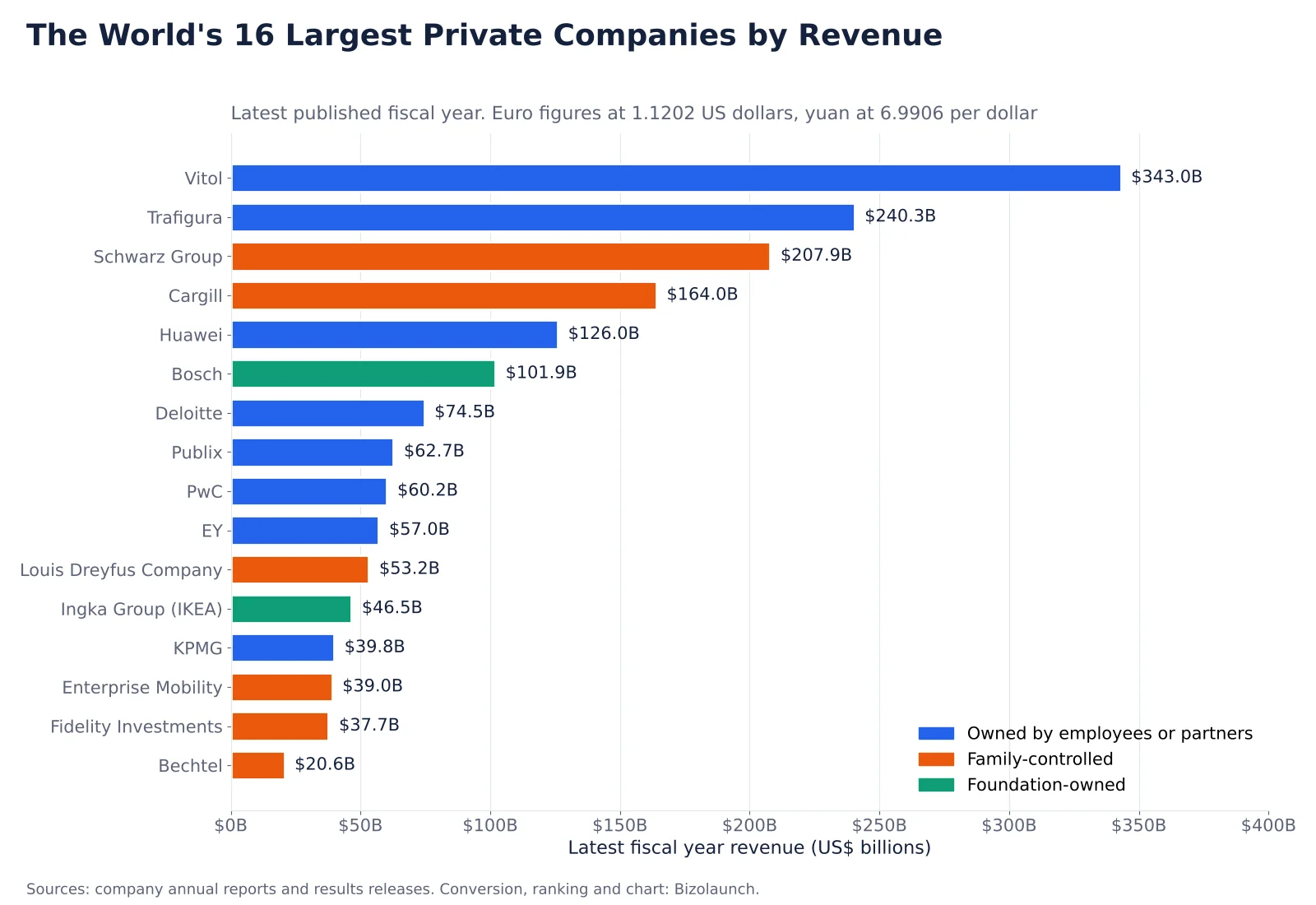
Two figures in the table need a note. First, Vitol reports turnover, which is the value of everything it sells. Second, Enterprise Mobility says only that revenue passed $39 billion, so we used $39 billion as a floor. In fact, its true figure is a little higher.
Who Counts as a Private Company in Our Ranking
We used three tests. A company must have no shares listed on any stock exchange. No government may hold a majority of it. And it must publish its own full-year revenue in an annual report, a filing or a results release. We ranked only groups that pass all three.
Employee-Owned Firms Stay In
Employee ownership still counts as private ownership. So Vitol, Trafigura and Publix are on the list. Publix files reports with the US Securities and Exchange Commission because it has so many staff shareholders. Still, its stock is not traded on any exchange. Instead, it sells shares only to current associates and board members.
Huawei needed a closer look. Huawei says its employees own 100% of the company through a shareholding plan. A trade union acts as the platform that holds those shares, and Huawei says there is no state capital in the business. However, some outside researchers have questioned how much control staff really have. We decided to include Huawei because no government entity appears as a shareholder in its own disclosures.
Partnerships and Foundations Stay In Too
The four big audit networks are owned by their partners. Each one reports a combined global revenue for its member firms. That is why we list Deloitte, PwC, EY and KPMG as private groups. Bosch and Ingka Group belong to foundations, and neither has listed shares, so they qualify as well.
State Firms, Mutuals and Co-ops Stay Out
We left out companies that a government controls, such as national oil firms and state grids. We also left out mutual insurers and retail co-ops, because their members or policyholders own them. Louis Dreyfus Company is a borderline case. Abu Dhabi’s state holding company ADQ bought a 45% stake in it. But the Louis Dreyfus family holding still owns the majority, so we kept it in.
How We Turned Euros and Yuan Into Dollars
Thirteen of the 16 groups report in US dollars, so we used their figures as they are. Three report in euros, and one reports in Chinese yuan. For those, we picked a method we can repeat every month.
- Euro reporters: We averaged the European Central Bank’s 22 daily euro reference rates for October 2026. The result was 1.1202 US dollars per euro. So Schwarz Group’s €185.6 billion becomes $207.9 billion.
- Huawei: We used the rate Huawei itself prints in its annual report, which is 6.9906 yuan per dollar. As a result, CNY 880.9 billion becomes $126.0 billion.
Each month we move to the newest monthly average. The effect is small but real. For instance, a one-cent change in the euro moves the three euro reporters by a combined $3.2 billion. None of the ranks in our table would change from a move that size.
What Each Private Giant Sells and Who Owns It
The names in the ranking fall into six clear groups. We grouped them so you can see what each one actually does to earn its revenue.
Vitol and Trafigura Move Oil, Gas and Metals
Vitol delivered 605 million tonnes of oil equivalent in its latest year. It also handled an average of 8 million barrels of crude and oil products a day, plus 23 million tonnes of liquefied natural gas. Its staff partners own the firm, and no single employee holds more than 5%. In one recent year, Vitol returned $10.6 billion to these employee owners through share buybacks.
Trafigura trades oil, metals and minerals. It earned a net profit of $2.7 billion on its $240.3 billion of revenue. That is a margin of about 1.1%. Its owners are more than 1,400 of its roughly 13,000 employees.
Schwarz Group, Publix and Ingka Run Shops
Schwarz Group is the largest retailer on our list. Lidl stores took in €140.2 billion, and Kaufland stores took in €36.7 billion. The group grew revenue by 5.8% and now employs 604,000 people.
Publix is a Florida-based supermarket chain. Its sales rose 5% to $62.7 billion, and net earnings reached $4.7 billion. Ingka Group runs most IKEA stores. Its revenue slipped 0.9% to €41.5 billion. Also, 15% of Ingka’s net profit goes to its foundation owner as a dividend, and the rest stays in the business.
Cargill and Louis Dreyfus Trade Crops and Food
Cargill posted $164 billion of revenue, up from $154 billion a year earlier. It calls itself a family-owned company. It works in 70 countries and has more than 155,000 employees. Louis Dreyfus Company, by contrast, is a third of Cargill’s size. It reported $53.2 billion of net sales and $653 million of net income.
Huawei and Bosch Make Technology
Huawei earned CNY 68 billion of net profit on its revenue. That is about $9.7 billion at Huawei’s own rate. It also spent CNY 192.3 billion on research and development, which is 21.8% of revenue. Bosch, meanwhile, grew sales slightly to €91.0 billion. It had 412,774 employees at the end of its year.
The Big Four Audit Networks Sell Advice
Deloitte, PwC, EY and KPMG together earned $231.5 billion. Deloitte leads with $74.5 billion and more than 500,000 people. PwC passed EY this year, with $60.2 billion against EY’s $57.0 billion. KPMG reported $39.8 billion for the year to September 30.
Enterprise, Fidelity and Bechtel Serve Drivers, Savers and Builders
Enterprise Mobility rents cars and manages business fleets. Its fleet unit alone manages about 900,000 vehicles. Fidelity’s revenue rose 15% to $37.7 billion, and its operating income hit $12.7 billion. Bechtel builds large plants and infrastructure. Its principal revenue rose 25% to $20.6 billion, and its backlog stood at $58.2 billion.
Sector Split and Revenue Concentration in Our Data
Our original research revealed that a few firms hold most of the money. The top three groups earn 47.3% of the combined $1.67 trillion. The top five earn 64.6%. Meanwhile, the bottom eight together earn only 21.1%.
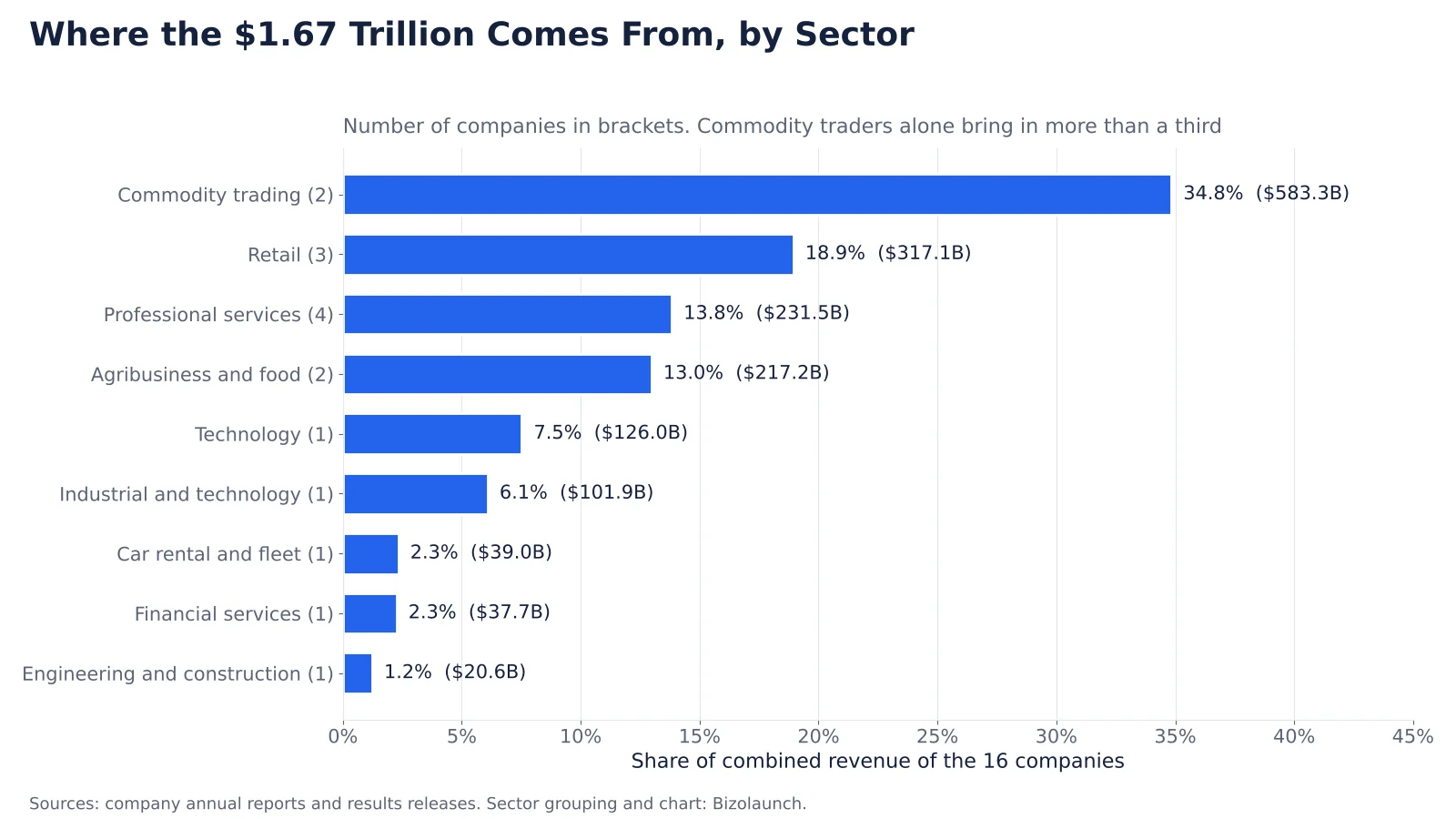
Commodity trading alone makes up 34.8% of the total, from just two firms. Retail follows with 18.9% from three firms. Next come the audit networks with 13.8% and the crop traders with 13.0%. So four sectors account for 80.5% of all revenue in the ranking.
We also measured concentration with the Herfindahl-Hirschman Index, a score that competition regulators use. We squared each company’s percentage share and added the results. The score came to 1,063. For comparison, the score would be 625 if all 16 firms were the same size. The gap shows how far Vitol and Trafigura pull ahead.
| Measure (our calculation) | Result |
|---|---|
| Combined revenue of 16 companies | $1,674.3B |
| Average revenue per company | $104.6B |
| Median revenue | $61.5B |
| Share of the largest company (Vitol) | 20.5% |
| Share of the top three | 47.3% |
| Share of the top five | 64.6% |
| Herfindahl-Hirschman Index | 1,063 |
| Vitol’s revenue compared with Bechtel’s | 16.7 times |
Ownership tells a similar story. Firms owned by employees or partners earn 59.9% of the total. Family-controlled groups earn 31.2%. Then the two foundation-owned firms, Bosch and Ingka, earn the last 8.9%.
Why Higher Turnover Does Not Mean a Bigger Business
Revenue ranks these firms by what passes through their hands. But it says little about profit or headcount. Traders buy and resell huge volumes of oil and grain at thin margins. So their revenue looks enormous next to firms that make products or sell services.
We divided revenue by headcount for every firm that publishes both. The results differ by more than 100 times. In fact, Trafigura earns about $18.5 million of revenue per employee. Cargill earns about $1.06 million. Schwarz Group earns about $344,000, and Bosch about $247,000. The audit networks sit lowest, with PwC at about $167,000 per person and EY at $137,000.
| Company | Revenue (US$) | Employees | Revenue per employee (our calculation) |
|---|---|---|---|
| Trafigura | $240.3B | About 13,000 | $18.5M |
| Cargill | $164.0B | 155,000+ | $1.06M |
| Schwarz Group | $207.9B | 604,000 | $344,000 |
| Bosch | $101.9B | 412,774 | $247,000 |
| PwC | $60.2B | 360,000+ | $167,000 |
| Deloitte | $74.5B | 500,000+ | $149,000 |
| EY | $57.0B | 415,182 | $137,000 |
Margins show the same gap. Trafigura kept 1.1 cents of each revenue dollar as net profit, and Louis Dreyfus kept 1.2 cents. By contrast, Huawei kept 7.7 cents and Publix kept 7.6 cents. That is why a retailer or a tech firm can be a larger employer and earner than a trader with twice the revenue. If you value businesses by sales, our price to sales ratios by industry show how much these margin gaps matter.
How Our Ranking Differs From Older Published Lists
We compared our data with the most widely copied public list of private companies by revenue. It has 127 entries. However, 80 of them rely on revenue figures that are at least six years old. And 101 of the 127 use figures from 2021 or earlier.
The older numbers change the picture. For example, that list still shows Vitol at $400 billion, a figure from a peak trading year. It also shows Fidelity at $20.9 billion and Publix at $38.5 billion, both from 2019. Our table uses each company’s newest report instead. Because of that, Publix and Fidelity sit far higher here.
Some famous private names are absent from our table for one reason. We ranked only firms that publish a full-year revenue number themselves. Estimates from journalists or data vendors can be useful, but we kept them out so every row traces back to the company.
What Changed This Month
This is the November edition of our ranking. Four events since early October shaped it.
- Gunvor became Centalion: On October 2, 2026, the oil trader renamed itself Centalion Group. It also plans to move its corporate home from Cyprus to Singapore. The firm is now owned by an employee partnership, after a management buyout last December.
- EY posted new results: On October 8, 2026, EY reported $56,969 million of revenue for the year to June. That moved EY to rank 10.
- PwC passed EY: On October 19, 2026, PwC reported $60,226 million for the year to June 30. As a result, PwC moved ahead of EY to rank 9.
- New exchange rate: We switched to the October average euro rate of 1.1202. This trimmed the dollar value of the three euro reporters slightly. No rank changed.
Next, we expect KPMG’s new global figure. KPMG released its last one in December. Also, Ingka Group’s next annual summary will replace its current figure once it appears.
Reader Questions About the Biggest Private Companies
What Is the Largest Private Company in the United States?
Cargill is the largest US-based company in our ranking, with $164 billion of revenue. Publix comes next among US firms with $62.7 billion. Then come Enterprise Mobility, Fidelity and Bechtel.
Is IKEA a Private Company?
Yes. Ingka Group, which runs most IKEA stores, has no listed shares. Its sole owner is the Stichting INGKA Foundation. Ingka’s latest revenue was €41.5 billion, or about $46.5 billion.
Is Huawei Owned by the Chinese Government?
Huawei says no. It states that employees own all of its shares through a plan held by a trade union. Even so, some researchers dispute how much control staff have. We include it because its own disclosures show no state shareholder.
Why Do So Many Giant Traders Stay Private?
Staying private lets the traders keep profits among their own staff. Vitol and Trafigura are both owned by employees, and Vitol pays owners through share buybacks. If you want to compare that path with selling shares to the public, our guide to types of company funding walks through each route.
Who Invests in Private Companies Like These?
Mostly founders, families, foundations and staff. Sometimes a state fund takes a minority stake, as ADQ did with Louis Dreyfus. Our explainer on types of investors covers family offices and sovereign funds in more detail.
Are There Large Family-Owned Groups Outside This List?
Yes, many. Some do not publish a group revenue figure, so they fall outside our method. For example, our profile of Omar Al-Futtaim and the Al-Futtaim Group covers one of the Gulf’s largest family businesses.
How Do You Work Out a Company’s Share of the Total?
Divide the company’s revenue by the combined revenue, then multiply by 100. For instance, Vitol’s $343 billion divided by $1,674.3 billion gives 20.5%. You can check any row with our percentage calculator.
Annual Reports and Releases Behind Our Ranking
We compiled this ranking from several sites, mainly company reports and results releases. The currency conversion, sector grouping, concentration measures, revenue per employee and margins are Bizolaunch calculations.
- Vitol: latest annual volumes and review statement
- Trafigura: reports and results (latest annual report)
- Schwarz Group: companies of Schwarz Group generate 185.6 billion euros in revenue
- Cargill: Annual Report 2026
- Huawei: annual reports
- Yicai Global: Huawei board secretary says employees own tech giant
- Bosch: annual report and key data
- CPA Practice Advisor: Deloitte sees 5.7% increase in global revenue during FY 2026
- Publix Super Markets: SEC filings, including the latest Form 10-K
- PwC: PwC announces FY26 global financial performance
- EY: global revenue increases 4.7% to US$57b for fiscal year 2026
- Louis Dreyfus Company: full-year financial results release
- World Grain: LDC completes sale of equity stake to ADQ
- Ingka Group: annual results release
- KPMG: corporate reporting and global revenue
- Travel Daily News: Enterprise Mobility reports record performance and $39 billion in revenue
- Fidelity Investments: data and insights, annual report
- Bechtel: financials
- Swissinfo: Vitol, the trading giant owned by its employees
- Centalion: Gunvor becomes Centalion
- European Central Bank: US dollar (USD) euro reference rates
- Wikipedia: List of largest private non-governmental companies by revenue (used for our cross-check)