Our List of 100 Incubator-Backed Startups Covers 12 Incubators
Incubator-backed startups include Airbnb, Stripe, Razorpay, Zepto, Ather Energy, Skyroot Aerospace and ideaForge. Each one spent its early days inside an incubator or accelerator. We compiled 100 such startups from 12 programs. Eight of the programs are Indian, such as the IIT Madras Incubation Cell, NSRCEL at IIM Bangalore and T-Hub in Hyderabad. The other four are global: Y Combinator, Techstars, Plug and Play and the Station F Founders Program.
We took the pains to check every name. Each startup on this page appears on its incubator’s own portfolio page, annual report, newsletter or official release. For every row, we noted the program, a sector and one fact we could confirm. Then we counted the sectors ourselves. Our original research revealed a clear split. Indian incubators mostly back deep-tech companies, while the global programs lean toward fintech and consumer apps.
What Our Count of 100 Startups Shows
- India’s mix: 41 of the 66 Indian startups (62%) work in health, space, robotics or climate tech.
- Global mix: 20 of the 34 global startups (59%) are fintech or consumer companies.
- Fintech: 12 of the 17 fintech startups on our list came from the four global programs.
- Space: T-Hub alone gave us 5 of the 12 space, drone and aerospace startups.
- Money on offer: Y Combinator invests $500,000, Techstars $220,000 in most programs, and India’s seed fund up to ₹70 lakh through incubators.

66 Startups From Eight Indian Incubators
India’s best-known incubators sit inside universities and research labs. So most of their startups are built on lab work, patents or engineering talent. That shows in the tables. You will find rocket engines, CAR-T cell therapy, quantum-safe hardware and underwater robots. Consumer apps are rare.
Also, many of these firms are still young. For example, a FITT resident or a KIIT-TBI incubatee may have a product but no big funding round yet. We kept them because the incubator names them. Still, we put the better-known graduates first in each table.
IIT Madras Incubation Cell: EVs, Rockets and Underwater Robots
The IIT Madras Incubation Cell is the deep-tech engine of our Indian list. By May 2021, it had incubated 240 startups in eight years. IIT Madras valued them at ₹10,500 crore from their last funding data. By our math, that is about ₹44 crore per startup on average.
| # | Startup | Incubator | Sector | One verified fact |
|---|---|---|---|---|
| 35 | Ather Energy | IIT Madras Incubation Cell | Mobility and EVs | Electric scooter maker that grew out of the IIT Madras incubation cell. |
| 36 | Uniphore | IIT Madras Incubation Cell | Software and AI | AI software company led by CEO Umesh Sachdev. |
| 37 | Stellapps | IIT Madras Incubation Cell | Agritech | Internet of Things startup working with dairy farms. |
| 38 | Agnikul Cosmos | IIT Madras Incubation Cell | Space, drones and aerospace | Test-fired a fully 3D-printed rocket engine. Raised an $11 million Series A led by Mayfield India. |
| 39 | VayuJal Technologies | IIT Madras Incubation Cell | Climate, energy and water | Atmospheric water generators that make 30 to 2,000 litres of water a day from air. |
| 40 | QNu Labs | IIT Madras Incubation Cell | Robotics and hardware | Quantum-safe hardware for sending data over fibre links up to 100 km. |
| 41 | The ePlane Company | IIT Madras Incubation Cell | Space, drones and aerospace | Electric flying taxi maker founded in 2019 with Professor Satya Chakravarthy. |
| 42 | HyperVerge | IIT Madras Incubation Cell | Software and AI | AI identity checks. Had completed over 410 million KYCs in India, with SBI as a client. |
| 43 | Fabheads Automation | IIT Madras Incubation Cell | Robotics and hardware | Built India’s first 3D printer for continuous fibre, aimed at carbon fibre parts. |
| 44 | Planys Technologies | IIT Madras Incubation Cell | Robotics and hardware | Underwater robots for inspection. Had inspected over 160 assets in three countries. |
| 45 | Yaathum Biotech | IIT Madras Incubation Cell | Health and biotech | TB test that shows which drugs will work in about two hours. |
Agnikul Cosmos is the clearest lesson here. The team test-fired a fully 3D-printed rocket engine and then raised an $11 million Series A. So a lab result came first, and the funding round followed. HyperVerge took another route. In fact, it grew on revenue and had completed over 410 million KYC checks in India.
NSRCEL at IIM Bangalore: Exits and Fintech
NSRCEL is IIM Bangalore’s startup hub. By September 2018, it had incubated over 225 startups. Those firms had created over 5,400 direct jobs. Today it also runs a Fintech Centre of Excellence, and four of our rows come from that portfolio.
| # | Startup | Program | Sector | One verified fact |
|---|---|---|---|---|
| 46 | Amagi | NSRCEL | Software and AI | Media technology company that went on to raise money from KKR. |
| 47 | Mango Technologies | NSRCEL | Software and AI | Mobile software startup acquired by Qualcomm. |
| 48 | One Click | NSRCEL | Software and AI | Software startup sold to Freshdesk. |
| 49 | MeshLabs | NSRCEL | Software and AI | Analytics startup sold to Pegasystems. |
| 50 | Milaap | NSRCEL | Fintech | Online crowdfunding platform from NSRCEL’s earlier ventures. |
| 51 | Rang De | NSRCEL Fintech Centre of Excellence | Fintech | RBI-regulated peer-to-peer lending platform. |
| 52 | Castler | NSRCEL Fintech Centre of Excellence | Fintech | Escrow infrastructure for digital businesses, at the pre-Series A stage. |
| 53 | Dhiway | NSRCEL Fintech Centre of Excellence | Software and AI | Data assurance infrastructure built on its CORD ledger. |
| 54 | Bimakavach | NSRCEL Fintech Centre of Excellence | Fintech | Custom liability insurance for startups and small firms. |
NSRCEL gave us the most acquisitions among the Indian incubators. Mango Technologies went to Qualcomm, One Click to Freshdesk and MeshLabs to Pegasystems. However, its newer fintech batch is still early. Castler, for instance, sits at the pre-Series A stage. That is why we counted NSRCEL as a mix of software and fintech.
CIIE.CO at IIM Ahmedabad: Seed Money for Deep Tech
CIIE.CO began in 2002 as the Centre for Innovation Incubation and Entrepreneurship at IIM Ahmedabad. It took the CIIE.CO name in 2018. By then it had made seed investments in more than 150 startups. It also runs the $100 million Bharat Innovation Fund, which was launched in 2017 for deep-tech firms.
| # | Startup | Fund | Sector | One verified fact |
|---|---|---|---|---|
| 55 | FireCompass | Bharat Innovation Fund | Software and AI | Cybersecurity startup backed by the $100 million Bharat Innovation Fund. |
| 56 | Detect Technologies | Bharat Innovation Fund | Software and AI | Industrial AI company backed by the Bharat Innovation Fund. |
| 57 | Zumutor Biologics | Bharat Innovation Fund | Health and biotech | Biotech startup in the Bharat Innovation Fund portfolio. |
| 58 | Unbox Robotics | CIIE.CO seed fund | Robotics and hardware | Warehouse robotics startup from the CIIE.CO seed portfolio. |
| 59 | Nunam | CIIE.CO seed fund | Climate, energy and water | Battery reuse startup from the CIIE.CO seed portfolio. |
| 60 | Ubreathe | CIIE.CO seed fund | Climate, energy and water | Clean air product startup from the CIIE.CO seed portfolio. |
CIIE.CO works more like an investor than a landlord. So founders who already have a working product often reach it through the fund. Agnikul, which we counted under IIT Madras, also sits in the CIIE.CO seed portfolio. That double backing is common in Indian deep tech.
SINE at IIT Bombay: Drones, Diagnostics and Messaging
SINE was set up as a society at IIT Bombay in 2004, after a pilot phase that began in 2000. Its best-known graduate is ideaForge, the drone maker. Gupshup, the messaging platform, also came out of SINE under its old name, Webaroo.
| # | Startup | Status | Sector | One verified fact |
|---|---|---|---|---|
| 61 | ideaForge Technology | SINE graduate | Space, drones and aerospace | Makes vertical take-off micro and mini drones for defence and security. |
| 62 | ImmunoACT | BIRAC SeedSINE | Health and biotech | CAR-T cell therapy platform for treating cancer. |
| 63 | Gupshup (Webaroo) | SINE incubatee | Software and AI | Messaging platform with APIs and SDKs for bots and in-app chat. |
| 64 | Indra Water | SINE incubatee | Climate, energy and water | Electric, decentralised wastewater treatment. Received funding from HCLTech. |
| 65 | Ayu Devices | SINE incubatee | Health and biotech | Wireless digital stethoscope. Raised money on Shark Tank India. |
| 66 | Babblebots.ai | SINE incubatee | Software and AI | Voice bots for recruiting. Runner-up at TechSparks Mumbai Pitch Fest. |
| 67 | Haystack Analytics | SINE incubatee | Health and biotech | Genome test for over 150 conditions and traits. Won an Aegis Graham Bell Award. |
| 68 | WeatherCast Solutions | SINE incubatee | Climate, energy and water | Hyperlocal weather forecasts for 18 places across the Mumbai region. |
| 69 | Liger Mobility | SINE incubatee | Mobility and EVs | Showed an auto-balancing electric scooter at Auto Expo 2023. |
| 70 | Inspecity Space Laboratories | SINE incubatee | Space, drones and aerospace | Won the DefSpace challenge at Manthan 2023. |
SINE’s newer startups show how varied a campus pipeline can be. For example, Ayu Devices raised money on Shark Tank India, while Haystack Analytics won an Aegis Graham Bell Award. Then there is WeatherCast, which sells hyperlocal forecasts across the Mumbai region. Each one came from a different lab or department.
T-Hub in Hyderabad: India’s Space and Robotics Cluster
T-Hub works with a network of over 3,300 startups. Space is its biggest theme on our list. In fact, half of our 10 T-Hub rows are space or aerospace companies.
| # | Startup | Incubator | Sector | One verified fact |
|---|---|---|---|---|
| 71 | Skyroot Aerospace | T-Hub | Space, drones and aerospace | Launched Vikram-S, India’s first private rocket, from Sriharikota in November 2022. |
| 72 | Dhruva Space | T-Hub | Space, drones and aerospace | Small satellites, satellite deployers and ground stations. |
| 73 | Tohands | T-Hub | Robotics and hardware | AI smart calculator that tracks sales, expenses and stock at kirana stores. |
| 74 | Bluj Aero | T-Hub | Space, drones and aerospace | Hydrogen-electric vertical take-off aircraft for heavy cargo. |
| 75 | Zodhya | T-Hub | Climate, energy and water | AI that cuts building energy use by tuning HVAC in real time. |
| 76 | Tractrix Opto Dynamics | T-Hub | Space, drones and aerospace | Electro-optical systems for aerospace and defence. |
| 77 | Cosmoserve | T-Hub | Space, drones and aerospace | Robotic spacecraft that remove orbital debris. |
| 78 | Perceptyne | T-Hub | Robotics and hardware | Semi-humanoid robots for factory work. |
| 79 | Monitra Health | T-Hub | Health and biotech | Remote heart monitoring to diagnose rhythm disorders. |
| 80 | Bluesemi | T-Hub | Robotics and hardware | Ultra-low-power chips for battery-free IoT devices and wearables. |
Skyroot Aerospace is the headline name. In November 2022, it launched Vikram-S, India’s first private rocket, from Sriharikota. Before that, it became the first private space company to sign an MoU with ISRO. Dhruva Space and Cosmoserve sit in the same cluster. As a result, a space founder in Hyderabad will meet peers, suppliers and mentors in one building.
KIIT-TBI in Bhubaneswar: Health, Fintech and Farm Tech
KIIT-TBI started in 2009 as a not-for-profit arm of KIIT University. It has incubated and mentored more than 200 startups and filed over 80 IP applications. Startup Odisha named it Successful Incubator of the Year 2023.
| # | Startup | Incubator | Sector | One verified fact |
|---|---|---|---|---|
| 81 | Hellodoctor 24×7 | KIIT-TBI | Health and biotech | Telehealth startup in the KIIT-TBI healthcare portfolio. |
| 82 | InDNA Life Sciences | KIIT-TBI | Health and biotech | Life sciences startup in the KIIT-TBI healthcare portfolio. |
| 83 | Iserveu Technology | KIIT-TBI | Fintech | Fintech startup from the KIIT-TBI incubatee list. |
| 84 | Lal10 | KIIT-TBI | Consumer and commerce | Product-led commerce startup from the KIIT-TBI list. |
| 85 | Upsoil Technologies | KIIT-TBI | Agritech | Agriculture startup from the KIIT-TBI incubatee list. |
| 86 | Rimagined (Rechakr Solutions) | KIIT-TBI | Climate, energy and water | Waste management startup from the KIIT-TBI incubatee list. |
KIIT-TBI groups its incubatees by sector, and healthcare is its longest list. So a health founder in eastern India has the most peers there. Iserveu shows that fintech also has a place in the mix.
Venture Center in Pune: Biotech on the CSIR-NCL Campus
Venture Center was set up on 10 January 2007 and is hosted by CSIR-NCL in Pune. It was the first incubator in CSIR. More than 750 startup teams have joined its programs. Also, its incubatees raised about ₹698 crore in risk capital over eight years. By our math, that is about ₹87 crore a year.
| # | Startup | Incubator | Sector | One verified fact |
|---|---|---|---|---|
| 87 | NobleExchange Solutions | Venture Center | Climate, energy and water | Runs the 350-tonne-a-day NEX plant in Talegaon under the line “City Waste to City Bus”. |
| 88 | Serigen | Venture Center | Health and biotech | Tissue engineering with silk fibroin. |
| 89 | Orthocrafts | Venture Center | Health and biotech | Synthetic biodegradable bone implants. |
| 90 | Jeevtronics | Venture Center | Health and biotech | Medical device startup. Founder Aniruddha Atre sits on the centre’s Startup Founders Council. |
| 91 | MyLab Discovery Solutions | Venture Center | Health and biotech | Pune molecular diagnostics company shown among the centre’s incubatees. |
| 92 | Bioprime | Venture Center | Agritech | Agri-biotech startup. Founder Renuka Diwan chairs the Startup Founders Council. |
Four of our six Venture Center rows are health companies. That matches the campus, which is a chemistry and materials lab. For instance, Serigen works with silk fibroin and Orthocrafts makes biodegradable implants. Both need wet labs that few co-working spaces can offer.
FITT at IIT Delhi: Mobility, Drones and Diagnostics
FITT runs the incubator at IIT Delhi. More than 150 startups have been incubated there. In the year to March 2023 alone, it took in 34 new residents.
| # | Startup | Status | Sector | One verified fact |
|---|---|---|---|---|
| 93 | Aftershoot | FITT resident | Software and AI | Photo selection and editing software for photographers. |
| 94 | Alt Mobility | FITT resident | Mobility and EVs | Emission-free transport and full-stack EV services for businesses. |
| 95 | DesignX | FITT resident | Software and AI | Digital Factory Operating System (DFOS) to digitise factory work. |
| 96 | TSAW Drones | FITT resident | Space, drones and aerospace | Drone network for moving cargo. |
| 97 | Machphy | FITT resident | Health and biotech | Cold chain products for healthcare supply chains. |
| 98 | Andromeida | FITT resident | Robotics and hardware | Pool Buddy pool-cleaning robot. Named MeitY’s best robotics startup for 2022. |
| 99 | Dweepi Innovations | FITT resident | Robotics and hardware | Portable system that measures railway track geometry. |
| 100 | Ramja Geosensor | FITT resident | Health and biotech | Paper-based test that finds infection and drug resistance in under two hours. |
FITT’s residents lean toward mobility and devices. For example, Alt Mobility runs EV services for businesses, and TSAW Drones moves cargo by drone. Ramja Geosensor shows the health side. Its paper-based test finds infection and drug resistance in under two hours.
34 Startups From Y Combinator, Techstars, Plug and Play and Station F
The four global programs work on a different model. They invest cash for equity, run a short program and end with investor meetings. So their alumni tend to be software, payments and consumer apps that can grow fast with little lab work.
Y Combinator Alumni From Airbnb to Zepto
Y Combinator runs batches named by season and year, such as Winter 2009. Its alumni include several Indian companies. Razorpay, Meesho, Groww and Zepto all went through YC.

| # | Startup | YC batch | Sector | One verified fact |
|---|---|---|---|---|
| 1 | Airbnb | Winter 2009 | Consumer and commerce | San Francisco marketplace for booking stays worldwide. It is now a public company. |
| 2 | Stripe | Summer 2009 | Fintech | Payments and financial software for internet businesses, based in San Francisco. |
| 3 | DoorDash | Summer 2013 | Consumer and commerce | Local delivery platform linking customers with restaurants and shops. Now public. |
| 4 | Instacart | Summer 2012 | Consumer and commerce | Online grocery and same-day delivery in North America. Now public. |
| 5 | Coinbase | Summer 2012 | Fintech | Crypto wallet and trading platform. |
| 6 | Brex | Winter 2017 | Fintech | Corporate cards, expense tools and business banking. Since acquired. |
| 7 | Rappi | Winter 2016 | Consumer and commerce | Bogota-based delivery app for food, groceries and more across Latin America. |
| 8 | Wave | Winter 2012 | Fintech | Low-cost financial services for African markets, run from Dakar, Senegal. |
| 9 | Razorpay | Winter 2015 | Fintech | Bengaluru company selling payments and banking tools to Indian businesses. |
| 10 | Meesho | Summer 2016 | Consumer and commerce | Bengaluru marketplace where small sellers reach buyers online. |
| 11 | Groww | Winter 2018 | Fintech | Indian investing app and one of the largest brokers by active NSE clients. |
| 12 | Zepto | Winter 2021 | Consumer and commerce | Mumbai grocery app that delivers in about 10 minutes from dark stores. |
The YC rows are split evenly. Six are fintech and six are consumer or commerce apps. Also, four of the 12 are now public companies. Wave and Rappi show that YC backs founders far from San Francisco too.
Techstars Graduates That Became Unicorns
Techstars began in Boulder and now runs programs in many cities. Techstars counts 29 unicorns in its portfolio. Most of our rows come from that group, with the city and year of each program.
| # | Startup | Program and year | Sector | One verified fact |
|---|---|---|---|---|
| 13 | SendGrid | Boulder, 2009 | Software and AI | Email delivery company. It went public, then merged with Twilio in a deal worth about $2 billion. |
| 14 | Zipline | Seattle, 2011 | Space, drones and aerospace | Drone delivery company that began as Romotive. |
| 15 | Remitly | Seattle, 2011 | Fintech | Money transfer app that began as BeamIt Mobile. Now public. |
| 16 | Outreach | Seattle, 2011 | Software and AI | Sales engagement software. One of the unicorns on the Techstars portfolio page. |
| 17 | DigitalOcean | Boulder, 2012 | Software and AI | Cloud hosting company based in New York. Now public. |
| 18 | ClassPass | New York, 2012 | Consumer and commerce | Fitness class subscription app. Since acquired. |
| 19 | PillPack | Boston, 2013 | Health and biotech | Online pharmacy bought by Amazon in 2018 for about $1 billion. |
| 20 | DataRobot | Cloud Accelerator, San Antonio, 2013 | Software and AI | Machine learning platform that later moved its base to Boston. |
| 21 | Owlet Baby Care | Portfolio year 2013 | Health and biotech | Baby health monitoring products. Now public. |
| 22 | Chainalysis | Portfolio year 2015 | Fintech | Blockchain data and investigations firm. One of the Techstars unicorns. |
Techstars has a long record of exits. SendGrid went public and later merged with Twilio. PillPack was bought by Amazon in 2018 for about $1 billion. However, its graduates span many sectors, from cloud hosting to baby monitors.
Plug and Play Investments From Silicon Valley
Plug and Play is an innovation platform based in Silicon Valley. It works in more than 50 locations across five continents. It says it has invested in hundreds of companies. We picked six it names itself.
| # | Startup | Link | Sector | One verified fact |
|---|---|---|---|---|
| 23 | PayPal | Investment | Fintech | Online payments company. |
| 24 | Dropbox | Investment | Software and AI | Cloud file storage and sharing. |
| 25 | Guardant Health | Investment | Health and biotech | Blood tests that help doctors find and track cancer. |
| 26 | LendingClub | Investment | Fintech | US online lending marketplace. |
| 27 | N26 | Investment | Fintech | Berlin mobile bank. |
| 28 | Honey | Investment | Consumer and commerce | Browser extension that finds coupon codes at checkout. |
Plug and Play also names Rappi among its investments. But we counted Rappi once, under Y Combinator. So the six rows here are all unique to this group.
Station F Founders Program, Fall 2024 Cohort
Station F in Paris runs the Founders Program for early-stage teams. Each batch takes at most 25 companies. The Fall 2024 batch had 18 startups, and 10 of them had repeat founders. Also, AI was central to 14 of the 18.
| # | Startup | Program | Sector | One verified fact |
|---|---|---|---|---|
| 29 | ARO | Fall 2024 cohort | Health and biotech | Preventive health service built on biomarker tests, AI insights and coaching. |
| 30 | Bloom Care | Fall 2024 cohort | Health and biotech | All-in-one software for home care companies. |
| 31 | Nao | Fall 2024 cohort | Software and AI | AI code editor built for data work. |
| 32 | Procureezy | Fall 2024 cohort | Space, drones and aerospace | Links space mission engineers with hardware suppliers. |
| 33 | Tranched | Fall 2024 cohort | Fintech | Embedded platform for asset-based lending that connects lenders and investors. |
| 34 | Uncia | Fall 2024 cohort | Software and AI | SaaS that maps technical architecture and monitors security compliance. |
These are the youngest companies on our list. So treat them as a picture of what the program selects today. Health, software and fintech all show up, plus Procureezy in space procurement.
Sector Counts Show Deep Tech in India and Fintech Abroad
We gave each of the 100 startups one main sector. Then we counted them by sector and by group. The table and chart show the result.
| Sector | Indian incubators | Global programs | Total | Share of 100 |
|---|---|---|---|---|
| Software and AI | 13 | 7 | 20 | 20% |
| Health and biotech | 14 | 5 | 19 | 19% |
| Fintech | 5 | 12 | 17 | 17% |
| Space, drones and aerospace | 10 | 2 | 12 | 12% |
| Consumer and commerce | 1 | 8 | 9 | 9% |
| Robotics and hardware | 9 | 0 | 9 | 9% |
| Climate, energy and water | 8 | 0 | 8 | 8% |
| Mobility and EVs | 3 | 0 | 3 | 3% |
| Agritech | 3 | 0 | 3 | 3% |
| All sectors | 66 | 34 | 100 | 100% |
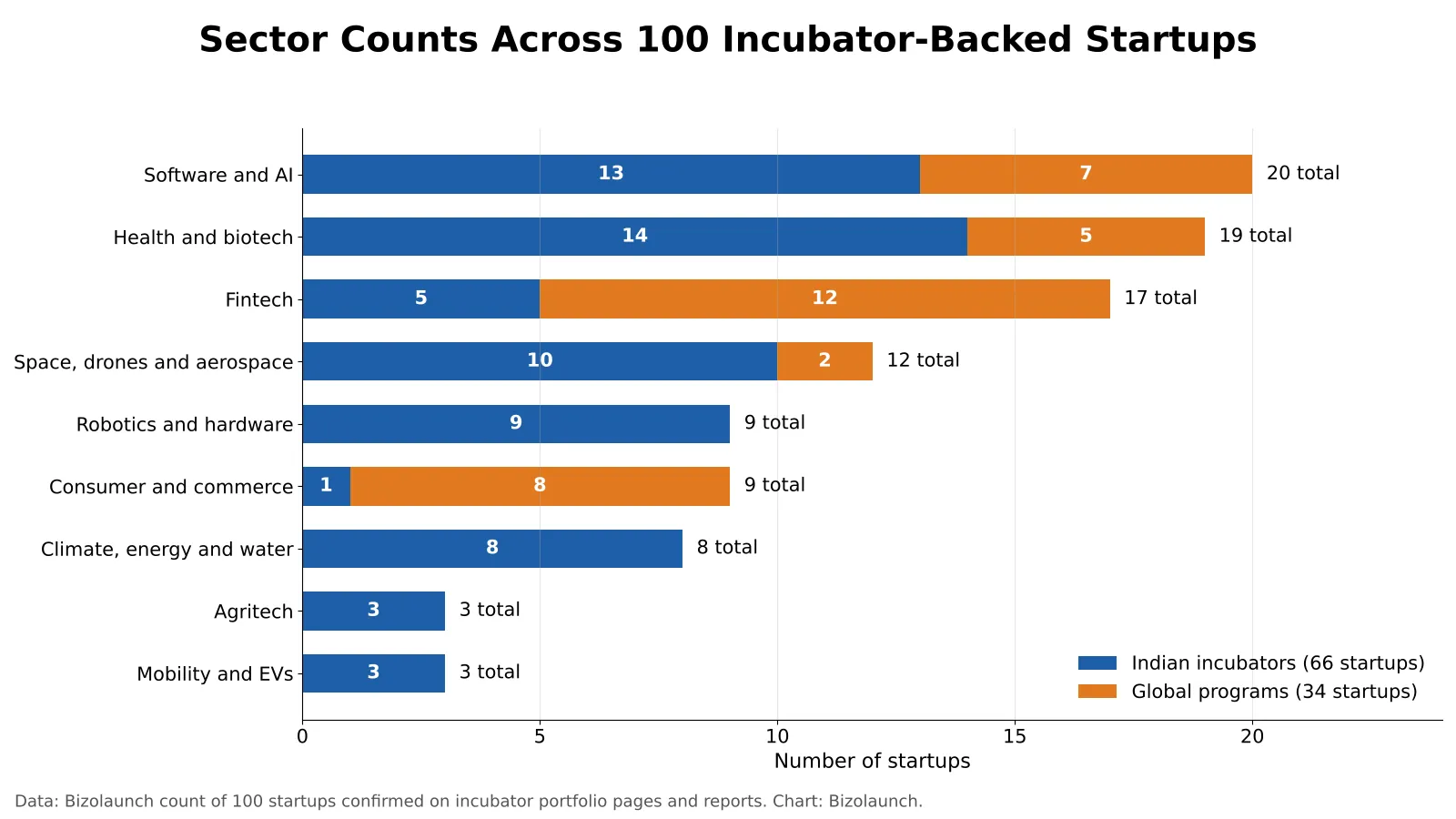
First, health and biotech has 19 startups, and 14 of them came from Indian incubators. Second, space, drones and aerospace has 12, and 10 of those are Indian. Robotics, climate, agritech and mobility startups appear only in the Indian group.
On the other hand, fintech flips the pattern. Twelve of the 17 fintech startups came from the global programs. Consumer apps are even more one-sided, with 8 of 9 from abroad. In our view, the reason is the host. A university incubator gives founders labs and faculty. A cash-for-equity accelerator rewards fast growth in software and payments.
So the right program depends on what you build. A hardware or biotech founder in India has more peers at IIT Madras, SINE, T-Hub or Venture Center. A payments or consumer app founder may get more from a YC-style program. To learn how each kind of backer thinks, read our guide to the different types of investors.
Cheques, Equity and Grants Each Program Offers
The global accelerators pay cash for equity. Indian incubators mostly offer space, mentors and access to grants. The table puts the published terms side by side.
| Program | Money on offer | Instrument and stake | Conditions |
|---|---|---|---|
| Y Combinator | $500,000 | $125,000 post-money SAFE for 7%, plus $375,000 uncapped SAFE with an MFN clause | YC also gets a pro rata right in later rounds |
| Techstars | $220,000 in most programs | $20,000 for 5% in common stock, plus a $200,000 uncapped MFN SAFE | Terms differ in a few programs |
| Startup India Seed Fund Scheme (through Indian incubators) | Up to ₹20 lakh grant, then up to ₹50 lakh | Grant for proof of concept; convertible debentures, debt or debt-linked instruments for market entry | DPIIT recognition; company incorporated no more than two years before applying |
| CIIE.CO Bharat Innovation Fund | $100 million fund | Venture investment in deep-tech startups | Launched in 2017 |
| NIDHI Centre of Excellence at FITT, IIT Delhi | Up to ₹1 crore per startup | Support under the NIDHI program | For startups at FITT |
Y Combinator’s deal has two parts. The first $125,000 buys 7% on a post-money SAFE. By our math, that values the company at about $1.79 million after the cheque. The other $375,000 is an uncapped SAFE with a most-favored-nation clause. YC’s own example converts it to 2.5% in a round at a $15 million post-money cap. So in that case, YC would own about 9.5% in total.

Techstars pays $220,000 in most programs. That is $200,000 on an uncapped MFN SAFE plus $20,000 for 5% in common stock. If you are new to these notes, our explainer on how a SAFE note works walks through the math.
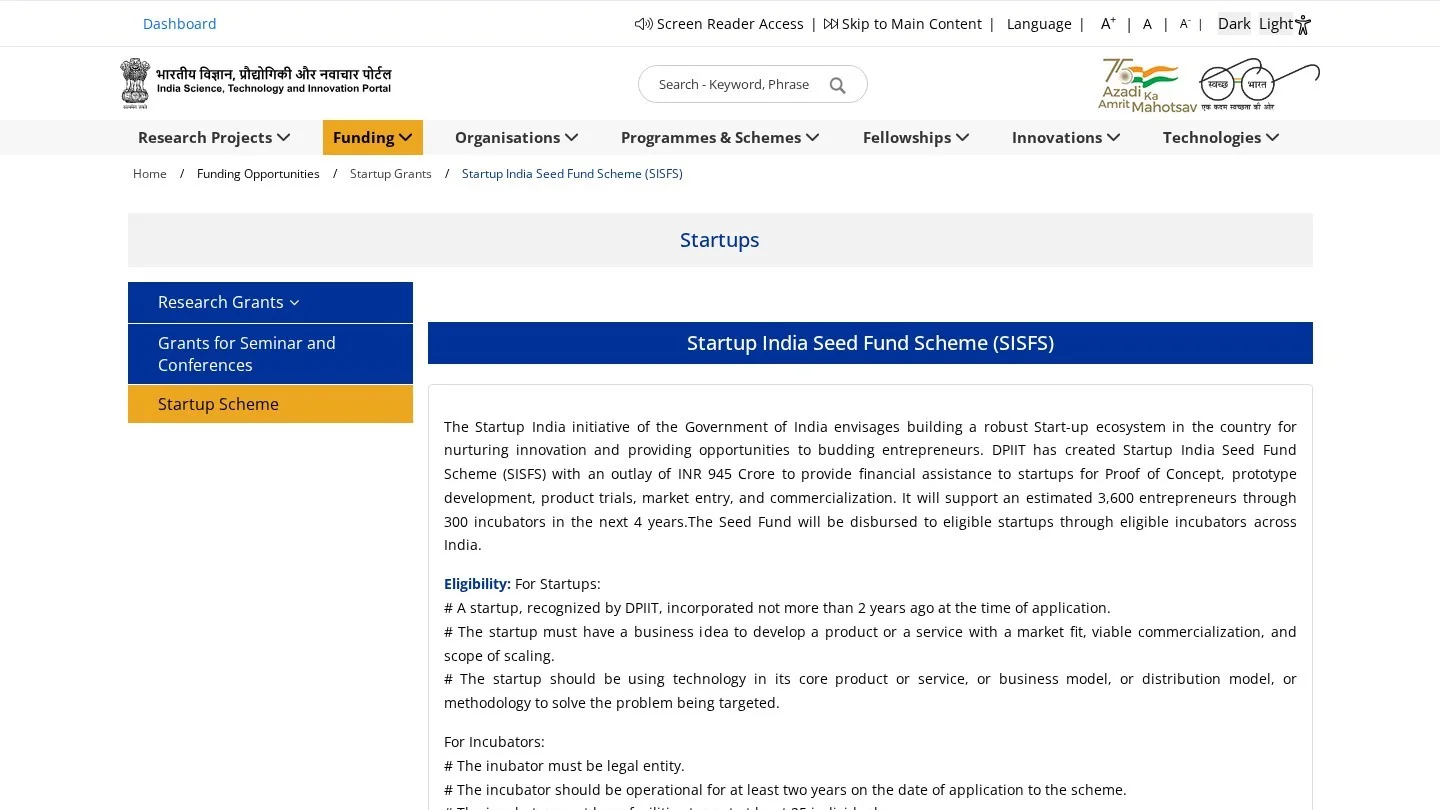
In India, the Startup India Seed Fund Scheme flows through incubators. A startup can get up to ₹20 lakh as a grant for a proof of concept. After that, it can get up to ₹50 lakh in convertible debentures or debt. The scheme’s ₹945 crore outlay aims to back about 3,600 entrepreneurs through 300 incubators. By our math, that is about ₹26 lakh per entrepreneur and 12 startups per incubator.
Pipeline Size at the Incubators We Covered
The incubators publish their own counts, but each uses a different year. We kept every figure tied to its date. Then we put them in one table, so you can compare the scale of each program.
| Program | Started | Published pipeline figure |
|---|---|---|
| IIT Madras Incubation Cell | Eight years before May 2021 | 240 startups by May 2021, valued at ₹10,500 crore |
| NSRCEL, IIM Bangalore | Not published on the pages we used | 225+ startups and 5,400+ direct jobs by September 2018 |
| CIIE.CO, IIM Ahmedabad | 2002 | 150+ seed investments |
| SINE, IIT Bombay | 2004 (pilot from 2000) | 84 companies in 2015 to 2019 and 77 in 2020 to 2023 |
| T-Hub, Hyderabad | Not published on the pages we used | Network of 3,300+ startups |
| KIIT-TBI, Bhubaneswar | 2009 | 200+ startups incubated and mentored; 80+ IP filings |
| Venture Center, Pune | 10 January 2007 | 750+ program teams; 175+ resident incubatees; ₹698 crore raised in eight years |
| FITT, IIT Delhi | Not published on the pages we used | 150+ startups incubated; 34 new residents in the year to March 2023 |
| Y Combinator | Not published on the pages we used | 177 India-based companies in its directory |
| Techstars | Boulder | 29 unicorns in its portfolio |
| Station F Founders Program | Paris | Up to 25 startups per batch; 18 in the Fall 2024 batch |
The gaps are large. T-Hub works with a network of over 3,300 startups, while Station F caps each Founders Program batch at 25. Still, a large network does not guarantee hands-on help. For example, Venture Center counts over 175 resident incubatees among more than 750 program teams. So ask each incubator how many startups get a desk, a mentor and seed money.
Choosing an Incubator by Sector and Stage
First, match the incubator to your sector. Our counts show that Indian university incubators are home to deep tech. In contrast, the global accelerators are home to fintech and consumer apps.
Next, check your stage. The Startup India seed fund needs DPIIT recognition and a company no more than two years old. Y Combinator and Techstars take very early teams, but they ask for equity at once. For other ways to raise that first money, see our list of company funding types. Also, our guide on where to find angel investors covers the networks that often invest after an incubator.
Then, look at who came before you. A drone founder will meet ideaForge’s story at SINE and Skyroot’s at T-Hub. A fintech founder will find a full portfolio at NSRCEL’s Fintech Centre of Excellence. Finally, polish your pitch before demo day. Our roundup of pitch deck design companies lists firms that build investor decks. For newer names to follow, we also track new startups to watch.

Founders’ Questions About Incubator-Backed Startups
What Is an Incubator-Backed Startup?
It is a company that spent its early stage inside an incubator or accelerator program. The program may give office space, mentors, lab access, seed money or investor meetings. For example, Ather Energy came out of the IIT Madras Incubation Cell, and Airbnb went through Y Combinator in Winter 2009.
How Is an Incubator Different From an Accelerator Like Y Combinator?
An incubator usually hosts a startup for a longer period and gives space and support. An accelerator runs a short, fixed program and invests cash for equity. However, the line is blurry. Many Indian incubators also invest seed money, as CIIE.CO does through its seed fund.
Do Incubators Take Equity in Startups?
Accelerators do. Y Combinator takes 7% for its first $125,000, and Techstars takes 5% in most programs. Indian incubators often pass on government grants, such as the up to ₹20 lakh proof-of-concept grant under the Startup India Seed Fund Scheme. Their own terms vary, so ask for them in writing.
Can One Startup Be Backed by Two Incubators?
Yes. Agnikul Cosmos came out of the IIT Madras Incubation Cell and is also in the CIIE.CO seed portfolio. Rappi went through Y Combinator, and Plug and Play also names it as an investment. We counted each startup only once.
Which Indian Incubator Has the Most Space Startups?
On our list, T-Hub does. Five of our 10 T-Hub rows are space or aerospace firms, led by Skyroot Aerospace and Dhruva Space. IIT Madras and SINE follow with two each. Founders in Uttar Pradesh can also compare state support in our UP startup policy guide.
Portfolio Pages and Reports Behind Our 100 Rows
- Y Combinator: startups in India directory
- Y Combinator: fintech startups directory
- Y Combinator: consumer startups directory
- Y Combinator: the YC standard deal
- Techstars: portfolio
- David Cohen: a review of the first eleven Techstars unicorns
- Techstars help center: investments in accelerator portfolio companies
- MWC Barcelona: Plug and Play Tech Center exhibitor profile
- Station F: Founders Program Fall 2024 cohort
- IIT Madras: Incubation Cell startups and valuation
- IIM Bangalore: NSRCEL centre of excellence page
- NSRCEL: about us and fintech portfolio
- IIM Ahmedabad faculty newsletter: the innovation continuum at IIMA
- SINE IIT Bombay: about us
- SINE IIT Bombay: home page and incubatee stories
- SINE IIT Bombay: newsletter, January to March 2023
- T-Hub: home page and founders
- Telangana Today: first private rocket made by T-Hub incubated company zooms into space
- KIIT: KIIT-TBI incubatee list and profile
- KIIT News: KIIT-TBI gets Successful Incubator of the Year 2023 award
- Venture Center: introduction deck
- FITT IIT Delhi: annual report 2022-23
- India Science and Technology portal: Startup India Seed Fund Scheme