
Take the total of every school charge due in the next 12 months. Subtract what you have already set aside. Then divide by the months left until each bill is due. That monthly figure is your school fee savings plan, and it turns a scary April or August bill into a steady transfer you barely notice.
The harder part is getting the total right. Tuition is only one line. Admission charges, books, uniforms, transport, exam fees and trips all land at different times. On top of that, many schools raise fees every year.
We built two full examples for this guide, one for a family in India and one in the US. We also went through the official rules for the accounts parents use most. In India, that means recurring deposits, PPF and Sukanya Samriddhi. In the US, it means 529 plans. Each section says which country it covers.
List Every Fee the School Charges
Get the fee schedule from the school office or the parent portal. Then write down every charge for one full school year, not only tuition. Parents most often miss the one-time and once-a-year items.
Use this template. Fill in the amount and the month each one is due.
| Fee item | How often | Amount | Month due |
|---|---|---|---|
| Tuition fee | Monthly, quarterly or yearly | … | … |
| Admission or registration fee | Once, at entry | … | … |
| Annual charges or development fee | Yearly | … | … |
| Books and stationery | Yearly | … | … |
| Uniforms and shoes | Yearly, plus top-ups | … | … |
| Transport or bus fee | Monthly or quarterly | … | … |
| Exam and board fees | Yearly, in board years | … | … |
| Trips, events and activity clubs | A few times a year | … | … |
| Devices or lab fees | Yearly or once | … | … |
Ask the school two questions while you are at it. How often have fees changed in the last few years? And does paying the full year in one go earn a discount? Both answers change your plan.
Map the Fees on a 12-Month Calendar
Next, put each amount in the month it is due. School costs bunch up. The start of the school year usually carries tuition, books, uniforms and annual charges at once.
Take a sample family in India. Their child is in Class 4 at a private CBSE school. The session starts in April. We used made-up but realistic numbers.
| Month | What is due | Amount |
|---|---|---|
| April | First quarter tuition, books, uniform, annual charges | ₹50,000. |
| July | Second quarter tuition | ₹30,000. |
| October | Third quarter tuition | ₹30,000. |
| January | Fourth quarter tuition | ₹30,000. |
| Every month | School bus | ₹2,500. |
| Total for the year | Lump sums plus 12 bus payments | ₹1,70,000. |
The bus fee is small and regular, so it belongs in the normal monthly budget. The four lump sums are the problem. They add up to ₹1,40,000 a year.
Work Out Your Monthly School Fee Saving
Now divide. The goal is to have each lump sum ready before its due date.
Monthly saving = (lump sums due in the year − money already saved) ÷ 12.
For the family above, ₹1,40,000 ÷ 12 = about ₹11,667 a month. They move that amount to a separate account on payday. As a result, every quarterly bill is paid from that account and never from the salary account.
The first year is harder if you start late. Say it is November and the April bill is only five months away. Then the family needs ₹50,000 in five months, which is ₹10,000 a month. From May onward, they switch to the steady ₹11,667 a month.
A sinking fund works the same way for any planned cost. Our sinking funds examples show how to run several of them side by side.
Add a Buffer for Yearly Fee Hikes
Most private schools raise fees from time to time. Your school can tell you its recent history. So build a buffer into the plan, because a saving amount set today will fall short next year.
We ran the ₹1,20,000 tuition from our example through three hike rates. These are what-if numbers, not forecasts.
| Yearly fee rise | Tuition after 3 years | Tuition after 5 years | Tuition after 10 years |
|---|---|---|---|
| 5% | ₹1,38,915 | ₹1,53,154 | ₹1,95,467. |
| 8% | ₹1,51,165 | ₹1,76,319 | ₹2,59,071. |
| 10% | ₹1,59,720 | ₹1,93,261 | ₹3,11,249. |
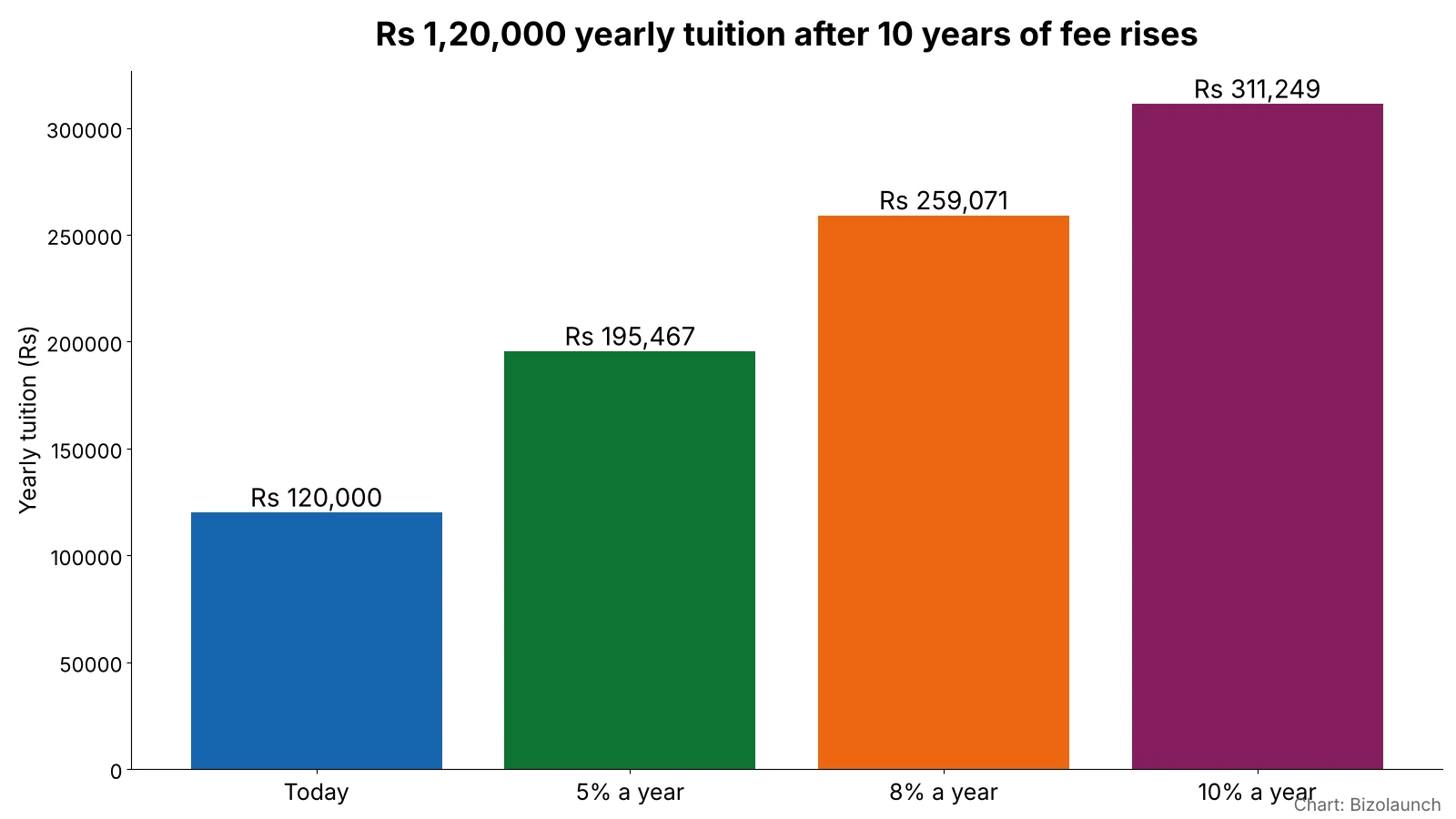
At 8% a year, tuition more than doubles in ten years. So raise your monthly saving each year by the same percent as the fee rise. A family saving ₹11,667 now would move to about ₹12,600 a month after an 8% increase.
Pick a Place to Keep School Fee Money in India
Match the account to how soon you need the money. Short-term fee money should be safe and easy to reach. Money for fees five or more years away can go into longer schemes.
The government sets small savings rates every quarter. For October to December 2026, the rates on small savings schemes stayed the same as the previous quarter. These are the rates that matter for school savings.
| Scheme | Rate for Oct to Dec 2026 | Best use for school fees |
|---|---|---|
| Post office time deposit, 1 year | 6.9% | Next year’s lump sums. |
| Post office time deposit, 3 years | 7.1% | Fees three years out. |
| Post office 5-year recurring deposit | 6.7% | Monthly saving for a big fee five years away. |
| Public Provident Fund (PPF) | 7.1% | Senior school or college costs 15 years away. |
| Sukanya Samriddhi Account | 8.2% | Higher education costs for a daughter. |
The time deposit, PPF and Sukanya rates come from the Indian Bank small savings rates page. The 6.7% recurring deposit rate comes from Business Today coverage of the Ministry of Finance decision for the quarter.
Use a Recurring Deposit for Fees One to Five Years Away
A recurring deposit (RD) matches the monthly habit this plan needs. You commit a fixed amount each month for a set term. Bank RDs come in shorter terms too, so match the term to the fee date and check your bank’s current rate.
For example, a parent wants ₹3,00,000 in five years for Class 11 and 12 coaching and fees. Saving with no interest would need ₹5,000 a month. In a 6.7% five-year RD, roughly ₹4,200 to ₹4,300 a month gets there. On the other side, ₹5,000 a month for five years grows to roughly ₹3.5 lakh. Your bank or post office will show the exact maturity value.
Use PPF Only for Costs Far in the Future
PPF works for long goals because the money is locked in. The account runs for 15 years. PNB lists the rules: a minimum of ₹500 and a maximum of ₹1,50,000 a year. Partial withdrawals open only after five years from the end of the year you opened the account.
Parents get one helpful exception. Premature closure is allowed after five financial years for the higher education of the account holder or dependent children. A 1% interest penalty applies, and you need proof of admission.
We ran one long-term example. A parent puts ₹60,000 into PPF at the start of each year. At 7.1% compounded yearly, the balance after 10 years is about ₹8.9 lakh on ₹6 lakh deposited. After 15 years, it is about ₹16.3 lakh on ₹9 lakh deposited. The rate changes every quarter, so treat these as estimates.
Know the Sukanya Samriddhi Limits Before You Count on It
Sukanya Samriddhi is a savings account for a girl child. Under the Sukanya Samriddhi Account Scheme, a guardian can open it before the girl turns 10. Deposits run from ₹250 to ₹1,50,000 a year for 15 years. The account matures 21 years after opening.
However, it will not pay regular school fees. Education withdrawals are allowed only after the girl turns 18 or passes Class 10. Even then, you can take out up to 50% of the balance from the end of the previous financial year. You also need proof, such as an admission offer or fee slip. So keep Sukanya for college costs and use an RD or savings account for school fees.
Pick a Place to Keep School Fee Money in the US
US families have one main tax-advantaged account for school costs: the 529 plan. It now covers more K-12 spending than it did before.
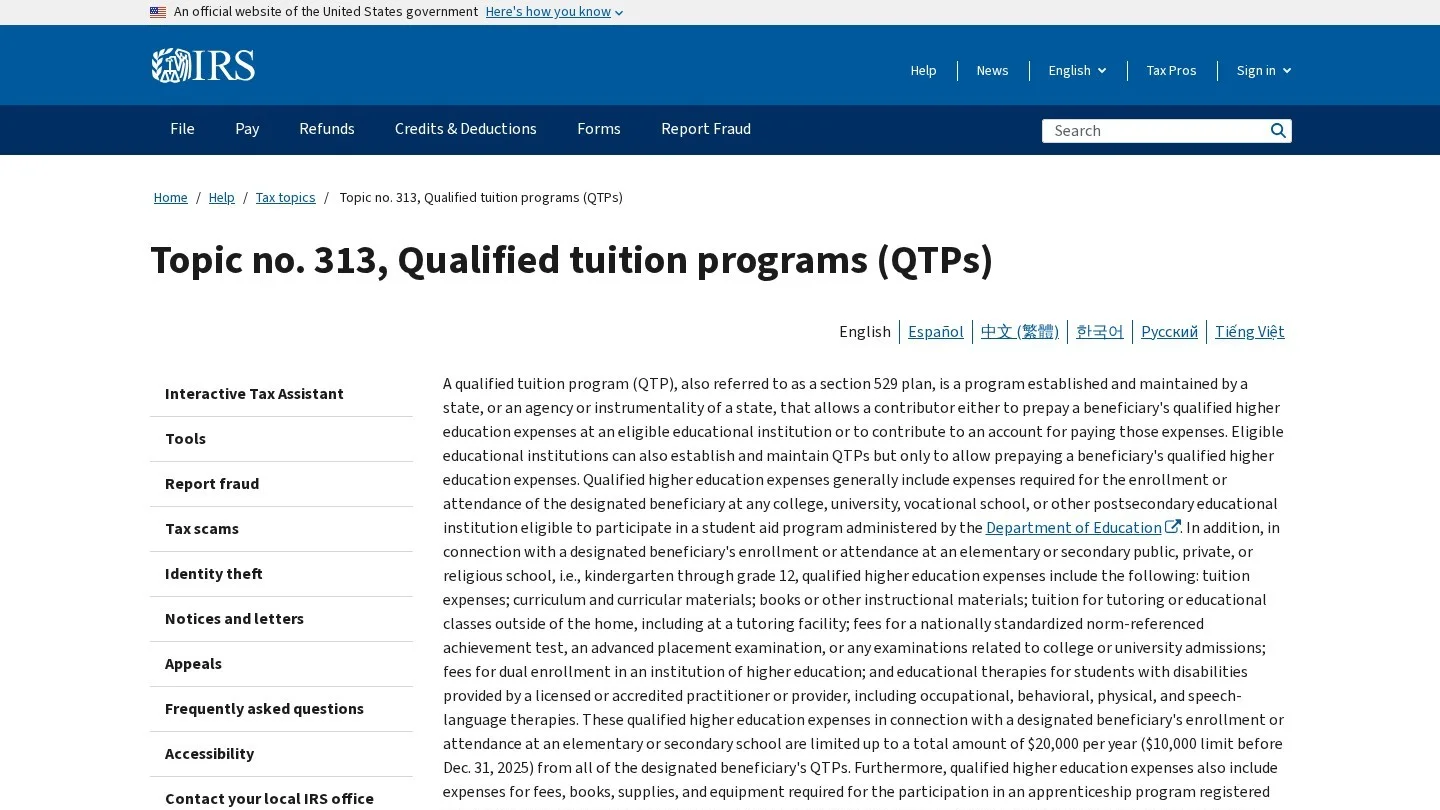
The IRS says 529 money can pay for qualified K-12 expenses up to $20,000 per year per beneficiary. That limit was $10,000 a year before. Qualified K-12 costs include tuition, books and other teaching materials, and outside tutoring. Certain standardized test fees, dual enrollment fees and therapies for students with disabilities count too. Earnings grow tax-free, and qualified withdrawals are not taxed federally. Contributions are not deductible on your federal return.
The SEC’s Investor.gov explains the trade-offs. Education savings plans are not guaranteed by state or federal governments, so you can lose money. Plans may charge enrollment, maintenance and asset management fees. Also, many states offer a tax deduction or matching grant, but often only for their own state’s plan. If you withdraw for something that does not qualify, the earnings face income tax plus an extra 10% federal tax.
Match the 529 to Your Timeline
Market risk matters more when the bill is close. A 529 invested in stocks can drop right before the August tuition bill. So many families split the money:
- Fees due within a year: Keep them in a savings account or a low-risk 529 option. State tax rules for K-12 withdrawals differ, so check your plan before you rely on a state tax break.
- Fees due in three to ten years: Choose a 529 investment option that matches the date, such as a conservative or age-based option.
- College costs: Leave this money invested longer, since higher education is the main purpose of a 529.
Run a US Example
A family pays $15,000 a year in private school tuition, plus about $1,200 for books, uniforms and trips. The school bills tuition in July. So they need $16,200 by July each year, or $1,350 a month.
For a long-term goal, the same family also saves $300 a month for high school costs 13 years away. With no growth, that becomes $46,800. If the account earned 5% a year, it would reach about $65,700. The 5% is an assumption for illustration, not a promise. Your 529 plan’s results will differ.
Fit School Savings Into the Family Budget
A saving target only works if the budget can carry it. So add the monthly school saving as a fixed line, the same as rent.
Then find the money. Most families cover it with a mix of cuts and timing:
- Pay from a separate account. Open a savings account just for school costs. Set an automatic transfer on payday.
- Use bonuses for the big month. A yearly bonus or tax refund can cover the April or August lump sum.
- Ask about payment options. Some schools give a discount for paying the full year in advance. Others let you spread fees with no extra cost.
- Buy used where you can. Books, uniforms and sports kits often have resale or swap groups at school.
If your household has two incomes, our guide to budgeting with two sources of income shows how to split a shared goal like this. Families still choosing a school can read our CBSE vs ICSE comparison before they commit to a fee level.

Avoid These School Fee Planning Mistakes
These are the slips that turn a plan into a scramble.
- Saving only for tuition. Books, uniforms and annual charges can add a large share on top. List them all first.
- Using the same account as daily spending. The money gets spent on other things. Keep it apart.
- Ignoring fee hikes. A plan set once and never changed falls behind in two or three years.
- Locking short-term money away. PPF and Sukanya cannot pay next year’s school bill. Use them only for far goals.
- Putting next term’s fees in stocks. A market drop right before the bill can leave you short.
- Borrowing for fees by habit. A loan or credit card for school fees adds interest every year. If you already carry card debt, our guide on the debt snowball and avalanche methods can help you clear it first.
School Fee Savings Questions From Parents
How much should I save each month for school fees?
Add every lump-sum fee due in the next 12 months. Subtract what you already have saved. Then divide by 12, or by the months left before the first bill if it is closer.
Can I use Sukanya Samriddhi for school fees?
Not for regular school fees. Education withdrawals start only after the girl turns 18 or passes Class 10, and they are capped at 50% of the previous year’s balance.
Can a 529 plan pay for private school?
Yes, for K-12 tuition and some other costs. The IRS limit is $20,000 per year per beneficiary for qualified K-12 expenses. State tax rules can differ, so check your own plan.
Is an RD better than a savings account for school fees?
An RD fixes your rate for the term and makes you save every month. A savings account is more flexible, but the money is easier to spend. Many parents use an RD for next year’s lump sums and a savings account for this term’s bills.
When should I start saving for my child’s schooling?
As early as you can. Even a few months of saving before the first big bill is cheaper than borrowing. For far-off costs, more years also means more time for interest to grow.
This guide gives general information for parents in India and the US. Rates and scheme rules change, so check the current terms with your bank, post office or 529 plan before you invest.