
A small vertical farming business in the US costs roughly $120,000 to $350,000 to launch if you buy a turnkey container farm, or about $3,000 a month if you rent one through a farm-as-a-service plan. Running it adds another $30,000 to $45,000 a year for electricity, labor and supplies at today’s power prices and farm wages. The harder number is the one most cost guides skip: at those costs, a single container has to sell its greens for well above supermarket prices to break even.
We built the numbers below from supplier price pages, the US Energy Information Administration, the Bureau of Labor Statistics and the FDA. Every input is linked, every assumption we had to make is labeled, and the goal is to help you decide whether to start, how big to start, and what you would need to charge.
Vertical Farm Startup Costs in One Table
Most new vertical farmers start with a container farm or a small room of racks, not a warehouse. Container farms are the easiest format to price because suppliers publish their figures, and the table pulls together the ranges and list prices we found.
| Cost item | Amount | Type of figure |
|---|---|---|
| Turnkey container farm, outright | $215,000 | List price (legacy Freight Farms model, now supported by Growcer) |
| Growcer container farm, outright | C$250,000 (about $180,000) | Company figure, Dec 2025 |
| Farm-as-a-service plan | $3,000 a month | Company plan, Oct 2025 |
| Fully equipped container farm, industry range | $100,000 to $250,000+ | Industry range, June 2026 |
| Utility connection | $2,000 to $30,000+ | Industry range |
| Shipping and delivery | $3,000 to $20,000+ | Industry range |
| Installation and commissioning | $2,000 to $15,000+ | Industry range |
| Training and onboarding | $1,000 to $10,000+ | Industry range |
| Total launch budget, all items | $120,000 to $350,000+ | Industry range |
The add-ons matter more than many first-time growers expect, because utility hookup, freight, installation and training add $8,000 at the low end and $75,000 at the high end, by our sum of ZipGrow’s ranges. A farm placed far from a three-phase power line can burn through a contingency fund before the first seed goes in.
Why Freight Farms Pricing Now Runs Through Growcer
For a decade, Freight Farms of Boston was the best-known container farm brand in the US. It filed for bankruptcy in April 2025, and Canadian company Growcer bought its assets on July 28, 2025. Growcer now supports former Freight Farms growers and sells its own Osiris farm.
Growcer’s main offer is the Growcer Fund, which the company describes as costing less than C$1,000 a week, with upfront costs up to 75% lower than an outright purchase. The plan covers the farm, maintenance, technical support and funding services, and lets you pay off the balance at any time to take ownership. Growcer’s CEO has said that investors pooled money to buy 100 farms for this rent-to-own model.
This is a good arrangement for a first-time grower who wants to test local demand without a six-figure loan, although it is less attractive if you already have cheap capital, since monthly payments add up to $36,000 a year.
Running Costs for a Container Farm, Line by Line
Startup cost gets the headlines, but operating cost decides whether the farm survives, so we built a yearly budget from four published inputs that you can swap in your own power rate and wage once you know them.
| Yearly cost | Low case | High case | How we calculated it |
|---|---|---|---|
| Farm-as-a-service payments | $36,000 | $36,000 | $3,000 a month x 12 |
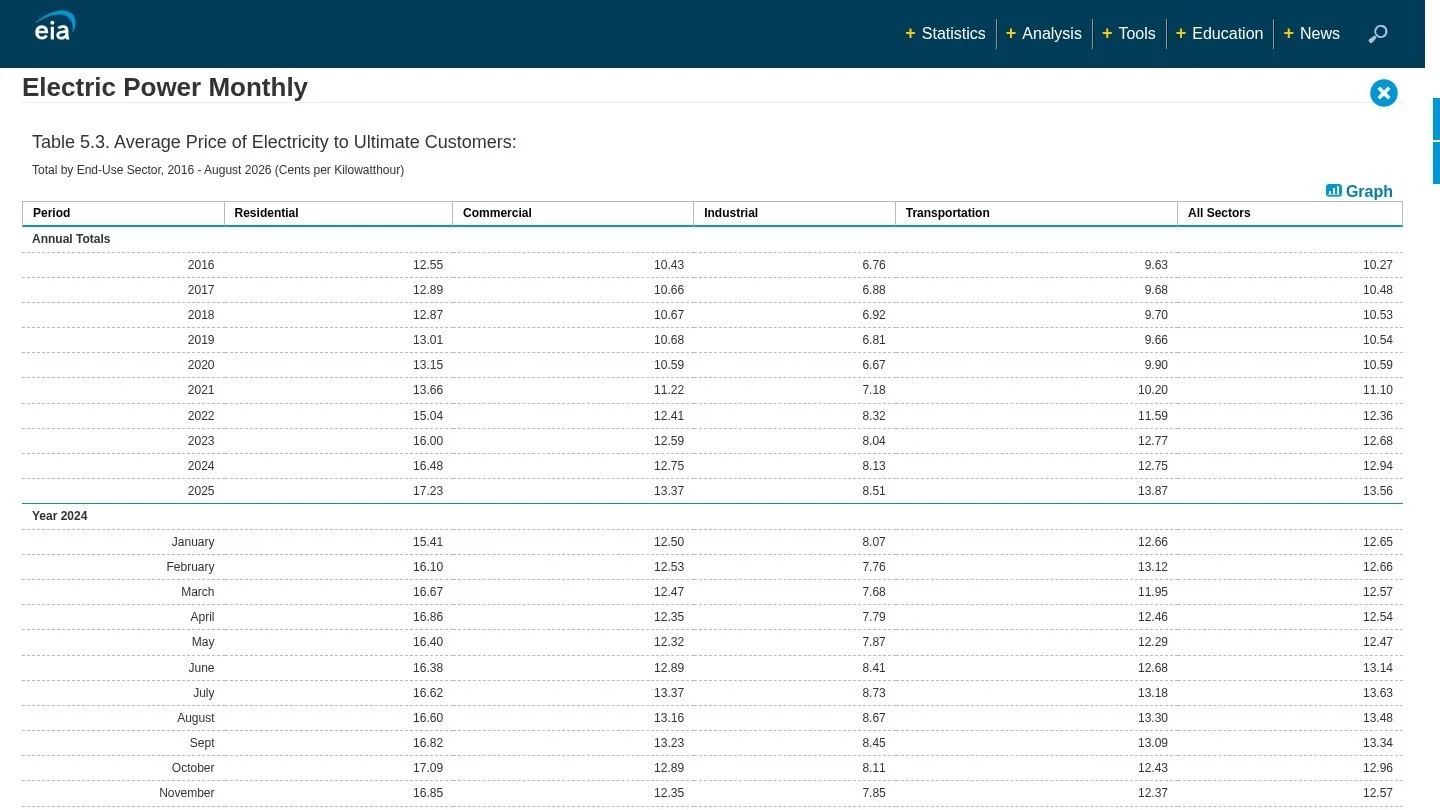
| Electricity | $7,821 | $18,128 | 151 or 350 kWh a day x 365 x 14.19 cents |
| Labor | $22,581 | $22,581 | 25 hours a week x 52 x $17.37 |
| Seeds, nutrients and consumables | $3,600 | $3,600 | $300 a month x 12 |
| Total | $70,002 | $80,309 | Sum of the four rows |
Each input is a published figure. Freight Farms lists average power use of 151 to 350 kWh a day for its container. The US average commercial electricity price was 14.19 cents per kWh in June 2026. Growcer says its farm needs about 25 hours of work a week, plus time for packing and sales. The mean wage for farmworkers in crop, nursery and greenhouse work is $17.37 an hour. ZipGrow budgets $300 a month for supplies on its own container farm.
Power is the line that swings most, and in a state with expensive commercial electricity rates the high case climbs quickly. Our average electricity bill by state table is a quick way to see how far your state sits from the national average before you sign a site lease.
Break-Even Price per Pound for Indoor Greens
Freight Farms says its farm can grow 2 to 6 tons of produce a year. We assumed short tons of 2,000 lb, so that is 4,000 to 12,000 lb. Dividing the yearly cost by the yearly harvest gives the price you must average on every pound just to cover costs, before any profit.
| Yearly harvest | Break-even per lb, low power | Break-even per lb, high power |
|---|---|---|
| 2 tons (4,000 lb) | $17.50 | $20.08 |
| 4 tons (8,000 lb) | $8.75 | $10.04 |
| 6 tons (12,000 lb) | $5.83 | $6.69 |
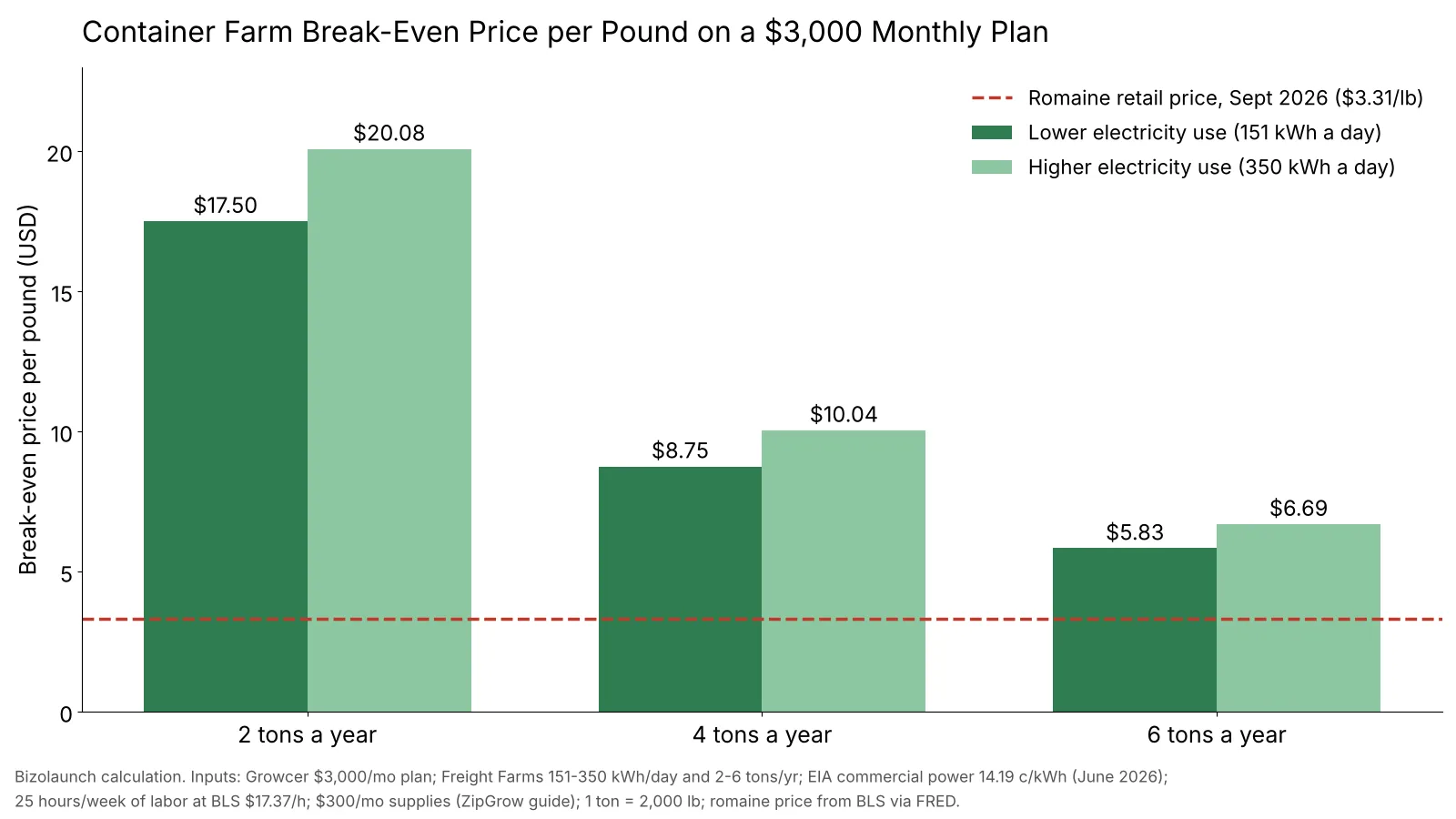
Now compare that with what shoppers actually pay at the store: the US average retail price for romaine lettuce was $3.31 a pound in September 2026, and $4.02 in June. Even at the top yield and the lower power case, a container farm on a monthly plan needs $5.83 a pound, which is 76% above the retail price of romaine. A grocery chain buying wholesale will pay less than retail, so the gap is wider still.
To break even selling at $3.31 a pound, the farm would need to sell about 21,000 to 24,000 lb a year. That is roughly twice the top of the published yield range. Our break-even calculator lets you test your own price and volume against these fixed costs.
Three Ways Small Vertical Farms Close the Gap
The math above does not mean the business cannot work; it means a container farm cannot compete as a cheap lettuce supplier. The growers who last tend to change one of the inputs.
Sell Higher-Value Crops
Herbs, microgreens and specialty greens sell for more per pound than romaine. A farm that averages $8 to $10 a pound across its crop mix reaches break-even at 4 tons a year in our model. Check prices at local farmers markets and specialty grocers before you choose a crop plan, since those buyers will set the ceiling on what you can charge.
Sell Direct and Local
Restaurant contracts, community-supported agriculture boxes and farm stands let you keep the retail margin. Growcer’s CEO has made a related point: the economics work best where greens are trucked long distances, such as Alaska or northern Canada, so local supply wins on freshness and price. Branded, well-packed greens also help a small farm earn its premium; our list of sustainable packaging suppliers covers compostable clamshells and bags.
Own the Labor or Own the Farm
If the owner does the 25 hours a week without drawing a wage, the yearly cost falls to $47,421 to $57,728 on the monthly plan. Buying a farm outright for about $180,000 and spreading it over an assumed 10-year life works out to $18,000 a year, which brings the yearly total with paid labor to $52,002 to $62,309. That second figure assumes the farm lasts 10 years and ignores interest. If you finance the purchase, our EMI calculator guide shows how to work out the monthly payment.
| Setup | Yearly cost, low power | Yearly cost, high power | Break-even at 6 tons |
|---|---|---|---|
| Monthly plan, paid labor | $70,002 | $80,309 | $5.83 to $6.69 |
| Monthly plan, owner does the work | $47,421 | $57,728 | $3.95 to $4.81 |
| Bought outright ($180,000 over 10 years), paid labor | $52,002 | $62,309 | $4.33 to $5.19 |
Even the most favorable row stays above the retail romaine price, which is a fair warning for anyone planning to sell only commodity lettuce.
What Happened to the Big Vertical Farms
Large indoor farms have shown how hard the economics are at scale. In March 2025, Plenty filed for bankruptcy after raising nearly $1 billion, keeping only a Virginia strawberry farm and a Wyoming research center. Bowery Farming, which raised more than $700 million, shut down in November 2024. AeroFarms filed for bankruptcy in 2023 after raising more than $300 million, and AppHarvest filed for Chapter 11 the same year.
The common thread was cost per pound, as power, labor and debt on large buildings ran ahead of what buyers would pay for greens. A small grower can avoid the debt part by starting with one unit, renting before buying, and selling locally at a premium.
Licenses and Food Safety Rules for US Indoor Farms
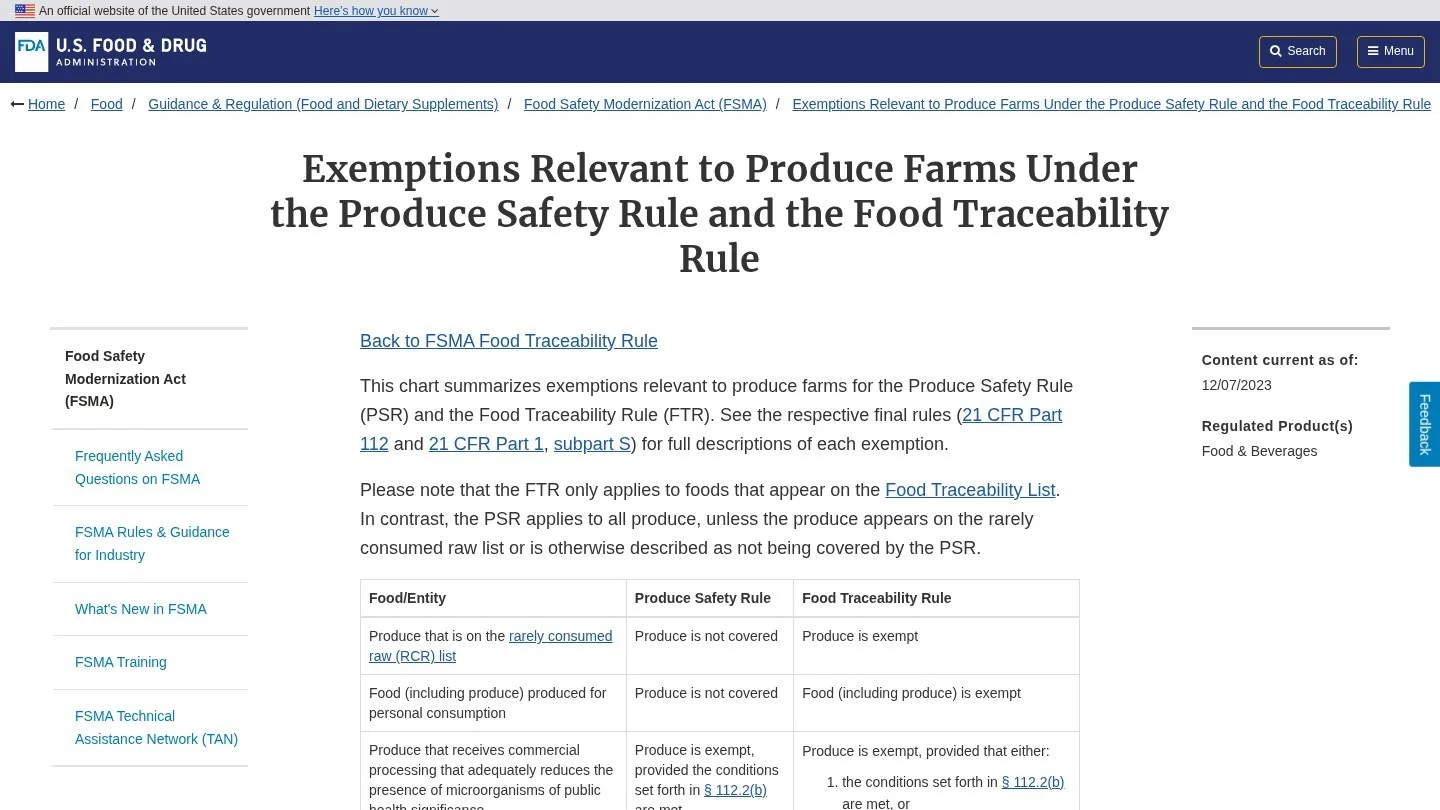
A vertical farm is a farm in the eyes of food safety law, so the FDA’s Produce Safety Rule is the main federal rule to check. Small farms below set sales cutoffs are exempt from some or all of it.
- Not covered: Farms with average annual produce sales of $25,000 or less, measured in 2011 dollars and adjusted for inflation, are not covered by the Produce Safety Rule.
- Qualified exemption: Farms with average annual food sales under $500,000, adjusted for inflation, can qualify if most sales go to qualified end users, such as consumers or local restaurants and stores.
- Food Traceability Rule: A farm not covered by the Produce Safety Rule under the $25,000 test is also exempt from the traceability rule, and the traceability rule has its own separate small-farm exemption.
A single container farm selling 12,000 lb at $6 a pound would gross $72,000. That is above the $25,000 line, so plan on either full coverage or the qualified exemption, which needs records of who you sell to. State and city rules sit on top of the federal ones, so expect a local business license, zoning approval for the site, an electrical permit for the power hookup, and sales tax registration if you sell direct to consumers.
Year-One Cash Needs on a Monthly Farm Plan
The first year is the most expensive one because the one-time costs land at the same time as the first monthly bills, while the farm is still learning to grow consistent crops. Adding ZipGrow’s one-time ranges for utility hookup, freight, installation and training to the yearly running costs in our table gives a first-year cash need of about $78,000 in the low case and about $155,000 in the high case.
Revenue also starts late, because seeds take weeks to reach harvest size, and new growers often lose part of their early trays while they tune light, nutrients and airflow. If we assume, as a planning cushion, that a farm sells for only 10 of its first 12 months, then a grower averaging $8 a pound would bring in about $53,000 at 4 tons a year and about $80,000 at 6 tons. Those two assumptions are ours, so treat them as a stress test rather than a forecast.
| Year-one line | Low case | High case |
|---|---|---|
| One-time add-ons (utility, freight, installation, training) | $8,000 | $75,000 |
| Yearly running costs on a $3,000 monthly plan | $70,002 | $80,309 |
| Total first-year cash out | $78,002 | $155,309 |
| Revenue at $8 per lb, 10 selling months, 4 tons a year | $53,333 | $53,333 |
| Revenue at $8 per lb, 10 selling months, 6 tons a year | $80,000 | $80,000 |
The gap between cash out and cash in is the working capital you need on day one. A founder who plans for the high case, and keeps a reserve for a failed crop cycle or a cooling system repair, is far less likely to be forced to sell the farm in its first winter.
Container, Grow Room or Warehouse Farm
The container is not the only format, and the right one depends on how much you plan to grow and how sure you are of your buyers. A container farm arrives as a sealed, tested unit, which keeps the setup risk low and lets you move the farm if a site does not work out. Its main limit is fixed growing space, so revenue tops out at whatever that box can produce in a year.
A grow room built inside a leased building, using racks, LED fixtures and hydroponic channels, can cost less per square foot of growing space, but you take on the design work, the permits for electrical and plumbing changes, and the risk of mistakes in airflow or humidity. ZipGrow, for example, sells a warehouse-style system alongside its container farm for growers who want to scale inside a building.
A warehouse farm only makes sense once you have signed buyers for most of its output. The failures of Plenty, Bowery and AeroFarms show what happens when a large building is financed ahead of demand. For most first-time founders, one container or one room, run well for a full year, is the cheapest way to learn what customers will actually pay. If you are still choosing a brand for the produce, our business name generator can help you shortlist names before you check trademarks.
A Launch Checklist for a First Container Farm
- Price your buyers first. Visit three restaurants and two specialty grocers, and write down what they pay per pound for the crops you plan to grow.
- Get a power quote for your site. Ask the utility for the commercial rate and the cost to bring service to the pad. This one number can move your yearly cost by $10,000.
- Pick rent or buy. Compare a monthly plan with a loan on a purchase over the same five years, including interest.
- Plan the hours. Budget 25 hours a week for growing plus packing, delivery and sales time.
- Check food safety coverage. Work out where you sit against the FDA’s $25,000 and $500,000 tests and set up sales records from day one.
- Track every cost monthly. A simple small business expense spreadsheet is enough to spot when power or supplies drift above plan.
Vertical Farm Cost Questions From New Growers
How Much Does a Small Vertical Farm Make a Year?
At 4,000 to 12,000 lb a year, revenue depends on price. At $8 a pound, that is $32,000 to $96,000 a year before costs. At the retail romaine price of $3.31, it is $13,248 to $39,744, which is below the running costs in our model.
Is a Container Farm Cheaper Than a Greenhouse?
Not on power, because a container runs LED lights for most of the day, so electricity is a large share of cost. Its real strengths are year-round output, a small footprint and tight control over the growing climate, which matter most in cold or remote locations.
How Much Electricity Does a Vertical Farm Use?
Freight Farms lists 151 to 350 kWh a day for its container. At 14.19 cents per kWh, that is $21 to $50 a day, or $7,821 to $18,128 a year.
Can I Finance a Vertical Farm?
Yes, financing is available: Growcer offers a rent-to-own plan at $3,000 a month, and equipment loans are an option if you buy outright. Compare the total paid over five years, not just the monthly figure.
Supplier Prices and Federal Data Behind These Farm Costs
- Freight Farms: Start Your Farm
- AgNavigator: Unit Economics Do Not Work Everywhere, Indoor Ag CEO Says (December 2025)
- Freight Farms: Growcer Acquires Freight Farms
- ZipGrow: How Much Does a Container Farm Cost?
- Produce Grower: Growcer Acquires Freight Farms After Bankruptcy
- Growcer: The Growcer Fund
- EIA: Electric Power Monthly, Table 5.3
- BLS: Farmworkers and Laborers, Crop, Nursery, and Greenhouse
- FRED: Average Price of Romaine Lettuce, US City Average
- TechCrunch: Plenty Files for Bankruptcy After Raising Nearly $1B (March 2025)
- FDA: Exemptions for Produce Farms Under the Produce Safety Rule