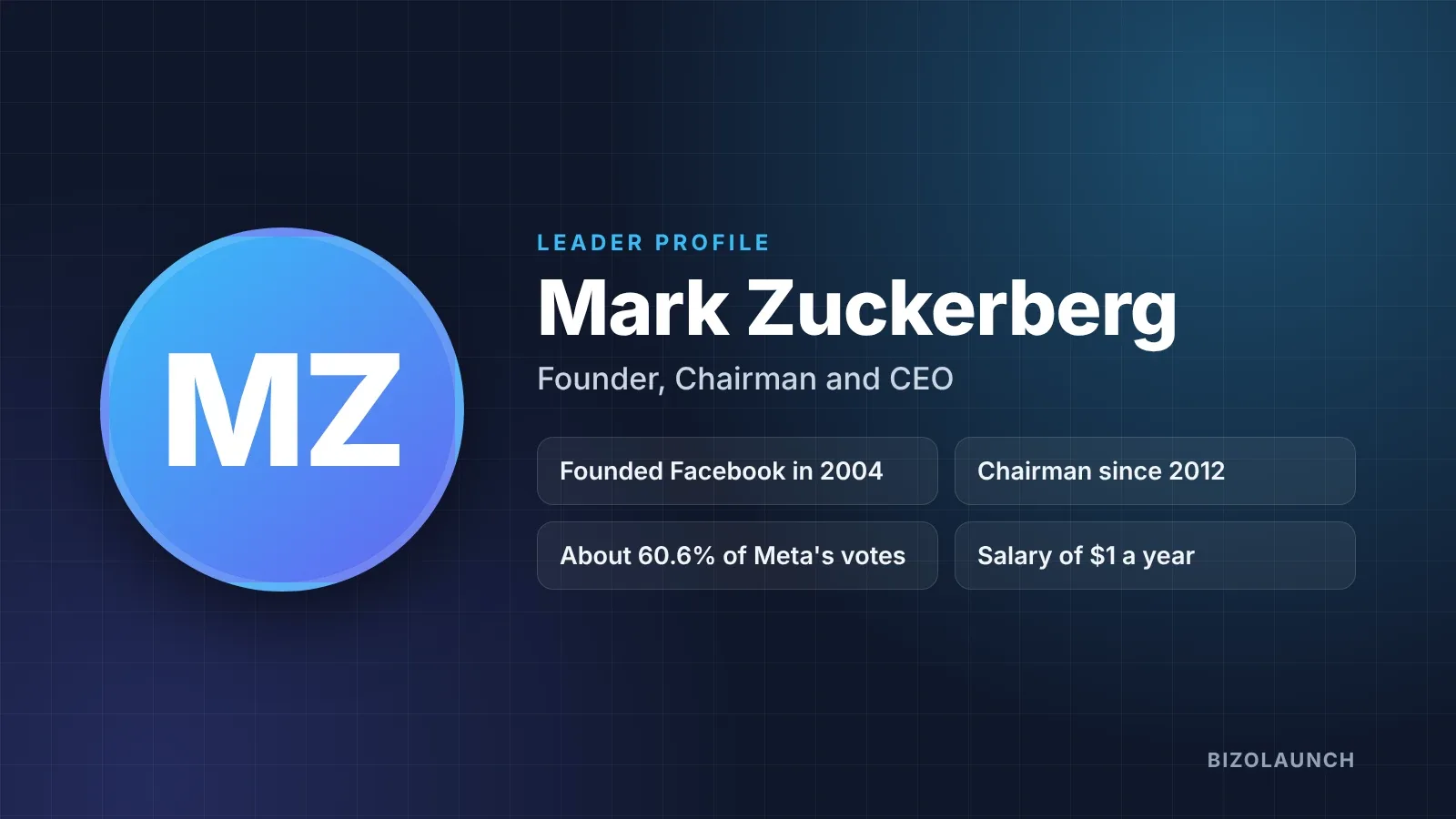
Mark Zuckerberg has run the company now called Meta since he started it as a Harvard student in 2004. He is its founder and chief executive, and he has also been chairman since 2012. On October 1, 2026, he held about 60.6% of Meta’s voting power but only about 13.4% of its economic interest. That gap explains much of how Meta is run, because it lets him make long, expensive bets that most public company CEOs could not get past their boards.
Meta earned $201.0 billion in revenue in 2025. Its apps, which include Facebook, Instagram, WhatsApp and Messenger, were used by 3.64 billion people a day on average in September 2026. Meta also lost $19.2 billion in 2025 on Reality Labs, the unit that makes headsets and smart glasses, and it now plans to spend up to $145 billion on capital projects in 2026.
| Detail | Record |
|---|---|
| — | — |
| Roles | Founder and CEO since 2004; chairman since 2012 |
| Age | 41 in Meta’s 2026 proxy statement |
| Education | Studied computer science at Harvard University |
| Other public company boards | None in the past five years |
| Base salary | $1 a year, at his own request |
| Bonus and equity grants | None |
| Personal security spending (2025) | $25.1 million |
| Voting power (October 1, 2026) | About 60.6% |
A Harvard Dorm Project That Became a Public Company
Zuckerberg studied computer science at Harvard and left before graduating to build Facebook full time. He has sat on the company’s board since 2004, the year it started, took the chairman’s seat in 2012, and is the only person who has ever run the company.
Facebook went public in May 2012, and its share price fell in the weeks after the listing, a drop that later came up in an antitrust case. The Instagram deal, agreed for $1 billion in cash and stock earlier that year, was worth about $750 million by the time it closed because the stock had fallen.
Mark Zuckerberg’s Career and Company Timeline
| Year | Event | Measurable result |
|---|---|---|
| — | — | — |
| 2004 | Starts Facebook at Harvard; joins its board | Founder and CEO from the start |
| 2012 | Buys Instagram; Facebook lists in May; becomes chairman | Instagram deal valued at about $750 million at closing |
| 2014 | Buys WhatsApp | Deal value about $22 billion |
| 2020 | US Federal Trade Commission sues to unwind Instagram and WhatsApp deals | Case runs five years |
| 2021 | Company renamed Meta in October | Revenue $117.9 billion; 71,970 staff |
| 2025 | Court rules for Meta in the FTC case on November 18 | Revenue $201.0 billion; 78,865 staff |
| 2026 | Five executives get long-dated stock options in March; Class C stock plan approved in October | Headcount 66,775 on September 30, down 15% in a year |
The Instagram and WhatsApp Purchases and the FTC Case
Zuckerberg’s two biggest purchases defined the company. Instagram was the first app Facebook bought and kept running as its own product, and WhatsApp followed two years later at a price of about $22 billion.
The FTC sued in 2020. It argued that Meta held a monopoly in social networking and had protected it by buying rising rivals. Zuckerberg testified at the trial in April 2025, and on November 18, 2025, US District Judge James Boasberg ruled for Meta. He found that the FTC had not shown that Meta holds monopoly power today, and he pointed to TikTok as Meta’s main rival. Meta did not have to sell Instagram or WhatsApp.
The deals have aged well for shareholders. Instagram, WhatsApp, Facebook and Messenger together reached 3.58 billion daily users in December 2025. Businesses that use WhatsApp to sell, as in our guide to WhatsApp marketing for real estate agents in Maharashtra, rely on an app that Zuckerberg bought in 2014.
The Meta Rename and the Reality Labs Bill
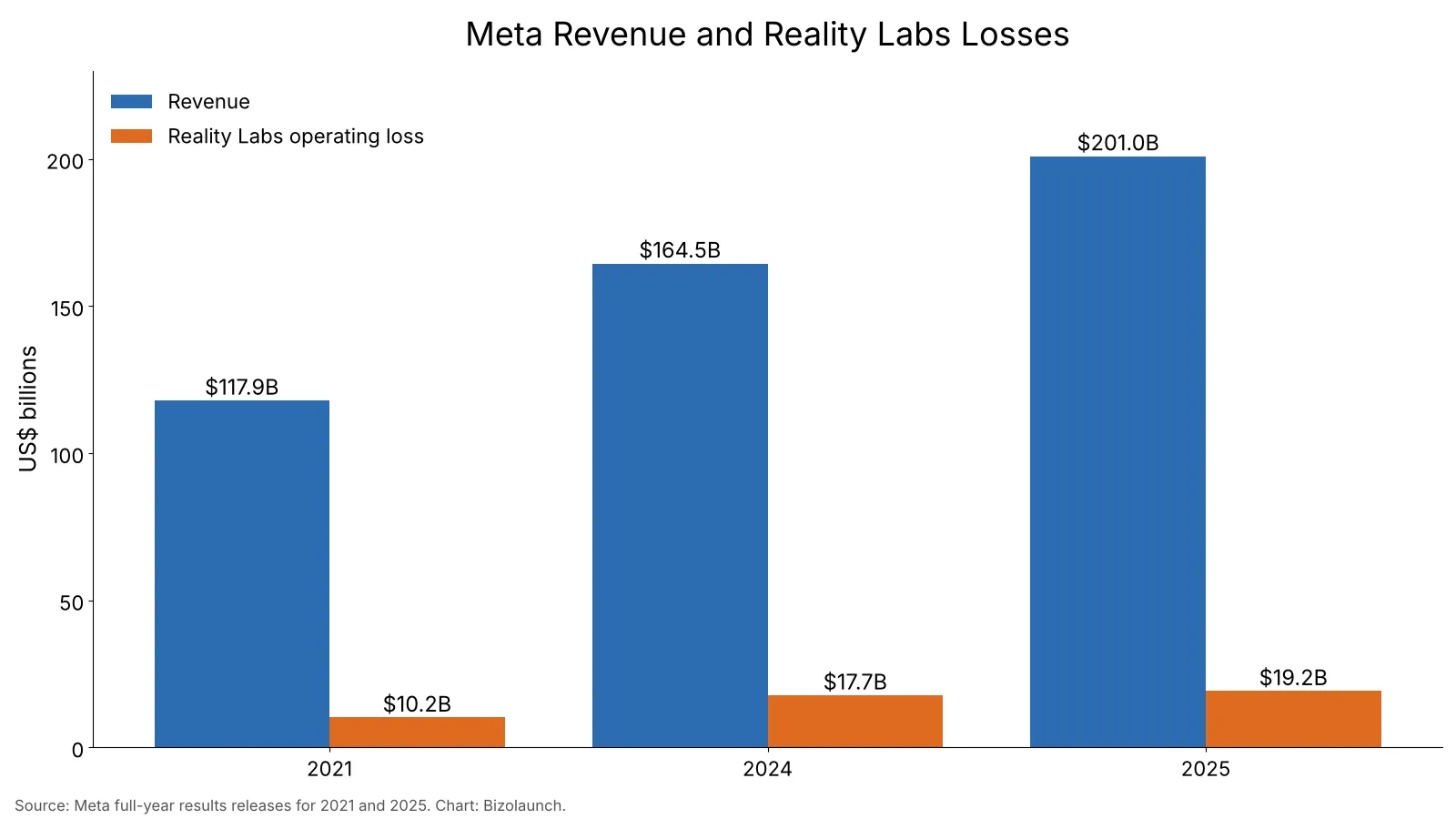
On October 28, 2021, Facebook, Inc. renamed itself Meta to signal a long-term bet on virtual and augmented reality. The cost has been steep and steady, since Reality Labs lost $10.2 billion in 2021, $17.7 billion in 2024 and $19.2 billion in 2025. Those three years alone add up to $47.1 billion of operating losses by our count.
Meta expects Reality Labs to lose $18 billion to $19 billion in 2026, a little less than in 2025. In the third quarter of 2026 the unit made $443 million in revenue and lost $4.13 billion.
Meta’s Numbers Under Zuckerberg, 2021 to 2025
| Measure | 2021 | 2024 | 2025 |
|---|---|---|---|
| — | — | — | — |
| Revenue | $117.93 billion | $164.50 billion | $200.97 billion |
| Net income | $39.37 billion | $62.36 billion | $60.46 billion |
| Reality Labs operating loss | $10.19 billion | $17.73 billion | $19.19 billion |
| Daily active people (December) | 2.82 billion | Not used here | 3.58 billion |
| Headcount at year end | 71,970 | Not used here | 78,865 |
| Revenue per employee (our calculation) | $1.64 million | Not used here | $2.55 million |
Revenue grew about 70% between 2021 and 2025, a compound rate of about 14.3% a year. Headcount grew by less than 10% over the same period. Revenue per employee rose by more than half. The workforce has since shrunk again. Meta ended September 2026 with 66,775 employees, 15% fewer than a year earlier.
Investors who follow Meta’s share count should also read our explainer on stock splits and bonus issues, because the coming Class C dividend works much like a bonus issue.
The AI Spending Push and How Meta Pays for It
Meta’s capital spending reached $72.2 billion in 2025. For 2026 it expects $135 billion to $145 billion, most of it for data centers and AI computing. In the third quarter of 2026 alone it spent $34.91 billion.
Zuckerberg framed that quarter this way: “We hit major milestones this quarter toward delivering personal superintelligence for everyone.” The quarter also showed the strain. Revenue rose 26% to $64.60 billion, but costs rose 68% to $51.61 billion. That figure includes a $9.89 billion legal charge. Operating income fell 37% to $12.99 billion.
To fund the build-out, Meta sold $25 billion of Class A stock at $625 a share on October 26, 2026, plus about $12.5 billion of mandatory convertible preferred stock. A further program of up to $60 billion in share sales could follow in 2027. Our report on Meta’s $37.5 billion stock offering walks through those terms.
A $1 Salary, $25.1 Million in Security and No Stock Grants
Zuckerberg takes a salary of $1 a year, does not take part in the bonus plan and receives no new equity awards, so most of what Meta spends on him goes to security.
| Year | Total reported pay | Main items |
|---|---|---|
| — | — | — |
| 2024 | $27.2 million | $1 salary; $14 million pre-tax security allowance; about $2.6 million for personal use of private aircraft |
| 2025 | Not totaled here | $1 salary; $25.1 million in personal security spending |
In March 2026, Meta granted long-dated stock options to five senior executives: Andrew Bosworth, Chris Cox, Susan Li, Curtis Mahoney and Dina Powell McCormick. Zuckerberg was not included in the grant. Each executive got seven tranches with exercise prices set between $1,116 and $3,727 a share. The top tranche only pays if Meta reaches a market value of about $9.46 trillion. Meta’s stock was $671.34 on April 28, 2026, so even the lowest tranche needs a rise of about 66%.
His personal wealth sits almost entirely in his shares, and his Meta stake was worth roughly $230 billion in April 2026. On October 1, 2026, he owned 1,220,703 Class A shares and 341,215,148 Class B shares, the class that carries extra votes.
The Class C Stock Plan and the Founder Alignment Agreement
In October 2026 Meta changed its share structure in a way that keeps Zuckerberg’s control in place while the company raises more money.
- October 19: the board approved a new non-voting Class C common stock and changes to the 2025 equity plan.
- October 20: holders of a majority of the votes approved it by written consent. Chan Zuckerberg entities held about 56.1% of the voting power by themselves.
- October 21: the restated charter was filed in Delaware.
- January 19, 2027: the changes take effect, and each Class A and Class B share receives one Class C share as a dividend.
Meta says the new stock lets it raise capital, pay employees and buy companies without cutting into voting power. A Founder Alignment Agreement ties Zuckerberg’s own Class C shares to his job. Only 20% of them can be sold freely, while the other 80% can only be sold together with a matching sale of voting shares. Of those restricted shares, 2.5% are released each quarter he stays in a leadership role, over 32 quarters, or eight years. The arrangement also avoids paying him cash or granting him new equity.
The record and payment details matter for anyone holding the stock, and our guide to record dates and ex-dates covers how those dates work.
Philanthropy Through the Chan Zuckerberg Entities
Zuckerberg and his wife, Priscilla Chan, give through the Chan Zuckerberg Initiative and related entities. Those entities are also large Meta shareholders. In October 2026 they owned 315,826,951 Class B shares, enough for about 56.1% of Meta’s voting power. That is why their written consent alone was able to approve the Class C plan.
Disputes and Legal Costs on Zuckerberg’s Watch
Meta’s size has brought steady legal pressure over the years. The FTC case was the largest, and Meta won it in November 2025, but the company still carries large legal costs. Its third-quarter 2026 results included a $9.89 billion legal charge, which cut operating margin to 20% from 40% a year earlier.
The governance model draws its own scrutiny. Because he controls the vote, other shareholders cannot remove him. The Class C plan answers part of that question by tying his new shares to staying in the job, though it does not change who controls the votes.
Where Meta Stands After Its Third Quarter of 2026
| Measure | Q3 2025 | Q3 2026 |
|---|---|---|
| — | — | — |
| Revenue | $51.24 billion | $64.60 billion |
| Costs and expenses | $30.71 billion | $51.61 billion |
| Operating income | $20.54 billion | $12.99 billion |
| Net income | $2.71 billion | $9.86 billion |
| Family daily active people | About 3.53 billion (our estimate from 3% growth) | 3.64 billion |
| Headcount | About 78,560 (our estimate from the 15% drop) | 66,775 |
Net income looks odd at first, because the year-ago quarter carried a large one-time tax charge, so profit rose 264% even though operating income fell. Ad impressions rose 10% and the average price per ad rose 14%, so the core ad business is still growing fast.
The open question for Zuckerberg is whether $135 billion or more a year in AI spending earns its keep. Meta now competes for AI talent and chips with Google, Microsoft, OpenAI and Anthropic. Our profile of Sundar Pichai at Alphabet shows a rival spending on a similar scale with a different ownership setup. Advertisers on Meta’s apps can compare the ad formats in our piece on Instagram’s 90-minute video feature.
Common Questions About Mark Zuckerberg and Meta
How Much of Meta Does Mark Zuckerberg Own?
On October 1, 2026, he held about 13.4% of Meta’s economic interest and about 60.6% of its voting power through 1,220,703 Class A shares and 341,215,148 Class B shares.
What Is Mark Zuckerberg’s Salary?
His salary is $1 a year, and he receives no bonus or new stock awards. Meta spent $25.1 million on his personal security in 2025.
Did Mark Zuckerberg Graduate From Harvard?
He studied computer science at Harvard and left to run Facebook full time.
Did Meta Have to Sell Instagram or WhatsApp?
No. On November 18, 2025, Judge James Boasberg ruled that the FTC had not shown Meta holds a monopoly today, so Meta kept both apps.
SEC Filings and Results Used for the Zuckerberg Profile
- Meta Platforms: 2026 proxy statement (Form DEF 14A)
- Meta Platforms: Information statement on Class C stock (Form DEF 14C)
- Meta: Third quarter 2026 results
- Meta: Fourth quarter and full year 2025 results (January 28, 2026)
- Meta: Fourth quarter and full year 2021 results
- Meta: Introducing Meta, a social technology company (October 28, 2021)
- Meta: Pricing of Class A and mandatory convertible preferred offerings (October 26, 2026)
- Dow Jones via Tiger Brokers: Zuckerberg’s 2024 compensation totaled $27.2 million
- Fortune: Meta executive stock options and Zuckerberg’s security costs (April 28, 2026)
- ABC7 News: Meta prevails in FTC antitrust case (November 18, 2025)