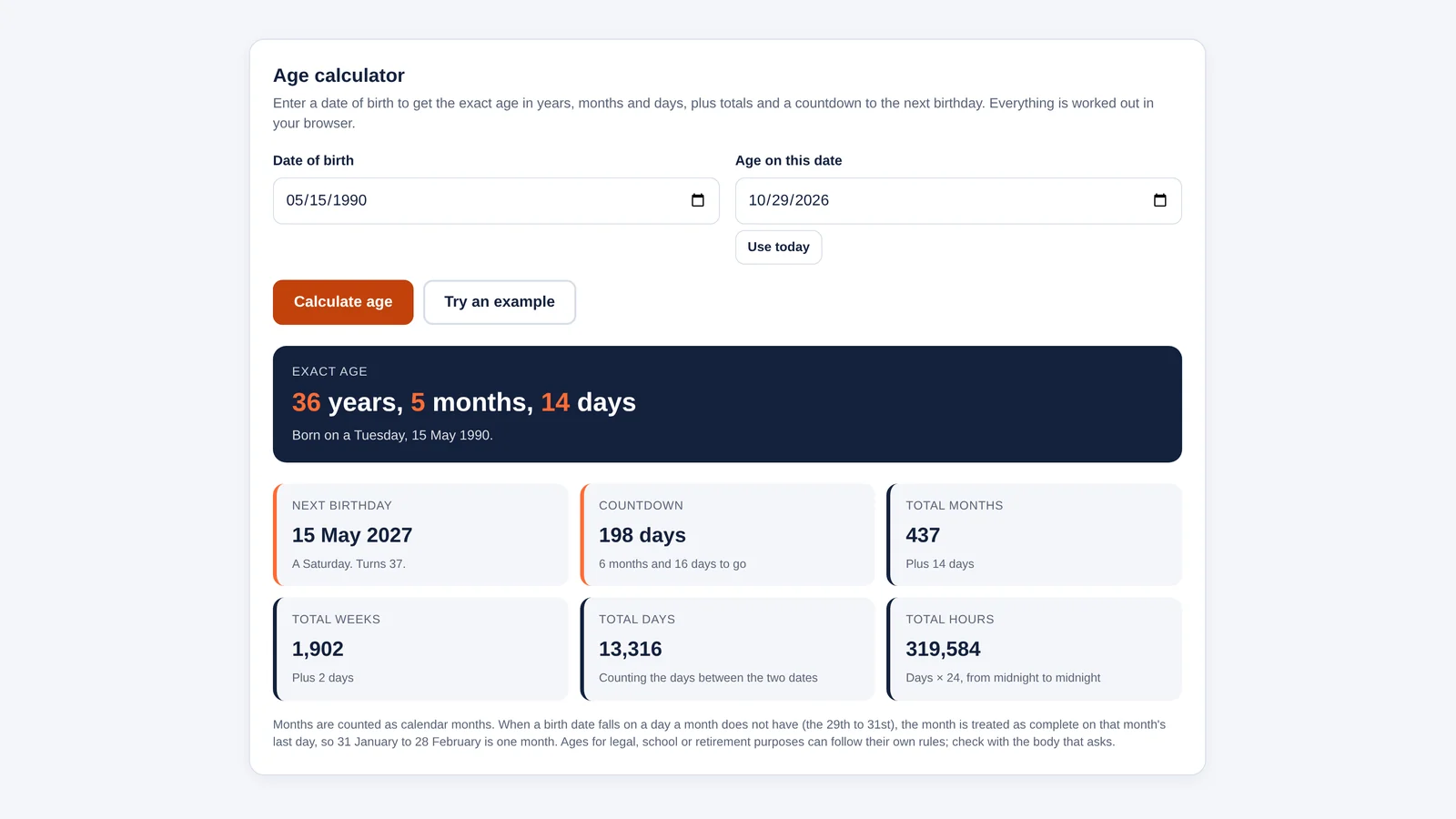
To work out someone’s exact age, count the full years since their date of birth, then the full months since their last birthday, then the days left over. It sounds simple until the birthday is 31 January or 29 February, which is where most quick calculations and many spreadsheets go wrong. The free age calculator below handles those edge cases and shows the answer in years, months and days, along with total months, weeks, days and hours and a countdown to the next birthday.
Enter a date of birth and, if you need an age on a date other than today, change the second date. That is useful for form deadlines, school admission cut-offs and scheme eligibility. Everything is calculated in your browser.
How Years, Months and Days Are Counted, Leap Days Included
- Age counts complete calendar years, then complete months, then remaining days, up to the “age on” date you choose.
- If the birth day does not exist in a month (the 29th, 30th or 31st), that month is treated as complete on its last day.
- People born on 29 February can choose whether their birthday falls on 28 February or 1 March in common years, because rules differ by country.
- The calculator was checked against an independent date library on more than 4,000 random and edge-case date pairs.
Age calculator
Enter a date of birth to get the exact age in years, months and days, plus totals and a countdown to the next birthday. Everything is worked out in your browser.
Exact age
–
Next birthday
–
Countdown
–
Total months
–
Total weeks
–
Total days
–
Counting the days between the two dates
Total hours
–
Days × 24, from midnight to midnight
Months are counted as calendar months. When a birth date falls on a day a month does not have (the 29th to 31st), the month is treated as complete on that month’s last day, so 31 January to 28 February is one month. Ages for legal, school or retirement purposes can follow their own rules; check with the body that asks.
How to Use the Age Calculator
- Date of birth: pick it from the calendar or type it. Any date from year 1 onwards works, so you can also date a company’s founding or a building’s age.
- Age on this date: defaults to today. Change it to see an age on a past or future date, then press Use today to switch back.
- Leap-day option: appears only for 29 February birthdays. Choose 28 February or 1 March as the birthday in years without a 29th.
- Results: the exact age, the weekday of birth, the next birthday with its weekday and the age that will be reached, a countdown in days and in months and days, and totals in months, weeks, days and hours.
Results update as soon as both dates are valid. If the “age on” date falls before the date of birth, the tool says so rather than showing a negative age.
How Age Is Calculated
The calculator counts forward from the date of birth in whole calendar months. It finds the latest monthly anniversary of the birth date that is on or before the “age on” date. The number of months to that anniversary gives the years (divide by 12) and the months (the remainder). The days are counted from that anniversary to the “age on” date.
- Total days = the number of days between the two dates. A person born yesterday is one day old.
- Total weeks = total days ÷ 7, with the leftover days shown separately.
- Total months = complete calendar months, plus leftover days.
- Total hours = total days × 24, as if both dates started at midnight. Time of birth and daylight saving changes are not included.
Worked Example: Born 15 May 1990
On 29 October 2026, someone born on 15 May 1990 is 36 years, 5 months and 14 days old. Their 36th birthday was 15 May 2026; adding five months reaches 15 October 2026; from there to 29 October is 14 days.
| Measure | Result |
|---|---|
| Exact age | 36 years, 5 months, 14 days |
| Born on | A Tuesday |
| Total months | 437 months and 14 days |
| Total weeks | 1,902 weeks and 2 days |
| Total days | 13,316 |
| Total hours | 319,584 |
| Next birthday | Saturday, 15 May 2027 (turns 37) |
| Countdown | 198 days, or 6 months and 16 days |
We checked these figures, and the weekdays, with Python’s standard date library.
Month-End Birthdays and Short Months
A baby born on 31 January has no monthly anniversary in February, April, June, September or November. A calculator has to pick a rule, and this one treats the month as complete on the last day of the shorter month. That matches how most date libraries add months and how many people think about it: someone born on 31 January turns one month old at the end of February.
| Date of birth | Age on | Result |
|---|---|---|
| 31 January 2023 | 28 February 2023 | 1 month, 0 days |
| 31 January 2023 | 1 March 2023 | 1 month, 1 day |
| 31 January 2024 | 28 February 2024 | 28 days |
| 31 January 2024 | 29 February 2024 | 1 month, 0 days |
| 31 March 2023 | 30 April 2023 | 1 month, 0 days |
Some tools borrow days from the previous month instead and can report 31 March to 30 April as 30 days. Neither approach is wrong, but they disagree by a day or so around month ends. If an official body asks for an age in months and days, ask which method it uses.
Leap-Day Birthdays: 28 February or 1 March
Someone born on 29 February has a real birthday only once every four years, and leap years skip three century years in four (2100 is not a leap year, 2000 was). Practice differs on which day counts in the other years. Scotland settles it in law: section 6 of the Age of Legal Capacity (Scotland) Act 1991 treats 1 March as the anniversary in a non-leap year. Elsewhere, families often celebrate on 28 February. The calculator defaults to 28 February and lets you switch.
| Born 29 February 2000, age on | 28 February rule | 1 March rule |
|---|---|---|
| 28 February 2001 | 1 year, 0 months, 0 days | 11 months, 30 days |
| 1 March 2001 | 1 year, 0 months, 1 day | 1 year, 0 months, 0 days |
| 29 February 2004 | 4 years, 0 months, 0 days | 4 years, 0 months, 0 days |
The choice can matter for a few hours of legal adulthood, a driving test booking or an insurance quote, so use the rule the organisation you are dealing with applies.
When an Exact Age Matters
- Government schemes: many have age bands. Uttar Pradesh’s CM YUVA business loan scheme, for example, is open to residents aged 21 to 40, as our CM YUVA scheme guide explains. Check the age on the scheme’s cut-off date, not today’s.
- Loans and insurance: lenders and insurers look at your age at application and at the end of the term. Pair the age result with our guide on how to calculate EMI when planning a long loan.
- Hiring and HR: minimum working ages and retirement dates are set by date of birth, so HR teams need exact ages, not rounded ones.
- School admissions: boards publish a minimum age on a specific date. Put that date in the “age on” box.
- International birthdays: a birthday starts at midnight local time, so a relative abroad may be a day ahead. Our time zone converter shows the gap.
Browse more free calculators on the Bizolaunch tools page.
Leap Day Birthdays, Past Dates and Privacy of Your Birth Date
How Do I Calculate My Exact Age?
Subtract your birth year from the current year, and take one off if this year’s birthday has not happened yet. Count the months since your last birthday, then the days since the last monthly anniversary. The calculator above does all three steps and handles short months and leap years.
How Is Age Calculated for Someone Born on 29 February?
In leap years the birthday is 29 February. In other years it is treated as either 28 February or 1 March, depending on the country or organisation. Scotland’s law uses 1 March. Pick the rule you need in the calculator.
Can I Calculate Age on a Past or Future Date?
Yes. Change the “age on” date to any date after the date of birth. That is how you check eligibility on an exam or scheme cut-off date, or find someone’s age at a past event.
Why Does the Calculator Show a Different Age From Another Website?
Years always agree. Months and days can differ by a day near month ends, because some tools borrow days from the previous month while this one treats a short month as complete on its last day. Totals in days and weeks should match exactly.
Is My Date of Birth Stored?
No. The calculation runs in your browser and nothing is sent to a server or saved.