Before a homeowner calls a painter, 88% of them read online reviews and 87% search Google, in a survey of 525 homeowners who had hired a professional painter in the past three years. That one finding explains most of what follows. Painting is a $28.4 billion industry in the US in 2026, and the jobs mostly go to the contractors who look trustworthy online before the first phone call.
Each section ends with what the figures mean for a painting company trying to fill its schedule.
Five Figures Painting Contractors Should Know
- US house painting and decorating contractors will bring in about $28.4 billion in 2026, a 1.1% dip on the year after five years of 1.6% average growth.
- About 326,900 people worked as construction and maintenance painters in 2025, and 31% of them were self-employed.
- Exterior painting was among the four most common outdoor projects in 2025, with median spending of $2,500, up 25%.
- In a 2026 survey, 68% of consumers said they only use businesses rated four stars or higher, up from 55% a year earlier.
- Google Ads for home and home improvement businesses averaged $8.33 per click and $90.92 per lead in 2026, above the all-industry averages of $5.42 and $66.69.
How Big the US Painting Contractor Market Is in 2026
The US house painting and decorating contractors market is worth $28.4 billion in 2026. Revenue slipped 1.1% this year, but the five years from 2021 to 2026 still show a 1.6% compound annual growth rate. That is a mature, slow-growing market. In a market like that, one company mostly grows by winning work from another, so marketing carries more weight than it would in a booming trade.
The labor side is just as useful for planning. There are about 326,900 jobs for construction and maintenance painters in 2025, with a median wage of $49,400 a year, or $23.75 an hour, in May 2025. Employment is projected to grow 3% from 2025 to 2035, with about 24,900 openings a year, mostly to replace workers who retire or switch trades.
| Measure | Figure |
|---|---|
| US market size, 2026 | $28.4 billion |
| Revenue change, 2026 | -1.1% |
| Average annual growth, 2021 to 2026 | 1.6% |
| Painter jobs, 2025 | 326,900 |
| Median painter pay, May 2025 | $49,400 a year ($23.75 an hour) |
| Projected job growth, 2025 to 2035 | 3% |
| Openings per year | 24,900 |
| Painters who are self-employed | 31% |
Who Employs Painters
The employment breakdown shows how fragmented the trade is. Painting and wall covering contractors employ 42% of painters, while 31% work for themselves and 5% work for residential building contractors. Nearly a third of the workforce, in other words, runs a one-person business, and those owners are both the marketer and the crew. That is why cheap, compounding channels such as reviews, referrals and a Google Business Profile matter so much in this trade.
What Homeowners Are Spending on Painting and Home Projects
Demand for home work is holding up. The average US household spent $12,472 on home projects in 2025. That was up 3.5% from $12,050 in 2024, and the typical household finished 10 projects, one more than the year before. Spending on maintenance rose to $2,041 from $1,750, while improvement spending was roughly flat at $9,288.
Two other findings matter for painters. Some 74% of millennial homeowners said mortgage rates push them to improve their current home rather than move, compared with 47% across all generations. And 70% of millennials said they have trouble finding skilled labor. A painting company that answers the phone and shows up on time is solving a real shortage.
Exterior Painting Among 2025 Home Projects
In 2025, 19% of renovating US homeowners took on exterior painting, the same share as gutter upgrades and just behind roofing at 22% and windows and skylights at 20%. Median spending on exterior painting reached $2,500, up 25% from the year before. Indoors, 67% of renovating homeowners worked on at least one room, a pool of interior repaint jobs that often goes along with other remodeling.
| Most common exterior projects, 2025 | Share of renovating homeowners |
|---|---|
| Roofing | 22% |
| Windows and skylights | 20% |
| Exterior painting | 19% |
| Gutter upgrades | 19% |
For context on ticket size, median roofing spending was $13,000 and decks $5,000. A $2,500 paint job is small next to those, which makes it one of the more affordable exterior upgrades on the list.
Painting Before a Home Sale
Real estate agents are a referral source many painters ignore. In 2025, 50% of Realtors said they recommend sellers paint the entire home before listing, and 41% recommend painting a single interior room. Agents see listings every week and need reliable painters on short notice, so one good agent relationship can feed a crew for months.
How Homeowners Find and Choose a Painter
The most painting-specific data on the buying journey is a survey of 525 homeowners who had hired a professional painter within the previous three years, asking what they did before choosing one.
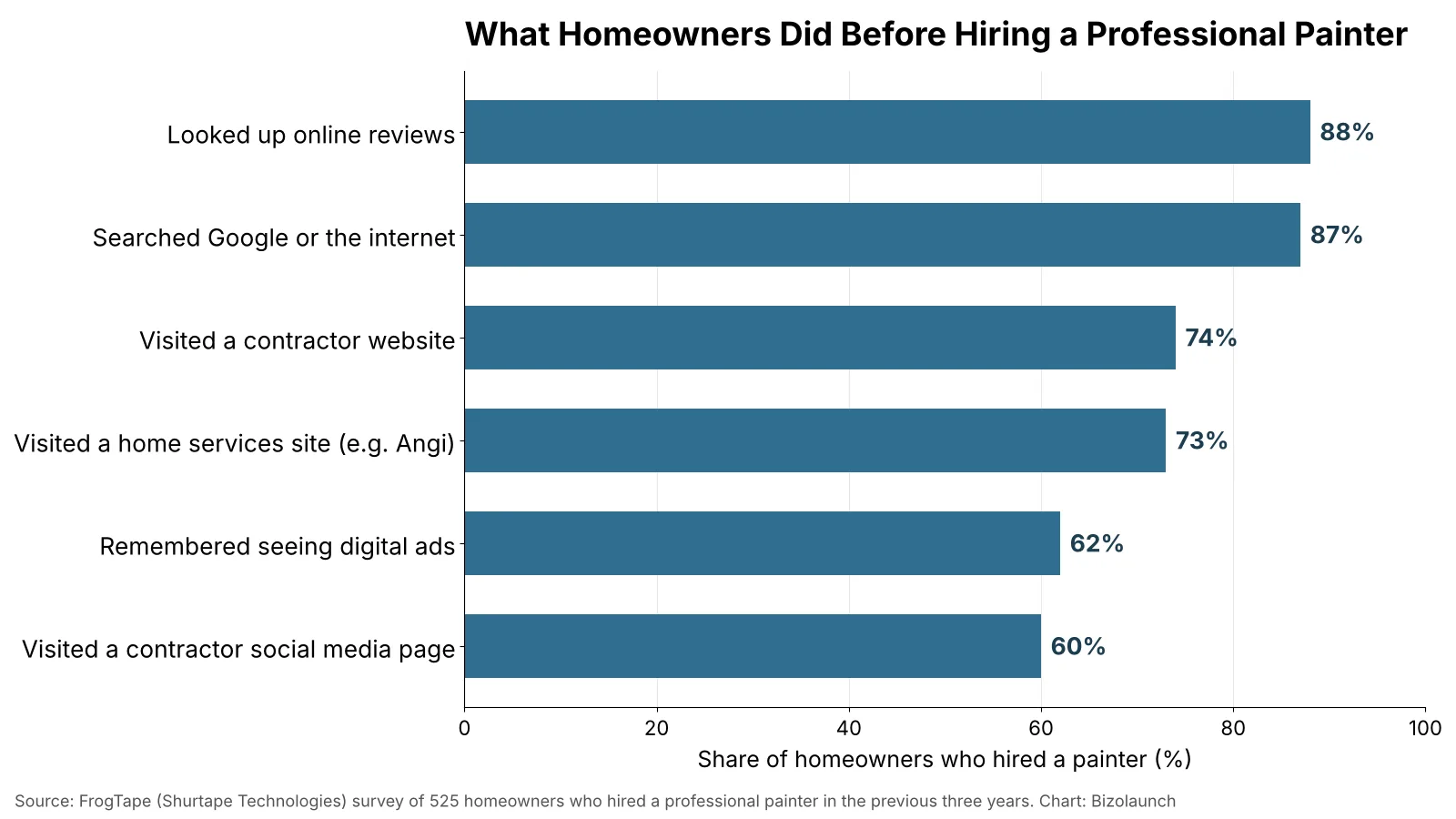
Almost everyone checked reviews and searched online, and most visited at least one website. Online reviews also beat word of mouth. When the survey asked which sources influenced the decision, 55% named online reviews and 38% named a personal recommendation. Referrals still matter, but a friend’s tip now gets checked against the internet before anyone picks up the phone.
What Homeowners Type Into Google
The survey also looked at the words homeowners searched with. Location was the most common qualifier: more than 150 respondents added phrases like “near me,” “local,” “in my area,” a city or a ZIP code. Another 89 named the type of job, such as interior or exterior, and 88 added “house,” “home” or “residential.” Only 10 searched for cheap or affordable painters, and another 10 asked for licensed or insured ones.
For a painting company, those searches point straight to local SEO. Service pages for interior painting, exterior painting and each town you cover should match the way people search, and your Google Business Profile needs the right service area and categories.
What Wins on a Painter’s Website
The contractor’s website ranked as the second most influential online source in the survey. Some 45% of homeowners visited the site of the painter they ended up hiring. The features that swayed them were before-and-after photos, customer testimonials, finished project photos and pricing information. The least influential were a polished modern design, a general company profile, a quote request form and photos of the owner and staff.
That ranking should change how a painter spends on a website. A plain site packed with real before-and-after pairs and a clear starting price will likely do more than an expensive redesign. If you collect photos on every job, you are building your best marketing asset at the same time.
Online Review Statistics That Shape Painting Leads
Wider consumer data from a 2026 panel of 1,002 US adults is not specific to painters, but painting customers behave the same way. The standards consumers set for reviews keep rising.
| Review behavior, 2026 | Share of consumers |
|---|---|
| Read reviews for local businesses | 97% |
| Always read reviews when browsing (29% in 2025) | 41% |
| Only use businesses rated 4 stars or higher (55% in 2025) | 68% |
| Only use businesses rated 4.5 stars or higher (17% in 2025) | 31% |
| Won’t use a business with fewer than 20 reviews | 47% |
| Look for reviews from the last three months | 74% |
| Expect the owner to respond to reviews | 89% |
| Put off by generic or templated replies | 50% |
| Were asked to leave a review in the past 12 months | 78% |
Three of those numbers deserve a painter’s full attention. The four-star cutoff now applies to more than two-thirds of consumers, so a 3.8 rating quietly removes you from most shortlists. Nearly half want at least 20 reviews, which is a reachable target for a crew that finishes a few jobs a week and asks every client. And three in four people want recent reviews, so a burst of reviews from 2023 counts for little today.
Where People Read Reviews Now
Google is still the main review platform, though its lead is shrinking. Some 71% of consumers used Google for reviews in 2026, down from 83% in 2025. AI tools such as ChatGPT jumped from 6% to 45%, becoming the third most-used source for local recommendations, and Apple Maps rose from 14% to 27%. In the painting survey, Google was used by 74% of homeowners who looked up reviews, with Yelp and Angi tied at 36%.
The practical answer is to keep Google first and make sure your business details match everywhere else. AI assistants draw on reviews and listings across the web, and Apple Maps reads its own business data. The same name, phone number, service area and photos on every listing make you easier for both people and software to trust.
Replies Matter as Much as Stars
Some 80% of consumers are likely to use a business that responds to all of its reviews, and 42% are unlikely to use one that never replies. Half are put off by templated replies. A short, specific answer that names the room or the color and thanks the client by first name takes two minutes and is read by every future customer.
Painting Contractor Advertising Costs and Google Ads Benchmarks
Paid search is the fastest way to buy leads, and it is getting more expensive for home trades than for most industries. Across thousands of Google Ads and Microsoft Ads campaigns in 2026, the home and home improvement category ran well above the cross-industry average on cost.
| Metric, 2026 | Home and home improvement | All industries |
|---|---|---|
| Click-through rate | 6.47% | 6.64% |
| Cost per click | $8.33 | $5.42 |
| Conversion rate | 8.05% | 8.18% |
| Cost per lead | $90.92 | $66.69 |
Home improvement clicks cost about 54% more than the average click, and each lead costs about 36% more. Conversion rates are almost the same, so the gap comes from competition for the clicks, not weaker landing pages. Cost per lead also fell across all industries for the first time in five years, even though clicks got slightly more expensive.
A Worked Example for a Painting Company
Take a painter who spends $1,500 a month on Google Ads. At the $90.92 average cost per lead, that budget buys about 16 leads. Suppose the company closes one lead in four (an assumed rate for illustration). That is four jobs a month. If each job is an exterior repaint at the median of $2,500, the ads bring in about $10,000 in revenue, and each won job costs $375 in ad spend.
| Step | Calculation | Result |
|---|---|---|
| Monthly ad budget | Set by owner | $1,500 |
| Leads | $1,500 / $90.92 | About 16 |
| Jobs won (assumed 25% close rate) | 16 x 0.25 | 4 |
| Revenue at median exterior job | 4 x $2,500 | $10,000 |
| Ad cost per job won | $1,500 / 4 | $375 |
The close rate drives this whole sum. At one in eight instead of one in four, the cost per job doubles to $750. That is why lead handling matters as much as the ad budget. A painter who returns calls within the hour and quotes within a day gets more out of every lead. Our guides to how long it takes to earn back acquisition cost and to blended versus paid customer acquisition cost show how to track this over a full season, and the break-even calculator helps you check whether a given ad budget pays for itself once paint and labor are counted.
Angi, Social Media and Digital Ads: Where Else Painting Leads Come From
Lead marketplaces play a bigger role in painting than many owners admit. In the painting survey, 73% of homeowners visited a home services website, 59% requested a quote through one, and 57% hired a painter through one. Angi was the largest. It was visited by 40% of all respondents, 34% requested a quote there, and 25% hired their painter through it.
That gives a painter two choices. You can buy those leads, or you can be the company those shoppers find when they cross-check you on Google. Most growing companies do some of both and watch the cost per job from each source.
Facebook Still Leads for Painters on Social
Some 60% of homeowners in the painting survey visited a contractor’s social media page. Of those, 75% used Facebook (45% of all respondents) and 47% used Instagram (28% of all respondents). The content that moved them was positive comments, testimonials and project photos. That is the same material that works on a website, so one good job photographed well can serve both.
Ads People Remember
Digital ads registered with 62% of homeowners, and 77% of those who recalled an ad clicked it or looked for more information. Social media ads were the most remembered format at 39%, ahead of banner ads at 33%. Offline touches still have a job to do here too. A yard sign with a short web address or a code from a free QR code generator lets a neighbor who sees your crew at work land on your project photos within seconds.
What the Numbers Mean for a Painting Business
Taken together, the data points to a simple order of priorities. None of it requires a big agency retainer, but all of it needs steady effort.
- Reviews come first: With 68% of consumers filtering out anything under four stars and 47% wanting at least 20 reviews, a written routine for asking every client matters more than any ad. Ask on the day of the final walkthrough, when the client is happiest, and reply to every review with something specific to that job.
- Photograph every job: Before-and-after photos topped the list of website features that swayed homeowners. Take the same angles before and after, and post them to your site, Google Business Profile and Facebook.
- Build local pages that match real searches: Homeowners search with a town name or “near me” plus interior or exterior. One page per service and per main town gives Google a clear match.
- Treat paid leads as a math problem: At around $91 per lead for home improvement, ads only pay when the close rate is healthy. A tested phone script for first calls and same-day quotes protect the budget.
- Court agents and repeat clients: Half of Realtors recommend repainting the whole home before a sale, and that work tends to be fast, repeatable and paid on closing.
- Keep the paperwork professional: A clean estimate and a branded invoice from a tool like our free invoice generator reinforce the trust your reviews built.
Painting has a lot in common with other local service trades that run on reviews and repeat customers. Our guide to starting a pressure washing business covers the licensing and pricing side of a similar exterior trade, and many painters add washing as a prep service.
Questions Painting Business Owners Ask About These Numbers
How Big Is the House Painting Industry in the US?
The US house painting and decorating contractors market is estimated at $28.4 billion in 2026. Revenue fell 1.1% this year after growing at a 1.6% average annual rate from 2021 to 2026. There are about 326,900 construction and maintenance painter jobs in 2025.
How Do Most Homeowners Find a Painting Contractor?
Mostly online. In a survey of homeowners who hired a professional painter, 88% read online reviews, 87% searched Google or the internet and 74% visited a contractor’s website. Online reviews influenced 55% of them, compared with 38% for a personal recommendation.
How Much Does a Lead Cost for a Painting Company on Google Ads?
In 2026 the home and home improvement category, the closest match for painters, averaged $8.33 per click and $90.92 per lead. The averages across all industries were $5.42 per click and $66.69 per lead.
How Many Reviews Does a Painting Business Need?
In a 2026 survey, 47% of consumers won’t use a business with fewer than 20 reviews, and 68% only use businesses rated four stars or higher. Recency also counts, since 74% look for reviews from the last three months.
Is Painting Still a Growing Trade?
Slowly. Painter jobs are projected to grow 3% from 2025 to 2035, with about 24,900 openings a year. Homeowner spending is firm, with the average household spending $12,472 on home projects in 2025.
Reports and Surveys Behind These Statistics
- IBISWorld: House Painting and Decorating Contractors in the US, Market Size (2026)
- US Bureau of Labor Statistics: Occupational Outlook Handbook, Painters, Construction and Maintenance
- Angi: State of Home Spending Report press release (January 2026)
- Houzz: 11 Things to Know About Home Renovations Today (2026 Houzz & Home Study)
- National Association of Realtors: 2025 Remodeling Impact Report press release
- FrogTape (Shurtape Technologies): Customer Research on Hiring Professional Painters
- BrightLocal: Local Consumer Review Survey 2026
- LocaliQ: Search Advertising Benchmarks 2026