On January 1, 2026, the main federal tax break for home batteries ended. The Residential Clean Energy Credit is not allowed for any expenditure made after December 31, 2025, and a battery counts as “made” only when the installation is finished. Anyone starting a home battery installation business now is selling into a market where the customer pays full price, so the pitch has to rest on backup power and electricity bills.
The business itself still works, and the steps are clear. To start a home battery installation business in the US, you need four things. The first is a state electrical contractor license, or a licensed electrician who qualifies the company. The others are installers trained on energy storage and on the brands you sell, insurance that meets your state’s minimums, and a firm grasp of the fire and electrical codes for home batteries. This guide walks through each step, then builds a startup budget and a per-job profit model so you can test the numbers before you buy a van.
Home Battery Business Basics for 2026
- Tax credit: The 25D credit, which covered home batteries of 3 kWh or more, ended for installs completed after December 31, 2025.
- License: Battery wiring is electrical work. Texas, for example, requires an electrical contractor license with a Master Electrician, a $110 fee and liability insurance of at least $300,000 per occurrence.
- Certification: NABCEP’s Energy Storage Installation Professional credential asks for 58 hours of training, OSHA 30 and six project credits.
- Code limits: Under IRC 2021 R328 and NFPA 855, each home battery unit is capped at 20 kWh and must be listed to UL 9540, with room-by-room totals of 40 kWh or 80 kWh.
- Our model: With the assumptions shown below, one Powerwall-size install leaves about $3,250 to cover overhead, and roughly two and a half jobs a month cover $8,000 of fixed costs.

How the End of the Battery Tax Credit Changes the Pitch
For three years, installers could tell homeowners that the government would pay 30% of a battery. That message is gone for most buyers. Under the One Big Beautiful Bill Act, the 25D credit “will not be allowed for any expenditures made after December 31, 2025.” An expenditure is treated as made when the original installation is completed, so a deposit paid in 2025 did not save a job finished in 2026.
Battery systems qualified for that credit when they had at least 3 kWh of capacity. That is the benefit your new business cannot offer.

What still sells a battery? Three things, and they should shape your marketing from day one:
- Backup power during outages: A battery keeps the fridge, lights, Wi-Fi and medical devices running. In storm and wildfire regions, this is the main reason to buy.
- Bill savings where rates vary by time of day: Where a utility charges more in the evening, a battery can store cheap or solar power and use it later. Our map of the average electricity bill by state shows where bills are high enough to make that case.
- Getting more from existing solar: Many homes with solar panels export power at low rates. A battery lets them use more of their own production.
Customers will ask how long a battery runs their house. Keep our battery backup time calculator guide handy, because the math is the same: usable kWh divided by the load in kW gives hours of backup.
Pick the Jobs Your Company Will Do
Home battery work falls into a few job types, and each needs slightly different skills and suppliers. Choose one or two to start.
| Job type | What it involves | Who it suits |
|---|---|---|
| Battery added to existing solar | Tie a battery into a working solar system, often with a new gateway or inverter | Solar installers adding storage, or electricians partnering with them |
| Standalone backup battery | Battery and transfer equipment with no solar, often replacing a generator | Electrical contractors |
| New solar plus storage | Full system design, roof work and battery | Firms with roofing and solar crews |
| Service and upgrades | Firmware, faults, expansions, moves | Any licensed firm with brand training |
New companies often start with standalone backup or add-on batteries. These jobs stay inside the garage or on an outside wall, avoid roof work and its insurance cost, and fit a two-person electrical crew.
Get the Electrical License Your State Requires
Batteries connect to the home’s main panel, so the work is electrical work under state law. Each state sets its own rules, and you must check with your state licensing board before you bid a job. Two examples show the range.
Texas: Electrical Contractor License Through TDLR
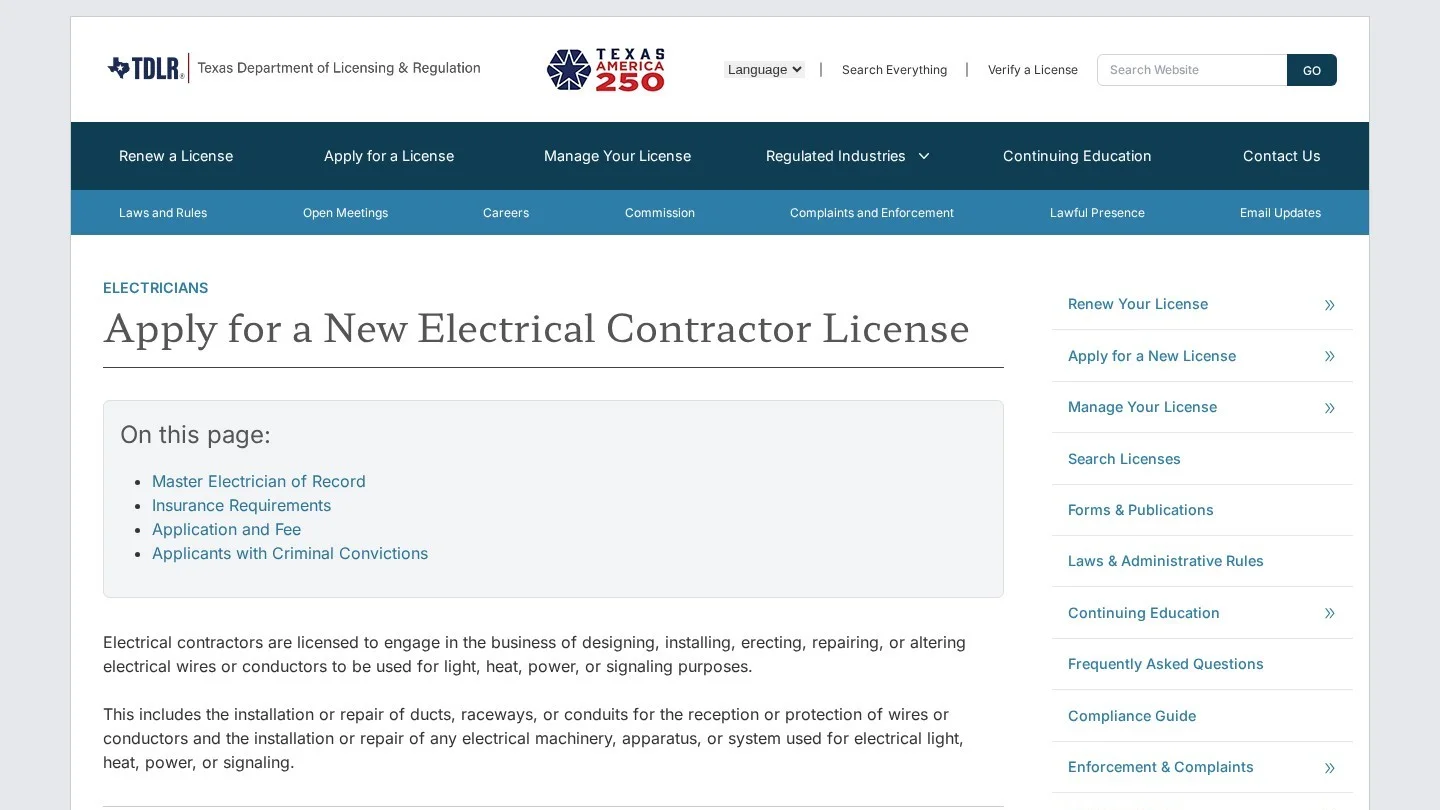
The Texas Department of Licensing and Regulation requires an electrical contractor license for businesses that do electrical work. The company must employ a licensed Master Electrician, who can be the owner. The application fee is $110, and the license is valid for one year and must be renewed annually.
Texas also sets insurance minimums. The contractor needs general liability coverage of at least $300,000 per occurrence, $600,000 in aggregate, and $300,000 in aggregate for products and completed operations. If the Master Electrician leaves, the company has thirty business days to name a new one.
California: Electricians and the Battery Licensing Debate
California has argued for years over who may install batteries. Its licensing board approved a rule in April 2024 that kept battery work open to C-10 electrical contractors and limited what C-46 solar contractors could do. The rule drew a lawsuit from solar groups. The safe path for a new California company is to hold a C-10 license, and to confirm the current rule with the Contractors State License Board before quoting.
If you are an electrician who wants to go out on your own, our guide to starting a locksmith business walks through a similar trade path from employee to licensed owner, including bonding and insurance.
Train Installers on Energy Storage
A license proves you can do electrical work. Battery work adds new risks, such as stored energy that cannot be switched off at the panel, and new paperwork with utilities and fire officials. Training covers the gap.
The industry credential is NABCEP’s Energy Storage Installation Professional (ESIP). The requirements are:
- Training: 58 hours of advanced energy storage training. Active NABCEP PV Installation Professionals get 18 hours of credit toward that total.
- Safety: OSHA 30 Outreach Training for the Construction Industry, or a state equivalent.
- Experience: A decision-making role on storage projects, with six project credits from the last two calendar years. A project of 1 to 80 kWh earns one credit.
- Renewal: 30 hours of continuing education for recertification.

Six credits means six home-sized projects at one credit each. A brand-new company may need to work under or alongside an experienced firm for its first jobs before it can earn ESIP. Battery makers such as Tesla and Enphase also run their own installer training and certification programs, and distributors often ask for proof of that training before they sell you equipment.
Learn the Code Rules for Batteries in Homes
Fire and building codes set hard limits on how big a home battery can be and where it can go. The main rules for residential energy storage under IRC 2021 R328 and NFPA 855 are:
| Rule | Limit |
|---|---|
| Product listing | Each unit listed and labeled to UL 9540 |
| Size of one unit | Up to 20 kWh |
| Spacing between units | At least 3 feet, unless a UL 9540A test report allows less |
| Total in utility closets, basements, storage rooms | 40 kWh |
| Total in garages, accessory buildings, on exterior walls or outdoors | 80 kWh |
| Larger systems | Allowed only with UL 9540A test data that supports them |
UL 9540 is the safety standard for the complete energy storage system. UL 9540A is a fire test method that shows how a battery behaves if one cell fails. When a homeowner wants three or four batteries, these limits decide where they can go, so do this check during the sales visit, not on install day.
Your state and city may adopt different code editions or add their own rules. Always check with the local building department, which issues the permit and sends the inspector.
Price a Battery Job and Find the Profit
The best public price point is Tesla’s own. Tesla’s website estimates about $15,600 to install one Powerwall 3 before incentives. The breakdown puts the battery at $8,200, the gateway at $900, accessories at $200 and installation at $6,300. Powerwall 3 stores 13.5 kWh and puts out 11.5 kW continuously.
That $6,300 installation line is the part an independent installer competes on. We built a simple per-job model around it. The wage is the median for US electricians, $30.38 an hour in May 2025. Every other line is a Bizolaunch planning assumption, labelled as such, that you should replace with your own quotes.
| Per-job item (one battery, add-on to existing solar) | Amount | Basis |
|---|---|---|
| Installation revenue | $6,300 | Installation line in Tesla’s estimate |
| Crew wages: 2 electricians x 12 hours x $30.38 | $729 | Median electrician wage; hours are an assumption |
| Payroll taxes and benefits at 30% on top | $219 | Assumption |
| Permit and inspection fees | $500 | Assumption; varies by city |
| Wire, conduit, breakers and mounting parts | $600 | Assumption |
| Sales and marketing cost per closed job | $1,000 | Assumption |
| Left to cover overhead and profit | $3,252 | Our calculation |
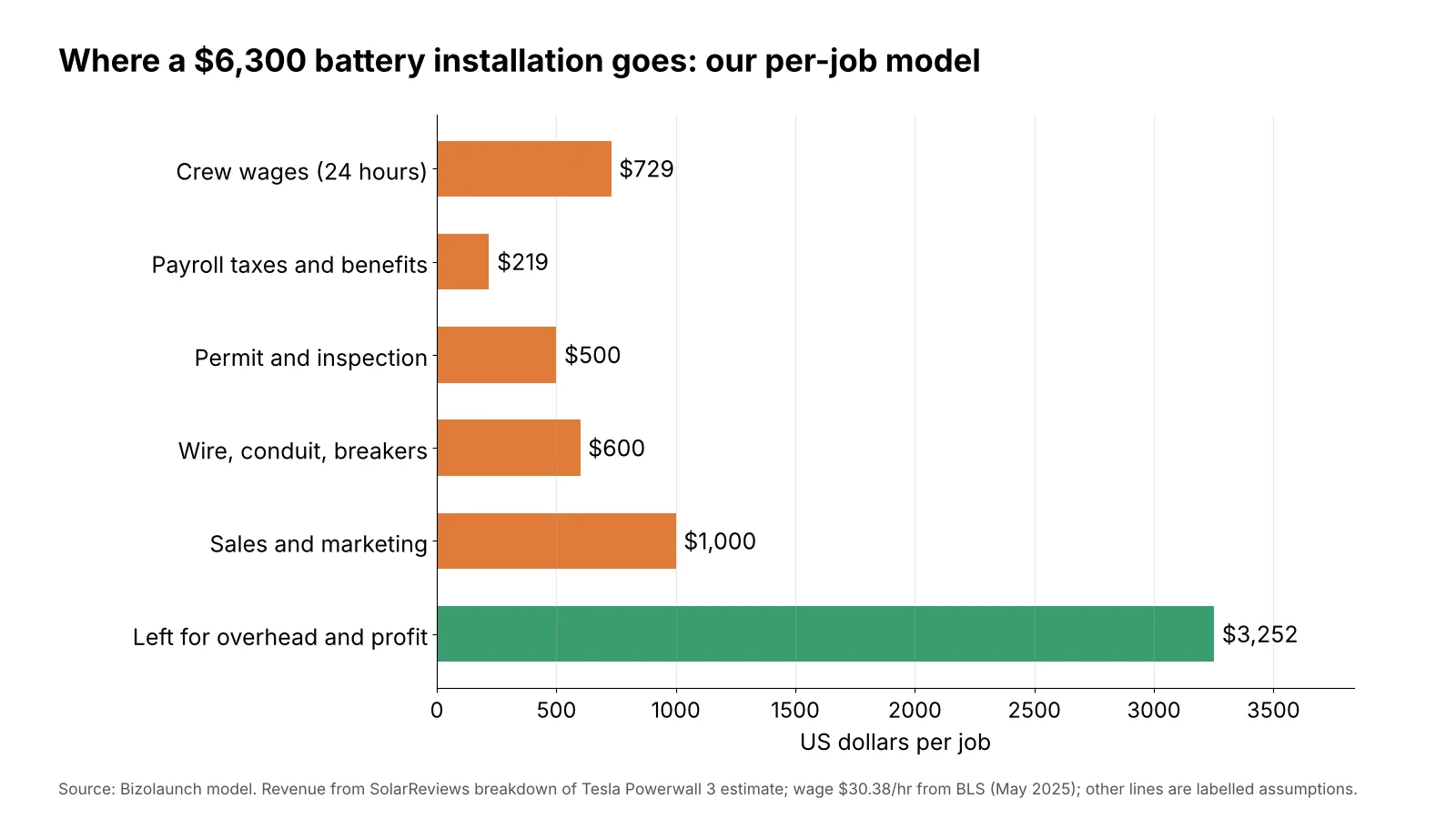
The method is installation revenue minus the five cost lines. Wages are 24 hours x $30.38 = $729.12, and the 30% burden adds $218.74, so labor totals $947.86. Then $6,300 – $947.86 – $500 – $600 – $1,000 = $3,252.14.
Hardware is left out of the margin on purpose. Many installers sell the battery with a markup, but distributor pricing is set by quote and changes often, so treat any hardware margin as a bonus on top of this model.
Now the break-even point. Suppose fixed costs, meaning the owner’s draw, van payment, insurance, software and office, come to $8,000 a month (an assumption). Dividing $8,000 by $3,252 gives 2.46, so about two and a half installs a month cover the fixed costs. Every job after that adds about $3,250 of profit before tax. Plug your own numbers into our break-even calculator to test a slower or faster month.
Startup Costs for a Two-Person Battery Crew
The table below is a budget for a lean start with one van and two electricians. Only the license fee is an official price. The rest are Bizolaunch assumptions for planning, and your local quotes will differ.
| Startup item | Estimate | Basis |
|---|---|---|
| Texas electrical contractor application | $110 | TDLR fee |
| Used work van | $30,000 | Assumption |
| Insulated hand tools, meters, PPE | $4,000 | Assumption |
| Ladders, racks, hand trucks | $2,500 | Assumption |
| First-year general liability premium | $4,000 | Assumption; must meet state minimums |
| Software for quotes, design and invoicing, first six months | $1,500 | Assumption |
| Website, brand and launch marketing | $3,000 | Assumption |
| Storage training and OSHA 30 courses | $1,500 | Assumption |
| Working capital for materials on the first jobs | $4,000 | Assumption |
| Total | $50,610 | Our sum |
Two lines matter most. Insulated tools rated for 1,000 volts are not optional with batteries, because a battery stays energized after the main breaker is off. Klein’s 8-piece premium insulated kit, for example, is rated to 1,000 V under IEC 60900 and ASTM F1505. And insurance has to match the legal minimums in your state before the first job, not after.
Billing is easier with tools built for the trade. Our roundup of invoicing software for electricians compares options that handle deposits, progress billing and job costing.
Run Each Job from Site Visit to Utility Approval
A battery install has more steps than a panel upgrade, mostly because of paperwork. A typical order of work looks like this:
- Site visit: Check the main panel, the space for the battery against the code limits above, and the customer’s backup goals.
- Design and quote: Size the battery to the loads the customer wants to back up, and write a fixed-price proposal.
- Permit: File plans with the city or county. Many require a one-line electrical diagram and the UL 9540 listing.
- Utility paperwork: If the battery connects to solar or the grid, file the utility’s interconnection application.
- Install: Mount the battery and gateway, wire them, label everything as the code and the maker require, and commission the system.
- Inspection: Meet the inspector and fix any items they flag.
- Permission to operate: Where the utility must approve, wait for its sign-off before the system exports power.
- Handover: Show the customer the app and backup settings, and register the warranty.
Every delay between steps 3 and 7 ties up your cash. Track how long each city and utility takes, and quote timelines from that record.
Win Customers Without Buying Leads
Home battery buyers do a lot of research, and they want to trust the person drilling into their wall. Start where trust already exists.
- Solar owners first: Homes that already have panels are the easiest sale. Partner with local solar installers who do not offer storage.
- Electricians’ existing customers: Every panel upgrade, EV charger or generator call is a chance to talk about backup power.
- Outage seasons: Run local ads after storms and before hurricane or wildfire season, when interest peaks.
- Teach in plain numbers: Show backup hours and monthly bill changes for the customer’s own home, using their utility’s rates and our solar panel savings calculator where solar is part of the plan.
- Smart controls: Many buyers also want to see and manage their home’s energy use, and pairing a battery with one of the smart home energy management systems we compared can make the value easier to see.
Pick a clear, local name that tells people what you do. Our business name generator can help with a first list, which you should then check against your state’s business registry.
Questions Founders Ask About Home Battery Businesses
Do I Need to Be an Electrician to Start a Battery Installation Company?
You do not have to do the wiring yourself, but the company usually needs a licensed electrician to qualify it. In Texas, for example, the electrical contractor license requires a Master Electrician on staff, who can be the owner.
Is There Still a Tax Credit for Home Batteries?
The federal 25D Residential Clean Energy Credit ended for installs completed after December 31, 2025. Some states and utilities run their own programs, so check local offers before quoting.
What Certification Do Battery Installers Need?
There is no single national license for battery work. NABCEP’s ESIP is the main industry credential, and battery makers require their own training before they authorize installers. The state electrical license is the legal requirement.
How Much Does It Cost to Start a Battery Installation Business?
Our lean budget comes to about $50,610 for one van and a two-person crew, with only the license fee fixed by the state and the rest labelled assumptions. Buying a van outright is the largest single cost.
How Many kWh of Battery Can Go in a House?
Under the IRC 2021 R328 and NFPA 855 rules summarized by UL, each unit can hold up to 20 kWh. Totals are capped at 40 kWh in utility rooms and basements and 80 kWh in garages, outdoors or on exterior walls, unless UL 9540A test data supports more.
Official Pages Behind These Steps
- IRS: FAQs on energy credits changed by the One Big Beautiful Bill Act.
- Hawaii State Energy Office: Federal Residential Credit FAQs (25D).
- TDLR: Apply for a New Electrical Contractor License.
- NABCEP: Energy Storage Installation Professional.
- UL: Residential ESS separation and maximum quantities summary.
- Canary Media: California battery licensing rule, July 2024.
- SolarReviews: Tesla Powerwall cost and BLS: Electricians.
- Klein Tools: 8-Piece Premium Insulated Tool Kit