Raise Money Twelve Ways and Know the Price of Each
There are 12 main types of company funding. First come bootstrapping, friends and family, grants and government schemes. Then there are angels, venture capital, SAFEs and convertible notes. Finally, you have bank loans, revenue-based financing, venture debt, crowdfunding and an initial public offering (IPO). Each one has a price. Some take a slice of your company. Others take interest, a share of sales, or months of paperwork.
So we compiled the official limits and published terms for each route in India, the US and the UK. Then we ran the same $500,000 raise through five of them to see what each one really costs. The table gives the short version. After that, every funding type gets its own section with a real company that used it.
| Funding type | Do you give up equity? | What it costs | How fast it arrives | Control you keep |
|---|---|---|---|---|
| Bootstrapping | No | Your own savings and slower growth | Immediate | Full |
| Friends and family | Sometimes | Equity or a personal loan, plus relationship risk | Fast | High |
| Grants | No | Application time and reporting | Slow | Full |
| Government schemes | Usually no | Interest on backed loans; tax reliefs go to investors | Slow | Full |
| Angel investors | Yes | A stake set by the valuation, such as 10% for $500,000 at a $5 million post-money value | Weeks | High |
| Venture capital | Yes | A larger stake, a board seat and growth targets | Months | Shared |
| SAFEs and convertible notes | Yes, later | Equity at the valuation cap or a discount | Fast | High until conversion |
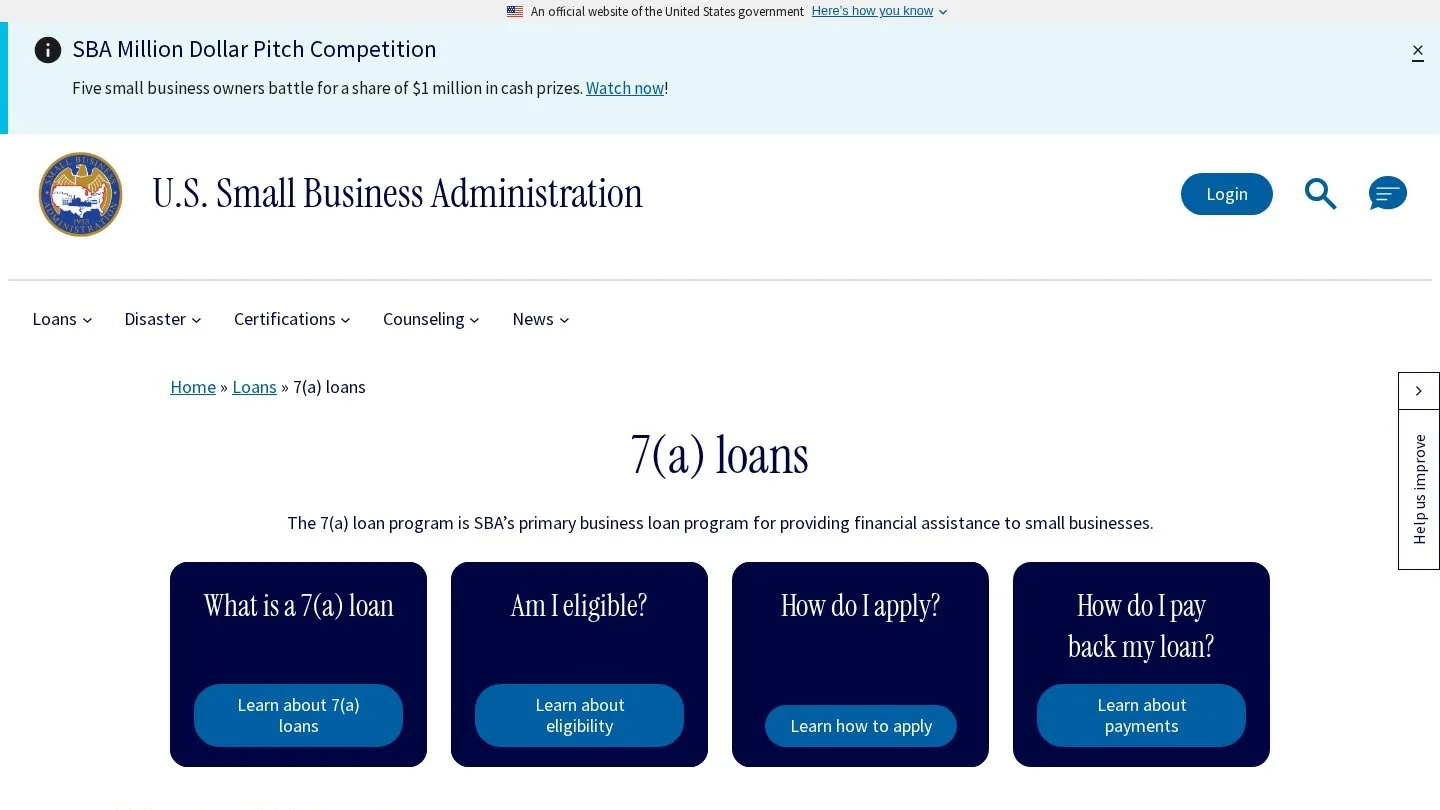
| Bank loans | No | Interest; SBA 7(a) caps it at base rate plus 3% to 6.5% | Weeks | Full, with covenants |
| Revenue-based financing | No | A repayment cap of 1.2 to 3 times the advance | Days to weeks | Full |
| Venture debt | Small, via warrants | About 10% to 14% interest plus 10% to 20% warrant coverage | Weeks | High, with covenants |
| Crowdfunding | Reward: no. Equity: yes | Platform and payment fees, or shares | One campaign | High |
| IPO | Yes | Underwriting spread (7% on most mid-size US deals) plus listing costs | Many months | Shared with public shareholders |
Two of these routes sit on the other side of the table. Angels, VCs and crowd investors are people. So we covered who they are, and how to reach them, in our guide to the types of investors at each stage. This page is about the money itself and the terms attached to it.
Fund the Company Yourself or Through People You Trust
Bootstrap From Savings and Early Sales
Bootstrapping means you pay for the company with your own money and then with customer revenue. Nobody else owns a share. Nobody sets your targets either. The trade-off is speed, because you can only spend what you earn.
For example, Mailchimp is the famous case. It grew without venture capital, and in September 2021 Intuit agreed to buy it for about $12 billion in cash and stock. Zoho, the Chennai software firm, went the same way. Its founder Sridhar Vembu calls it a company that has never raised outside capital, and Zoho says it serves more than 100 million users.
Still, most bootstrapped firms grow far more slowly than those two. That is why this route works best when customers pay early, for example in services, agencies or small software tools. Before you commit, run your numbers through our break-even calculator to see how many months of savings you need.
Borrow From Friends and Family on Written Terms
Friends and family money is often the first outside cash a founder gets. It can be a gift, a loan or a small stake. In fact, Amazon started this way. Jeff Bezos’s parents put $245,573 of their savings into the company in 1995, a figure disclosed in Amazon’s 1997 prospectus.
However, family money carries a cost that no term sheet shows. If the company fails, the loss lands at the dinner table. So put every deal in writing. State whether it is a loan or equity, the interest rate or share count, and what happens if the business closes. Treat it as seriously as a bank loan.
Apply for Grants and Government-Backed Schemes
Win Non-Dilutive Grants for Early Product Work
A grant is money you do not repay and that buys no shares. As a result, it is the cheapest cash a founder can get. The price is your time, because grants come with long forms, milestones and reports.
India’s Startup India Seed Fund Scheme is a good example. It has a corpus of ₹945 crore and runs through approved incubators. A startup can get up to ₹20 lakh as a grant for proof of concept, prototypes or product trials. It can also get up to ₹50 lakh for market entry, but that part comes as convertible debentures or debt. To qualify, the startup needs DPIIT recognition and must be no more than two years old when it applies.
In Europe, the EIC Accelerator works on a bigger scale. It offers grants of up to €2.5 million to deep-tech startups and small firms. It can also add an equity investment of up to €10 million through the EIC Fund.
Use State-Backed Loans and Investor Tax Reliefs
Governments also help in less direct ways. Some guarantee bank loans so lenders take more risk. Others give tax relief to the people who invest in you. We researched the main schemes in three countries and put the official limits side by side.
| Country | Scheme | What it offers | Official limit |
|---|---|---|---|
| US | SBA 7(a) loan | A bank loan partly guaranteed by the SBA | Up to $5 million; 85% guaranty up to $150,000, 75% above |
| India | Credit Guarantee Scheme for Startups (CGSS) | Guarantee cover to lenders for loans to DPIIT startups | Up to ₹20 crore per borrower |
| India | PM Mudra Yojana | Small business loans through banks and NBFCs | Up to ₹20 lakh in the Tarun Plus tier |
| India | Startup India Seed Fund Scheme | Grant plus debt or convertible debentures via incubators | ₹20 lakh grant; ₹50 lakh investment |
| UK | Seed Enterprise Investment Scheme (SEIS) | 50% income tax relief for your investors | Company can raise £250,000 in total |
| UK | Enterprise Investment Scheme (EIS) | 30% income tax relief for your investors | £10 million a year; £24 million lifetime (from 6 April 2026) |
Next, read the SBA rules closely. Most 7(a) loans run 10 years or less, unless they finance real estate or long-life equipment. On variable-rate loans above $350,000, the lender can charge at most the base rate plus 3%. On loans of $50,000 or less, that margin rises to 6.5%.
Meanwhile, the UK schemes work through your investors. Under SEIS, an angel can claim 50% of the investment back as income tax relief. That makes a £10,000 check cost them £5,000 after tax. For example, a company trading for under three years, with gross assets under £350,000 and fewer than 25 staff, can use SEIS. Then it moves to EIS, whose limits doubled from 6 April 2026.
Sell Equity to Angels and Venture Capital Firms
Take an Angel Check Before You Have Traction
An angel investor is a person who invests their own money in an early company. In return, they get shares or a SAFE. Angels usually come in before a VC would, when you have a prototype and a few users but little revenue.
For example, if an angel puts in $500,000 at a $5 million post-money valuation, they own 10%. That stake stays with them for good. Also, angels often bring advice and introductions, which can matter as much as the money.
Raise Venture Capital When the Market Is Large
Venture capital firms invest other people’s money from a fund. They look for companies that could return the whole fund on their own. That is why they ask about market size before they ask about profit.
Google is the textbook case. In June 1999, Sequoia Capital and Kleiner Perkins together put $25 million into the company. In exchange, VCs usually take a board seat and expect fast growth. So VC works for a company that can reach a very large market and needs heavy spending first. For a steady local business, it is usually a poor match.
Before you pitch, get the deck right. Our list of pitch deck design companies covers firms that build investor decks. For a feel of what is raising money right now, our weekly startup funding roundup lists recent rounds and their lead investors.
Delay the Valuation With SAFEs and Convertible Notes
A SAFE or a convertible note lets an investor fund you now and get shares later. The price is set when you raise a priced round. As a result, you avoid a long fight over valuation at the very start.
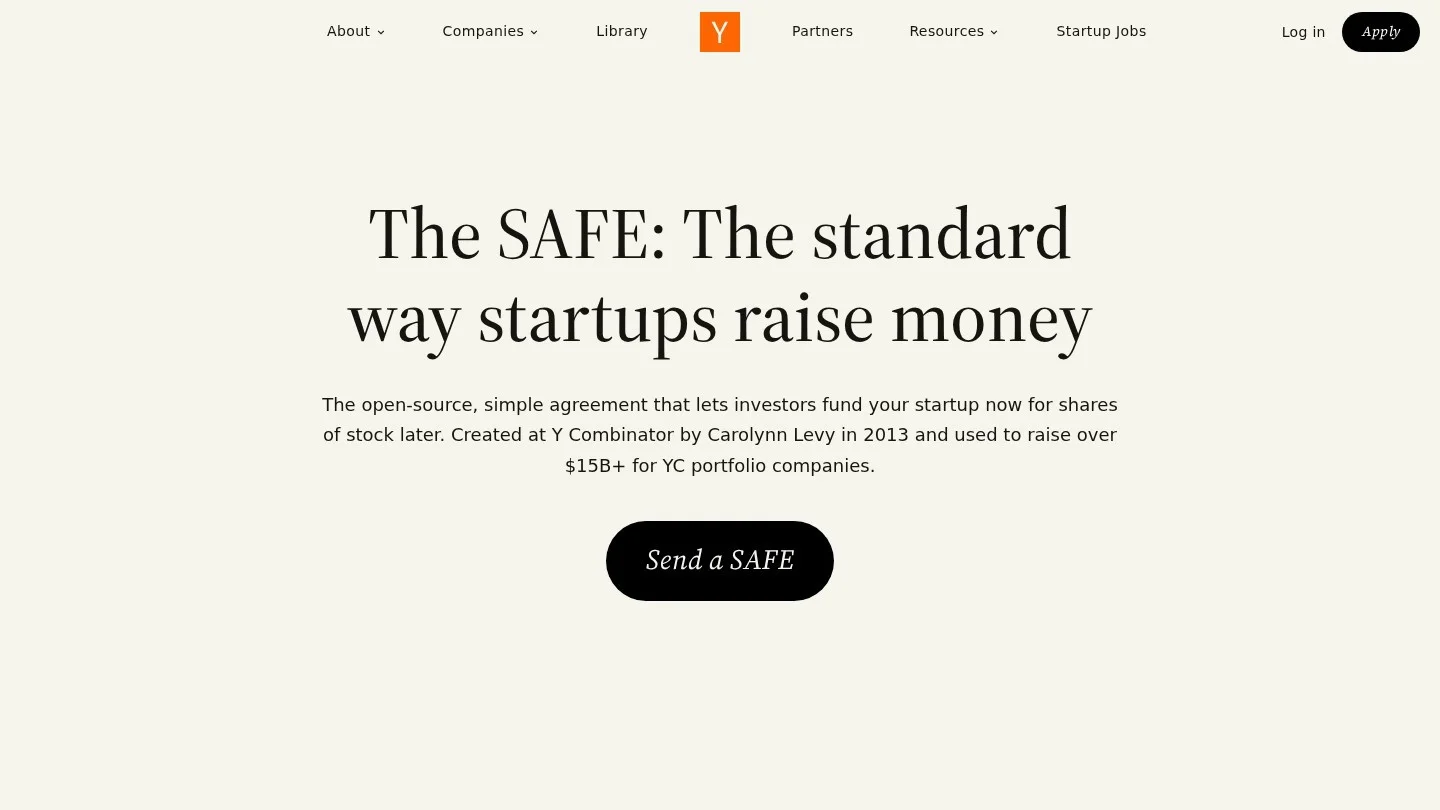
But the two differ in one big way. A convertible note is a loan, with an interest rate and a maturity date. A SAFE is not debt. It has no interest and no due date. Y Combinator created the SAFE in 2013 and switched to a post-money version in 2018.
Peter Thiel’s first check into Facebook shows how a note works. In August 2004 he put in $500,000 as a convertible note for a 10.2% stake. The note was set to convert if Facebook hit 1.5 million users by year end. Facebook missed that goal, but he let it convert anyway.
Today, Y Combinator’s standard deal uses SAFEs. It invests $125,000 on a post-money SAFE for 7% of the company. Then it adds $375,000 on an uncapped SAFE with a most favored nation (MFN) clause. That second SAFE converts on the best terms you give any later SAFE investor.
You can check the math yourself. Divide the investment by the post-money cap. So $500,000 on a $10 million cap buys 5%. Our SAFE note explainer walks through caps, discounts and conversion step by step.
Borrow Against Your Assets, Revenue or Last Round
Get a Bank Loan or a Credit Line
A bank loan gives you cash now and fixed repayments later. You keep all your shares. But banks want proof you can repay, so they ask for revenue history, collateral or a personal guarantee.
For instance, we ran the numbers on a typical case. A $500,000 loan at 10% a year over five years needs a monthly payment of about $10,624. Over the full term, you pay about $137,400 in interest. To test other rates and terms, use our guide on how to calculate EMI.
Also check your legal form before you choose. An LLP in India cannot issue shares, so it cannot raise equity from angels or VCs. If you plan to raise equity, read our LLP registration guide first. It explains where an LLP works and where a private limited company is the better choice.
Repay Revenue-Based Financing From Monthly Sales
Revenue-based financing (RBF) gives you an advance. Then you repay it as a share of monthly revenue. Typical shares run from 1% to 15% of revenue. You keep paying until you hit a cap, which usually sits between 1.2 and 3 times the advance.
For instance, a $100,000 advance at a 1.2 cap means you repay $120,000 in total. When sales dip, the payment dips too. However, this route only works if you already have revenue. Most RBF providers turn down pre-revenue startups, and some ask for $500,000 or more in annual revenue.
Add Venture Debt After an Equity Round
Venture debt is a loan for startups that have just raised equity. Lenders size it at roughly 20% to 50% of your last VC round. So a $5 million round might support a $1 million to $2.5 million loan.
The price has two parts. First, there is interest. Light-covenant deals run about the prime rate plus 3% to 4%, or 10% to 14% in total. Second, there are warrants, which give the lender the right to buy shares later. Light-covenant deals usually carry 10% to 20% warrant coverage. Most loans run three to five years, with 12 to 18 months of interest-only payments at the start.
Crowdfund From Customers or Small Investors
Presell a Product on a Reward Platform
Reward crowdfunding lets backers pay now for a product you ship later. You give up no shares. Instead, you owe them the product. Kickstarter runs on an all-or-nothing rule, so you get the money only if you hit your goal.
Pebble Time is still one of the best-known cases. The smartwatch raised more than $20.3 million on Kickstarter in March 2015. Kickstarter takes a 5% fee on funded projects, and payment processing adds about 3% plus a small fee per pledge.
Sell Shares Through Equity Crowdfunding
Equity crowdfunding, by contrast, sells real shares to many small investors through a licensed platform. In the US, Regulation Crowdfunding lets a company raise up to $5 million in 12 months. The offering must run on one SEC-registered funding portal or broker-dealer.
The paperwork grows with the raise. Above $124,000, your financial statements must be reviewed by an independent accountant. Above $618,000, repeat issuers and larger first-time raises need a full audit.
List Shares in an Initial Public Offering
An IPO sells shares to the public and lists them on a stock exchange. It can raise far more money than any private round. It also gives early investors and staff a way to sell.
The cost is high, though. In the US, more than 90% of IPOs raising $20 million to $80 million paid underwriters a fee of exactly 7%. That pattern was found in a well-known academic study of US listings. On top of that, you pay lawyers, auditors and exchange fees, and you report results every quarter. Public investors judge you on sales multiples, so our table of price-to-sales ratios by industry shows what a listing might value your sector at.
Compare What $500,000 Really Costs Under Five Funding Types
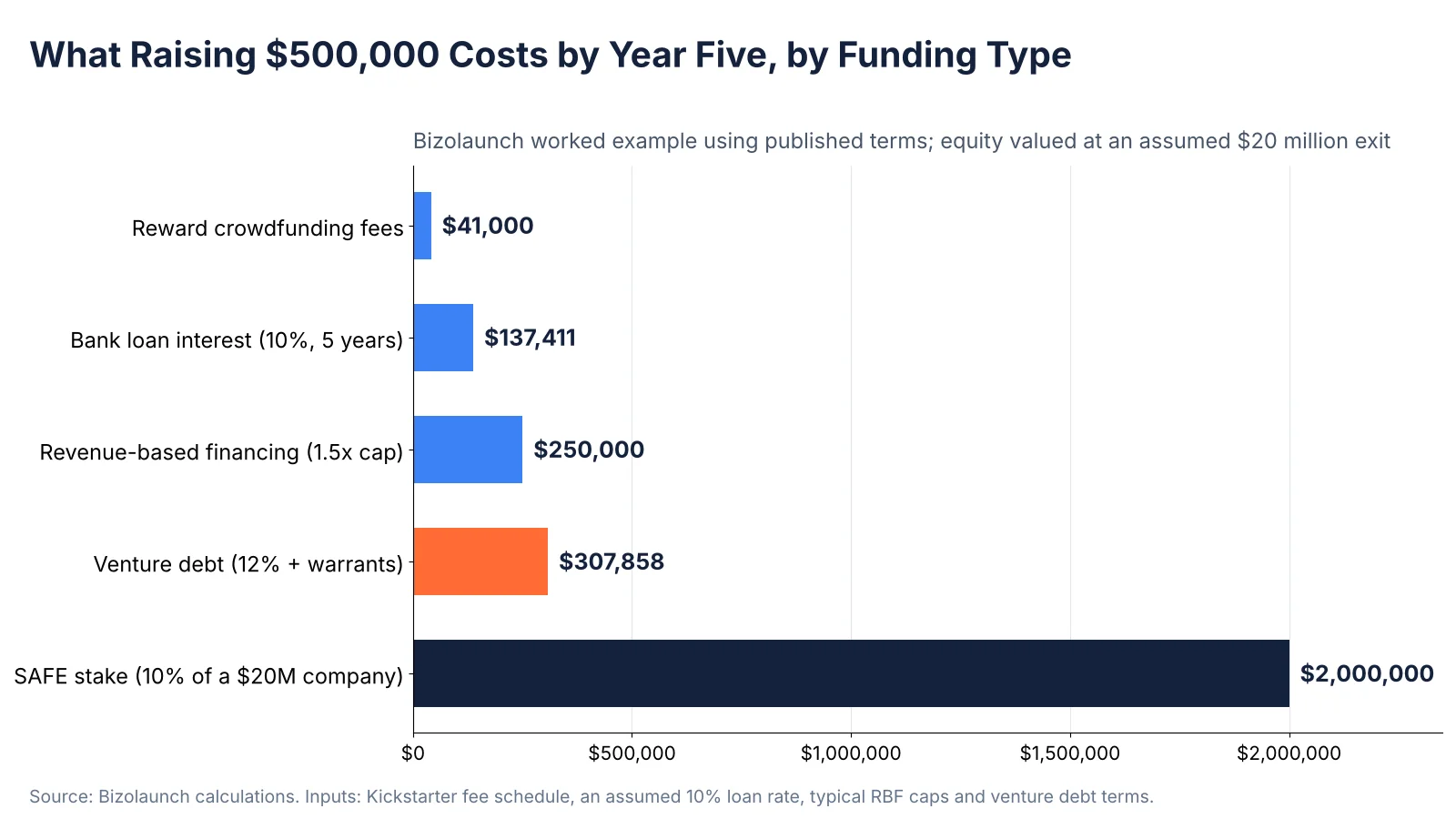
We took the published terms above and ran one $500,000 raise through five routes. Then we added up what each would cost by year five. For equity, we assumed the company is worth $20 million by then. These are our own calculations, so change the inputs to match your case.
| Route | Our inputs | Cost by year five |
|---|---|---|
| Reward crowdfunding | 5% platform fee, 3% processing, $0.20 on each of 5,000 pledges of $100 | $41,000 in fees, plus the cost of making the rewards |
| Bank loan | 10% a year, repaid monthly over 60 months | $137,411 in interest |
| Revenue-based financing | Repayment cap of 1.5 times the advance | $250,000 above the advance |
| Venture debt | 12% interest, 12 months interest-only, then 36 months of repayments; 10% warrant coverage at a $5 million valuation | $157,858 in interest plus warrants worth about $150,000 above their strike price |
| SAFE with angels or VCs | $500,000 on a $5 million post-money cap, so 10% of the company | $2,000,000 if the company is worth $20 million |
Equity was the costliest route by far, but only because the company succeeded. If the business fails, the SAFE investor loses everything and you owe nothing. By contrast, the bank still wants its $137,411. So the cheapest route depends on how sure you are about growth.
Also, the venture debt figure depends heavily on the warrants. At a $10 million exit instead of $20 million, the warrants are worth about $50,000 above their strike price. That drops the total to roughly $208,000.
Match the Funding Type to Your Stage
No single route works at every stage. Our own view, based on the terms above, is that most companies stack them in a rough order. For example, a founder might bootstrap, then add a grant, then sell a SAFE, and later take venture debt after a priced round.
| Stage | What you have | Routes that usually open up |
|---|---|---|
| Idea | A plan and maybe a prototype | Bootstrapping, friends and family, grants |
| Pre-seed | A working product and first users | Angels, accelerators, SAFEs, reward crowdfunding |
| Seed | Early revenue or clear usage growth | Seed VC, equity crowdfunding, government-backed loans |
| Growth | Repeatable revenue | Series A and later VC, venture debt, revenue-based financing, bank loans |
| Mature | Large, steady revenue and audited accounts | Private equity, bank debt, IPO |
Finally, think about control as well as cost. Every equity round adds owners with a say in big decisions. Debt adds lenders with covenants. Only bootstrapping and grants leave the company fully yours.
Settle Common Founder Questions About Funding
What Are the Main Types of Funding for a Company?
There are 12 main types. They include self-funding, grants, angels, venture capital, bank loans, venture debt, crowdfunding and an IPO. In fact, they fall into three groups: money you repay, money that buys shares, and money you neither repay nor trade for shares.
Which Funding Does Not Require Giving Up Equity?
Bootstrapping, grants, bank loans, revenue-based financing and reward crowdfunding all leave your shares untouched. Venture debt takes only a small slice through warrants. However, every debt route must be repaid even if the company struggles.
What Is the Cheapest Way to Fund a Startup?
In cash terms, a grant is cheapest because you repay nothing. Your own revenue comes next. In our $500,000 example, reward crowdfunding fees came to about $41,000, while a 10% bank loan cost about $137,400 in interest.
What Is the Difference Between a SAFE and a Convertible Note?
A convertible note is debt, with interest and a maturity date. A SAFE has neither. Both turn into shares at your next priced round, usually at a valuation cap or a discount.
Can a Startup Get Government Funding Without Giving Up Equity?
Yes. For example, India’s Startup India Seed Fund Scheme offers grants of up to ₹20 lakh through incubators. The US SBA backs loans of up to $5 million, and India’s CGSS guarantees startup loans of up to ₹20 crore per borrower.
This article is for information and education only and is not investment, tax, legal or financial advice. Scheme limits and loan terms change, so confirm current details with the official source or a registered adviser before acting.