Only one lab-grown seafood product can be legally sold in the United States right now. It is Wildtype’s cultivated coho salmon, which cleared the US Food and Drug Administration’s pre-market consultation on May 28, 2025 and has since appeared on restaurant menus in Oregon, California, Washington and, briefly, Texas. Every other maker of cell-cultivated fish, from BlueNalu’s bluefin tuna toro to Umami Bioworks’ eel and Forsea’s unagi, is still waiting for a regulator to say yes.
That gap between one approved product and a long line of prototypes is the real story of this industry in late 2026. Below we compare the manufacturers that are still operating, what species each one grows, how far each has moved through regulators, and how much money each has disclosed. We also ran a simple capacity check against US seafood demand to show how small the first plants are next to the fish counter.
Cultivated Seafood Makers by Stage
- On sale in the US: Wildtype coho salmon, served in a handful of restaurants since June 2025.
- Waiting on FDA: BlueNalu has filed a dossier for bluefin tuna toro and also submitted one in Singapore.
- Pet food first: Umami Bioworks registered two cultivated white fish ingredients on the EU Feed Materials Register in 2025.
- Pivoted for now: Bluu, a German trout and salmon cell company, has put food products on hold and is selling into skin care first.
- Scale check: BlueNalu’s planned 6 million lb plant would cover the yearly seafood intake of about 326,000 Americans, by our math.
The One Lab-Grown Fish You Can Order in the US Today
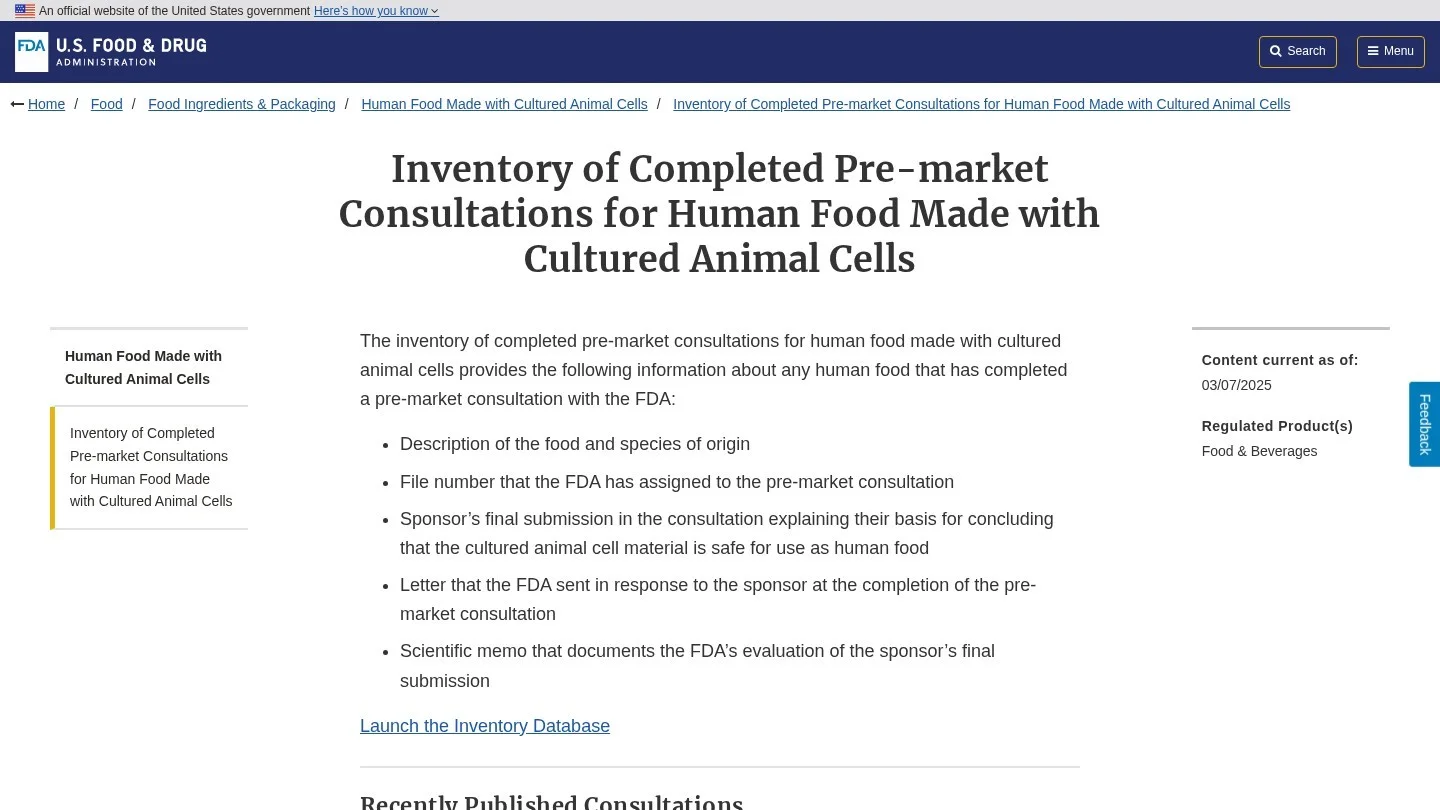
Wildtype is a San Francisco company founded in 2016 by Aryé Elfenbein and Justin Kolbeck. It grows cells taken from Pacific coho salmon in steel tanks that look a lot like brewery fermenters. In late May 2025 the FDA sent the company a “no questions” letter, which means the agency had no further safety questions about the product. It is file 000005 in the FDA’s inventory of completed consultations, “Oncorhynchus kisutch (salmon) cell material,” with a response dated May 28, 2025.
Within days, Portland chef Gregory Gourdet put it on the menu at Kann. By August 2025 three more restaurants had signed on: Otoko in Austin, Robin in San Francisco and The Walrus and the Carpenter in Seattle. Tasting menus at Otoko run from $150 to $250 and at Robin from $119 to $219, so this is still a fine-dining item, not a grocery staple.
Seafood is a little simpler to regulate than meat or poultry in the US. Cell-cultivated chicken and pork need both FDA and US Department of Agriculture sign-off, while Wildtype’s salmon sits outside USDA oversight. That shorter path is one reason the first cultivated fish reached diners through a single agency.
Cultivated Seafood Manufacturers Compared by Species and Stage
The table covers firms that were still reporting activity in 2025 or 2026. Startups that had gone quiet or closed were left out. “Stage” describes the furthest public milestone we could find for each company.
| Company | Base | Species | Furthest public milestone | Latest dated update |
|---|---|---|---|---|
| Wildtype | San Francisco, US | Coho salmon | FDA “no questions” letter, May 28, 2025; served in restaurants | Restaurant rollout, Aug 2025 |
| BlueNalu | San Diego, US | Bluefin tuna toro | FDA and Singapore dossiers filed; UK sandbox member | $11M raise, Jan 2, 2026 |
| Umami Bioworks | Singapore | Eel, bluefin tuna, white fish | Two pet food ingredients on EU Feed Materials Register; human dossier in final stage in Singapore (Sep 2025) | EU registration, Sep 2, 2025 |
| Forsea Foods | Israel | Freshwater eel (unagi) | Public tasting at a Tel Aviv restaurant, June 2024 | Cell density claim, Nov 2024 |
| Bluu | Hamburg, Germany | Rainbow trout, Atlantic salmon cells | 1,000-liter reactor harvest; food work on hold | Personal care push, Apr 2026 |
| Atlantic Fish Co. | North Carolina, US | Whitefish cell lines | Hybrid seafood trials with Revo Foods | Partnership, Jan 26, 2026 |
Two patterns jump out. First, the United States has the only approved product and the only company with menus to show for it. Second, the younger firms are hedging, either by selling into pet food and personal care first or by blending fish cells with plant or fungal ingredients to stretch expensive biomass.
Six Lab-Grown Seafood Makers and What Each Has Shown
Wildtype: Sushi-Grade Coho Salmon
Wildtype raised a $100 million Series B in February 2022, led by L Catterton, which took its total past $120 million. Its pilot plant opened in June 2021 with room for about 50,000 lb of product a year, and the company said it could scale that to 200,000 lb.
The product itself is a blend. Harvested salmon cells are washed, chilled and frozen, then combined with plant-based ingredients that give the fillet its structure. Wildtype has said retail sales come after the restaurant phase. The company also joined UPSIDE Foods in a lawsuit against Texas’s two-year sales ban in September 2025, which we cover further down.
BlueNalu: Bluefin Tuna Toro for Sushi Bars
BlueNalu, founded in 2018 in San Diego, raised about $11 million in convertible notes and preferred stock at the turn of 2026, bringing its total to $129 million. Agronomics, Siddhi Capital and Lewis & Clark AgriFood led the round. If you are new to how notes like these convert into shares, our plain guide to SAFE notes covers the same basic idea.
The company runs two San Diego sites, including a 38,000 sq ft pilot plant, and plans a 140,000 sq ft facility that could make 6 million lb a year. It has filed an FDA dossier and a Singapore dossier, sits in the UK Food Standards Agency sandbox, and lists partners such as Nomad Foods, Pulmuone, Mitsubishi, Thai Union and Rich Products. Bluefin toro is a smart first target. It is one of the priciest cuts on a sushi menu, so a cultivated version does not have to be cheap to compete.
Umami Bioworks: Eel, Tuna and a Pet Food Bridge
Singapore’s Umami Bioworks merged with fellow cell-based seafood firm Shiok Meats in 2024. In September 2025 it registered two cultivated white fish ingredients for pet food on the EU Feed Materials Register, with EU pet food launches targeted for the second quarter of 2026. Its human food dossier was in the final stage in Singapore, and it had raised $7.5 million.
Pet food is a clever bridge. EU feed rules register the production site rather than demand a full novel food approval, so the company can sell, learn and earn while human food files work through the system. Its eel program is the most advanced, which makes sense given how tight wild eel supplies are.
Forsea Foods: Cultivated Unagi Without Scaffolds
Israel’s Forsea uses organoid technology, in which cells organize themselves into tissue without a plant-based scaffold. It showed its first cultivated freshwater eel prototype in January 2024 and held a tasting at a Tel Aviv restaurant in June 2024. In November 2024 it claimed a cell density above 300 million cells per milliliter. Higher density means more meat from each liter of costly growth medium, which is the main cost lever in this business.
Bluu: Trout and Salmon Cells, Skin Care First
Hamburg-based Bluu has raised €30 million and in 2026 harvested rainbow trout cells from a 1,000-liter reactor at Cultivate at Scale’s plant in Maastricht. The company has paused food product development and is selling marine cell ingredients into cosmetics first, because that route to market is faster than food approval. It says food will follow. We list it here because it still makes fish cells at a scale few rivals have shown.
Atlantic Fish Co.: Whitefish Cells for Hybrid Products
North Carolina’s Atlantic Fish Co. supplies whitefish cell lines. In January 2026 it began testing them with Austria’s Revo Foods, which makes 3D-structured mycoprotein seafood, to build hybrid whole cuts. Hybrids like this use a small share of fish cells for flavor and nutrition and a fungal base for bulk, which cuts the amount of cell biomass each fillet needs.
How Cell-Cultivated Fish Is Made, Step by Step
The process differs by company, but the public descriptions from Wildtype and others follow the same broad path. Knowing it helps explain why prices start high and why plant size matters so much.
- Take a cell sample. A small biopsy from a living fish, or from fertilized eggs, gives the starting cells. No fish needs to be killed for later batches.
- Build a cell line. Scientists select cells that keep dividing and that turn into muscle or fat tissue. This line is banked so every batch starts the same way.
- Feed the cells. Cells grow in a liquid medium of proteins, sugars, fats, salts and minerals inside a sealed tank kept at fish-friendly temperature and pH. Wildtype grows its cells in suspension in tanks similar to beer fermenters.
- Harvest and wash. Wildtype spins the cells out of the liquid in a bowl centrifuge, washes them three times, blast-chills them and stores them frozen.
- Shape the product. Cells are blended with plant or fungal ingredients, or grown on scaffolds, or (in Forsea’s case) allowed to self-organize, to create the texture of a fillet or a slice of toro.
- Clear the regulator. In the US, the company submits safety data to the FDA, which ends the consultation with a “no questions” letter if it is satisfied.
Steps three and four set the cost. Growth medium is expensive, and a tank only produces as much as its cell density allows. That is why Forsea’s density claim and Bluu’s 1,000-liter harvest got attention. Both are attempts to make more fish from the same tank time.
Where Lab-Grown Seafood Is Banned in the US
An FDA letter does not guarantee you can sell everywhere. By September 2025, seven states had passed laws against selling cultivated meat: Alabama, Florida, Indiana, Mississippi, Montana, Nebraska and Texas. Texas’s SB 261 took effect on September 1, 2025 and bans sales for two years, with civil penalties of up to $25,000 a day.
That is why Otoko in Austin served Wildtype salmon only for a limited time. Wildtype and UPSIDE Foods, represented by the Institute for Justice, sued Texas in the US District Court for the Western District of Texas, arguing the law breaks the Commerce Clause and the Supremacy Clause. For a seafood startup, these bans shrink the early restaurant map and push launches toward states such as California, Oregon and Washington.
| Rule | What it means for cultivated seafood sellers |
|---|---|
| FDA pre-market consultation | Needed before sale; ends with a “no questions” letter |
| USDA oversight | Applies to cultivated meat and poultry; Wildtype’s salmon sits outside it |
| State sales bans | Seven states; Texas’s runs two years from Sept 1, 2025 |
| UK FSA sandbox | BlueNalu is a member; a route to future UK approval |
| Singapore | BlueNalu and Umami Bioworks have filed dossiers |
If you are tracking the meat side of this industry as well, our sister piece on cultivated meat companies and costs covers the chicken and pork approvals by country.
Plant Capacity Against US Seafood Demand
Americans ate 18.4 lb of seafood per person in 2024, and edible seafood imports reached 6.4 billion lb that year. We used those two numbers to put the announced plant capacities in context. The method is simple: divide each plant’s yearly output by 18.4 lb to get the number of people whose full seafood intake it could cover, then divide by 6.4 billion lb to compare it with imports.
| Plant | Stated output a year | People covered at 18.4 lb each | Share of 2024 US edible imports |
|---|---|---|---|
| Wildtype pilot (2021) | 50,000 lb | 2,717 | 0.0008% |
| Wildtype stated scale-up | 200,000 lb | 10,870 | 0.003% |
| BlueNalu planned plant | 6,000,000 lb | 326,087 | 0.09% |
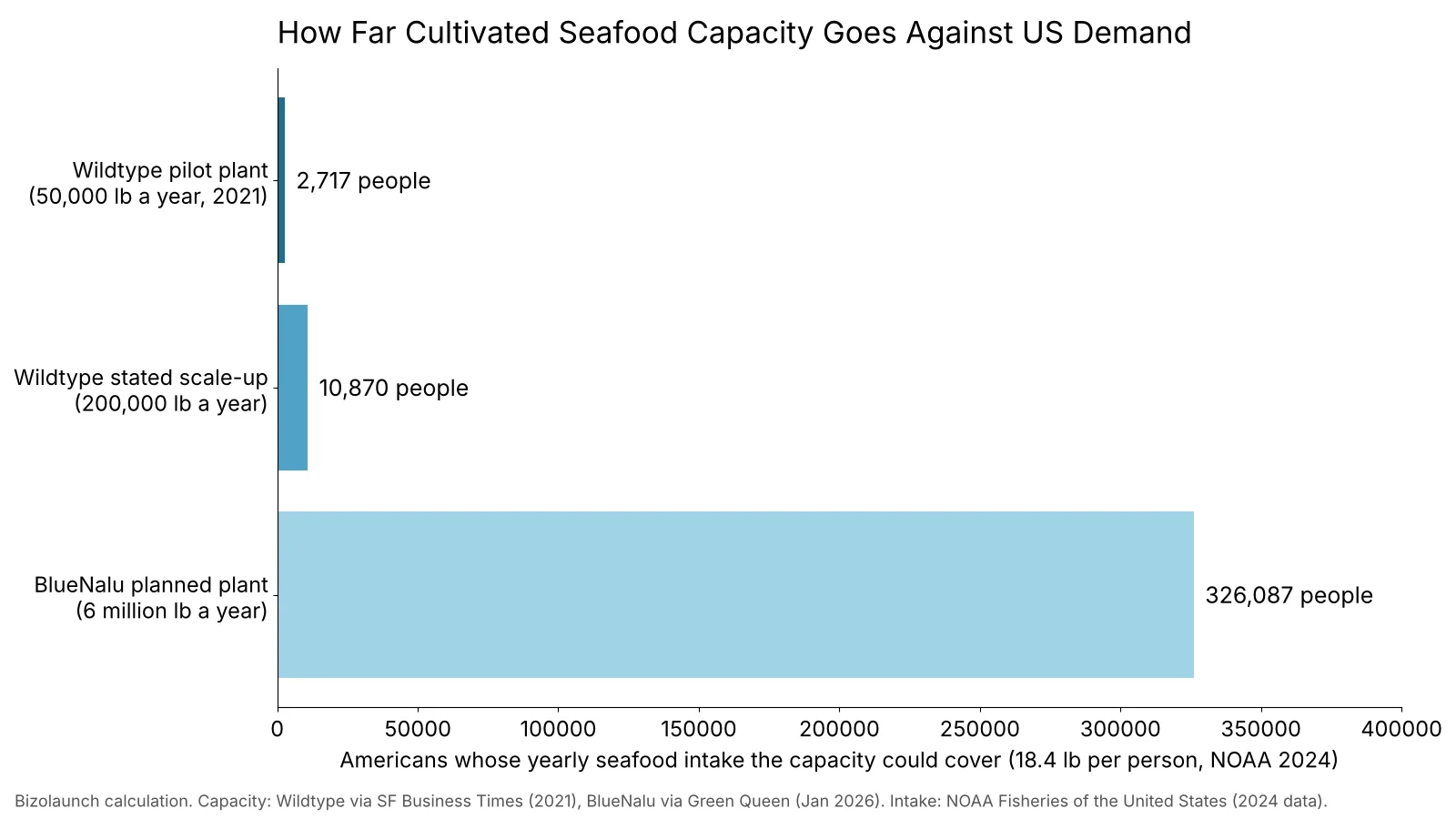
Even the largest planned plant would replace less than a tenth of one percent of US seafood imports. That does not make it small for a startup. It shows that the near-term market is premium species where supply is tight and prices are high, such as bluefin toro, eel and sushi-grade salmon, rather than everyday fish sticks.
One more ratio is worth a look. BlueNalu’s $129 million in total funding works out to about $21.50 per lb of its planned yearly capacity, while Wildtype’s $120 million against a 200,000 lb target is about $600 per lb. These are not like-for-like, since BlueNalu’s plant is still a plan and Wildtype has a product on sale. Still, the gap shows how much each company is betting on future scale to bring the cost per fillet down.
Money Raised by Lab-Grown Seafood Startups
Funding for the wider cultivated protein sector has cooled. Cultivated meat startups raised $139 million in 2024, down 40% on the previous year, and $36 million in the first nine months of 2025. Several meat-focused firms shut down in 2025. Against that backdrop, the seafood companies below are the ones still publishing progress.
| Company | Disclosed funding | Date of figure |
|---|---|---|
| Wildtype | More than $120 million | Feb 2022 |
| BlueNalu | $129 million | Jan 2026 |
| Bluu | €30 million | Apr 2026 |
| Umami Bioworks | $7.5 million | Sep 2025 |
For founders watching the space, the lesson is about runway. The firms still standing either have a product on sale, a regulator file in progress, or a side market such as pet food or skin care that brings in revenue before the main approval. Our weekly startup funding roundup tracks new rounds as they land, and related biotech food plays are covered in our list of precision fermentation food companies.
Questions Chefs and Diners Ask About Cultivated Fish
Is Lab-Grown Salmon Real Fish?
Yes, at the cell level. Wildtype’s salmon is made from coho salmon cells grown outside the animal, then blended with plant ingredients for structure. It is not a plant-based imitation, and it is not genetically modified fish caught at sea.
Where Can I Eat Cultivated Seafood in the US?
Only Wildtype’s salmon is on sale, and only in a few restaurants. Kann in Portland, Robin in San Francisco and The Walrus and the Carpenter in Seattle were the named venues in 2025. Texas sales stopped when SB 261 took effect.
Is Cultivated Fish Free of Mercury and Microplastics?
Companies make that case because the cells grow in sealed, controlled tanks rather than the ocean. The FDA’s review focuses on whether the food is safe as made. Diners who care about this point should read each company’s own disclosures, since claims differ by product.
When Will BlueNalu’s Bluefin Tuna Be Available?
BlueNalu has not given a launch date. It says sales can start after it receives an FDA “no questions” letter, and it is lining up chefs and distributors in the meantime.
Can a Small Business Invest in or Sell Cultivated Seafood?
Restaurants can buy it once a supplier is cleared and their state allows sales. Early buyers are high-end sushi and tasting-menu kitchens. For investors, most of these firms are private and raise through venture rounds and convertible notes. Readers comparing fast-moving sectors may also find our look at the fastest-growing industries in the US useful context.
Filings, Releases and Reports We Checked
- FDA, Inventory of completed pre-market consultations for human food made with cultured animal cells.
- NOAA Fisheries, Fisheries of the United States, 2024 consumption and import figures.
- Business Wire, Wildtype $100 million Series B release, February 2022.
- Green Queen reports on Wildtype’s approval, Wildtype’s restaurants, BlueNalu’s funding, Umami Bioworks and Bluu.
- FoodNavigator, Texas lawsuit and state bans, September 2025.
- SeafoodNews, Forsea eel tasting, and vegconomist’s cultivated seafood news feed.
- Wikipedia: Wildtype (company)