Precision fermentation food companies use microbes such as yeast or fungi as tiny factories to make one specific animal protein, like whey or egg white, without the cow or the hen. The leaders in late 2026 are Perfect Day and Vivici in whey protein, The EVERY Company and Onego Bio in egg protein, Remilk in finished milk, Verley in functional dairy proteins and TurtleTree in lactoferrin. Each of these has either an FDA “no questions” letter, a product on shelves, or both.
Money has grown tighter. Fermentation startups raised $357 million in 2025, down from $632 million in 2024. Yet precision fermentation took 66% of that total, up from 33% in 2023, which tells you where investors now see the clearest path to revenue. We built the company list from regulatory letters, company announcements and the Good Food Institute’s annual industry report.
Precision Fermentation Food Companies and Their Milestones
| Company and base | Protein | US regulatory status | Latest commercial milestone | Funding fact |
|---|---|---|---|---|
| Perfect Day, USA | Beta-lactoglobulin (whey) | Current plant sold out under signed contracts | Gujarat plant with Zydus due to start in the second half of 2026 | More than $825 million raised since 2014 |
| The EVERY Company, USA | Egg white proteins OvoPro and OvoBoost | GRAS with FDA no-objection letters | Ingredients sold in Walmart stores nationwide | $55 million Series D, November 2025 |
| Onego Bio, Finland | Ovalbumin (Bioalbumen) | FDA no-questions letter, September 2025 | Planned $250 to $300 million Wisconsin plant, opening 2028 | About $71 million raised |
| Vivici, Netherlands | Beta-lactoglobulin (Vivitein BLG) | FDA no-questions letter, February 2025 | Backed by DSM-Firmenich and Fonterra | Not disclosed |
| Verley, France | FermWhey Native and FermWhey MicroStab | FDA no-questions letter (GRN 1241), September 2025 | Scaling with contract manufacturers | Not disclosed |
| Remilk, Israel | Beta-lactoglobulin in finished “New Milk” | Eyeing a US partner in 2026 | Nationwide launch in Israel with Gad Dairies, November 2025 | About $150 million spent on development |
| TurtleTree, Singapore | Lactoferrin (LF+) | FDA no-questions letter, March 2025 | Sells a high-value milk protein rather than bulk whey | Not disclosed |
“No questions” means the FDA reviewed the company’s safety notice and had no questions about its conclusion that the ingredient is generally recognized as safe (GRAS).
How Precision Fermentation Turns Sugar Into Milk Protein
The process looks a lot like brewing. Scientists give a microbe the genetic instructions for one protein. The microbe is grown in large steel tanks on sugar and nutrients, and it makes the protein as it grows. The protein is then separated from the microbes, filtered and dried into a powder.
The result is molecule-for-molecule the same as the animal version, which is why it behaves like the real thing in coffee, baking and cheese. Onego Bio, for example, uses the fungus Trichoderma reesei to make ovalbumin, the main egg white protein. Because the protein is identical to the animal one, people allergic to milk or egg proteins should treat these foods exactly as they would the originals.
It differs from biomass fermentation, where the whole microbe becomes the food, as with mycoprotein. It also differs from cultivated meat, which grows real animal cells. Precision fermentation makes ingredients, so most of these firms sell to food brands rather than straight to shoppers.
Whey Protein Makers: Perfect Day, Vivici and Verley
Perfect Day
Perfect Day, founded in 2014, is the best-funded name in animal-free dairy, with more than $825 million raised, the company said in December 2025. Its current plant is sold out under signed contracts. A new plant in Gujarat, India, run through a joint venture with Zydus Lifesciences, was due to start in the second half of 2026 and ramp up into 2027. Operations chief Marshall Bredwell said the venture expects to be profitable from launch.
The company has been through a hard stretch, including a leadership change and lawsuits, and one dispute was dismissed in January 2025 with the other party later becoming an investor. Building the India plant is its clearest step toward the low-cost scale this industry needs.
Vivici
Vivici is a Dutch company backed by two dairy and nutrition giants, DSM-Firmenich and Fonterra. It makes Vivitein BLG, a beta-lactoglobulin for sports and medical nutrition. It filed with the FDA in July 2024 and received its no-questions letter in February 2025. Having a big dairy co-op as a parent gives it routes to market that a stand-alone startup has to build from scratch.
Verley
Verley, a French startup, went a step further than plain whey. Its FDA letter (GRN 1241) in September 2025 covers FermWhey Native, which is about 95% beta-lactoglobulin, and FermWhey MicroStab, a heat- and acid-stable version for ready-to-drink protein shakes. A third protein for gels and textures is in the pipeline.
Egg Protein Makers: The EVERY Company and Onego Bio
Egg proteins are the second big market. When US egg prices averaged $8.17 a dozen in March 2025, food makers had a fresh reason to look at a supply that does not depend on hens.
The EVERY Company, based in San Francisco, closed a $55 million Series D in November 2025 led by McWin Capital Partners. It was the largest fermentation deal of the year. Its OvoPro and OvoBoost egg white proteins are GRAS with FDA no-objection letters, and its ingredients are sold in Walmart stores across the US.
Onego Bio, a spinout of Finland’s VTT research center, received its FDA letter for Bioalbumen in September 2025, nine months after filing. It produces at demo scale through a European contract maker and plans a $250 million to $300 million plant in Jefferson County, Wisconsin, opening in 2028. The company says the plant will match the egg protein output of six million hens. On those figures, we calculate a build cost of about $42 to $50 per hen of equivalent output. The two egg companies are also in patent disputes with each other, which is common in a young field with valuable know-how.
Finished Dairy and Specialty Proteins: Remilk, TurtleTree and Formo
Remilk is one of the few precision fermentation firms selling a finished drink. In November 2025 it launched “New Milk” across Israel through a joint venture with Gad Dairies, one of the country’s largest dairy distributors. The milk is made under contract in Spain, has 75% less sugar than regular milk, and went first to cafés and restaurants. Remilk spent almost six years and about $150 million to get here, and it is seeking a US partner in 2026.
TurtleTree, from Singapore, focuses on lactoferrin, a specialty milk protein, rather than bulk whey. Its LF+ ingredient received an FDA no-questions letter in March 2025, and Vivici has said it plans its own lactoferrin too, which suggests the specialty end of the market is attracting more than one player.
Formo raised $36 million in venture debt in 2025, one of the year’s three largest fermentation deals. Strauss Group also launched dairy-free milk and cream cheese using whey protein from Imagindairy, another sign that big food brands are starting to buy these ingredients.
Where Precision Fermentation Funding Went in 2025
There are 163 specialized fermentation companies and at least 267 with some involvement, up from 210 a year earlier. Funding moved the other way. Fermentation companies raised $357 million in 2025, a 44% fall from $632 million in 2024 by our arithmetic. Precision fermentation’s share rose to 66%, so we estimate it drew about $236 million (0.66 x $357 million).
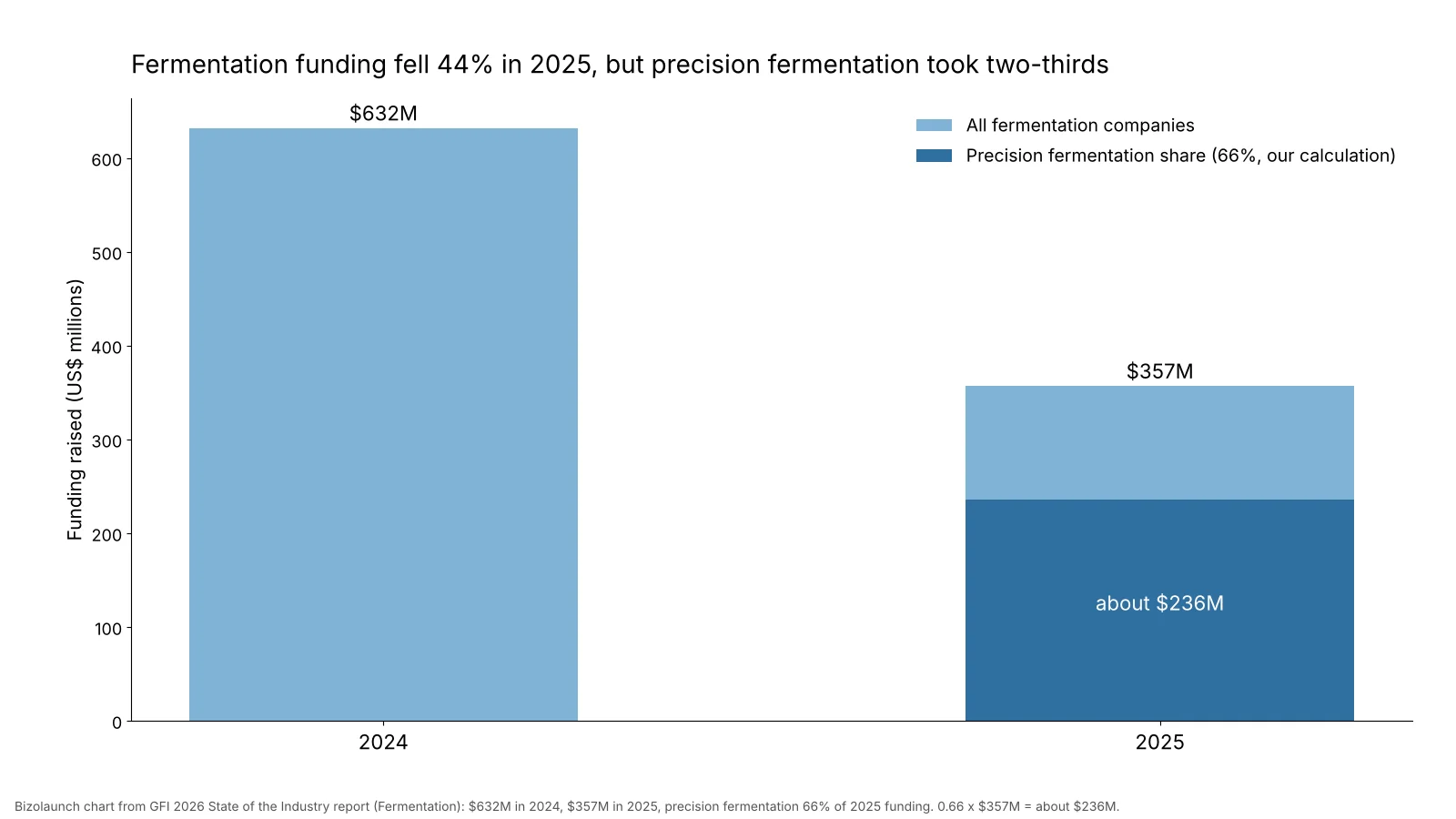
The money was concentrated. The three largest deals, EVERY ($55 million), Formo ($36 million) and The Protein Brewery ($35 million), added up to $126 million, or about 35% of the year’s total. For the first time, European companies raised more ($179 million) than North American ones ($154 million). Founders raising in this climate should expect investors to ask about plant capacity and signed buyers before anything else; our guides to SAFE notes and the weekly startup funding roundup show how early rounds are being structured.
Factories, Tank Sizes and the Cost Problem
Price is the main thing holding these proteins back, and price depends on scale. A fermentation tank makes the same kind of product whatever its size, but bigger tanks spread labor and equipment over more output. That is why plant and tank volumes get so much attention in this industry.
Several 2025 milestones point in the right direction. Pow.Bio, working with Bühler and ATV Technologies, ran continuous fermentation of dairy proteins at 3,000 liters and reported more than three times the productivity and a 50% cost cut. Continuous means the tank keeps running instead of being emptied and cleaned after each batch, which is closer to how a brewery or a chemical plant runs at its best.
Fats and oils are scaling too. The UK’s Clean Food Group bought a one-million-liter facility for fermentation-made oils and fats, C16 Biosciences took an oil-producing yeast to 50,000 liters, and NoPalm Ingredients validated a palm oil alternative at 120,000 liters using food waste as feedstock. These are not milk or egg proteins, but they share the same tanks, the same contract makers and the same investors, so progress in one area helps the others.
| Company | Product | Scale reached |
|---|---|---|
| Clean Food Group (UK) | Oils and fats | One-million-liter facility acquired |
| NoPalm Ingredients | Palm oil alternative | Validated at 120,000 liters |
| C16 Biosciences | Yeast oil | Scaled to 50,000 liters |
| Pow.Bio with Bühler and ATV | Dairy proteins, continuous process | 3,000 liters; 50% cost reduction |
| Onego Bio | Egg white protein | Planned plant equal to six million hens |
For buyers, the main lesson from these numbers is about timing. Prices for animal-free whey and egg protein are likely to stay above commodity levels until plants like Perfect Day’s in Gujarat and Onego Bio’s in Wisconsin are running at full output, which on the companies’ own timelines means 2027 and 2028.
US Regulatory Timeline for Fermented Dairy and Egg Proteins
In the US, these proteins reach the market through the FDA’s GRAS process. The table lists the 2025 letters in the order they arrived, with filing times where they were reported.
| Company | Ingredient | Letter received | Time from filing |
|---|---|---|---|
| Vivici | Vivitein BLG (whey) | February 2025 | About 7 months (filed July 2024) |
| TurtleTree | LF+ lactoferrin | March 2025 | Not disclosed |
| Verley | FermWhey Native and MicroStab | September 2025 | Filed early 2025 |
| Onego Bio | Bioalbumen (egg white) | September 2025 | About 9 months |
The rules may tighten. Health Secretary Robert F. Kennedy Jr. has directed the FDA to reevaluate and eventually remove the “self-affirmed” GRAS route, under which a company can conclude on its own that an ingredient is safe without an FDA letter. If that happens, a formal FDA letter becomes the only path, which favors the companies that already hold one. In Europe, EU policymakers agreed in March 2026 to stop alternative proteins from using “meat” and 31 related terms, which shows how labeling rules can shape these markets too.
Lessons for Food Founders Watching This Field
Three patterns repeat across the companies above. First, the winners pair up with incumbents: Vivici with Fonterra, Remilk with Gad Dairies, Perfect Day with Zydus and Imagindairy with Strauss. A big partner brings distribution, trust and sometimes factory space. Second, several firms start with specialty proteins such as lactoferrin or functional whey rather than the cheapest bulk products. Third, capacity is the real bottleneck, which is why so much of the news is about plants rather than products.
For anyone building a food business around these ingredients, the practical route is to buy rather than make. A bakery, café or snack brand can use animal-free egg or whey protein as an ingredient and market the benefits, as Walmart’s shelves now show. Founders tracking other farm-free food models can compare this sector with lab-grown seafood makers and the economics in our guide to vertical farming start-up costs.
Buying Animal-Free Protein for a Food Brand: A Short Checklist
Small brands can use these proteins today, but the buying process is closer to sourcing a specialty ingredient than ordering flour. These are the questions we would put to any supplier.
- Ask for the regulatory paper: request the FDA letter number, such as Verley’s GRN 1241, and check it covers your use.
- Plan the allergen label: the protein is the same as the animal one, so milk or egg allergen warnings still apply.
- Check supply: Perfect Day says its current plant is sold out, so ask any supplier about lead times and minimum orders.
- Test in your recipe: functional versions such as Verley’s MicroStab are built for heat and acid, so match the grade to the product.
- Model the cost: price the protein per serving, not per kilogram, before you decide it is too expensive.
New entrants appear every few months in this field. Our running list of new startups to watch is a useful place to spot the next supplier before it signs its big brand deals.
Common Questions About Precision-Fermented Food
Is Precision Fermentation Dairy Vegan?
No animal is used to make the protein, so many vegans accept it. The protein itself is identical to the animal version, which means people with milk or egg allergies should avoid it.
Which Companies Make Animal-Free Whey Protein?
Perfect Day, Vivici, Verley and Remilk all make beta-lactoglobulin, the main whey protein. Vivici and Verley received FDA no-questions letters in 2025.
Is Precision-Fermented Food Approved by the FDA?
Several proteins have FDA no-questions letters under the GRAS program, including Vivici’s whey, TurtleTree’s lactoferrin, Verley’s FermWhey and Onego Bio’s Bioalbumen. EVERY’s egg proteins also have FDA no-objection letters.
How Is Precision Fermentation Different From Lab-Grown Meat?
Precision fermentation uses microbes to make one protein. Lab-grown, or cultivated, meat grows actual animal cells into tissue.
Reports and Regulatory Coverage Behind This List
- Industry data: GFI 2026 State of the Industry report: Fermentation.
- Company and regulatory reports: AgFunderNews on Perfect Day (December 2025), FoodNavigator on EVERY (November 2025), Green Queen on Onego Bio (September 2025), Green Queen on Vivici (March 2025), FoodNavigator on Verley (October 2025), The Spoon on Remilk (November 2025).