Cultivated meat, grown from real animal cells in steel tanks instead of on a farm, is legal to sell in only a handful of places in late 2026: Singapore, the United States, Australia and New Zealand, with Israel approving one product. Roughly a dozen products have been cleared worldwide, from UPSIDE Foods and GOOD Meat chicken to Wildtype salmon, Vow quail and Aleph Farms beef. Yet none is sold at commercial scale anywhere, and seven US states have banned it.
Cost is the main reason. Published estimates of production cost at scale range from about $6 to about $51 per kilogram, depending on who did the math, and the only retail product so far, Singapore’s GOOD Meat 3, contains just 3% cultivated chicken. Investment also halved, from $139 million in 2024 to $73.9 million in 2025. This guide sets out who is approved where, what the numbers say about cost, and what has to happen for the industry to grow.
Cultivated Meat Approvals by Country
The US FDA lists completed consultations by species and date but not always by company, so the table notes where the FDA does not name the company.
| Country | Regulator | Company and product | Date |
|---|---|---|---|
| United States | FDA, plus USDA for meat and poultry | Chicken (UPSIDE Foods, not named by FDA) | FDA letter November 16, 2022 |
| United States | FDA, plus USDA | GOOD Meat cultured chicken | FDA letter March 20, 2023 |
| United States | FDA | Pork fat (Mission Barns, not named by FDA) | FDA letter March 7, 2025 |
| United States | FDA | Coho salmon (Wildtype, not named by FDA) | FDA letter May 28, 2025 |
| United States | FDA | Chicken (Believer Meats, not named by FDA; company closed December 2025) | FDA letter July 24, 2025 |
| Singapore | Singapore Food Agency | GOOD Meat chicken, Vow quail, Parima chicken and duck, Aleph Farms beef | Parima duck April 2026; Aleph Farms August 2026; others earlier |
| Australia and New Zealand | FSANZ | Cultured quail (Vow), application A1269 | Board approval announced April 9, 2025 |
| Israel | Israeli food safety regulators | Aleph Farms beef | December 2023 |
| United Kingdom | Food Standards Agency | Pet food only (Meatly); human food via a 2025 sandbox | No human-food approval yet |
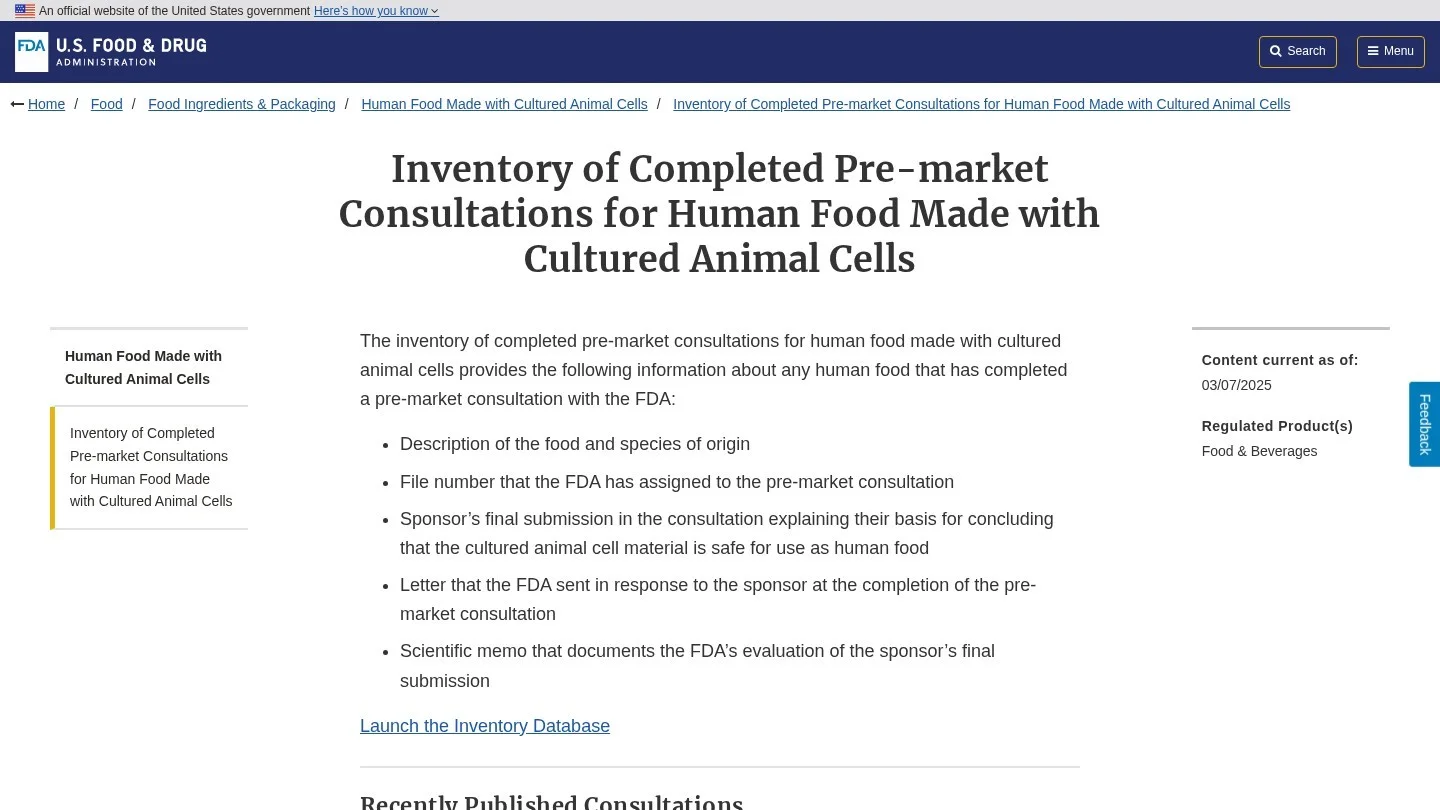
In the US, cultivated meat and poultry go through a joint review by the FDA and the USDA, while seafood such as salmon falls to the FDA.
The European Union has approved nothing yet, though applications run through its novel food system. Japan’s review is described as well advanced. South Korea passed a food tech promotion law in December 2025, which may speed things up there.
US States That Ban Lab-Grown Meat
Federal clearance does not mean you can buy cultivated meat everywhere in the US. Seven states have banned it: Florida, Alabama, Mississippi, Texas, Indiana, Montana and Nebraska. Florida’s ban started in May 2024, and Texas passed a two-year moratorium in September 2025.
The companies are fighting back in court, with mixed results so far. UPSIDE Foods challenged Florida’s law, but in March 2026 a three-judge panel of the 11th Circuit Court of Appeals upheld the ban, finding that federal poultry law does not override it. Wildtype and UPSIDE also sued Texas the day after its moratorium took effect.
For a startup, the bans shrink the home market and raise legal costs. Texas and Florida alone are large food markets, so these laws push companies to launch first in friendlier states, or abroad in Singapore and Australia.
Cultivated Meat Companies to Know
UPSIDE Foods and GOOD Meat in Chicken
These two California companies were the first through the US system, in 2022 and 2023. GOOD Meat, part of Eat Just, also made the world’s first retail sale. On May 16, 2024, it began selling GOOD Meat 3 at Huber’s Butchery in Singapore: a 120-gram pack of plant protein with 3% cultivated chicken, priced at S$7.20. UPSIDE has also taken state bans to court.
Wildtype in Salmon and Mission Barns in Pork Fat
Both cleared FDA review in 2025, and both chose products where a small amount of cultivated material makes a big difference. Wildtype grows coho salmon cells, and Mission Barns grows pork fat. In our view, a fat or a fish product is a sensible first target, because the cultivated part can be one ingredient in a dish rather than a full cut of meat that has to look and chew like a steak.
Vow in Quail
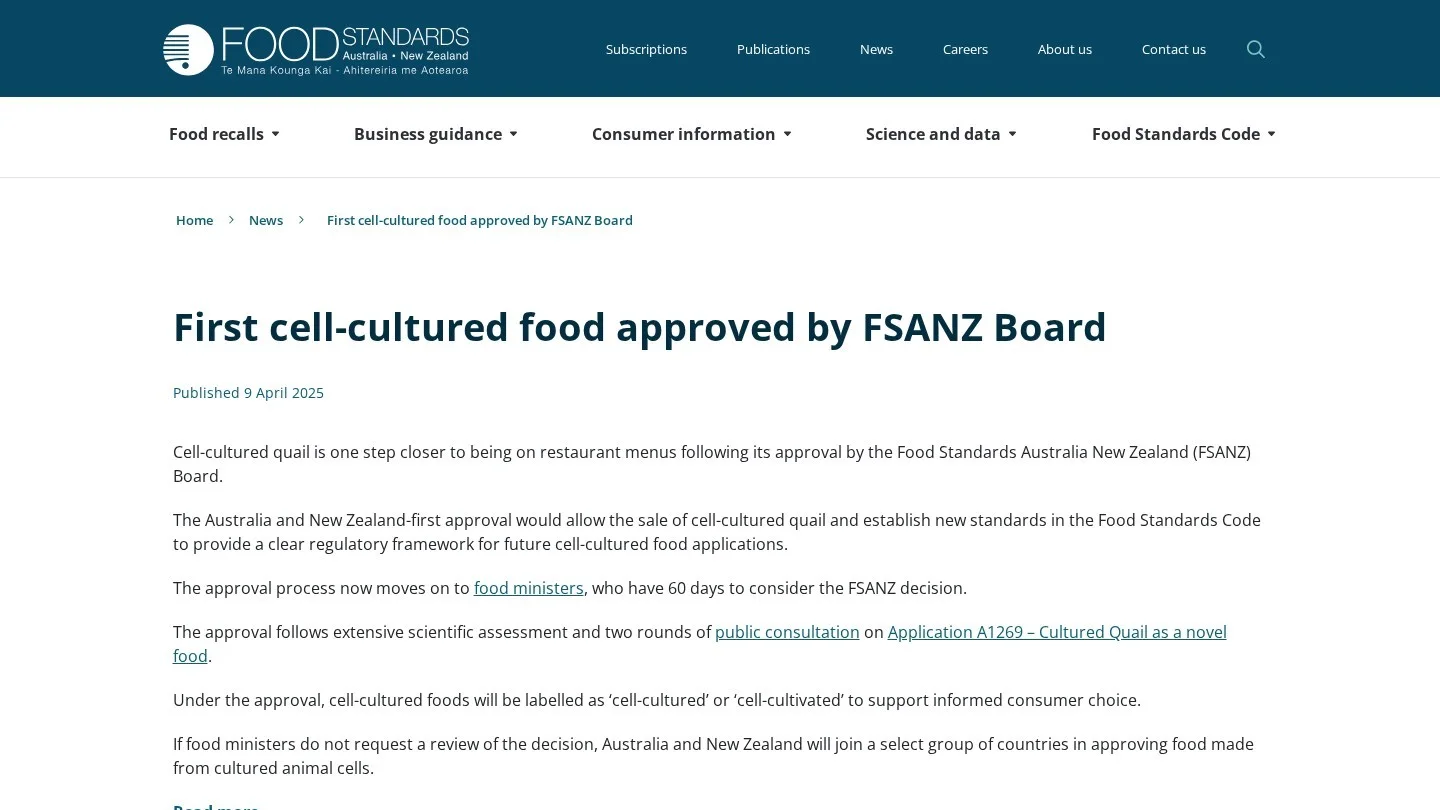
Vow, from Sydney, holds approvals in both Singapore and Australia and New Zealand. FSANZ approved its cultured quail as the first cell-cultured food in the two countries, and new labels must say “cell-cultured” or “cell-cultivated.” Vow reached 20,000-liter production at its Sydney plant, which has 35,000 liters of total capacity, making it the largest cultivated meat facility operating in the world.
Aleph Farms in Beef
Israel’s Aleph Farms won approval at home in December 2023 and in Singapore in August 2026, nearly four years after it applied there. Its Thin-Cut Steak combines Black Angus cow cells with a soy and wheat protein base. The company plans to start production in Singapore in the first half of 2027 with select restaurants. It has raised $147 million, and its $29 million round was the largest cultivated meat deal of 2025.
Parima, Mosa Meat and BlueNalu
Parima holds Singapore approvals for chicken and, since April 2026, duck, with plans for high-end dishes such as foie gras. Mosa Meat ($17.6 million) and BlueNalu ($11 million) closed two of 2025’s three largest rounds. Believer Meats is a reminder of the risk: it cleared US review in 2025 and closed in December of the same year.
What Cultivated Meat Costs to Make
Nobody publishes audited production costs, so the best guides are two techno-economic analyses, which model a full-size factory on paper. They reach very different answers.
- Humbird analysis for Open Philanthropy (December 2020): about $17 per pound at the factory gate with 20,000-liter reactors, and over $23 with perfusion reactors. It modeled plants making 6.8 kilotons a year and expected ground products to retail near $40 per pound.
- CE Delft analysis for GFI (2021): about $2.50 per pound by around 2030, assuming large cost cuts in growth media and full-scale plants.
We converted both to kilograms (1 pound is 0.4536 kg, so multiply by 2.2046):
| Estimate | Per pound | Per kilogram (our conversion) |
|---|---|---|
| CE Delft, projected around 2030 | $2.50 | $5.51 |
| Humbird, 20,000-liter reactors, factory cost | $17 | $37.48 |
| Humbird, perfusion reactors, factory cost | $23 | $50.71 |
| Likely retail price of a ground product (The Counter, on Humbird) | $40 | $88.18 |
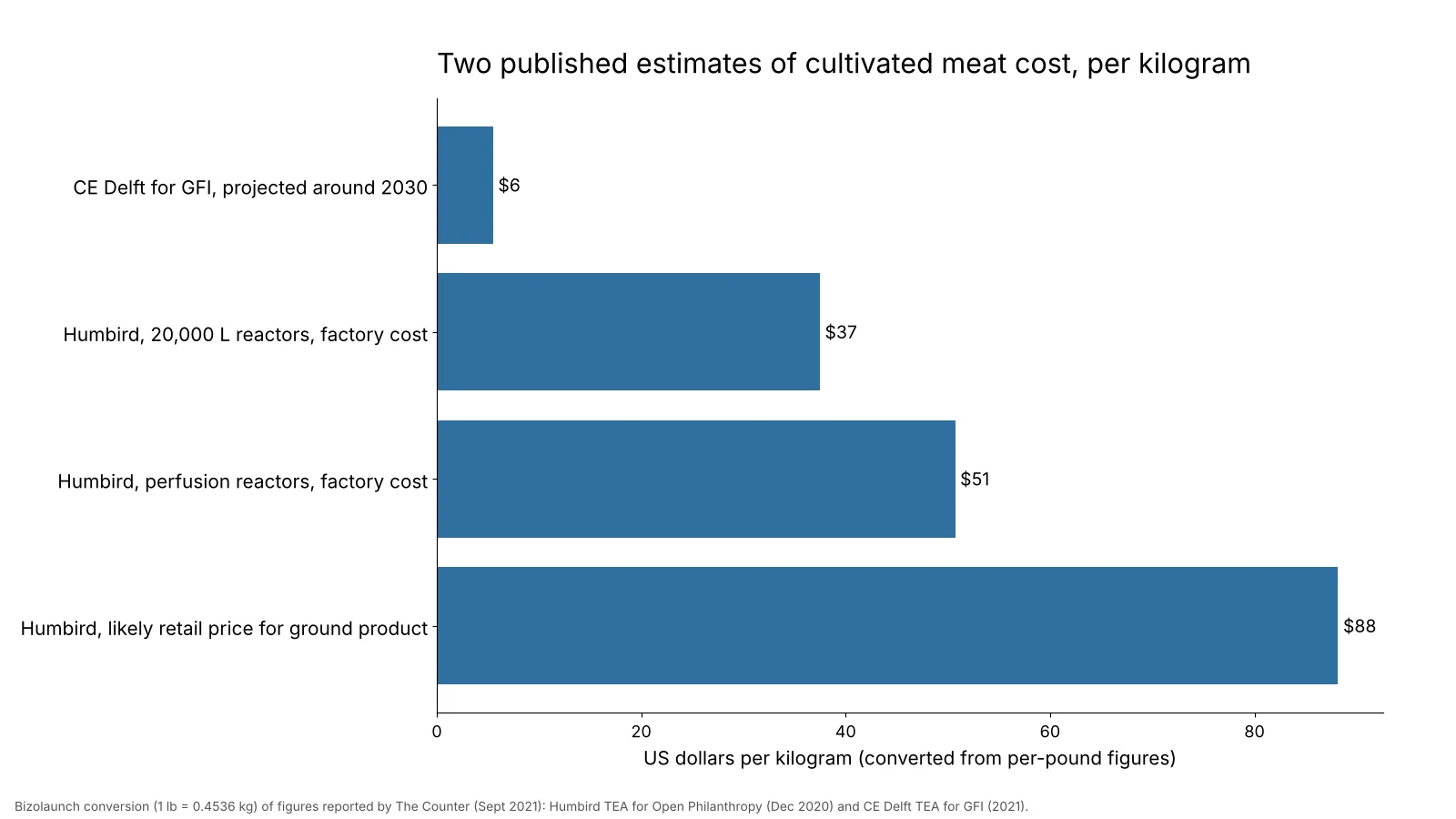
The two studies differ by a factor of about seven at the factory gate. Humbird’s work flags growth factors and the need for clean-room conditions as costs that may not fall far, and it assumes the product is a cell slurry suited only to ground-meat-style foods. CE Delft’s lower figure depends on those same inputs getting much cheaper at scale.
How Cultivated Meat Is Made, Step by Step
Understanding the process makes the cost debate easier to follow. Each step below carries its own cost, and the studies disagree mainly about how far those costs can fall.
- Start with cells. A company takes a small sample of cells from an animal, or uses a stored cell line, and picks cells that grow well.
- Feed them. The cells grow in a liquid “media” of sugars, amino acids, salts and growth factors. Humbird estimated amino acids alone add about $8 per pound, and flagged growth factors as a cost that may not fall much.
- Grow them in bioreactors. Steel tanks keep the cells warm, fed and free of germs. Humbird’s model assumed clean-room conditions, which are expensive to build and run.
- Harvest. In Humbird’s model the result is a slurry of about 30% cells and 70% water, suited to ground or blended products.
- Turn it into food. The cells are blended with plant proteins, fats or binders and shaped into nuggets, cutlets or thin steaks.
Our Scale Math: How Far Today’s Plants Are From a Full Factory
Humbird’s study described a cost-efficient plant as about two dozen 20,000-liter reactors producing about 6.8 kilotons a year, in an industry making 100 kilotons a year worldwide. We used those inputs to size the gap.
| Measure | Input | Result |
|---|---|---|
| Reactor volume in one model plant | 24 x 20,000 liters | 480,000 liters |
| Vow’s Sydney plant compared with that | 35,000 liters of total capacity | About 7% of one model plant |
| Plants needed for a 100-kiloton industry | 100 / 6.8 kilotons | About 15 plants |
So even the largest cultivated meat facility in operation holds about one-fourteenth of the reactor volume in a single model plant, and the model industry needs about 15 of those plants. A 100,000-liter reactor might cost about $20 million and take a year to build. Those numbers explain why investors now ask about factory plans before anything else, and why falling funding slows the whole timeline.
What the First Retail Pack Tells Us About Price
GOOD Meat 3 is the one product with a public shelf price, so we ran the numbers on it. A 120-gram pack at S$7.20 works out to S$60 per kilogram. At 3% cultivated chicken, each pack holds about 3.6 grams of cultivated cells (120 x 0.03).
That design choice explains the price. By blending a small share of cells into a plant base, GOOD Meat could sell at an everyday price while the cultivated part remained costly to produce. Aleph Farms’ Thin-Cut Steak, which pairs cow cells with a soy and wheat base, is also a hybrid. For now, hybrids are how the industry gets a product in front of diners, and the share of cells in each product is the number to watch as costs fall.

Investment and Factory Scale Heading Into 2027
Money has become scarce, and that matters more here than in most startup fields because factories are so expensive to build. Cultivated meat and seafood companies raised $73.9 million in 2025, down 47% from $139 million in 2024 by our arithmetic. The three largest deals, Aleph Farms ($29 million), Mosa Meat ($17.6 million) and BlueNalu ($11 million), made up $57.6 million, or about 78% of the total.
Public money is shifting too. US federally funded research declined, while China’s state-owned State Development and Investment Corporation committed over CNY 4 billion (about $555 million) to biomanufacturing infrastructure. GFI also bought eight cow cell lines from the former startup SCiFi Foods, which will keep that research available to others. Founders following this market can track rounds in our weekly startup funding roundup.
Future Prospects for Lab-Grown Meat
The near-term path looks narrow but real, and it runs through restaurants before supermarkets. Expect more approvals in Asia and Australia, more hybrid products in restaurants, and a focus on high-value items such as foie gras, salmon and pork fat, where a small amount of cultivated material adds a lot of value. Aleph Farms’ restaurant launch in Singapore in 2027 and Vow’s larger plant are the milestones to watch.
The long-term case rests on cost. If growth media get as cheap as CE Delft assumed, cultivated meat could reach everyday price levels. If Humbird is closer to right, it will stay a premium product. In the US, the state bans and the Florida court ruling add a legal question on top of the cost question.
Labeling rules will also shape how these foods reach shoppers. Australia and New Zealand require the words “cell-cultured” or “cell-cultivated” on packs, which gives buyers a clear signal. In Europe, policymakers agreed in March 2026 to stop alternative proteins, including cultivated products, from using “meat” and 31 related terms. Rules like these affect marketing budgets and brand names long before a product reaches a shelf, so a founder entering this field should plan the label and the name country by country, alongside the safety file.
Cultivated meat is one of several routes to food made without farms. Precision fermentation companies are already selling animal-free whey and egg protein at scale, and lab-grown seafood makers follow a similar path to Wildtype. For founders weighing a capital-heavy food startup, our guide to vertical farming start-up costs shows how another indoor food model handles high fixed costs, and the break-even calculator helps test pricing assumptions.
Reader Questions About Cultivated Meat
Where Can You Buy Lab-Grown Meat?
Sales are allowed in Singapore, the US (outside states with bans) and Australia, but no product is on sale at commercial scale. GOOD Meat 3 at Huber’s Butchery in Singapore was the first retail product.
Is Lab-Grown Meat Approved by the FDA?
Yes. The FDA has completed pre-market consultations for chicken, pork fat and salmon, the first in November 2022. Meat and poultry products also go through USDA inspection and labeling.
How Much Does Lab-Grown Meat Cost?
Published factory-cost estimates range from about $5.51 per kilogram in an optimistic 2030 scenario to about $50.71 per kilogram for perfusion reactors in Humbird’s model. The only retail product, a 3% hybrid, sold at S$7.20 for 120 grams.
Which States Have Banned Lab-Grown Meat?
Florida, Alabama, Mississippi, Texas, Indiana, Montana and Nebraska. Florida’s ban was upheld by a federal appeals court in March 2026.
Regulator Pages and Reports We Relied On
- Regulators: FDA inventory of completed consultations, FSANZ announcement (April 2025).
- Company: GOOD Meat retail launch (May 2024).
- Reports: FoodNavigator (February 2026), Cultivated X (August 2026), Cultivated X on GFI data (April 2026), Green Queen (August 2026), Quartz, CBS News Miami (March 2026), The Counter (September 2021).