How Many US Optometry Offices Compete for Patients
The US had 22,501 offices of optometrists in 2023, employing 147,931 people with a combined payroll of $7.2 billion. Those offices brought in $18.2 billion in revenue in 2022, up 15.7% from the pandemic low of 2020. Divide one by the other and the typical office takes in roughly $809,000 a year with about six or seven staff. Most of that money depends on two things marketing can move: how often patients come back for exams, and whether they buy their glasses and contacts in the same building.
The figures below come from federal business surveys, labor data, large consumer tracking surveys of eyewear buyers, and federal rules. Where we combined them, the method sits next to the number.
| Measure | Figure | Period |
|---|---|---|
| Offices of optometrists (establishments) | 22,501 | 2023 |
| People employed in those offices | 147,931 | 2023 |
| Annual payroll | $7.2 billion | 2023 |
| Revenue of employer offices | $18.2 billion | 2022 |
| Revenue per office (our estimate) | About $809,000 | 2022 revenue over 2023 office count |
| Employees per office (our calculation) | 6.6 | 2023 |
| Payroll as a share of revenue (our estimate) | About 40% | 2023 payroll over 2022 revenue |
Revenue for employer offices of optometrists ran $16.1 billion in 2018 and $16.6 billion in 2019. It dropped 5.3% to $15.7 billion in 2020, then recovered to $18.0 billion in 2021 and $18.2 billion in 2022. Growth from 2018 to 2022 was 12.9% in total, so the market is growing, but slowly. Practices mostly grow by winning patients from each other, which makes retention and local visibility worth more than broad awareness.
Eye Exam Habits That Shape Recall Campaigns
In a survey of 12,058 US adults in the second quarter of 2024, 62% had an eye exam within the past 12 months and 21% said their last exam was more than two years ago. That leaves about 17% in the one-to-two-year gap, by subtraction. These three groups need different messages. The first needs an annual reminder, the second a nudge before they lapse, and the third a reason to come back at all.
Younger adults are moving the right way. Annual exam rates rose 9 percentage points for Gen Z and 11 points for millennials between early 2023 and mid-2024. Younger adults were still less likely than older ones to have an annual exam or to plan their next one within a year, so they need more reminders.
| Exam timing (Q2 2024) | Share of adults | In a 3,000-patient database (our example) | Message that fits |
|---|---|---|---|
| Within the past 12 months | 62% | 1,860 | Annual recall reminder |
| One to two years ago (derived) | 17% | 510 | “You are due” outreach with booking link |
| More than two years ago | 21% | 630 | Reactivation offer or new-symptom check |
The 3,000-patient database is a hypothetical practice used to show scale, with the national shares applied. In a practice that size, 630 people have drifted past two years. Bringing back one in ten of them would add 63 exams, plus whatever eyewear those patients buy.
Where Patients Book Exams and Buy Eyewear
More than 80% of US adults use some form of vision correction, in a 12,097-adult survey for the third quarter of 2025. In that quarter, 86% of eyewear purchases were made in a store, and more than half of recent eye exams and eyewear purchases happened at independent optical practices. Corporate chains and online sellers had their biggest following among younger buyers and contact lens wearers.
Contact lenses are where online sellers gain ground. The share of contact lens buyers purchasing online stood at 33% in the second quarter of 2024. It reached 35% in late 2024 and 39% in the first quarter of 2025. More than 75% of contact lens users bought lenses within the past year, and nearly a third wear daily lenses, so this is a frequent, repeat purchase that leaves the practice easily.
| Quarter | Contact lens buyers purchasing online |
|---|---|
| Q2 2024 | 33% |
| Q4 2024 | 35% |
| Q1 2025 | 39% |
A practice with 600 contact lens patients would, at the 39% rate, see about 234 of them buying supplies online. Annual-supply pricing, rebates on the practice’s own site, and auto-ship programs are the usual answers, and they can be pitched at the exam itself.
Spending and Insurance Figures for Pricing Optical Offers
Price sensitivity is high. In early 2025, 40% of adults paid under $100 out of pocket for glasses, while 28% spent $200 or more, up a point from late 2024. On contact lenses, 17% spent over $200, up from 14%. Spending of $100 or more on non-prescription glasses, such as sunglasses and blue-light frames, jumped to 34% from 28%, the highest level in three years.
| Spending measure | Q4 2024 | Q1 2025 | Change |
|---|---|---|---|
| Spent $200+ on eyeglasses | 27% | 28% | +1 point |
| Spent over $200 on contact lenses | 14% | 17% | +3 points |
| Spent $100+ on non-prescription glasses | 28% | 34% | +6 points |
| Paid under $50 for an eye exam | Not reported | 67% | No comparison |
| Paid over $100 for an eye exam | Not reported | 15% | No comparison |
Insurance shapes the visit. Employer-sponsored managed vision coverage stood at 47% in the first quarter of 2025, down from 50% in an earlier quarter. In mid-2024, managed vision care coverage of any kind was highest among Gen X at 71%, with millennials close behind at 69%. Two-thirds of adults paid under $50 for their exam, so the exam itself is rarely the barrier. Ads that explain which plans the practice accepts, and what the benefit covers, answer the question most patients have before booking.
Staffing Numbers Behind the Optometry Front Desk
Offices of optometrists employed 151,610 people in May 2023. Only 40 of them were marketing managers and 170 were marketing specialists or analysts, about 0.14% of all staff combined. With roughly one dedicated marketer for every hundred offices, marketing in most practices falls to the owner, the front desk and the opticians.
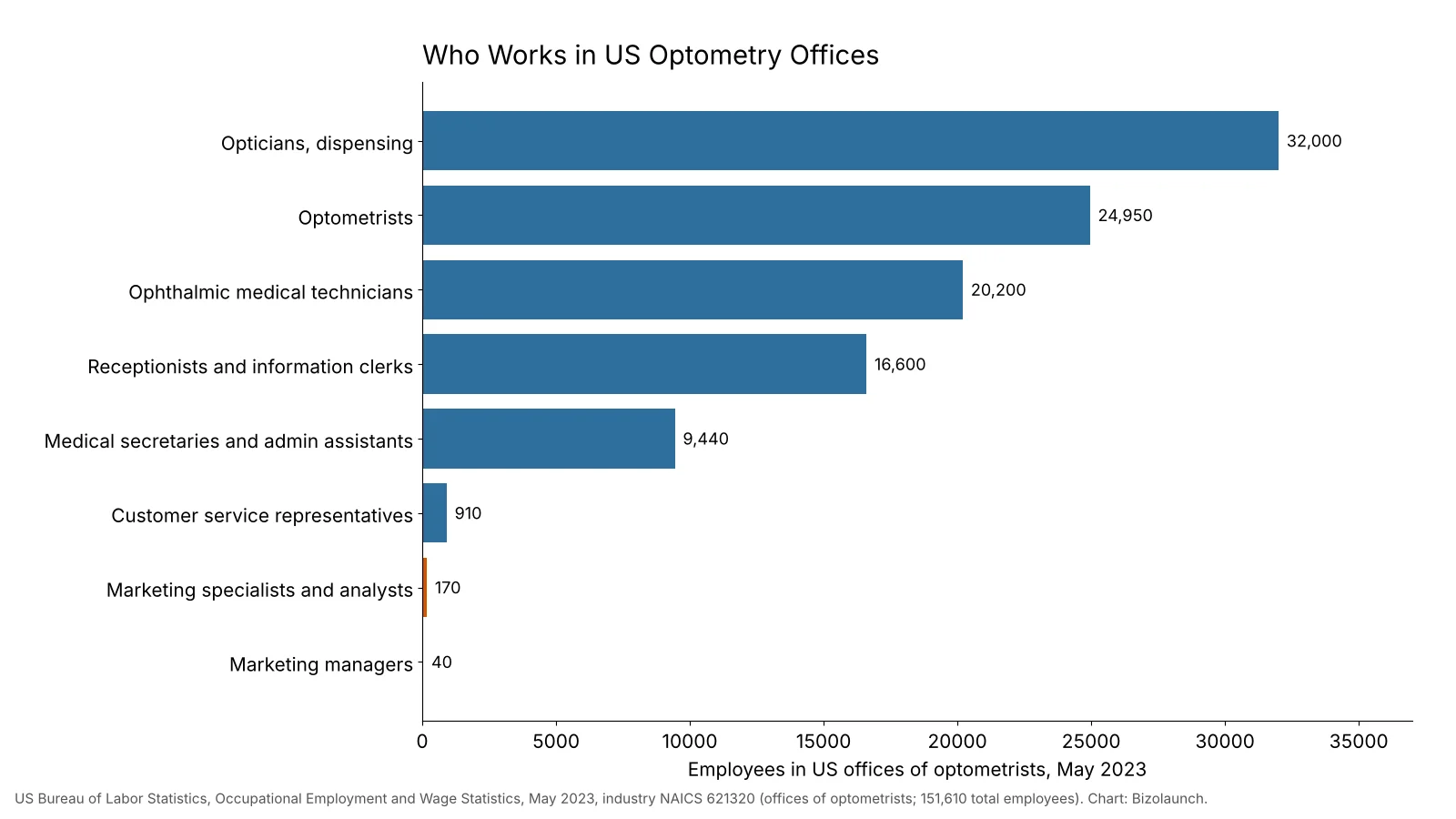
| Occupation in offices of optometrists | Employment, May 2023 | Share of staff (our calculation) | Annual mean wage |
|---|---|---|---|
| Opticians, dispensing | 32,000 | 21.1% | $42,610 |
| Optometrists | 24,950 | 16.5% | $131,590 |
| Ophthalmic medical technicians | 20,200 | 13.3% | $38,020 |
| Receptionists and information clerks | 16,600 | 10.9% | $35,490 |
| Medical secretaries and administrative assistants | 9,440 | 6.2% | $38,740 |
| Customer service representatives | 910 | 0.6% | $36,790 |
| Market research analysts and marketing specialists | 170 | 0.1% | $41,390 |
| Marketing managers | 40 | 0.03% | $162,330 |
There are about two receptionists for every three optometrists in these offices. For many patients the phone call is the first contact with the practice, and a missed call is often a lost booking. Practices that cannot staff the phone through lunch and evenings often use an outside service, compared in our guide to medical answering services. For booking and recall calls, a short written script keeps the message consistent, and our sales call script examples adapt well to a front desk.
Where Optometrists Work and Earn
The US had 45,100 optometrist jobs in 2025, with a median wage of $136,570 in May 2025. Employment is projected to grow 10% from 2025 to 2035, much faster than the average for all occupations, with about 2,000 openings a year. Offices of optometrists employ 61% of optometrists, physicians’ offices 14% and retailers 13%, while 5% are self-employed. That 13% in retail is the chain and big-box competition independent practices market against.
By state, California had the most optometrists in May 2023 at 6,190, followed by Texas (2,880), Florida (2,520), New York (2,010) and Ohio (1,860). North Dakota had the highest density at 0.59 optometrists per 1,000 jobs, followed by South Dakota (0.43) and Hawaii (0.40). Practices in those states may face denser local competition, where reviews and map listings carry extra weight.
Social Platforms Eye Care Patients Use
In a 2026 survey of 5,511 US adults, 84% used YouTube and 70% used Facebook. Instagram reached 51%, TikTok 37%, WhatsApp 33% and LinkedIn 31%. Nextdoor, the neighbourhood network, reached 18%, the same as X.
| Platform | US adults using it, 2026 | Fit for an optometry practice |
|---|---|---|
| YouTube | 84% | Short explainers on exams, dry eye, myopia control for children |
| 70% | Local ads to older patients, event posts, review collection | |
| 51% | Frame launches, try-on reels, staff faces | |
| TikTok | 37% | Younger buyers, the group more likely to use chains and online sellers |
| Nextdoor | 18% | Neighbourhood recommendations |
TikTok’s audience lines up with the younger patients most likely to drift toward chains and online sellers. Facebook still reaches the older patients who favour independent practices and plan their next exam.
Federal Rules That Limit Optometry Advertising
Two federal rules shape what a practice can promise. The updated Eyeglass Rule, approved 5-0 by the Federal Trade Commission in June 2024, requires prescribers to hand over the prescription right after a refractive exam, before offering to sell glasses. Prescribers who sell eyewear must also ask the patient to sign a confirmation of receipt and keep it for at least three years. A digital copy is allowed only with the patient’s verifiable consent.
The FTC’s rule on consumer reviews and testimonials, announced on August 14, 2024, bans fake reviews, including AI-written ones. It also bans reviews by staff or owners without disclosure, and rewards conditioned on a positive review. Each violation can cost up to $51,744. A practice can still ask every patient for a review, as long as the request does not depend on what they say.
- Prescription first. Hand over the prescription, get the signed confirmation, then show frames.
- Ask every patient for a review. Do not offer gift cards or discounts tied to a five-star rating.
- Label staff posts. If an employee reviews or promotes the practice, disclose the connection.
- Keep records. Store signed prescription confirmations for three years in a form you can retrieve.
Turning These Optometry Figures Into a Yearly Plan
Start with the money each patient is worth. If your office is near the national average of about $809,000 in revenue, and you see 3,000 active patients, each is worth about $270 a year. That number sets how much you can spend to win one back. Compare it with your cost to acquire a new patient, a method we lay out in how to calculate CAC payback.
- Recall first. With 21% of adults more than two years past an exam, reactivation is often cheaper than new-patient ads.
- Protect contact lens revenue. At 39% online buying, offer annual supplies and home delivery at the exam.
- Explain coverage. With 47% on employer vision plans, list accepted plans on every ad and booking page.
- Use print in the office. A QR code at checkout that opens the review page costs nothing; our free QR code generator makes one.
- Know your break-even. Before adding a second location or a paid campaign, run the fixed and variable costs through our break-even calculator.
Other trades show the same pattern of local, review-driven buying; our painting contractor marketing statistics offer a useful comparison for practice owners who sit on local business groups.
Optometry Marketing Questions Practice Owners Ask
How Often Do Americans Get an Eye Exam?
In mid-2024, 62% of US adults had an eye exam within the past year and 21% had gone more than two years without one. Older adults were more likely to keep to a yearly schedule and to book their next visit in advance.
Do Most People Buy Glasses Online Now?
No. In the third quarter of 2025, 86% of eyewear purchases were made in a store. Contact lenses are the exception, with 39% of buyers purchasing online in early 2025, up from 33% a year earlier.
How Much Revenue Does an Optometry Practice Make?
Employer offices of optometrists earned $18.2 billion in 2022. Spread across the 22,501 offices counted in 2023, that is roughly $809,000 per office, though a solo practice and a multi-doctor clinic will sit far apart from that average.
Can an Optometrist Offer a Discount for a Google Review?
Offering a reward only for positive reviews breaks the FTC’s 2024 review rule, with penalties up to $51,744 per violation. Asking every patient for feedback, with nothing tied to the rating, stays within the rule.
Eye Care Surveys and Federal Data Cited
Per-office revenue, staff shares, the recall example and the contact lens example are Bizolaunch calculations from the figures in these sources.
- US Census Bureau County Business Patterns 2023, NAICS 621320 figures as tabulated by PlainBizBench (establishments, employees, payroll)
- US Census Bureau Service Annual Survey via FRED: Total revenue for offices of optometrists
- US Bureau of Labor Statistics: OEWS May 2023, offices of optometrists
- US Bureau of Labor Statistics: Occupational Outlook Handbook, Optometrists
- US Bureau of Labor Statistics: OEWS May 2023, Optometrists (29-1041)
- The Vision Council: Consumer inSights Q3 2025 release (November 17, 2025)
- The Vision Council: Consumer inSights Q1 2025 release (April 17, 2025)
- The Vision Council: Consumer inSights Q2 2024 release (July 25, 2024)
- Pew Research Center: Social Media Fact Sheet (2026 survey)
- Federal Trade Commission: Final Eyeglass Rule announcement (June 2024)
- Davis Wright Tremaine: FTC finalizes rule banning fake consumer reviews (August 2024)