The US Hospital Market Behind Every Marketing Budget
Advertising by hospitals and other health services aimed straight at patients grew from $542 million in 1997 to $2.9 billion in 2016, a 5.4-fold rise. By our calculation that is about 9.2% growth a year, more than three times the pace of medical marketing overall. The spending now competes for attention among 6,100 US hospitals, most of them in systems. Patients compare those hospitals on public star ratings, posted prices and their own phones.
The statistics below come from hospital association survey data, federal ratings and enforcement records, a federal survey of patient technology use, a peer-reviewed study of medical marketing, and a national survey of social media use. Calculations are ours and marked as such.
| US hospitals, 2024 survey data | Count | Share of community hospitals (our calculation) |
|---|---|---|
| All US hospitals | 6,100 | Not applicable |
| Community hospitals | 5,121 | 100% |
| Not-for-profit community hospitals | 2,984 | 58.3% |
| Investor-owned (for-profit) community hospitals | 1,224 | 23.9% |
| State and local government community hospitals | 913 | 17.8% |
| Rural community hospitals | 1,797 | 35.1% |
| Urban community hospitals | 3,324 | 64.9% |
| Community hospitals in a health system | 3,567 | 69.7% |
| Federal government hospitals | 210 | Not applicable |
| Nonfederal psychiatric hospitals | 656 | Not applicable |
Seven in ten community hospitals belong to a system, which shapes how marketing is run. A system hospital often shares its brand and website with sister facilities, while an independent hospital carries its whole marketing load alone. Community hospitals had 775,297 staffed beds and 33.6 million admissions. That works out to about 151 beds and 6,552 admissions per hospital on average, or roughly 43 admissions per bed each year.
How Much Health Services Advertising Has Grown
The most detailed accounting of US medical marketing covers 1997 to 2016. Total spending rose to $29.9 billion from $17.7 billion. The share aimed straight at consumers rose to 32% from 11.9%, reaching $9.6 billion. Within that consumer slice, health services (hospitals, cancer centers, clinics and similar providers) went to $2.9 billion from $542 million.
| Medical marketing measure | 1997 | 2016 | Annual growth (our calculation) |
|---|---|---|---|
| Total medical marketing | $17.7 billion | $29.9 billion | 2.8% |
| Direct-to-consumer advertising, all types | $2.1 billion | $9.6 billion | 8.3% |
| Direct-to-consumer prescription drug ads | $1.3 billion | $6.0 billion | 8.4% |
| Health services advertising to consumers | $542 million | $2.9 billion | 9.2% |
By 2016, health services made up about 30% of all direct-to-consumer medical advertising. Hospitals were no longer a side player next to drug makers. They were buying close to a third of the patient-facing ad market, and every dollar of it faced the same question from boards: did it bring patients through the door?
Hospital Star Ratings Patients See on Care Compare
The 2026 federal star ratings covered 3,203 hospitals, up 312 from 2025. Five stars went to 385 hospitals, 94 more than a year earlier, the first rise in five-star hospitals since 2023. One star went to 204, down from 233. About 70% of hospitals received a rating, so roughly three in ten have no star to show at all.
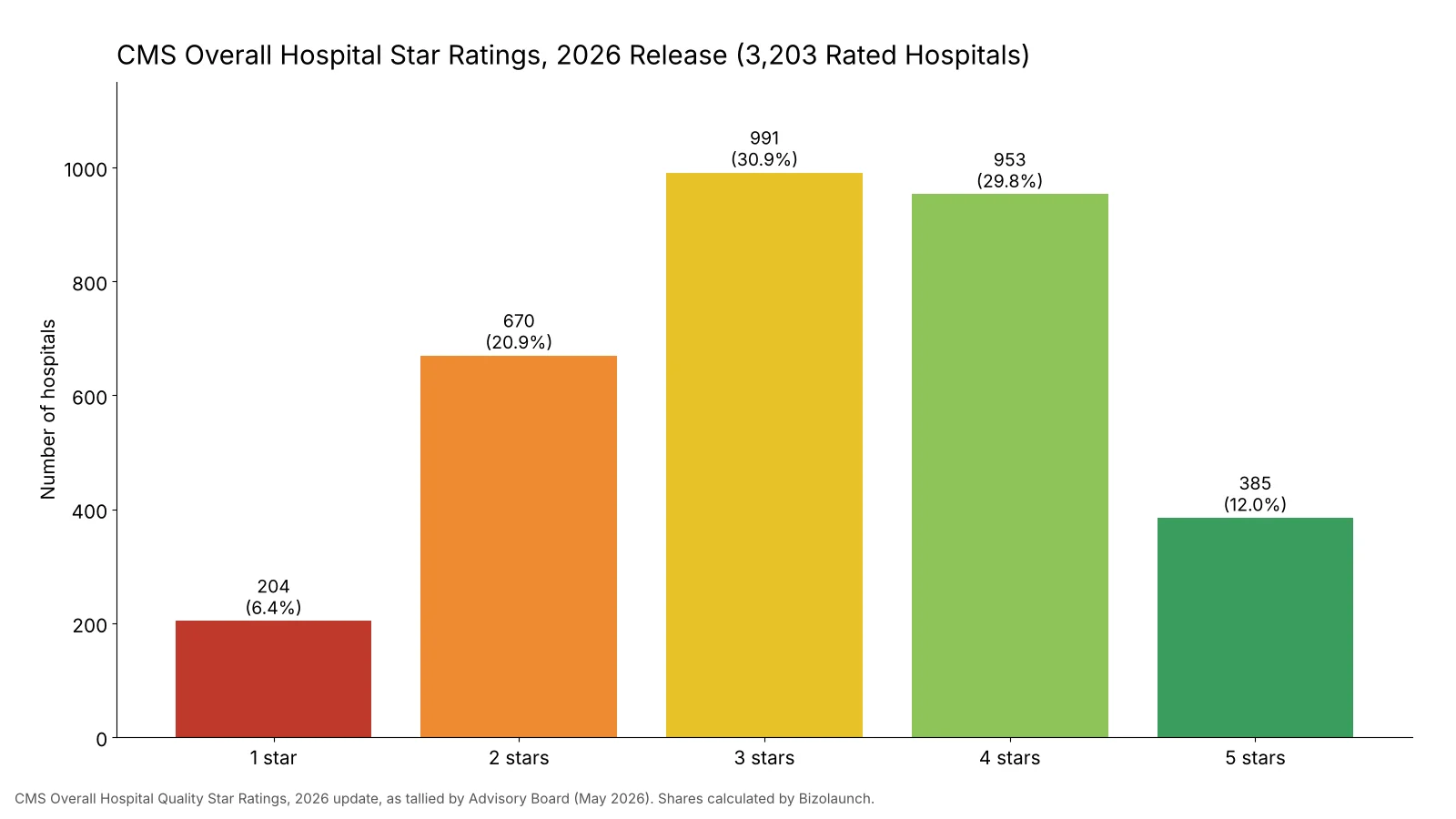
| Star rating, 2026 | Hospitals | Share of rated hospitals | Change from 2025 |
|---|---|---|---|
| 5 stars | 385 | 12.0% | +94 (+32.3%, our calculation) |
| 4 stars | 953 | 29.8% | Not published |
| 3 stars | 991 | 30.9% | Not published |
| 2 stars | 670 | 20.9% | Not published |
| 1 star | 204 | 6.4% | -29 |
By our count, 41.8% of rated hospitals hold four or five stars, a rating worth featuring in advertising, while 27.3% sit at one or two. For the second group, star ratings are a reputational risk that campaigns cannot hide, because the rating is public and free to check. A marketing plan for a two-star hospital can start with the service lines and physicians that earn their own praise.
The jump in rated hospitals also changes the competitive picture in many markets. When 350 hospitals newly qualified for a rating in 2026, patients in their areas gained a side-by-side comparison that did not exist a year earlier. Marketing teams at those hospitals now have a public score to explain, defend or promote.
Price Transparency Enforcement Against Hospitals
Since 2021, hospitals must post their prices online, and those pages have become a marketing asset or a liability. Federal estimates put full compliance at 27% of hospitals in February 2021 and 70% in November 2022. From 2021 to 2023, regulators reviewed 1,746 hospitals, mostly after complaints, and took 1,287 enforcement actions, 851 of them in 2023 alone. Fourteen hospitals were fined a combined total of more than $4 million, with penalties of up to $5,500 a day depending on hospital size.
Enforcement picked up after a February 2025 executive order. Ten hospitals were fined in 2025, with penalties from $32,301 for a small Louisiana facility up to $309,738 for Arkansas Methodist Medical Center. The largest fine on record, $871,122, was issued in 2024 to Jackson Memorial Hospital in Miami. By mid-2025, 65% of 3,764 hospitals reviewed had received at least one warning notice or request for a corrective action plan.
| Date | Price transparency event |
|---|---|
| February 2021 | 27% of hospitals estimated fully compliant |
| November 2022 | 70% estimated fully compliant |
| 2021 to 2023 | 1,287 enforcement actions, 14 fines totalling over $4 million |
| 2024 | Record fine of $871,122 (Jackson Memorial Hospital) |
| February 2025 | Executive Order 14221 orders enforcement within 90 days |
| May 2025 | Placeholder “estimated allowed amount” loophole closed |
| 2025 | 10 fines, $32,301 to $309,738 |
| November 2025 | CY 2026 outpatient rule requires actual dollar amounts and a senior official’s attestation |
| April 2026 | Enforcement of the new requirements begins |
For marketers, the shoppable-services page is now a landing page that patients actually use and regulators actually check. A price page that patients can reach from the home page, that matches the posted file, and that links to booking does double duty as compliance and conversion.

Patient Portal and App Use Trends
In 2024, 77% of US adults were offered online access to their medical records by a provider or insurer, and 65% accessed a portal or online record at least once in the past year. Ten years earlier the access figure was 25%, so it has risen by 40 percentage points. Among people who used their records, 57% used an app, up from 38% in 2020.
| Patient technology measure | Figure | Year |
|---|---|---|
| Offered online access to records | 77% | 2024 |
| Offered and accessed at least once | 65% | 2024 |
| Offered and accessed at least once | 25% | 2014 |
| Users accessing through an app | 57% (38% in 2020) | 2024 |
| Users with more than one portal | 59% | 2024 |
| Caregiver or proxy access | 51% (24% in 2020) | 2024 |
| People with a recent cancer diagnosis who accessed records | 76% | 2024 |
Three trends matter for hospital marketing. The portal is now a channel in its own right, reaching most adults with a login they already trust. Patients juggle several portals, so a hospital’s portal competes with the clinic and insurer apps on the same phone. Caregivers matter more too, with proxy or caregiver access reported at 51% in 2024, up from 24% in 2020, which makes adult children of older patients a real audience for service-line campaigns. Remote care is growing on the same rails, covered in our piece on AI in remote patient monitoring.
Social Media Reach for Hospital Campaigns
A 2026 survey of 5,511 US adults found YouTube used by 84% and Facebook by 70%. Instagram reached 51%, TikTok 37% and LinkedIn 31%. Nextdoor reached 18%, which matters to hospitals because its audience is grouped by neighbourhood around a facility.
| Platform | US adults using it, 2026 | Typical hospital use |
|---|---|---|
| YouTube | 84% | Procedure explainers, physician introductions, maternity tours |
| 70% | Community health events, service-line ads to older adults, caregivers | |
| 51% | Staff stories, new facility openings | |
| TikTok | 37% | Nurse recruitment, health tips for younger adults |
| 31% | Clinical hiring, physician referral relations | |
| Nextdoor | 18% | Neighbourhood notices, urgent care hours |
The gap between platforms shapes budget splits. YouTube reaches 33 points more adults than Instagram, and Facebook reaches 19 points more, by our subtraction. A hospital with one video producer will usually get more reach from a library of short procedure explainers on YouTube than from a daily Instagram feed, while Facebook remains the place where caregivers and older patients see community events.
Review and Testimonial Rules for Hospitals
The Federal Trade Commission’s rule on consumer reviews and testimonials, announced on August 14, 2024, applies to hospitals as it does to any business. It bans fake or AI-generated reviews and testimonials. It also bans undisclosed reviews by insiders such as officers and managers, and rewards tied to a positive or negative review. Using baseless legal threats or intimidation to get a review removed is banned too. Each violation can bring a civil penalty of up to $51,744.
- Patient stories. Use real patients with written consent, and keep the consent on file.
- Staff reviews. Employees who post about their own hospital should disclose that they work there.
- Survey incentives. A raffle for completing a survey is different from a reward for five stars, and only the second is banned by the rule.
- Negative reviews. Reply politely and take details offline. Threats to sue over a review fall under the ban.
Planning a Hospital Marketing Calendar Around the Data
These figures point to a different order of work than a typical “brand campaign first” plan. Start with what patients check, then pay to reach new ones.
| Quarter | Focus | Data point behind it |
|---|---|---|
| Q1 | Audit the price page, machine-readable file and booking links | New attestation rule, enforcement from April 2026 |
| Q2 | Prepare messaging for the annual star rating release | 41.8% of rated hospitals at four or five stars |
| Q3 | Portal and app campaigns for screenings and flu season | 65% of adults accessed records, 57% of them by app |
| Q4 | Caregiver-focused service-line ads ahead of open enrollment | 51% proxy or caregiver access; plan choices for the coming year |
Open enrollment is when many patients pick the plans that decide which hospitals are in network; our guide to ACA open enrollment for 2027 covers the dates and premiums. Phone access counts as much as ads, and hospitals that route overflow calls to an outside team can compare options in our review of medical answering services. For measuring what a paid campaign returns, the method in calculating CAC payback works for a service line as well as a software company. Eye care practices face many of the same issues, covered in our optometry marketing statistics.
Questions Health System Marketing Teams Ask
How Much Do Hospitals Spend on Advertising?
The most recent full accounting puts advertising by hospitals and other health services aimed at consumers at $2.9 billion in 2016, up from $542 million in 1997. That was about 30% of all direct-to-consumer medical advertising that year.
How Many Hospitals Have Five Stars From CMS?
In the 2026 release, 385 of 3,203 rated hospitals earned five stars, or 12.0%. Another 953 earned four stars, so 41.8% of rated hospitals hold four or five.
What Is the Fine for Not Posting Hospital Prices?
Penalties scale with hospital size, reaching up to $5,500 a day for hospitals fined between 2021 and 2023. Fines issued in 2025 ranged from $32,301 to $309,738, and the record so far is $871,122, issued in 2024.
Do Patients Use Hospital Portals?
Yes. In 2024, 65% of US adults were offered and used an online medical record or portal at least once in the year, and 57% of those users did so through an app. Patients with a recent cancer diagnosis used them at a higher rate of 76%.
Hospital Data Sets, Rules and Studies Cited
Shares, growth rates, per-hospital averages and the planning calendar are Bizolaunch calculations and analysis built on these sources.
- American Hospital Association: Fast Facts on US Hospitals, 2026 (2024 AHA Annual Survey data)
- Dartmouth Geisel School of Medicine: Medical marketing in the United States, 1997-2016 (JAMA study summary)
- Advisory Board: CMS 2026 overall hospital star ratings tally
- US Government Accountability Office: GAO-25-106995, hospital price transparency enforcement (October 2024)
- Word & Brown JR Report: CMS has accelerated hospital price transparency enforcement (May 2026)
- ASTP/ONC Data Brief No. 77: Individuals’ access to online medical records, 2024 HINTS data
- Pew Research Center: Social Media Fact Sheet (2026 survey)
- Davis Wright Tremaine: FTC finalizes rule banning fake consumer reviews (August 2024)