


Cybercrime cases registered in India rose from 52,974 in 2021 to 86,420 in 2023. That is a 63% jump in two years. On top of that, the national financial fraud reporting system had logged more than 24.65 lakh complaints by 31 January 2026. Each of those cases, and every company that holds customer data, needs people who understand both technology and the law.
After graduation, the best career option in cyber law for most students is data protection and privacy compliance. India’s Digital Personal Data Protection (DPDP) Act now has its rules in force, with penalties of up to ₹250 crore. So companies are hiring people to run their privacy programmes. LLB graduates have a second good route in cyber crime litigation. And any graduate, even from BA or BCom, can begin with a PG Diploma in Cyber Law.
Your degree decides which door opens first. So this guide sets out each role, the courses with real fees, and the pay ranges reported in India.

Cyber Law Career Options by Graduation Degree
Cyber law covers crimes committed with computers, online contracts and data privacy. It also covers e-commerce rules, intellectual property on the internet and the duties of platforms. In India, the main laws are the Information Technology Act, 2000 and the DPDP Act, 2023, along with CERT-In’s cyber security directions.
Not every cyber law job needs a law degree. Compliance and policy roles hire graduates from many streams. However, arguing cases in court needs an LLB and Bar Council enrolment.
| Career | What you do | Who can enter | Typical qualification |
|---|---|---|---|
| Data protection officer or privacy analyst | Runs a company’s privacy programme and DPDP compliance | Any graduate; law or tech background helps | PG Diploma in Cyber Law, privacy training |
| Privacy and technology counsel | Drafts privacy notices, data deals and tech contracts | LLB graduates | LLB, often an LLM in cyber law |
| Cyber crime lawyer | Handles online fraud, hacking, defamation and data theft cases | LLB graduates | LLB plus Bar Council enrolment |
| Cyber cell legal adviser or consultant | Helps police with IT Act sections, evidence and notices | LLB or PG diploma holders | LLM or PG Diploma in Cyber Law |
| Cyber security compliance analyst | Maps company controls to CERT-In and sector rules | BTech, BCA, BSc IT | PG diploma plus security training |
| Digital forensics and legal support | Links forensic evidence to legal procedure | BSc, BTech or LLB | Forensics plus cyber law course |
| Tech policy researcher | Studies laws on AI, data and platforms for think tanks and firms | Any graduate, LLB preferred | LLM or master’s degree |
| Academic or trainer | Teaches cyber law at colleges and police academies | LLM holders | LLM, then NET or PhD |
If you already hold an LLB and prefer office work to court, our guide on career options after LLB without litigation covers related corporate and compliance paths.
Why Demand for Cyber Lawyers Is Rising in India
Three changes have created most of the new jobs. Cybercrime has grown, a new data protection law is in force and cyber security reporting rules are tighter.
Cybercrime numbers keep climbing
NCRB’s Crime in India data, given in a Home Ministry reply in March 2026, shows the trend in registered cases.
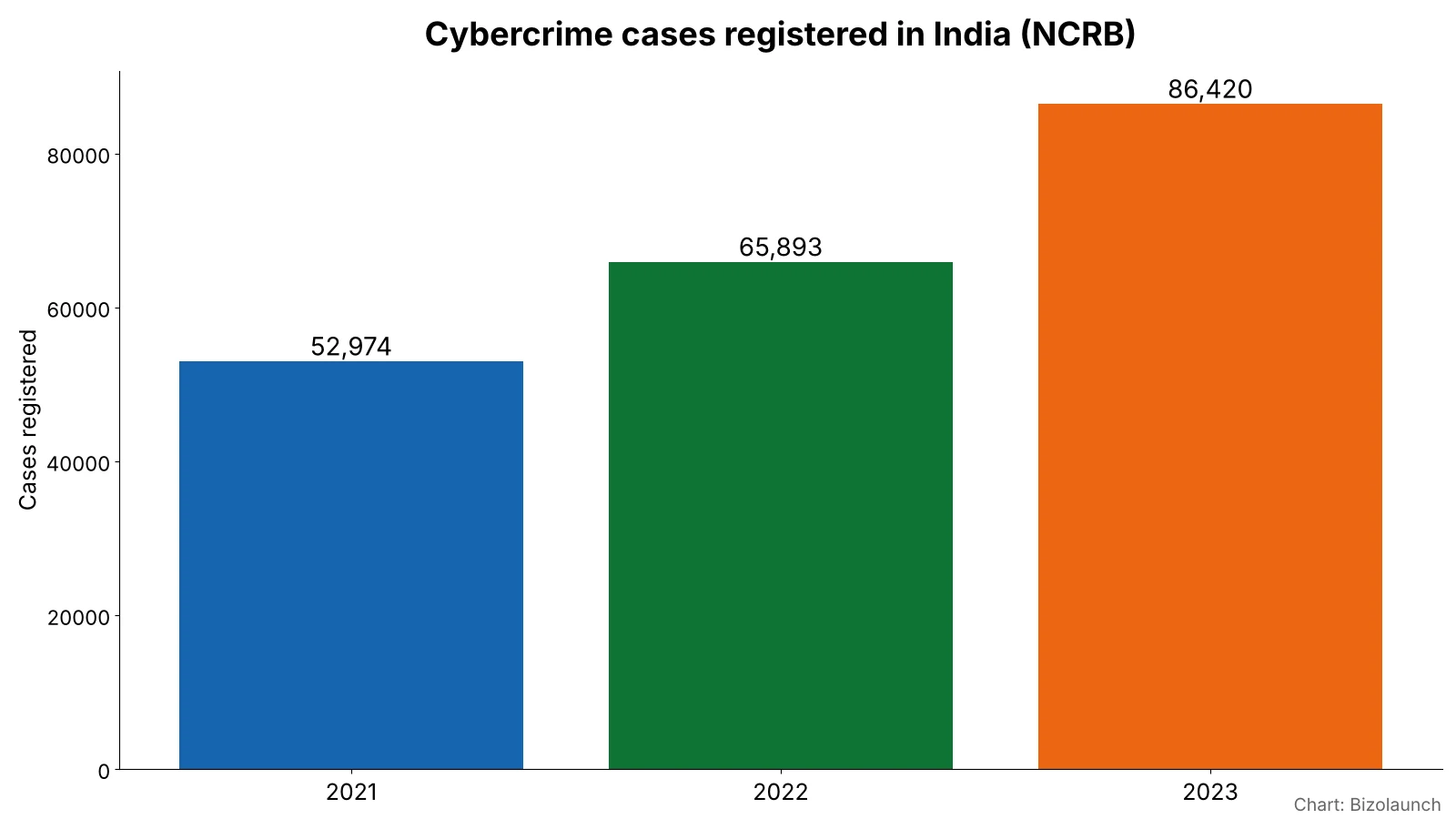
Registered cases are only the formal FIRs. The Citizen Financial Cyber Fraud Reporting and Management System had received more than 24.65 lakh complaints by 31 January 2026. Quick reporting through the 1930 helpline had saved more than ₹8,690 crore. Every one of these complaints can lead to bank freezes, police notices and court work.
The DPDP Act now has teeth
Parliament passed the DPDP Act on 11 August 2023. Its rules were notified a year ago, in November, with an 18-month phased rollout. By our count, the full set of duties falls due around May 2027. The Act sets these maximum penalties:
| DPDP Act breach | Maximum penalty |
|---|---|
| Failing to keep reasonable security safeguards | ₹250 crore |
| Failing to report a personal data breach to the Board or to affected people | ₹200 crore |
| Breaking obligations on children’s data | ₹200 crore |
| Any other breach of the Act or Rules | ₹50 crore |
The Data Protection Board is fully digital, with four members. Citizens can file complaints online, and appeals go to TDSAT. Significant Data Fiduciaries, the large data handlers, must run independent audits and impact assessments. Every data fiduciary must also name a contact for data queries, such as a Data Protection Officer.
So thousands of companies need privacy notices, consent flows, breach plans and vendor contracts redone. That is daily work for cyber law graduates.
CERT-In’s six-hour rule
CERT-In’s cyber security directions of 28 April 2022 came into force on 27 June 2022. They require covered organisations to report 20 types of cyber incidents within six hours of noticing them. Firms must also keep ICT system logs in India for 180 days. Cloud, VPN and data centre providers must keep subscriber records for five years after the service ends. Breaking the directions can bring up to one year in jail, a fine of up to ₹1 lakh, or both.
Legal teams now write incident response plans around these timelines. They also check vendor contracts so that logs and records can be produced on time.
1. Data Protection Officer or Privacy Analyst
A privacy analyst maps the personal data a company collects. The analyst also tracks where it is stored and who it is shared with. Then the analyst updates notices, consent screens and contracts to match the DPDP Act. A Data Protection Officer leads this work and answers to senior management.
This is the most open route after any degree. A BCom graduate who understands processes or a BTech graduate who understands systems can both do well here.
On AmbitionBox’s data protection officer page, 128 salaries across up to 18 years of experience range from ₹1.1 lakh to ₹55 lakh a year. The early years look like this:
| Experience | Salaries reported | Annual range |
|---|---|---|
| Fresher | 16 | ₹1 lakh to ₹4.8 lakh |
| 1 year | 11 | ₹1 lakh to ₹5 lakh |
| 2 years | 12 | ₹1.1 lakh to ₹7 lakh |
| 3 years | 11 | ₹1.4 lakh to ₹7 lakh |
| 4 years | 18 | ₹2 lakh to ₹24 lakh |
The jump at four years is the point to note. Once you have run a privacy programme end to end, pay can rise sharply. Data protection analysts, a related title, report ₹1.5 lakh to ₹15 lakh across 2 to 13 years. That figure comes from only 29 salaries, so treat it as a rough guide.
2. Privacy and Technology Counsel
Tech counsel work in law firms and in-house at IT, fintech, e-commerce and SaaS companies. They draft data processing agreements, cloud and software contracts, terms of service and cross-border data clauses. They also advise product teams before a new feature launches.
This role needs an LLB. Many tech counsel add an LLM in cyber law or start in a law firm’s technology practice. Startups need the same help, and our list of legal documents every startup needs shows where privacy policies and data agreements fit.
Read also: Best Career Options in Intellectual Property Law
3. Cyber Crime Lawyer
Cyber crime lawyers handle online fraud, hacking, identity theft, sextortion, online defamation and data theft cases. Some represent victims who need bank accounts frozen or content taken down. Others defend accused persons or advise banks and companies after a breach.
You need an LLB and Bar Council enrolment. Most lawyers in this field start as juniors with a criminal or technology lawyer. Reading digital evidence well matters a lot, because these cases depend on logs, screenshots and device reports.
4. Cyber Cell Legal Adviser and Consultant
State police cyber cells and cyber crime stations deal with a growing load of complaints. They need legal support on IT Act sections, evidence handling, notices to platforms and bank freezes. Lawyers and diploma holders work with them as legal consultants, trainers or panel advisers.
Police academies and judicial academies also run cyber law training. That creates teaching and consulting work for LLM holders with field experience.
5. Cyber Security Compliance Analyst
Compliance analysts sit between the security team and the legal team. They map a company’s security controls to CERT-In directions, sector rules from RBI, SEBI or IRDAI, and the DPDP Act. Then they prepare audit evidence and track gaps.
BTech, BCA and BSc IT graduates fit well here, especially with a PG diploma in cyber law. If you want to run this as your own practice later, our guide on how to start a cybersecurity consulting business covers the business side.
6. Digital Forensics and Legal Support
Forensic examiners recover data from phones and computers. But that evidence only works in court if it was collected and handled the right way. Legal support specialists check chain of custody, certificates and procedure, and they help lawyers read forensic reports.
A science or tech degree plus a cyber law course is the usual mix. Forensic science universities offer both sides under one roof.
7. Tech Policy Researcher and Academic
Think tanks, industry bodies and large tech firms hire policy researchers. They study data protection, AI rules, platform liability and online safety. The work involves reading draft laws, writing comments and briefing clients.
Teaching is the other long-term path. Law colleges need faculty for cyber law papers, and that usually needs an LLM plus UGC NET or a PhD.
Cyber Law Courses After Graduation: Fees and Eligibility
The right course depends on whether you hold an LLB. The three real options in this table cover different levels.
| Course | Institution | Duration or batch | Eligibility | Fee |
|---|---|---|---|---|
| LLM (Cyber Law and Cyber Crime Investigation) | National Forensic Sciences University, Gandhinagar | 1 year (2 semesters), 20 seats | 3-year LLB or 5-year integrated LLB with 50%, plus CLAT PG | ₹65,000 tuition per semester |
| Post Graduate Diploma in Cyber Law and Cyber Security | Kristu Jayanti (Deemed to be University), Bengaluru | PG diploma, 2026 batch | Any bachelor’s degree | ₹50,000 academic fee, plus ₹5,000 registration and ₹1,200 application |
| Post Graduate Diploma in Cyber Law (evening) | Dr. Ram Manohar Lohiya National Law University, Lucknow | One year, 2 semesters | Any graduate with 45% (40% for SC/ST) | Set by the university each year |
NFSU LLM in cyber law
The NFSU LLM admits through CLAT PG scores. Tuition is ₹65,000 a semester, so the one-year course comes to ₹1,30,000 in tuition alone, before hostel and other charges. With only 20 seats, your CLAT PG rank matters a lot.
Kristu Jayanti PG diploma for any graduate
The Kristu Jayanti PG diploma is open to any bachelor’s degree holder. For a student from a Karnataka board or university, the first-year cost adds up to ₹56,200: the ₹50,000 academic fee, ₹5,000 registration and ₹1,200 application. Students from outside Karnataka pay an extra first-year fee by category, up to ₹1,00,000 for foreign nationals.
RMLNLU evening diploma
The RMLNLU PGDCL is an evening course in Lucknow, so working graduates can join. It has six papers:
- Paper I: Introduction to Cyber Space
- Paper II: Regulation of Cyber Space
- Paper III: E-Commerce
- Paper IV: Intellectual Property and the Internet
- Paper V: Cyber Crimes, Cyber Security and Cyber Forensics
- Paper VI: Dissertation, running across both semesters
Each paper carries 100 marks, plus a 50-mark viva in each semester. Each subject has up to 30 seats, and a course runs only if at least 15 students join.
Routes Into Cyber Law From BA, BTech and LLB
Your starting degree changes the order of steps.
- BA, BCom or BBA: Take a PG Diploma in Cyber Law. Then apply for privacy analyst, compliance and policy support roles. Add an LLB later if you want to practise in court.
- BSc, BCA or BTech: Pair your tech background with a cyber law diploma. Aim for compliance analyst, privacy engineering support or digital forensics roles.
- LLB or BA LLB: Intern with a technology or criminal law practice. Then take CLAT PG for an LLM in cyber law, or join a firm’s privacy team directly.
- Working professionals: Choose an evening or part-time diploma, such as the RMLNLU course, and move into your own company’s privacy or compliance team.
Skills That Get Cyber Law Graduates Hired
Employers in this field look for a mix of legal and technical basics.
- Know the core laws. Read the IT Act, the DPDP Act and Rules, and the CERT-In directions in full, not from summaries.
- Understand how data moves. Learn what cookies, APIs, cloud storage and logs are. You cannot advise on data you cannot follow.
- Draft well. Practise writing privacy notices, data processing agreements and breach notices in plain language.
- Read digital evidence. Learn how screenshots, call records and device extractions are collected and certified for court.
- Track new rules. RBI, SEBI and IRDAI each add their own cyber and data rules for their sectors.
Read also: Top Career Options After BCom Without Maths, Ranked
Errors That Cost Cyber Law Graduates Jobs
- Picking a course by its name. Check the papers. A good course covers the DPDP Act and cyber crime procedure, not only theory.
- Ignoring the tech side. Lawyers who cannot read a log file or a cloud contract struggle in this field.
- Waiting for the perfect job. Privacy and compliance teams often hire interns first. One internship gives you real cases to talk about.
- Skipping CLAT PG planning. Top LLM seats, such as the 20 at NFSU, go by CLAT PG rank. Prepare a year in advance.
- Forgetting enrolment. Without Bar Council enrolment, you cannot appear in court, however much cyber law you know.
Graduates’ Questions About Cyber Law Careers
Can I study cyber law without an LLB?
Yes. PG diplomas in cyber law, such as those at Kristu Jayanti University and RMLNLU, accept graduates from any stream. However, an LLM in cyber law and court practice both need an LLB.
What is the salary of a cyber lawyer in India?
Pay depends on the role. Data protection officers report ₹1 lakh to ₹4.8 lakh as freshers and up to ₹55 lakh at senior levels on AmbitionBox. Litigation income varies widely and grows with your client base.
Which is better, an LLM or a PG diploma in cyber law?
An LLM makes more sense for LLB graduates aiming for senior legal, academic or litigation roles. A PG diploma is the faster and cheaper route for non-law graduates moving into compliance or privacy work.
How much does the NFSU LLM in cyber law cost?
Tuition is ₹65,000 per semester, or ₹1,30,000 for the one-year course, before hostel and other charges. Admission is through CLAT PG, and there are 20 seats.
Is cyber law a good career after BTech?
Yes. BTech graduates who add a cyber law diploma fit compliance, privacy and digital forensics roles well. Those who want to practise in court can take a three-year LLB after their BTech.
































































































