Kamla Pujari saved over a hundred varieties of paddy by walking to villages around her home in Odisha’s Koraput district. She collected seeds farmers no longer grew, stored them and sowed them again season after season. A farmer from the Bhumia Adivasi community, she had no lab and no degree. Yet the Government of India gave her the Padma Shri in 2019 for this work.
Her name appears in several spellings: Kamla, Kamala, Pujari and Pujhari.
Who Kamla Pujari Was
Kamla Pujari lived in Patraput, a small hamlet in the Jeypore block of Koraput district in southern Odisha. She moved there after her marriage, more than four decades before PARI met her in 2019. She belonged to the Bhumia Adivasi community.
PARI described Patraput as a hamlet of 119 households, three km from Kanjeipatraput village in Dongorchinchi panchayat. The wider village had 966 people, of whom 381 were from Scheduled Tribes. Her family farmed two acres.
In March 2018, the Hindustan Times described her as 68, a widow, living in a mud-and-thatch house with her two sons. She still worked her own land.
| Fact | Detail |
|---|---|
| Community | Bhumia Adivasi. |
| Home | Patraput hamlet, Jeypore block, Koraput district, Odisha. |
| Family land | Two acres. |
| Known for | Collecting and saving traditional paddy seeds. |
| Varieties saved | Over a hundred, per Down To Earth. |
| Highest honour | Padma Shri, presented in March 2019. |
| Died | July 2024, aged 74. |
Why Koraput’s Paddy Was Disappearing
Koraput and nearby Kalahandi have hundreds of rice varieties. When Kamla Pujari first came to Patraput, villagers grew about 15 indigenous paddy varieties. They include kalajira, gothia, haladichudi, umuriachudi, machhakanta, bhudei and dodikaburi.
“Every family cultivated two or three types of paddy, different from each other,” she told PARI.
Then, from roughly 25 years before that interview, the varieties began to fade. PARI gives three reasons from the villages:
- Joint families split. Smaller households had less land and less reason to grow many types.
- Farmers shifted to higher-yielding hybrids. These gave more grain per acre.
- Mandi buying rules changed. Procurement followed “fair average quality” standards, which favoured uniform grain.
By 2019, most neighbouring families grew only machhakanta and haladichudi. So a dozen or more local types were slipping out of use in one generation.
How She Collected Seeds on Foot
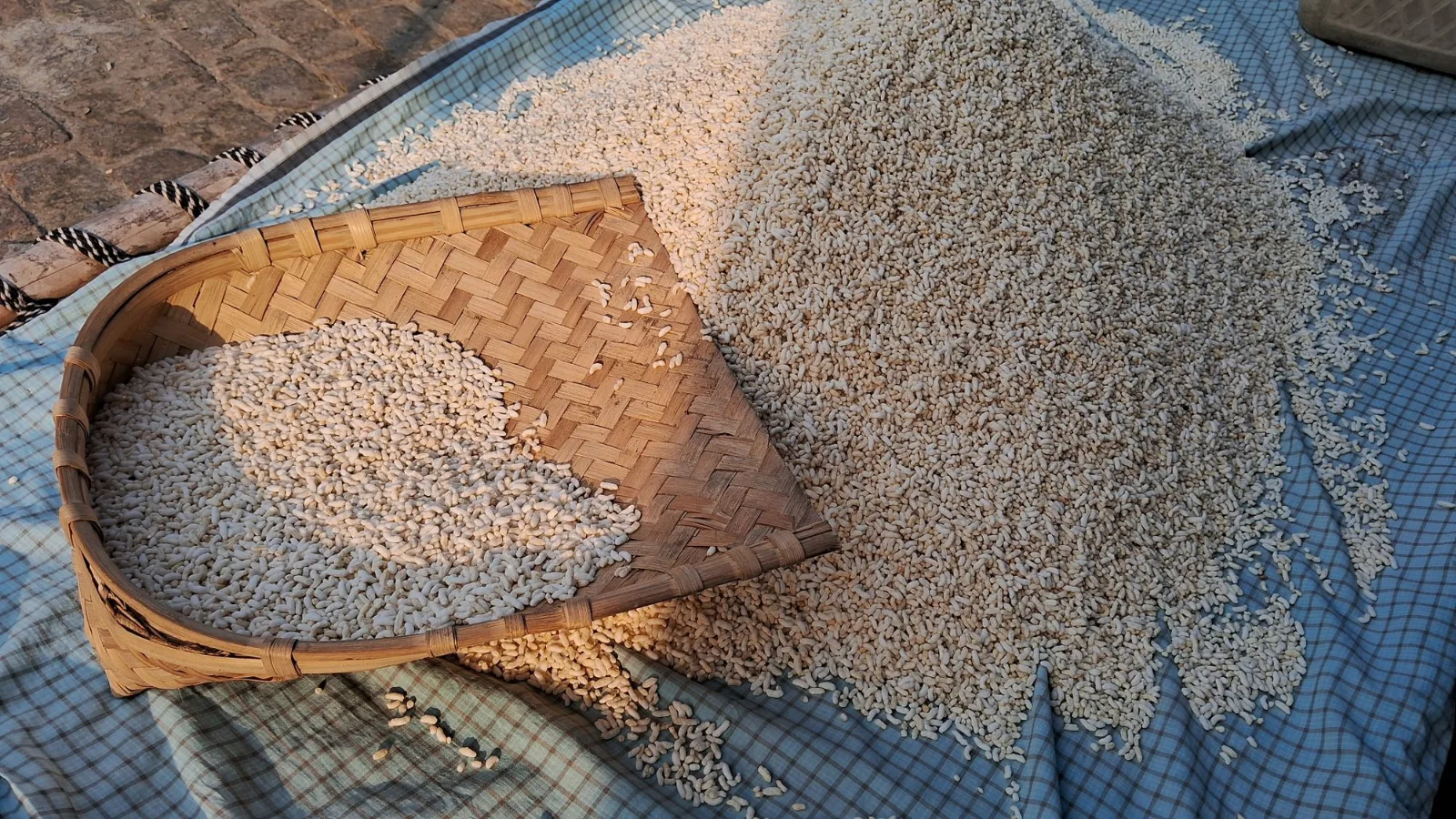
Kamla Pujari’s method was plain hard work. She searched villages within a 20 km radius of Patraput, mostly on foot, and asked farmers for seeds of the old varieties.
At first, she stored the seeds at home. Then she sowed them in small plots on the family’s two acres. That step mattered, because she grew each type again to renew the stock.
She summed up her whole approach for PARI in one line. “Seed thrives only if it is used in the fields consistently, season after season, and not otherwise”.
She also described the full cycle: “In agriculture, seed has to be sown, grown, collected, stored, distributed.” Each step had a purpose. Sowing kept the seed alive. Collecting and storing kept it safe. Distributing put it back into other farmers’ hands, where it could spread again.
Over the years, her collection grew. Down To Earth wrote that it grew to “over a hundred varieties”. The Hindustan Times put it as “hundreds of local varieties of paddy”. Neither source gives an exact count.
Read also: 100+ Boys Names Starting With A, With Meanings
The Community Seed Banks Around Jeypore
Home storage has limits, so the next step was a shared seed bank. In 2001, the MS Swaminathan Research Foundation (MSSRF) set up a seed bank in Patraput through its Jeypore branch, about 13 km away. Kamla Pujari later used it for her seeds.
PARI mentions three community-run seed banks set up by MSSRF in the area, at Patraput, Nuaguda and Jholaguda. They keep local seed in the villages that grow it.
The Nuaguda bank shows how much these stores can hold. Nuaguda is about 35 km from Patraput, in Limma village of Kundura block. In 2019, PARI counted 94 paddy varieties and 16 ragi varieties there. A local resource person, Budra Pradhan, said the paddy collection had since grown to more than 110 varieties.

Working With MSSRF on Kala Jira
Kamla Pujari did more than keep old seeds. She also helped improve one.
Down To Earth writes that MSSRF set up a small research station in the Kalahandi area in 1994. She shared many of her traditional varieties with its scientists. Together, they developed a higher-yielding kala jira, a local rice variety.
Then she did the part no scientist could do alone. She “rallied thousands of tribal women” to grow the improved kala jira and cleared up their doubts about it. In that way, a lab result became a crop in real fields. Down To Earth also credits tribal farmers under her leadership with practising organic farming.
Awards and Public Recognition
Recognition came slowly at first and then quickly near the end of her life.
| Year | Recognition |
|---|---|
| 2002 | Collected the Equator Initiative award in Johannesburg on behalf of the Adivasi communities of Jeypore. |
| 2009-10 | Plant Genome Saviour Community Award from India’s PPVFRA, on behalf of a local society she served as vice president. |
| 2018 | Nominated to the Odisha State Planning Board. |
| 2019 | Padma Shri, presented at Rashtrapati Bhavan in March. |
The Equator Initiative award in 2002 brought the work of Jeypore’s tribal farmers to a world stage. The second award, from the Protection of Plant Varieties and Farmers’ Rights Authority (PPVFRA), went to the Panchabati Gramya Unayana Samiti. Kamla Pujari had served as its vice president.
In March 2018, the Hindustan Times reported her nomination to the Odisha State Planning Board, along with four others. The board drafts plans and policy guidelines for the state, and the chief minister heads it. The same report said a hostel at the Odisha University of Agriculture and Technology in Bhubaneswar was named after her.
A year later, she received the Padma Shri. She later told PARI how the President greeted her. “He said, ‘Welcome to Rashtrapati Bhavan’,” she recalled.
The Seed Rights Question
Awards did not give her legal rights over the seeds she had saved. PARI raised this point directly.
Take kalajira, one of the varieties she grew up around. Under India’s plant variety rules, rights to kalajira were registered to Jogendra Sahu of Harichandrapur, Odisha. They run from 8 October 2013 to 7 October 2028. The application was advertised in the Plant Variety Journal of India in June 2013, and objections had to come within three months.
By May 2019, the PPVFRA had issued certificates for 3,538 varieties. Of those, 1,595 were farmers’ varieties. So farmers can register their varieties. But someone has to know the process, file on time and watch the journal for competing claims.
For a farmer in a thatched house in Patraput, that paperwork was far away. PARI’s point is plain. Conserving a seed and owning the rights to it are two different things.
The Yield Trade-Off Farmers Face
Why did so many farmers drop the old varieties? Yield is the plain answer.
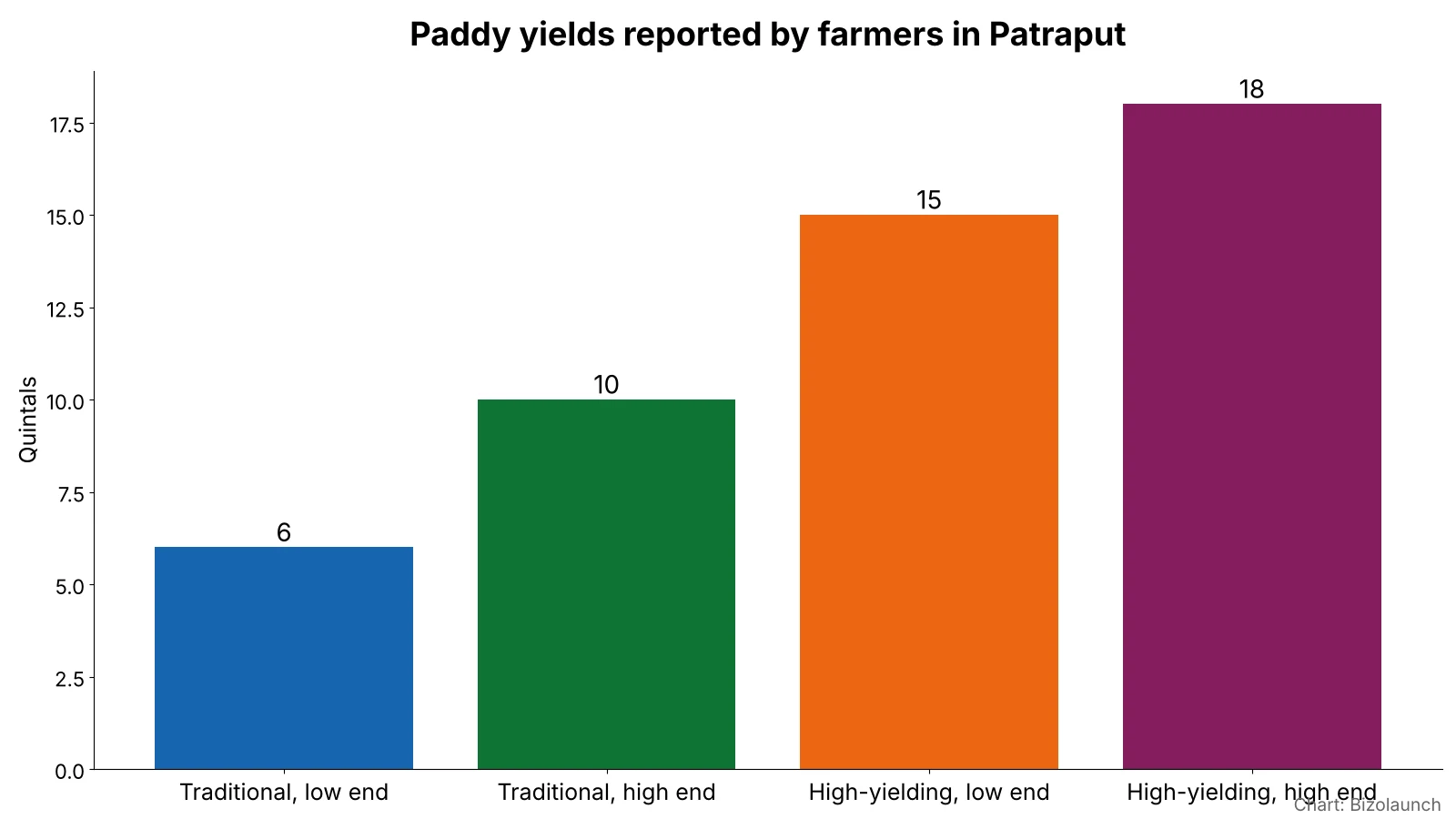
Her son, Tankadhar Pujhari, told PARI that traditional varieties gave 6 to 10 quintals in their fields. High-yielding varieties gave 15 to 18 quintals. “Our income depends on how much we produce,” he said.
Still, the old varieties have uses that a yield figure misses. Rukmani Khillo, a Paroja farmer, grows muktabali and machhakanta. These mature in 90 to 100 days. Longer-duration types take 120 to 140 days. Chandramma Masia of Nuaguda grows an “improved” variety for sale and pandkagura, a 100-day upland landrace, for her family.
Kamla Pujari’s daughter, Raimati Ghiuria, went further. She grows only landraces on six acres in Nuaguda, for a family of 10. So families split the decision. Some fields earn cash. Others feed the household and keep the old seeds alive.
The old varieties also hold a place in ritual. At Nuakhai, around September and October, the first meal from the new harvest is offered to the village goddess, Gaon Budhi Thakurani. Damu Paroja of Kundura village told PARI that the grain for it is ground by hand.
Her Last Years and the Tributes
Fame did not change her daily life much. In March 2018, the Hindustan Times found her still in a mud-and-thatch house. She had applied for a house under the Indira Awas Yojana in 2016 and not received one. Her grandson, Sudam Pujari, put the question plainly to the paper. He asked why the government could not give her a pucca house.
She died in July 2024, aged 74, at SCB Medical College and Hospital in Cuttack. The Deccan Chronicle reported the cause as cardiac arrest. Family members said she had kidney problems and had recently been on dialysis.
Tributes came from the top. Prime Minister Narendra Modi said she “made a monumental contribution to agriculture”. He also called her a beacon for tribal communities. Odisha Chief Minister Mohan Majhi said she “played a champion role in preserving indigenous paddy varieties and other seeds”.
A Timeline of Kamla Pujari’s Seed Work
Her story spans about five decades. The dates in the table come from the same four news sources.
| When | What happened |
|---|---|
| Over four decades before 2019 | She moved to Patraput after her marriage. |
| About 25 years before 2019 | Local paddy varieties began to decline. |
| 1994 | MSSRF set up a small research station in the Kalahandi area. |
| 2001 | MSSRF’s Jeypore branch set up the Patraput seed bank. |
| 2002 | She collected the Equator Initiative award in Johannesburg. |
| 2009-10 | A local society she served received a PPVFRA community award. |
| 2013 | Rights to kalajira were registered to another Odisha farmer. |
| 2016 | She applied for a government house and did not get one. |
| March 2018 | She was nominated to the Odisha State Planning Board. |
| March 2019 | She received the Padma Shri at Rashtrapati Bhavan. |
| July 2024 | She died in Cuttack, aged 74. |
Two things stand out in that list. First, the slow years came before the fast ones. She had been collecting for decades before the awards arrived. Second, public honour and private hardship ran side by side. In the same year she joined the State Planning Board, she was still asking for a pucca house.
The table also shows how her work linked to institutions. MSSRF gave her seeds a shared home in 2001. The Equator Initiative award in 2002 came on behalf of the wider Adivasi community of Jeypore. So her collection was never a private hobby. It fed into a village system that other farmers could use.
Read also: Q.security Seed Funding Brings $11.5M to Stop Quantum Hacks
What Her Work Teaches Anyone Building Something
Kamla Pujari never ran a company. Even so, her method holds lessons for anyone who builds slowly from the ground up.
- Start where you stand. She began with a 20 km radius she could walk. Her first store was her own home, and her first test plots were on the family’s two acres.
- Keep the asset in use. Seeds survive when they are sown each season. Products and skills work the same way, because they stay sharp only when people use them.
- Build shared systems. Her seeds went into community banks that others could borrow from. That made the work bigger than one person.
- Bring people with you. She won over thousands of women farmers to try the improved kala jira. Adoption, more than invention, changed the fields.
- Protect what you build. The kalajira rights story shows that good work still needs paperwork. Registration, deadlines and objections are part of the job, even for a farmer.
Founders working in farming can find practical guides on our site. Two examples are starting an agricultural drone spraying business and what a vertical farming business costs. The tools differ, but the starting point is the same. Know the ground you work on, and the people who farm it.
Questions About Kamla Pujari
How many types of paddy did Kamla Pujari save?
Her collection grew to more than a hundred local paddy varieties, and some accounts put it in the hundreds. There is no exact figure.
When did Kamla Pujari receive the Padma Shri?
She received the Padma Shri in 2019, at a ceremony at Rashtrapati Bhavan in March. The Deccan Chronicle described the award as recognition of her pioneering work in organic agriculture.
Where did Kamla Pujari live?
She lived in Patraput, a hamlet in the Jeypore block of Koraput district, Odisha. The MSSRF Jeypore branch set up a community seed bank there in 2001.
What role did MSSRF play in her work?
MSSRF set up community seed banks in the area, including one in Patraput. Its scientists also worked with her traditional varieties to develop a higher-yielding kala jira.