Federal regulators shut United Fidelity Bank of Evansville, Indiana, on Friday, Nov. 27. The Office of the Comptroller of the Currency (OCC) found it unsafe to keep open and handed it to the FDIC. The bank held about $5.9 billion in total assets at the end of September, which makes it far larger than either of the two U.S. banks that failed earlier this year. The twist is in its record. For about a decade, United Fidelity grew in part by taking over banks the FDIC had already closed.
First-Citizens Bank & Trust of Raleigh, North Carolina, will take on the deposits and buy nearly all of the assets, a local TV report on the FDIC deal shows. So customers do not lose access to their insured money. However, the closing came on the Friday after Thanksgiving, when many shops were in a busy sales weekend.
The failure also follows years of warning signs that were public. In June 2024, the Federal Reserve put the bank and its owners under a cease-and-desist order. The order dealt with how the bank planned for capital and risk. As a result, the collapse raises a plain question for any business owner: how well do you know the bank that holds your payroll cash?
What the OCC Said When It Closed the Bank
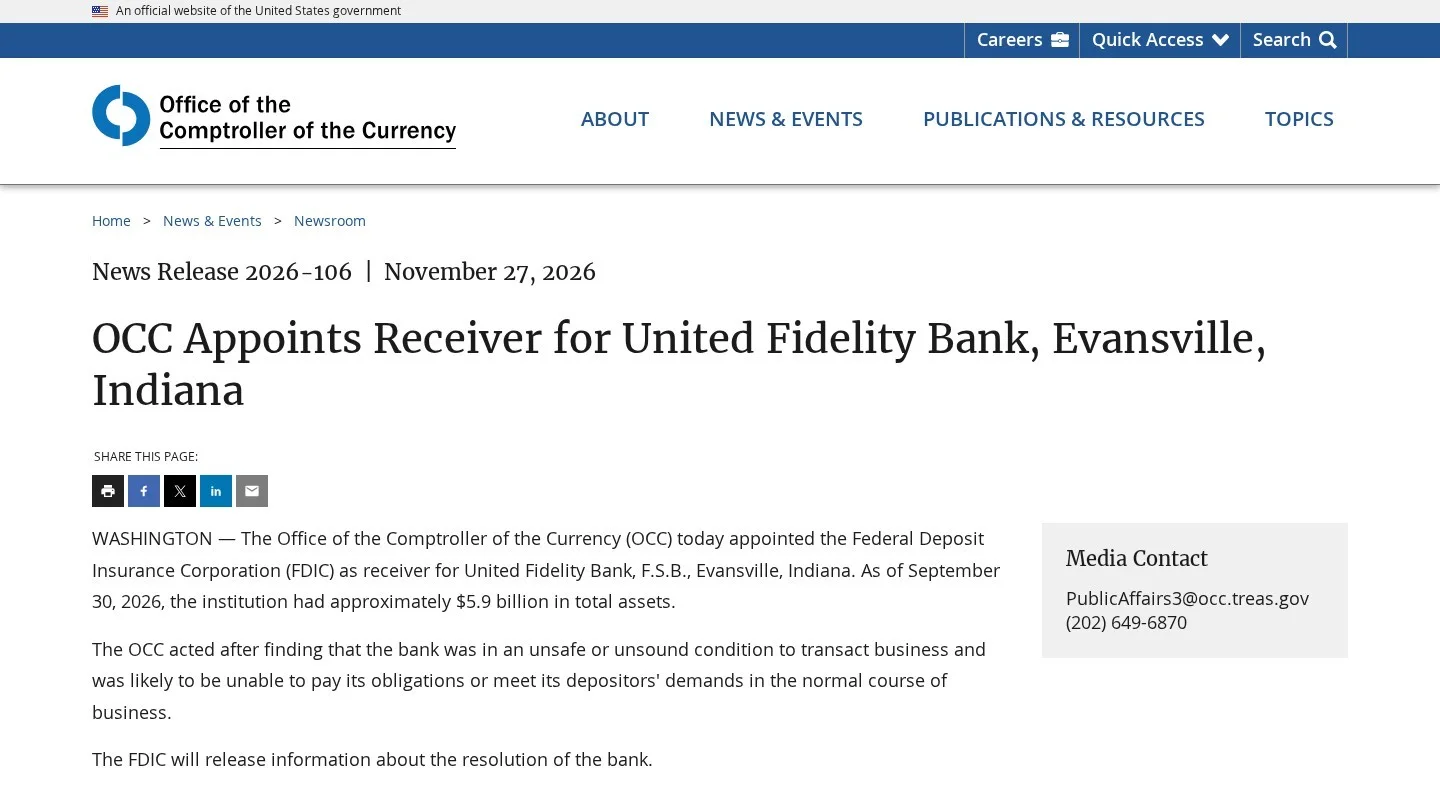
The OCC said it acted because it found the bank in “unsafe or unsound condition to transact business.” It also found the bank “likely to be unable to pay its obligations or meet its depositors’ demands in the normal course of business,” the OCC release states. Those are the legal grounds that let a regulator take a bank from its owners and put the FDIC in charge.
The release itself is short. It gives the asset figure and the grounds, then says the FDIC will release details on how the bank was resolved. In fact, it carries no spokesperson quote and no timeline. That is normal for a closing, because the OCC’s job ends when the FDIC steps in.
United Fidelity ran 22 branches in Indiana, Illinois, Colorado, Florida and the U.S. Virgin Islands, plus four sites in Evansville that include its head office, WEHT reported. For example, a firm that banked at a Colorado or Florida branch may not have known the bank was based in Indiana at all.
A Buyer of Failed Banks Becomes One
United Fidelity often bid when other small banks went under. In July 2015, it took all deposits of Premier Bank in Denver, which had $31.7 million in assets and $29.6 million in deposits when Colorado closed it. The FDIC put the cost of that failure to its insurance fund at $4.4 million. Then, in May 2017, it took the deposits of Fayette County Bank in Saint Elmo, Illinois.
In October 2020, it stepped in again for First City Bank of Florida in Fort Walton Beach. That bank had $134.7 million in assets and $131.4 million in deposits, and the FDIC expected a $10 million hit to the fund. Also, five of its eight deals in the past ten years were mergers of failed banks backed by the government, American Banker reported, as cited by Banking Dive.
| Bank | Year | Role of United Fidelity | Total Assets |
|---|---|---|---|
| Premier Bank, Denver | 2015 | Bought it after it failed | $31.7 million |
| Fayette County Bank, Saint Elmo, Illinois | 2017 | Took all deposits | Not given in FDIC record |
| First City Bank of Florida | 2020 | Bought it after it failed | $134.7 million |
| United Fidelity Bank, Evansville | 2026 | Failed itself | About $5.9 billion |
The scale gap tells the story. By our math, United Fidelity at closing was about 44 times the size of First City Bank of Florida, the largest failed bank it had bought in this group.
Read also: Medicare Just Set Prices for 13 More Drugs. For the First Time, Doctors’ Offices Are in the Deal
The 2024 Order Was a Public Warning
The Fed’s order came on June 25, 2024. It named the bank and its two parent firms, Fidelity Federal Bancorp and Pedcor Financial Bancorp. It flagged weak plans for capital, risk, backup cash and board oversight, Banking Dive reported. The order also barred capital payouts without the Fed’s written approval and asked for a strategic plan within 60 days.
The OCC, its main regulator, had issued a similar order, and its concern was how fast the bank was growing. Meanwhile, a bank officer told local outlet Current in February 2024 that the bank made about $200 million in profit over two years, well above its peers, Banking Dive noted. That claim and the regulators’ worry sat side by side for more than two years before the closing.
For small firms, the point is that enforcement orders are public records. Anyone can read them on the Fed and OCC sites, and they often come years before a failure.
How It Compares with This Year’s Other Failures
Two other U.S. banks failed earlier this year, and both were small. Metropolitan Capital Bank & Trust in Chicago closed in January with $261.1 million in assets, and Community Bank and Trust – West Georgia in LaGrange closed in May with $288.0 million. Taken together, those two hold less than a tenth of what United Fidelity had.
The buyer has done this before on a far larger scale. In March 2023, First-Citizens bought about $72 billion of Silicon Valley Bank’s assets at a $16.5 billion discount, with the FDIC sharing losses on commercial loans. Back then, depositors moved over on their own. The FDIC told them to keep using their branch until they got notice.
What Business Owners Should Do This Week
Most firms that banked with United Fidelity will see little change in the short run, because insured deposits move to First-Citizens. Even so, a closing over a holiday weekend can still upset cash flow. So, if you bank there, or if your vendors do, take these steps now:
- Check that your payroll run, ACH debits and card deposits for the coming week clear as normal, and call your payroll provider before the next run.
- Keep making loan payments on schedule. A change of owner does not cancel the debt, and missed payments still count.
- Watch for mail from First-Citizens about new account numbers, online banking logins and check stock.
- Review balances above the FDIC insurance limit. In fact, many owners split cash across two banks for this reason.
- Ask vendors and customers who paid you from United Fidelity accounts to confirm their payments went through.
Beyond this one bank, use the failure as a prompt to review where your cash sits. A cash reserve plan works only if the money is reachable on a bad day. Also, run your numbers through a startup runway calculator with a one-week freeze built in, and see how long you could cover payroll.
Founders who raise money should also ask how their bank is regulated and whether it is under any public order. That check takes ten minutes on the regulators’ sites. In addition, track your cash with the same care as the financial metrics investors watch, because a bank problem turns into a runway problem very fast.
Bank deals are not only a U.S. story either. For instance, the fight over the UniCredit and Commerzbank deal shows how bank owners change and how slowly. Finally, if you are lining up new credit, compare lenders and funding platforms for startups before you need the money, not after your bank’s sign changes.