A $28 t-shirt on Etsy can leave you with less than $8 after printing, shipping and fees. That single number decides most print on demand businesses, and this guide is built around it.
Print on demand (POD) means a supplier prints your design only after a customer orders. You never buy stock. The supplier prints, packs and ships the item under your store name, and you keep the gap between your price and the costs. To start, you need a niche and a few designs. You also need a POD supplier such as Printful, Printify or Gelato, and a place to sell, usually Etsy or Shopify.
This guide covers current plan prices for Printful, Printify, Gelato, Etsy and Shopify. It then runs one t-shirt through every fee, step by step, so you can see where the money goes before you design anything.

Pick a Print on Demand Niche Buyers Already Search For
Generic designs sell poorly, because thousands of shops already offer them. A niche gives buyers a reason to pick your shop. Good POD niches are groups of people who like to show who they are. Think of nurses, dog breed owners, runners, teachers or fans of one hobby.
Use these checks before you commit:
- Search the marketplace first. Type your idea into Etsy search and read the first two pages. If every result looks the same, look for a narrower angle, for example “retired nurse” in place of “nurse”.
- Look for repeat occasions. Birthdays, graduations, team events and holidays give a niche several buying moments each year.
- List 20 design ideas. If you cannot write 20 ideas in one sitting, the niche may be too thin to grow.
- Check the words people use. Etsy search suggestions show the phrases buyers type. Use them later in titles and tags.
Keep your designs legally safe
Never print brand logos, sports team marks, film quotes or celebrity faces without a licence. Marketplaces remove these listings, and repeated strikes can close a shop. Search your slogan in the USPTO trademark database before you list it, because some common phrases are registered for clothing.
Compare Printful, Printify and Gelato Before You Sign Up
All three suppliers are free to join and let you connect a store. The differences show up in product prices, plan discounts and where they print.
| Supplier | Free plan | Paid plan | Paid plan perks |
|---|---|---|---|
| Printful | $0 a month | Growth at $24.99 a month | Up to 33% off products. |
| Printify | $0 a month, up to 5 stores | Premium at $24.99 a month billed yearly | Up to 20% off all products. |
| Gelato | Free to start | Gelato+ at $24 a month or $239 a year | Larger product discounts and extra tools. |
Printful prints most products itself
Printful runs its own production for most items, so quality tends to stay consistent from order to order. The free plan includes 607 custom products, a design maker, a mockup generator and links to more than 20 selling platforms. You also get 20% off sample orders. The Growth plan costs $24.99 a month, adds 9% off branding and becomes free once you reach $12K a year in sales.
Branding extras cost money. An inside label printed on a DTG shirt costs $0.99, and an outside label costs $2.49. Embroidery digitization runs $2.95 to $6.50 per design, charged once.
Shipping rates are fixed and easy to plan around. In the US, a single t-shirt ships for $4.95, and each extra shirt in the same order adds $2.20. Hoodies cost $8.79, and an 11oz mug costs $6.69. Printful takes 2 to 5 business days to make an item, then standard US delivery takes 3 to 4 business days. From 15 October 2026 to 17 January 2027, Printful also adds a $0.40 surcharge on every US order.
Printify connects you to many print partners
Printify works as a marketplace of print providers. You pick a provider for each product, so prices and shipping times vary within one catalog. Gelato’s own comparison counts more than 100 production partners for Printify.
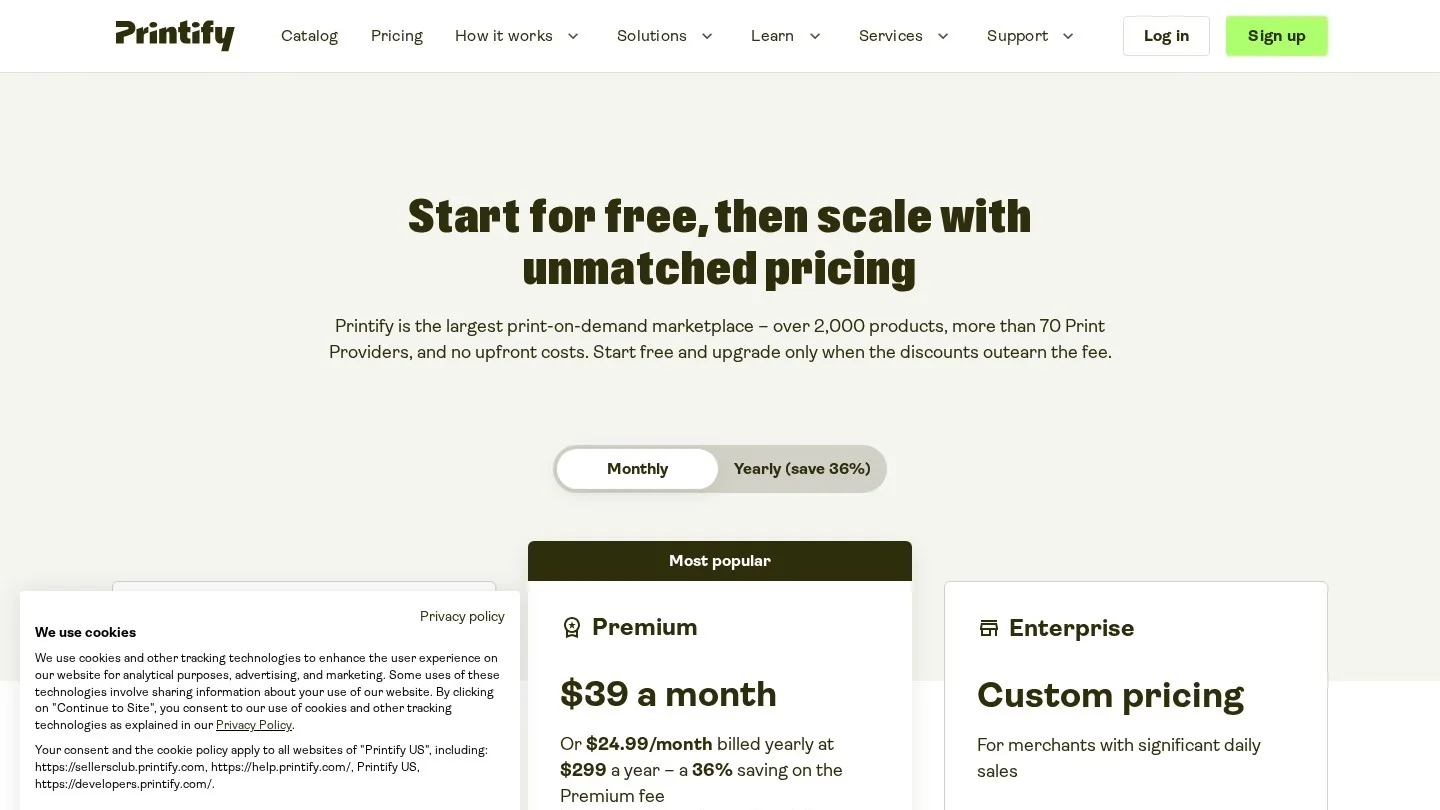
The free plan allows 5 stores and unlimited designs. Premium costs $24.99 a month on yearly billing and cuts product prices by up to 20%. Premium is non-refundable, so cancel before renewal if you stop selling.
Gelato prints close to the buyer
Gelato routes each order to a partner near the customer. It lists more than 130 production partners in 32 countries. That network helps if you plan to sell in Europe, Australia or Asia as well as the US. Gelato+ costs $24 a month or $239 a year.
So which supplier should you pick? Order samples from at least two before you decide. Price matters, but print quality and fabric feel bring repeat buyers.
Choose Where to Sell: Etsy or Your Own Shopify Store
Most new POD sellers pick one of two routes. Etsy brings shoppers to you, while Shopify gives you full control but no built-in traffic.
Count every Etsy fee
Etsy has no monthly fee for a standard shop. It charges per listing and per sale instead. In the US, these fees apply:
- Listing fee: $0.20 per listing. A listing stays live for four months or until it sells.
- Transaction fee: 6.5% of the sale price, including the shipping you charge.
- Payment processing: 3% plus $0.25 per order through Etsy Payments.
- Offsite Ads: 15% of a sale that comes from an Etsy ad on another site.
- Currency conversion: 2.5% when your listing currency differs from your bank currency.
- Setup fee: Some new shops pay a one-time setup fee, which varies by location.
One detail catches POD sellers out. Printful notes that its products often show stock of 999 on Etsy, so the listing renews after each sale. Each renewal costs another $0.20.
Count every Shopify cost
Shopify charges a monthly plan fee and a card fee on each sale. You can try it for 3 days free, then pay $1 a month for 3 months on most plans.
| Shopify plan | Billed monthly | Billed yearly | Online card rate |
|---|---|---|---|
| Basic | $39 a month | $29 a month | 2.9% + 30 cents. |
| Grow | $105 a month | $79 a month | 2.7% + 30 cents. |
| Advanced | $399 a month | $299 a month | 2.5% + 30 cents. |
If you use a payment provider other than Shopify Payments, Shopify adds 2% on Basic, 1% on Grow and 0.6% on Advanced. So most small POD stores keep Shopify Payments switched on.
Our Shopify vs WooCommerce comparison covers the other common store builder. If you sell from India, our guide on how to sell on Etsy from India explains payouts and tax steps.
Read also: How to Start an AI Product Catalog Management Business
Work Out Your Profit on One Print on Demand Order
Take one t-shirt through all the fees. The sale price is $28 with free shipping for the buyer. The base cost is $12. Your real cost depends on the blank, print size and supplier, so replace it with the number in your supplier dashboard.
Profit on an Etsy sale
| Item | Amount |
|---|---|
| Sale price | $28.00. |
| Base shirt and print (sample figure) | -$12.00. |
| Printful US shipping, one shirt | -$4.95. |
| Etsy listing fee | -$0.20. |
| Etsy transaction fee (6.5% of $28) | -$1.82. |
| Etsy payment processing (3% + $0.25) | -$1.09. |
| Profit per order | $7.94. |
So the shop keeps $7.94, a margin of about 28%. During the Printful holiday surcharge window, the $0.40 extra drops that to $7.54.
Now say the same sale came through an Etsy Offsite Ad. The 15% ad fee adds $4.20, and profit falls to $3.74. That is why many POD sellers set a higher price on items they expect to sell through ads.
Profit on a Shopify sale
On Shopify Basic, the card fee on $28 is $1.11. The order leaves you $9.94 after the shirt and shipping. However, the monthly plan fee still needs to come out of those profits.
Etsy fees on this order total $3.11, compared with $1.11 on Shopify. The $2.00 gap per order pays for Shopify Basic on yearly billing ($29 a month) once you pass about 15 orders a month. Under that, Etsy costs less. Over it, Shopify starts to pay off, but only if you can bring your own traffic.

Decide if a paid supplier plan pays off
Printify Premium and Printful Growth both cost $24.99 a month. With our $12 base cost, a full 20% discount saves $2.40 per shirt. So Printify Premium covers its own cost at about 11 shirts a month. A 33% Printful discount would save $3.96 per shirt, so about 7 shirts a month would cover Growth. Discounts vary by product, though, so check the price of your own top seller with and without the plan.
Shipping costs change the picture too. Our guide on how to calculate shipping costs for ecommerce shows how to build shipping into a product price.
Set Up Your Store Step by Step
Once the numbers work, setup takes a weekend. Follow this order to avoid rework.
- Create your supplier account. Sign up free with Printful, Printify or Gelato.
- Open your sales channel. Create an Etsy shop or start a Shopify trial.
- Connect the two. Each supplier has an Etsy and Shopify integration, so orders flow across without manual entry.
- Upload your first designs. Use high-resolution PNG files with transparent backgrounds. Check the supplier’s print area size for each product.
- Make mockups. Use the supplier’s mockup generator, then add one or two lifestyle photos of a sample.
- Write titles and tags. Use the exact phrases buyers type, starting with the product and niche.
- Set prices. Run each product through the profit table above, including shipping and the platform fees.
- Order samples. Wear, wash and photograph your own product before you push sales.
- Write your policies. POD items are made to order, so explain returns plainly. Our collection of ecommerce return policy examples shows wording other stores use.
Grow Sales Without Burning Your Margin
Your first sales usually come from marketplace search, so listing quality matters most at the start. Add new designs every week, because each listing is another way for a buyer to find you.
Next, collect email addresses from Shopify buyers. A short email for a new design or a holiday drop costs little and reaches people who already bought once. Also post your designs where your niche spends time, for example running clubs, breed groups or teacher communities.
Paid ads come last. Test ads only on a design that already sells without them, and work out how much one sale can afford to pay for a click. If your profit is $7.94, an ad that costs $10 per sale loses money on every order.
Avoid These Print on Demand Mistakes
We see the same errors in seller forums again and again. Each one costs margin or the whole shop.
- Pricing from the base cost alone. Shipping, listing fees, processing and ads can take $10 or more from a $28 sale. Always price from the full table.
- Skipping samples. A design that looks sharp on screen can print dull or off-centre. Customers notice, and refunds cost you twice.
- Using trademarked phrases. Brand names and registered slogans get listings removed and shops suspended.
- Uploading low-resolution files. Blurry prints lead to returns. Use the file size each supplier asks for.
- Ignoring production time. Printful needs 2 to 5 business days before shipping. State realistic delivery times, especially before holidays.
- Paying for a plan too early. Stay on the free plans until your order count covers the monthly fee.
If you want a business with no physical product at all, our list of digital product business ideas covers templates, courses and other downloads.
Pros of Starting a Print on Demand Business
These upsides come from how print on demand handles stock and shipping.
- Cash stays in your account: You pay the supplier only after a buyer has paid you. A slow month costs a few listing fees, and no boxes of unsold shirts sit in a spare room.
- Cheap tests for new designs: One Etsy listing costs $0.20, so 50 test designs cost $10. You keep the few that sell and drop the rest.
- One design, many products: A design that sells on a t-shirt can go on a hoodie, mug or tote in a few minutes. That stretches one good idea across several price points.
- No packing or post office runs: The supplier prints, packs and ships every order. So the shop can run around a day job, from any laptop.
- Buyers outside the US: Gelato sends each order to a printer near the buyer. You can sell in Europe or Australia without a warehouse there.
Cons of Starting a Print on Demand Business
The same model that saves you money also takes control away from you.
- Thin profit per sale: Base cost, shipping and platform fees take most of the price. An ad-driven sale can cut profit by more than half.
- Quality sits with the supplier: A crooked print or late parcel still lands in your reviews. You cannot check an item before it ships.
- Crowded marketplaces: Thousands of shops sell look-alike designs. A new shop with no niche gets very little search traffic.
- Platform rules set your margin: Etsy and Shopify decide the fees and policies. Any fee rise comes out of your profit, and Etsy reviews do not move with you to another platform.
- Holiday crunch: Most gift sales land in the last quarter. That is also when suppliers add surcharges and production slows.
Licenses Required for a Print on Demand Business
No special license covers printing designs on demand. A US seller needs the same general filings as any small online shop. Etsy collects and pays sales tax on its orders in nearly every state with a sales tax. So the state permit matters most for sales through your own store.
| License or permit | Who issues it | When you need it | Cost |
|---|---|---|---|
| Employer Identification Number (EIN) | IRS | When you hire staff or form a partnership or corporation. Many solo sellers get one to keep their Social Security number off supplier forms. | Free |
| LLC or DBA filing | Secretary of State, or a county clerk for a DBA in many states | Before you sell under a company or brand name | LLC: $40 in Kentucky to $500 in Massachusetts |
| Sales tax permit | State revenue department | Before you collect tax on sales from your own Shopify store | Varies by state |
| Resale certificate on file with your supplier | You complete it with your state permit number and upload it to Printful or another supplier | To stop paying sales tax on blanks you resell | No fee |
| Local business license or home business permit | City or county | Where your city licenses home-based sellers | Varies by city |
Read also: How to Start a Mobile Dog Grooming Business in North Carolina
Print on Demand Business Budgeting Table
This budget covers the first six months for one person. The low column is an Etsy shop on free plans. The high column adds a Shopify store, a paid supplier plan, design software and a small ad test.
| Expense | Low estimate | High estimate | Notes |
|---|---|---|---|
| Business registration | $0 | $500 | Low is a sole owner trading under their own name. High is an LLC in Massachusetts. |
| EIN | $0 | $0 | Free from the IRS. |
| Sample orders | $38.15 | $120.75 | 3 to 10 shirts at the $12 sample base cost with 20% off samples, plus Printful US shipping. |
| Etsy listing fees | $4 | $20 | 20 to 100 listings at $0.20 each, before renewals. |
| Shopify store | $0 | $120 | Low sells on Etsy only. High is Basic billed monthly: $1 a month for 3 months, then $39 a month. |
| Paid supplier plan | $0 | $149.94 | Six months of Printful Growth or Printify Premium at $24.99 a month. |
| Design software | $0 | $144 | Low uses the supplier design maker. High is a year of Kittl Pro at $12 a month, with a commercial license. |
| Etsy Ads test | $0 | $90 | The minimum Etsy Ads budget is $1 a day. High runs ads for 90 days. |
| Total | $42.15 | $1,144.69 | First six months |
State sales tax permits and city licenses are not in the total, because their fees vary by state and city.
Print on Demand Questions New Sellers Ask
How much does it cost to start a print on demand business?
You can start for very little. Printful, Printify and Gelato all have free plans, and Etsy charges $0.20 per listing. Budget for sample orders, some listing fees and possibly an Etsy setup fee in your country.
Is print on demand still profitable?
It can be, but margins are thin. In our worked example, a $28 shirt leaves $7.94 on Etsy and $3.74 when the sale comes from an Offsite Ad. Profit comes from good designs in a focused niche and careful pricing.
Which is better, Printful or Printify?
Printful runs much of its own production and has fixed shipping rates. Printify lets you choose between many print providers, often at lower prices. Order samples from both and compare quality before you decide.
Do I need a business licence for print on demand?
Rules depend on your country and state. Many places require a business registration and sales tax registration once you sell. Check with your local tax office before your first sale.
Can I sell print on demand on Etsy?
Yes. Printful, Printify and Gelato all connect to Etsy, so orders pass to the supplier on their own. Read the Etsy seller policy on production partners before you list, and keep the listing renewal fee in mind.