Microsoft Advertising started rolling out a rebuilt automated bidding model on November 18, 2026. The new model hits cost-per-acquisition (CPA) and return-on-ad-spend (ROAS) targets more often, and it reacts nearly twice as fast when an advertiser changes a target. Microsoft calls it the “biggest upgrade to bidding models in a decade.”
The gains in early tests are large. Some advertisers moved from Enhanced CPC (eCPC) to Maximize Conversions with a CPA target. They got about 18% more conversions at a similar cost per action. The rollout is automatic, and more upgrades will follow in 2027.
What Changed in Microsoft Advertising Automated Bidding
The upgrade replaces the model that predicts the chance of a conversion. That prediction is the core of every automated bid. If the model thinks a click is likely to convert, it bids higher. If not, it bids lower.
The new model uses new user signals, though Microsoft has not named them. It also values each conversion more accurately, which matters most for advertisers who bid on revenue or profit. Carlo Buchmann, a principal product manager at Microsoft Advertising, wrote the launch post.
Three changes stand out for day-to-day account work:
- Targets met more often. Bids now land closer to CPA and ROAS targets, without cutting conversion volume or value to get there.
- Faster reactions. After an advertiser edits a CPA or ROAS target, bids adjust nearly twice as fast as before.
- Even budget pacing. Spend spreads more evenly across the day, and campaigns reach their full budget sooner.

The update covers the main conversion-based strategies. Those are Maximize Conversions with an optional target CPA, and Maximize Conversion Value with an optional target ROAS. eCPC stays in place for small accounts.
Microsoft Advertising Bidding Test Results
The results come from Microsoft internal data on global accounts, gathered over the summer:
| Strategy change | Result | Test period | Traffic |
|---|---|---|---|
| Maximize Conversion Value or Target ROAS | About 10% more conversion value per click at similar ROAS | August 2026 | Search and Audience Network |
| Target CPA to Target ROAS | About 8% more conversion value at similar ROAS | August to September 2026 | Search campaigns |
| eCPC to Maximize Conversions with a CPA target | About 18% more conversions at similar CPA | June to July 2026 | Global |
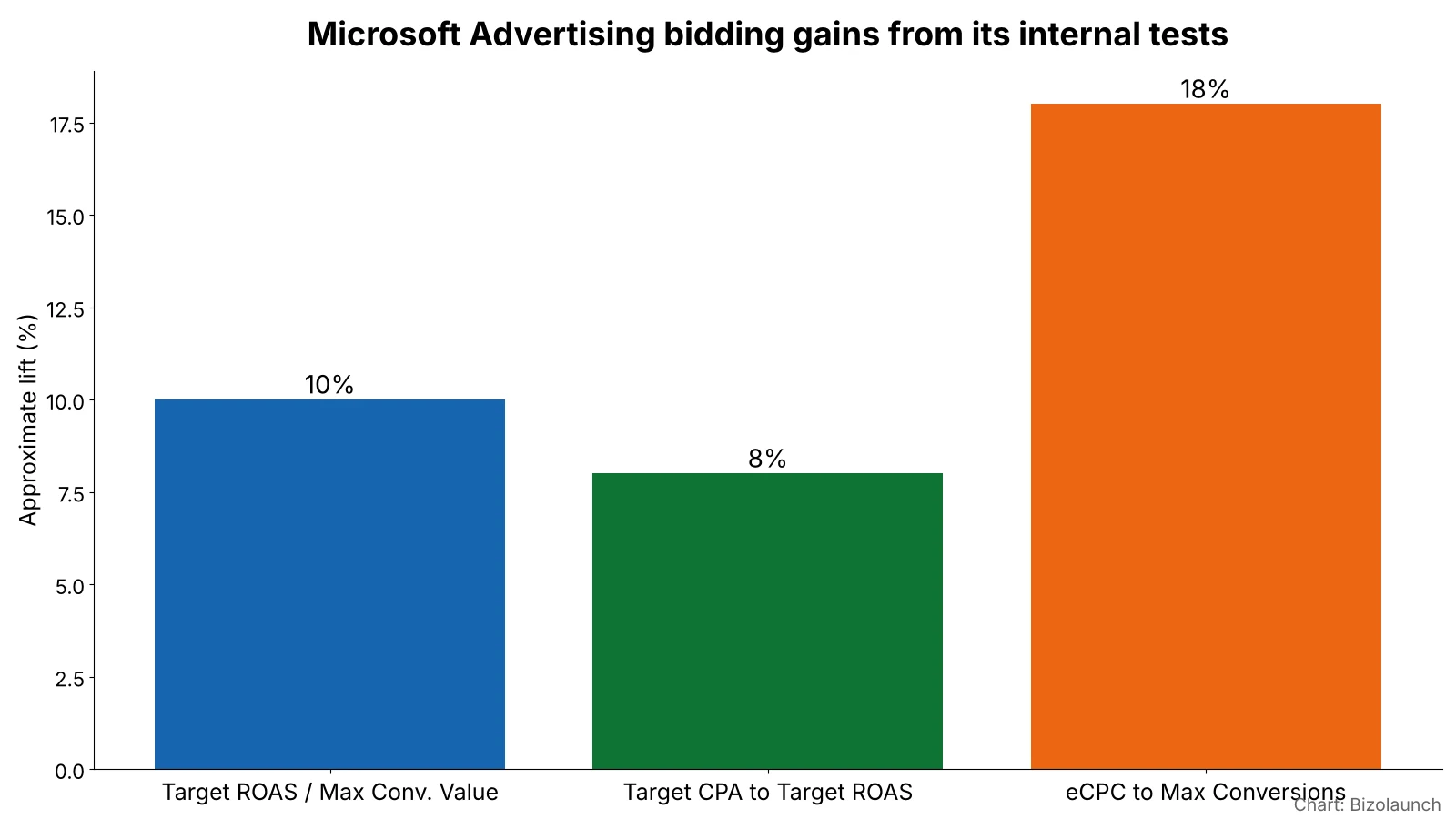
Keep two limits in mind. First, these are Microsoft’s own numbers. The company has not published sample sizes or a detailed method. Second, the figures are averages. A single account can do better or worse, depending on its conversion volume and tracking quality.
Read also: Which Indian Brands Are Using AI in Advertising?
What an 18% Lift Looks Like in a Real Account
Percentages are easier to judge in dollars. Take a small home services company that spends $5,000 a month on Microsoft Advertising with eCPC. It gets 100 leads at a $50 cost per lead.
If that account matches the 18% test average after switching to Maximize Conversions with a $50 CPA target, it would get about 118 leads. At the same $50 cost per lead, spend rises to about $5,900. So the business pays $900 more for 18 extra leads.
| Scenario | Monthly spend | Leads | Cost per lead |
|---|---|---|---|
| Before, with eCPC | $5,000 | 100 | $50 |
| After, at the 18% average lift | About $5,900 | About 118 | About $50 |
That only works if the budget allows it. With the budget capped at $5,000, the gain would show up as extra leads from the same money only if the model finds cheaper conversions. The test result is about volume at a similar CPA, so plan budget headroom before you switch.
Revenue-focused stores can run the same math for ROAS. A shop that earns $40,000 in conversion value from $10,000 of spend runs at 400% ROAS. A 10% gain in value per click at the same ROAS would mean about $44,000 in value, with spend near $11,000.
Settings Microsoft Advertising Wants Advertisers to Change
The rollout is automatic, but account setup still decides how much of the gain you see. The official guidance comes down to five rules.
Fix Conversion Tracking First
A bidding model is only as good as the conversions it learns from. Microsoft recommends Universal Event Tracking (UET) as the base layer. Conversions API and offline conversion import come on top, so the model also sees sales that close off the website, such as phone orders.
Also check what counts as a conversion. If an account counts page views or button clicks, the model will chase those cheap actions. Count only actions that bring in revenue or real leads, so the model learns from the right outcome.
Pick a Strategy by Conversion Volume
Accounts with at least five conversions should move to a conversion-based strategy straight away. Accounts with fewer conversions should begin on eCPC. Once data builds up, they can move to Maximize Conversions with a target CPA. Stores that track revenue can pick Maximize Conversion Value with a target ROAS instead.
Change Targets in Small Steps
Change CPA and ROAS targets by about 15% at a time. Then wait one full conversion cycle before the next change. Big jumps, such as a large CPA increase or a large ROAS cut, cause short-term swings.
For example, an advertiser who wants to move a $40 CPA target down to $30 should not do it in one edit. A 15% step takes it to $34. A second step after one cycle brings it to about $29.
Remove Maximum CPC Caps
Microsoft does not recommend keeping a maximum CPC on campaigns that use automated bidding. A cap fights the CPA or ROAS target, because it blocks the model from bidding up on clicks it rates highly. Use budgets, targets and conversion value rules to steer spend.
Judge Results at the Right Level
Wait for about 30 conversions in 30 days before judging a strategy. After a major change, give it one to two conversion cycles. Then look at campaign or portfolio results, using conversions, CPA and ROAS. Keyword-level CPCs are the wrong yardstick for automated bidding.
Major changes, for this purpose, include launching a new campaign, switching bid strategy and adding or removing conversion goals.
Which Microsoft Advertising Accounts Gain the Most
The test results point to three groups of advertisers. Each one has a different next step.
| Account type | Typical setup today | Move to make | Matching test result |
|---|---|---|---|
| Lead generation with 5 or more conversions | eCPC | Maximize Conversions with a CPA target | About 18% more conversions at similar CPA |
| Online store tracking order value | Target CPA | Target ROAS | About 8% more conversion value at similar ROAS |
| Store already bidding on value | Target ROAS or Maximize Conversion Value | Keep the strategy and clean up tracking | About 10% more value per click at similar ROAS |
| New or very small account | Manual bids or eCPC | Stay on eCPC until conversions build | No test figure given |
The first group has the most to gain, because it moves from a semi-manual strategy to a fully automated one. The second group gains by bidding on revenue in place of a flat cost per sale. A store that sells both a $20 item and a $400 item should not pay the same for each order. Target ROAS lets the model tell them apart.
The third group gets the upgrade without doing anything. Even so, missing revenue values in tracking will cap the gain, since the model can only value what it can see.
Why This Upgrade Matters for Paid Search Marketers
Many teams treat Microsoft Advertising as a copy of their Google Ads account. They import the campaigns and then rarely touch them. This upgrade is a reason to look again.
Imported campaigns often carry old settings. Maximum CPC caps and eCPC are common leftovers. Both now limit results on Microsoft, so a quick account audit could capture part of the 18% average lift without any new spend on creative.
The timing also matters. The rollout lands just before Black Friday and Cyber Monday, the busiest weeks of the year for many retailers. The faster reaction to target changes helps here. Advertisers who raise ROAS targets after a promotion ends will see bids follow sooner.
Even pacing has a side effect worth planning for. Spend that used to burn out by early afternoon may now run into the evening. That is good for most online stores. However, a business that only answers phones from 9 to 5 may pay for calls nobody picks up. Such accounts should set an ad schedule that matches staffed hours before the new model spreads their budget.
One caution applies, though. Large target changes during the holiday rush can cause the short-term swings Microsoft warns about. Teams should plan target changes in 15% steps a week or two before peak days, then leave them alone.
For small businesses that also run local ads, compare the cost per lead here with what you pay on other channels. Our breakdown of Google Local Services Ads cost gives a useful benchmark. If you also run paid social, our list of AI tools for social media ads covers tools that test creative at scale.
Read also: Microsoft Earnings: Azure Up 48% as Spend Hits $45.2B
Advertiser Questions About the Bidding Upgrade
Do I need to opt in to the new Microsoft Advertising bidding model?
No. The upgrade rolls out automatically to more accounts over time. You only need to use one of the automated, conversion-based strategies to benefit.
Should I switch every campaign off eCPC right away?
Only if the account has at least five conversions. Under that number, eCPC is still the recommended starting point. Move once the account has enough conversion data.
How long should I wait before judging results?
Aim for about 30 conversions in 30 days. After any big change, such as a new bid strategy, wait one to two conversion cycles before you compare numbers.
What Comes Next for Microsoft Advertising Bidding
The November rollout is the first stage. These are the next points to watch:
- Wider rollout. The new model reaches more accounts automatically over the coming months. No opt-in is needed.
- More upgrades in 2027. Microsoft plans further bidding improvements next year. No dates or details are public yet.
- No retired strategies. The update does not remove any bid strategy. eCPC remains for low-volume accounts.
- Holiday data. Results from Black Friday and Cyber Monday will be the first large real-world test of the new model under peak demand.
For most accounts, the to-do list is short. Check tracking, drop CPC caps, move eligible campaigns off eCPC and change targets in small steps. Then give the model 30 days before you judge it.