A platform business model makes money by linking two groups, such as buyers and sellers, and taking a cut of each deal between them. The ten platforms in this list keep between 6.5% and 30% of a sale in headline fees, from Etsy’s 6.5% transaction fee to the 30% standard rate on Apple’s App Store. That cut is called the take rate, and it is the number every platform founder has to get right.
Platforms do not make the goods or do the work. Instead, they build the place where the trade happens, then charge for trust, reach and payments. Airbnb, for example, owns no rooms, yet it booked 155.0 million nights and seats in the three months to September 30 this year.
Ten real examples follow, each with its current fee and its latest scale numbers. Airbnb, Uber, Etsy, Upwork, Shopify, Apple, Google Play, Amazon, eBay and DoorDash each price their cut in a different way. Some of these models suit a small start-up, while others only work at huge scale.
The last part turns these cases into plain lessons for founders. So if you are sketching a marketplace, an app store or a gig site, you can set a first fee with real numbers next to you.
How a Platform Business Model Works
A platform business model works by bringing two sides together and making each side more useful to the other. More hosts on Airbnb mean more choice for guests. In turn, more guests mean more bookings for hosts. This loop is called a network effect, and it is the main reason one platform tends to win each market.
Most platforms have two sides, so people call them two-sided markets. Some have more. Newer ones, such as AI agent marketplaces, link software makers with buyers. Uber, for instance, links riders, drivers, eaters, shops and couriers in one app.
A platform earns money in three common ways, and our guide to marketplace startup revenue models goes deeper:
- A commission on each sale, like eBay’s final value fee.
- A flat fee to list or to join, like Etsy’s $0.20 listing fee or Amazon’s $39.99 monthly plan.
- Paid extras, such as ads, faster payouts or a higher spot in search.
The take rate is the share of total sales that the platform keeps as revenue. Etsy, for example, reported a take rate of 26.2% for the quarter ended September 30, 2026, far above its 6.5% headline fee, because ads and payment fees add up.
10 Platform Business Model Examples
The 10 platform business model examples are Airbnb, Uber, Etsy, Upwork, the Shopify App Store, the Apple App Store, Google Play, Amazon, eBay and DoorDash. Etsy is the best one for a small start-up to study, since its fees are low and easy to copy. Uber is the worst one to copy at the start, because it needs huge cash and scale before the network pays off.
1. Airbnb
Airbnb links people with spare rooms to travellers, and since this year it charges hosts a single 15.5% service fee, taken out of the payout. Listings in Brazil and Mexico pay 16%. Before the switch, Airbnb split the fee between host and guest.
The scale is huge. In the third quarter of this year, Airbnb booked 155.0 million nights and seats and $27.7 billion in gross booking value, and it made $4.9 billion in revenue. It also has over 5.5 million hosts. The lesson is simple: one fee, paid by one side, is easier for users to understand than a split.
2. Uber
Uber had 215 million monthly active users in the third quarter of this year. It took $14,766 million in revenue on $59,819 million of gross bookings in that quarter, across 4,061 million trips. Rides brought in $29,512 million of bookings and delivery brought in $28,539 million.
Rides and delivery now bring in almost the same bookings, and that is the useful idea for founders. One app can serve more than one need, so each new service rides on users you already have. Do not copy Uber’s model if you cannot fund years of losses while the network fills in.
3. Etsy
Etsy charges a $0.20 listing fee per item and a 6.5% transaction fee on the full order, which takes in shipping and gift wrap. Payment fees vary by country and come on top.
Those small fees add up. In the quarter ended September 30, 2026, the Etsy marketplace sold $2.6 billion of goods, made $692.5 million in revenue and posted a 26.2% take rate. It also had about 88 million active buyers over twelve months. So Etsy shows that a low headline fee plus paid extras can still lead to a high take rate.
4. Upwork
Upwork links firms with freelancers and charges the freelancer a service fee of 0% to 15% per contract. The rate is set by market factors and then locked once the contract starts, so it will not change halfway through a job.
This model works for any service marketplace, such as tutors or designers. If you sell your own service instead, see these productized service model examples. In fact, a variable fee lets you charge less in crowded job types and more where talent is rare. Avoid it if your users want one simple number, because a changing fee can feel unfair to new sellers.
5. Shopify App Store
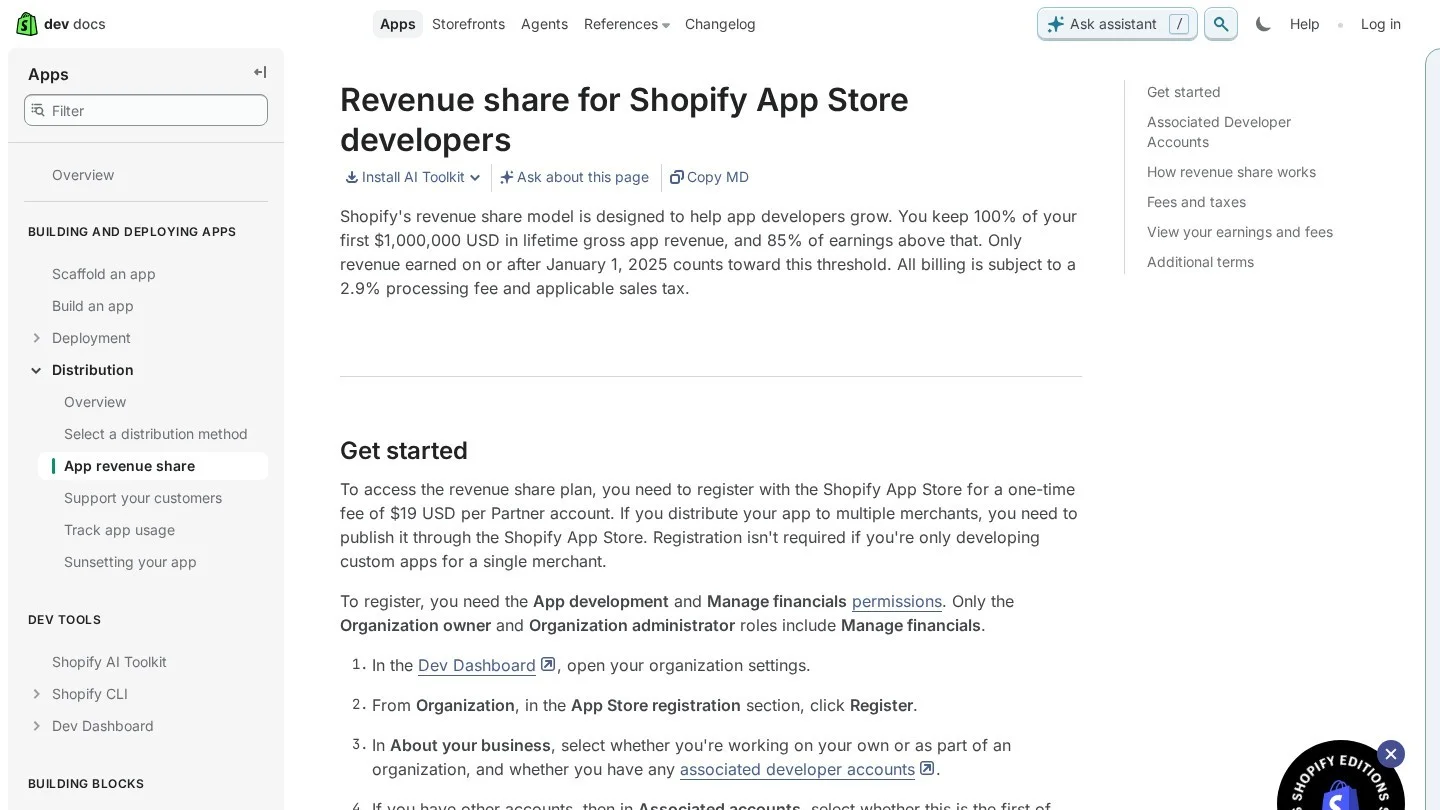
Shopify takes 0% of the first $1,000,000 in lifetime app revenue and 15% after that, its developer docs state. Only revenue earned from January 1 of last year counts toward that limit. Developers pay a one-time $19 fee to register, and firms past $20 million in App Store sales or $100 million in total revenue pay 15% on all of it.
The free first million is a clever hook. It pulls in small developers, whose apps make Shopify more useful for shop owners, which in turn draws more shops. A start-up can copy this with a free tier for early sellers. It is the wrong model if you need cash from day one, since the first sales bring in nothing.
6. Apple App Store
The App Store’s standard commission is 30%, but developers who earned up to $1 million in the prior year can pay a reduced 15%. Apple set this up in its Small Business Program, announced on November 18, 2020, and the lower rate began on January 1, 2021.
Apple can charge that much because it controls the device, the store and the payment step. Most start-ups own none of those things. So the lesson is not the rate, but the two tiers: a lower fee for small sellers keeps them coming in while big sellers pay full price.
7. Google Play
Google Play is in the middle of a fee change. In the US, UK and EEA, new rates began on June 30, 2026, with subscriptions at 10% plus a 5% billing fee. Australia and Japan moved on September 30, 2026. In other markets, eligible developers still pay 15% on the first $1 million and 30% above it.
Two fee systems at once show how fast store rules can change. Also, Google now lists a separate billing fee, so developers see what they pay for the store and what they pay for payments. A small platform rarely needs this much detail, so keep your first fee to one or two lines.
8. Amazon
Sellers on Amazon pay for a plan and a referral fee. The Individual plan costs $0.99 per item sold and the Professional plan costs $39.99 a month. The most common referral fee is 15%, though it runs from 3% to 45% by category.
Two plans let Amazon serve both casual sellers and full-time brands. As a result, a seller who sells fewer than 40 items a month pays less on the per-item plan. That kind of switch point is easy to copy. Skip the category-by-category fee table, though, until you have enough data to price each one.
9. EBay
eBay’s final value fee is 13.6% of the sale up to $7,500 in most categories, and 2.35% on any part above that. It adds a per-order fee of $0.30 on orders of $10 or less and $0.40 above that. Sellers also get 250 free listings a month, then pay $0.35 per listing.
Free listings take away the fear of trying, so new sellers sign up. Then the fee only bites when an item sells. This “pay when you win” model is a good first choice for any start-up marketplace. However, the lower rate above $7,500 shows you may need to cut the fee on big tickets, or those sellers will deal off the platform.
10. DoorDash
DoorDash gives restaurants three plans: Basic at 15%, Plus at 25% and Premier at 30% of each delivery order. Pickup orders cost 6% on every plan. There is no monthly fee and no contract.
The restaurant picks the plan, so each shop decides how much of each order it will give up. This tiered cut is a smart model when your sellers differ a lot in size and goals. It is the wrong choice for a tiny new platform, though, because three plans are hard to explain before anyone trusts you.
Read also: Productized Service Business Model Examples and What They Charge
Platform Fees Side by Side
Platform fees range from Etsy’s 6.5% transaction fee to the 30% that Apple and DoorDash Premier charge. The chart and table show the headline rate on each platform, so you can see where a new marketplace might price its own cut.

| Platform | Who it links | Main fee | Who pays |
|---|---|---|---|
| Airbnb | Hosts and guests | 15.5% service fee | Host |
| Uber | Riders, drivers, eaters, shops | No single public rate | Varies by service |
| Etsy | Makers and buyers | $0.20 per listing plus 6.5% | Seller |
| Upwork | Firms and freelancers | 0% to 15% per contract | Freelancer |
| Shopify App Store | App makers and shops | 0% to $1M, then 15% | Developer |
| Apple App Store | App makers and users | 30%, or 15% for small firms | Developer |
| Google Play | App makers and users | Varies by market | Developer |
| Amazon | Sellers and shoppers | Plan fee plus 15% most often | Seller |
| eBay | Sellers and buyers | 13.6% plus a per-order fee | Seller |
| DoorDash | Restaurants and diners | 15%, 25% or 30% | Restaurant |
Lessons for Start-Ups Building a Platform
The main lesson for start-ups is to charge the side that gains the most, and only when they gain. Etsy, eBay and Airbnb all take their cut after a sale, not before. So sellers feel the fee only when they already have cash coming in.
- Fill one side first. Pick the harder side to win, often sellers, and make it free or cheap for them, the way Shopify waives fees on the first $1,000,000. Then learn how to get buyers for the other side.
- Start in one small niche. A network effect works best when users can find each other, so a city or one product type beats a whole country.
- Keep the first fee simple. Airbnb moved to a single fee this year. One clear number builds more trust than a fee table.
- Add paid extras later. Etsy’s 26.2% take rate is four times its 6.5% headline fee, because sellers pay for ads and payments too.
- Plan for big sellers. eBay’s lower rate above $7,500 and Apple’s two tiers show that large sellers need a reason to stay on the platform.
- Stop deals from leaving. Build trust tools, such as reviews, safe payments and dispute help, so buyers and sellers keep paying you instead of trading off the site.
Also, track your own take rate from the first month. Divide revenue by the total value of trades, and watch whether it rises as you add extras.
FAQs
What Is a Take Rate?
A take rate is the share of total sales on a platform that the platform keeps as revenue. Etsy’s take rate was 26.2% in the quarter ended September 30, 2026.
What Is a Two-Sided Market?
A two-sided market is a business that serves two groups who need each other, such as hosts and guests on Airbnb. The platform makes money by helping them meet and trade.
Which Platform Charges the Lowest Fee?
Of the ten here, Etsy has the lowest headline sale fee at 6.5%, plus $0.20 per listing. Shopify charges 0% on the first $1,000,000 of app revenue, but that applies to app makers, not shops.