LinkedIn raised about $10 million from Greylock in 2004 with a deck that opened on its investment thesis instead of its team. Reid Hoffman later published that deck with notes on what he would change. That combination, a real deck plus the founder’s own critique, is the most useful thing a first-time founder can study.
Here are five real startup pitch deck examples whose founders or companies made them public: LinkedIn, Airbnb, Buffer, Front and Uber. For each, you get what the round was, what the slides did well, and what the founders said they got wrong. After that comes Sequoia Capital’s ten-section structure and a slide plan you can copy.
Five Real Pitch Decks and What They Raised
| Company | Round | What the deck is known for |
|---|---|---|
| Series B, 2004, about $10 million from Greylock. | Opens with the investment thesis; heavy use of analogies. | |
| Airbnb | First round after Y Combinator, 2008 era. | Short problem and solution slides; Couchsurfing as proof of demand. |
| Buffer | Seed, $450,000 from 18 investors. | Traction first; rebuilt competition slide. |
| Front | Series A, $10 million, 2016. | Capital efficiency and land-and-expand data. |
| Uber | First deck, late 2008. | An early vision deck from before the app existed. |
LinkedIn Series B: Lead With the Investment Thesis
LinkedIn pitched Greylock in the summer of 2004. David Sze led the deal, and Greylock invested at roughly $0.60 per share. The deck asked for about $10 million. Hoffman later called it a concept pitch, because LinkedIn had little revenue data at the time.
Slide one answered three questions: what LinkedIn is, why it matters and how it differs. Hoffman put the investment thesis first, before the team. Looking back, he said he would also end on the thesis.
Slides five to nine pitched by analogy. LinkedIn compared itself to eBay, PayPal and Google, and to information services such as Monster and LexisNexis. Hoffman’s rule is to pitch by analogy but not to reason by analogy. In other words, comparisons help investors understand you, yet they are not proof that you will succeed.
What Hoffman Would Change
Hoffman’s notes are unusually frank. These are the slides he flagged:
- Risk factors (slide 14). Risks belong in the deck, each with a plan to reduce it.
- Customer logos (slide 16). He calls this a mistake for a consumer internet company.
- Market size (slide 23). Investors give TAM figures little credibility.
- Customer quotes (slide 26). He calls these weak evidence and prefers internal data.
- Closing slide (37). It should have repeated the thesis.
He also kept product ideas investors could grasp. Slide 24 showed InLeads, an ad product modelled on Google AdWords that never launched. Slide 28 showed a subscription mockup that later became a real paid product.
Lesson for your deck: Write the investment thesis in one or two sentences. Put it on slide one and repeat it on the last slide. Then tackle the biggest objection early. For LinkedIn in 2004, that objection was revenue.
Airbnb: Problem, Solution and Proof in a Few Slides
Airbnb was founded in 2008. Its first fundraising deck came after the founders joined Y Combinator. It is short and plain, which is exactly why it gets shared so often.
The problem slide named three issues. Price was a worry for people booking travel online. Hotels left guests cut off from the city and its culture. And there was no easy way to book a room with a local or become a host. The solution slide answered in one line: book rooms with locals, not hotels.
For proof of demand, the deck pointed to Couchsurfing.com, which had 630,000 users at the time. That number showed people already stayed with strangers. Airbnb’s angle was making it easy and central. The rest of the deck covered market size, site mockups, plans to drive adoption, competitors and Airbnb’s advantages.
Sequoia’s own pitching guide, which lays out its preferred slide order, is introduced with the Airbnb founders’ story. So Airbnb’s flow maps closely to the Sequoia structure covered later in this article.
Lesson for your deck: Borrow someone else’s numbers when you have none. A related product with real users can prove the behaviour exists.
Read also: 10 Best Pitch Deck Design Companies in the USA
Buffer Seed Deck: Traction Does the Heavy Lifting
Buffer closed a $450,000 seed round from 18 investors. Co-founder Joel Gascoigne published the deck and the story in May 2013. His main advice to first-time founders was to focus on traction and product-market fit before raising. Good traction made the round far easier.
The numbers behind the round show how much work a deck needs to carry. The team contacted about 200 investors, met with about 50, and closed 18. Gascoigne said “the law of averages really comes into play” with fundraising.
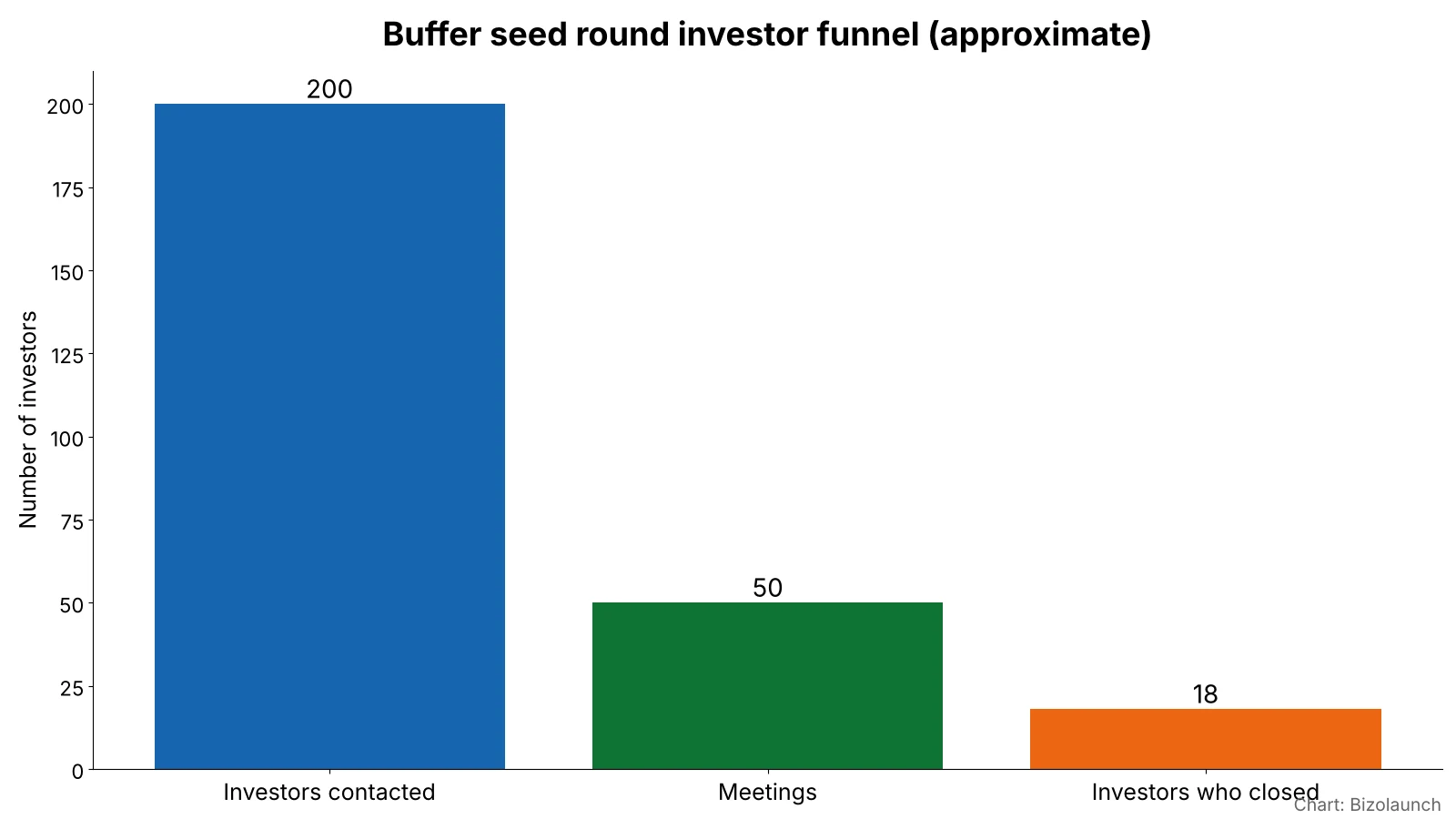
Competition caused friction. Investors asked about competitors in nearly every meeting. So the team redesigned the competition slide to explain Buffer’s position better.
Lesson for your deck: If one question comes up in every meeting, the deck is missing an answer. Fix that slide before the next pitch.
Front Series A: Show the Metrics Investors Trust
Front raised a $10 million Series A in 2016. CEO Mathilde Collin felt ready in April that year, when Front had about $100,000 in monthly recurring revenue, low churn and a roadmap in place. About 10 days into the process, she had three term sheets.
Collin later shared which slides worked and which did not. Two slides landed well:
- Capital efficiency. Front spent less than its annual recurring revenue. Collin was surprised investors liked this, since not every VC wants a startup to burn its cash quickly.
- Land and expand. Customers spent about 50% more after 12 months, net of churn. Investors saw that as very good for a SaaS company.
Two slides fell flat. The acquisition slide was weak because most traffic was organic, so it was hard to show how growth would scale. The projections slide was weak because there was no model showing how the new money would be spent.
Investors also wanted data the deck did not include. They asked for usage numbers such as time in app, daily and monthly active users, and the DAU/MAU trend. They also wanted a clearer picture of the typical buyer.
Collin’s advice on process is blunt: raise or do not raise, but never “kind of raise.” A short, focused process gave her the best result. She also warned that due diligence after the term sheet was “ten times worse” than pitching.
Lesson for your deck: For SaaS, show net revenue retention and burn against revenue. Then add a use-of-funds model that links the money to hires and growth.
Uber: A Vision Deck Before the Product
Garrett Camp, an Uber co-founder, posted the company’s first pitch deck on Medium. He timed it with the ninth anniversary of the idea. In his words, it was “the very first pitch deck we created in late 2008” for the company. It is a useful example of an early-stage deck that sells a vision before the product exists.
Treat it as a historical example. The company it describes changed a great deal before launch. Even so, it shows that a first deck does not need to be polished. It needs to explain the problem and the idea plainly enough for an investor to want a second meeting.
Use Sequoia’s Ten-Section Pitch Deck Structure
Sequoia Capital has a pitching guide it has refined over many years. It has ten sections in this order:
- Company purpose. One sentence about the mission. Avoid listing features.
- Problem. The customer’s pain, how it is handled today, and where current options fall short.
- Solution. The idea behind the company, what makes the offer distinct and lasting, and where it goes next.
- Why now. Why this is possible today and why nobody built it earlier.
- Market potential. Who the customer is and how big the market is. Sequoia notes some great companies create their own markets.
- Competition and alternatives. Direct and indirect competitors, and how you win.
- Business model. How the company will make money and succeed.
- Team. The stories of the founders and core team members.
- Financials. Include them if you have any.
- Vision. What you will have built in five years if things go well.

The real decks above line up with this order. Airbnb covers problem, solution, market and competition in the same sequence. LinkedIn’s slide one covers company purpose. Front’s capital efficiency slide sits in financials and business model.

Build Your Own Deck Slide by Slide
Use Sequoia’s order as the backbone and the lessons from the five decks to fill it in. This plan works for a seed round of 12 to 15 slides.
| Slide | What to put on it | Lesson from the examples |
|---|---|---|
| 1. Title and thesis | Company name, one-line purpose, the investment thesis. | LinkedIn led with the thesis. |
| 2. Problem | Who hurts, how often and what it costs them. | Airbnb named three plain problems. |
| 3. Solution | What you built and the idea behind it. | Airbnb answered in one line. |
| 4. Why now | The change that makes this possible today. | Sequoia asks for it explicitly. |
| 5. Product | Screenshots or a short demo flow. | LinkedIn used mockups investors understood. |
| 6. Traction | Users, revenue, growth rate, retention. | Buffer and Front led with numbers. |
| 7. Market | Bottom-up market size you can defend. | Few investors are convinced by TAM figures. |
| 8. Competition | Direct and indirect rivals and your edge. | Buffer rebuilt this slide after investor questions. |
| 9. Business model | Pricing, unit economics, sales motion. | Front showed land and expand. |
| 10. Go-to-market | How you will win customers at scale. | Front’s acquisition slide was its weak spot. |
| 11. Team | Why these founders can win. | LinkedIn placed team late, after the thesis. |
| 12. Risks | Top risks and how you will reduce them. | Hoffman wished he had included them. |
| 13. Financials and use of funds | Burn, runway, what the money buys. | Front lacked a use-of-funds model. |
| 14. Vision and close | Five-year picture and the thesis again. | Hoffman would end on the thesis. |
For the market slide, build the number from real customer counts. Our guide to TAM, SAM and SOM shows how. Practise saying the whole story in 30 seconds too; our elevator pitch guide helps with that.
Design the Slides So They Read in Seconds
Assume an investor gives each slide a few seconds. Keep each slide to one idea. Give each slide a large headline that states the point. For example, write Revenue grew 4x in 12 months in place of a bare label like Traction. Show charts in place of tables of numbers where you can. Put details in an appendix.
If design is not your strength, a specialist can help. Our lists of the best pitch deck design companies and pitch deck design companies in the USA compare agencies and their prices.
Read also: Startup Unit Economics: 5 Examples With the Math Shown
Avoid These Pitch Deck Mistakes
The five decks and their founders’ notes point to the same errors:
- Burying the thesis. If an investor reads only slide one, they should know why this could be a big company.
- Dodging the obvious objection. LinkedIn faced revenue doubts; Buffer faced competition questions. Address the hardest question early.
- Relying on quotes and logos. Hoffman called both weak evidence. Internal data is better.
- Big top-down market numbers. Investors discount them. Show your bottom-up maths.
- No use of funds. Front’s investors wanted to see how the money would turn into growth.
- Leaving out risks. Naming risks with a plan shows judgement.
- Raising halfway. Collin’s advice is to run a short, focused process.
Match the Deck to the Round
A pre-seed deck and a Series A deck do different jobs. Hoffman separates concept pitches from data pitches, and he called LinkedIn’s Series B a concept pitch. Plan for the round you are raising:
- Pre-seed. The vision, the problem and the team carry most of the weight. Uber’s first deck sits here.
- Seed. Early traction matters. Buffer’s round leaned on traction first.
- Series A. Investors look for repeatable revenue. Front showed about $100,000 in monthly recurring revenue, retention and capital efficiency.
Hoffman also advises thinking about the next round from the start. So ask what the following investor will want to see, and use this round to get there.
When the deck is ready, you need the right audience. Our guide on where to find angel investors covers that step.
Pitch Deck Questions Founders Ask Us
How many slides should a startup pitch deck have?
We suggest 12 to 15 slides for a seed deck, with extra detail in an appendix. Sequoia’s structure has ten sections, and some sections can take two slides.
Should the team slide come first?
Not always. Hoffman opened LinkedIn’s deck with the investment thesis and placed the team later. Lead with the team only if the team is the best reason to invest.
Can I use a famous startup’s deck as a template?
You can borrow the structure. However, copy the logic, not the look. Your problem, numbers and thesis must be your own.
What if I have no traction yet?
Use proof from elsewhere, as Airbnb did with Couchsurfing’s user count. Show customer interviews, a waitlist or pilot commitments, and make the why-now slide do more of the work.
Should I send the deck before the meeting?
Sending a short version by email and presenting a fuller one in the meeting works well. The emailed version must make sense without you there to explain it.