Agency Swarm is a free, open-source Python framework for building teams of AI agents that work like a small company. The best Agency Swarm alternatives are CrewAI for most teams, LangGraph for long jobs and the OpenAI Agents SDK for coders who want fewer layers. Also, the Microsoft Agent Framework is the pick for .NET shops. Google ADK fits teams on Google Cloud, and Mastra is the pick for TypeScript. Each one can run a group of agents that pass work to each other, so the choice comes down to language, hosting and cost.
Agency Swarm is built by VRSEN and has 4.6k stars and 1.1k forks on GitHub. It runs on top of the OpenAI Agents SDK, so it works best with OpenAI models. However, it has no hosted plan of its own for running agents in production. As a result, many teams look for a tool with a paid cloud, a second language or more built-in memory.
First, the sections that follow cover what Agency Swarm does and where it falls short. Then each alternative gets its features, prices, pros and cons. Finally, a short guide on picking one and a few common questions close the post.
What Is Agency Swarm?
Agency Swarm is a Python framework for multi-agent apps, where each agent has a job title, a set of tools and its own instructions. For example, you can make a CEO agent that plans the work and a Developer agent that writes code. The CEO then hands tasks to the Developer and checks the result.
Under the hood, Agency Swarm extends the OpenAI Agents SDK and the Responses API. The current v1.x line needs Python 3.12 or newer, and you install it with one command.
pip install -U agency-swarmAgents talk through a built-in send_message tool. You set who may talk to whom on the Agency object with the > sign. So ceo > dev means the CEO can start a chat with the Developer, but not the other way round. In addition, tools use Pydantic models to check their inputs. You can write a tool with @function_tool, extend BaseTool, or build tools from an OpenAPI file with ToolFactory.
Agency Swarm is free under the MIT license. OpenAI models such as the GPT-5 family and GPT-4o work out of the box. Claude, Gemini, Grok, Azure OpenAI and OpenRouter models work through LiteLLM. Meanwhile, VRSEN sells a separate service at agents.vrsen.ai, where its team builds custom agent swarms for a business.

Features That Agency Swarm Misses
Agency Swarm misses a hosted cloud, support for languages other than Python, and built-in storage for chat history. Each gap matters more once an agent leaves a laptop and goes live.
First, Agency Swarm has no paid platform to deploy, trace and scale agents. You host the app yourself, while CrewAI, LangGraph and Mastra each sell a cloud with tracing and logs.
Second, the framework is Python only, and it needs Python 3.12 or newer. So a team that writes TypeScript, C# or Java has to look elsewhere. For example, Mastra is built for TypeScript, and Google ADK runs in five languages.
Third, chat history does not save itself. To keep a thread across sessions, you write your own load_threads_callback and save_threads_callback that read and write a database. By contrast, LangGraph and Mastra save state for you, so a run can pause and pick up later.
Finally, Agency Swarm is OpenAI first. Other models run through the LiteLLM adapter, not through their own connectors. Also, moving an older v0.x project to v1.x means rewriting parts of it, because the base changed to the Agents SDK.
Read also: Findable App Alternatives: 10 AI Search Tools to Try
Best Alternatives to Agency Swarm
The best alternatives to Agency Swarm are CrewAI, LangGraph, the OpenAI Agents SDK, Microsoft Agent Framework, Google ADK and Mastra. All six are free to install. Your costs come from model calls, plus a cloud plan if you want one.
| Tool | Code it runs in | Paid cloud | Pick it if you |
|---|---|---|---|
| CrewAI | Python | Free plan, then a quote | Want teams of agents with roles |
| LangGraph | Python and JS | LangSmith from $0, then $39 a seat | Run long jobs that must save their place |
| OpenAI Agents SDK | Python | None, you pay for each model call | Want the same base as Agency Swarm |
| Microsoft Agent Framework | .NET and Python, Go in test | None, you pay for models and Azure | Code in C# or host on Azure |
| Google ADK | Five, from Python to Go | None, you pay for models and Google Cloud | Host on Google Cloud |
| Mastra | TypeScript | Free, then $25 or $250 a month | Code in TypeScript |
1. CrewAI
CrewAI is the closest match to Agency Swarm, because it also builds teams of agents with roles, goals and tasks. It is a Python framework under the MIT license, and it was built from scratch with no LangChain inside. Version 1.15.45 came out on November 24, 2026, and it runs on Python 3.10 to 3.13.
CrewAI has two building blocks. Crews are teams of agents that split up a task and hand parts to each other. Flows are event-driven workflows with state and branches, so you can fix the order of steps when free-form teamwork is too loose. In addition, more than 100,000 developers have passed the free CrewAI courses.
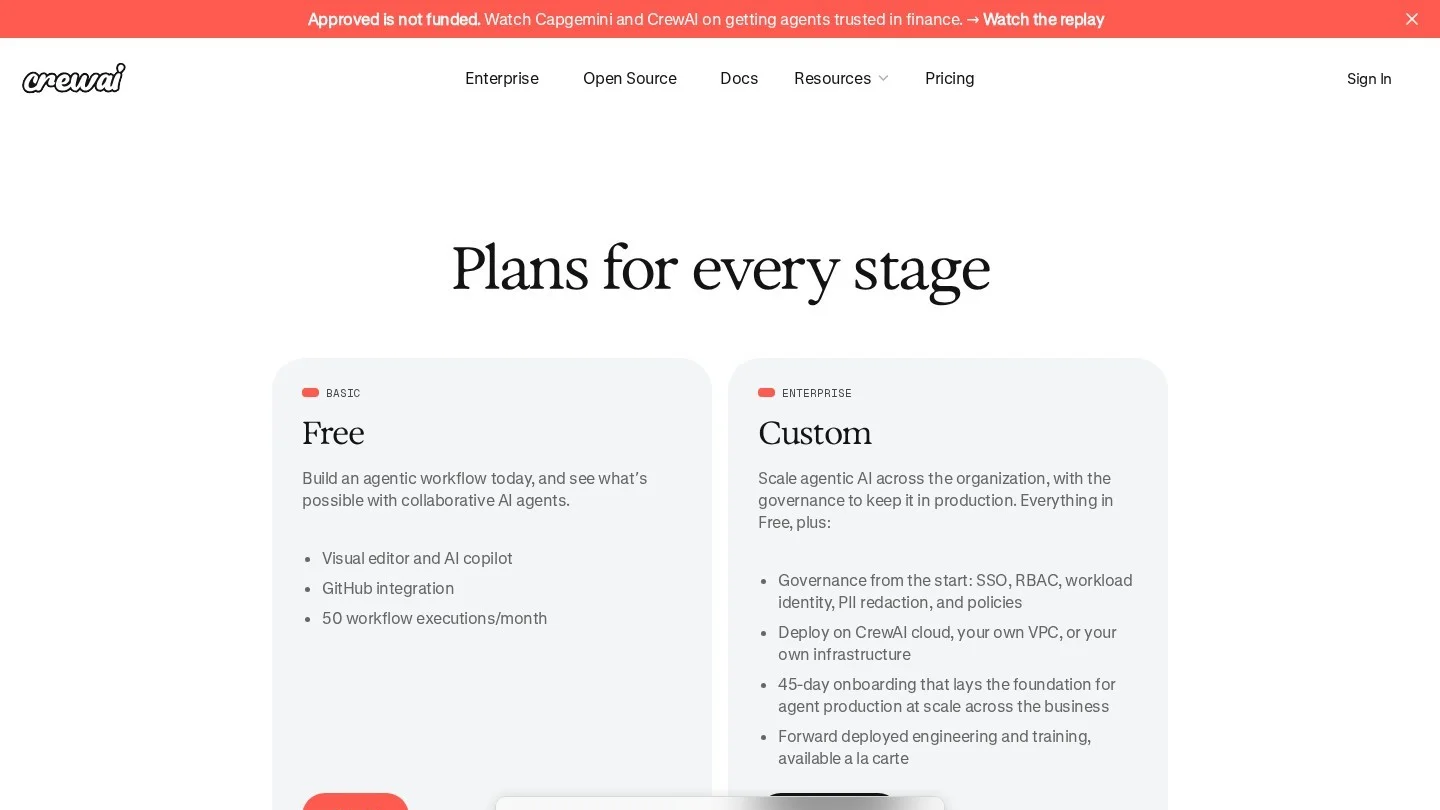
On pricing, the open-source library costs nothing. The hosted CrewAI AMP has a Free plan with 50 workflow runs a month and 2 automations. That plan still includes the Studio visual editor, tracing, guardrails, human input and cron jobs. Beyond that, the Enterprise plan has custom pricing and adds SSO, role-based access, PII redaction and the option to run in your own cloud.
Pros
- Same mental model: Agency Swarm users already think in roles and tasks, so the switch is short.
- Visual editor on the free plan: Non-coders on the team can build and test crews in Studio.
Cons
- Big jump in price: After 50 runs a month, the next step is a sales call for Enterprise.
- Python only: Teams on TypeScript or .NET get no native library.
CrewAI is the best Agency Swarm alternative for most teams. However, a small team that needs a few hundred hosted runs a month should skip it. No plan sits between Free and Enterprise.
2. LangGraph
Unlike CrewAI, LangGraph does not organize agents by job title. Instead, it is a low-level tool for long-running agents that keep their state. You draw the work as a graph of steps, and LangGraph saves the state at each step. As a result, a run can pause for a human, survive a crash and pick up where it stopped.
LangGraph is free under the MIT license and has a JavaScript version too. It offers durable runs, streaming, human-in-the-loop steps, saved state and memory. Klarna, Replit and Elastic use it.
The paid side is LangSmith. The Developer plan costs $0 for one seat and up to 5,000 traces a month. Plus costs $39 a seat each month, with up to 10,000 traces and unlimited seats. Plus also includes one small serverless Agent Server. Beyond that, hosted servers are billed by use, for example 0.0675 LSU per vCPU-hour of runtime, where 1 LSU equals $1.
Pros
- State that survives: Saved steps let long jobs resume, which Agency Swarm leaves to your own code.
- Two languages: Python and JavaScript teams can share the same ideas.
Cons
- More code to write: You build the graph by hand, so a simple two-agent team takes longer to set up.
- Usage billing takes math: Hosted servers are priced by CPU, memory and database time.
LangGraph is the pick for long jobs, such as research agents that run for hours or flows that wait for a manager to approve. On the other hand, a solo developer who wants a quick demo will find it slower to set up than CrewAI.

3. OpenAI Agents SDK
The OpenAI Agents SDK is the layer that Agency Swarm itself is built on. So dropping Agency Swarm and using the SDK directly removes one layer of code between you and the model.
The SDK has three core parts. Agents are models with instructions and tools. Handoffs, or agents used as tools, let one agent pass work to another. Guardrails check what goes in and what comes out. On top of that, the SDK adds sessions for memory, human-in-the-loop steps, MCP tools, voice agents and tracing. It also has sandbox agents that work in their own file space and can resume later.
pip install openai-agentsThe SDK itself has no price. You pay OpenAI for model calls, and other models can plug in through adapters such as LiteLLM.
Pros
- Fewest layers: Everything Agency Swarm does sits on these same parts.
- Built-in tracing: Runs show up in OpenAI tracing for debugging, evals and fine-tuning.
Cons
- No agency structure: You write the rules for who talks to whom yourself.
- OpenAI first: Other model makers work through adapters, much like in Agency Swarm.
The OpenAI Agents SDK is the right choice for coders who like Agency Swarm’s base but not its extra rules. By contrast, a team that wants to move away from OpenAI models should pick LangGraph, Google ADK or Mastra instead.

4. Microsoft Agent Framework
For .NET teams, the Microsoft Agent Framework fills the biggest gap in Agency Swarm. It runs in .NET and Python, and a Go version is in public preview. Microsoft shipped version 1.0 in April 2026 with stable APIs and long-term support.
The framework is the direct successor to AutoGen and Semantic Kernel, and it comes from the same teams. It takes the simple agent setup of AutoGen and adds the business features of Semantic Kernel, such as sessions, filters and telemetry. Graph-based workflows handle long tasks with human steps. In addition, ready patterns such as handoff and group chat cover common multi-agent setups. Connectors cover Azure OpenAI, OpenAI, Anthropic Claude, Google Gemini, Amazon Bedrock, Ollama and Microsoft Foundry.
The framework itself has no fee. Instead, you pay for the models you call and for Azure if you host there. Note that AutoGen now gets only bug fixes and security patches, so new AutoGen projects should start here.
Pros
- Real .NET support: C# teams get a first-party agent framework with long-term support.
- Many model connectors: Claude, Gemini and Bedrock have their own connectors.
Cons
- Azure-first quick start: The sample code uses Microsoft Foundry and an Azure sign-in.
- Some parts still in preview: DevUI and some Foundry features are not stable yet.
Microsoft Agent Framework is the best Agency Swarm alternative for companies that run on .NET and Azure. However, a Python startup with no Microsoft ties will move faster with CrewAI.

5. Google ADK
Google’s Agent Development Kit, or ADK, runs in five languages: Python, Go, TypeScript, Java and Kotlin. That is the widest choice on this list. Every version has an MCP client and speaks the A2A protocol, so an ADK agent in Go can call an agent in Python over HTTP.
In Go and TypeScript, ADK 2.0 runs workflows as a graph, with routes based on conditions and steps that run side by side. Python has adapters for Gemini, Anthropic, OpenAI and LiteLLM models. Also, the agents-cli scaffold command sets up deployment to Cloud Run, Gemini Enterprise Agent Runtime or Google Kubernetes Engine. In Python, adk eval scores how an agent behaved against test cases, so you can run checks in CI.
ADK has no license fee. You pay for model calls and for the Google Cloud services you deploy on.
Pros
- Five languages: Mixed teams can build agents in the language each person knows.
- Agents that talk across tools: A2A lets ADK agents work with agents built in other frameworks.
Cons
- Features differ by language: The graph workflow runtime is in Go and TypeScript first.
- Google Cloud lean: The deploy commands target Google services.
Google ADK is the pick for teams already on Google Cloud or Gemini. On the other hand, a team that hosts on AWS or Azure gets less from its deploy tools.
6. Mastra
Mastra is an open-source TypeScript framework for agents and workflows, released under the Apache 2.0 license. So it is the main pick for web teams who do not want a Python service in their stack.
Agents in Mastra can use tools, memory and many steps of reasoning. They can also ask for tool approval and hand work to supervisor agents. Workflows support steps in a row or side by side, branches, loops, and pauses for a human. State saves on its own, and time-travel replay lets you rerun a past step. On top of that, the model router reaches more than 1,000 models from OpenAI, Anthropic, Google and others. A Studio app lets you test agents, read traces and edit prompts.
Mastra Platform has a Free plan with unlimited agents and 100,000 trace events. Starter costs $25 a month with one small dedicated project and 250,000 events. Team costs $250 a month with two medium projects, a SOC 2 report and 10 million events. Extra memory and CPU each cost $0.25 per hour of use.
Pros
- Built for TypeScript: It fits Next.js, React, Astro, Express and other JavaScript apps.
- Cheap paid step: The $25 Starter plan sits between free and enterprise.
Cons
- No Python library: Python data teams cannot share code with it.
- Usage fees on top: Heavy agents pay per hour for memory and CPU past the plan limits.
Mastra is the best Agency Swarm alternative for TypeScript teams. By contrast, it is the wrong pick for a team whose agents depend on Python data tools.

How to Choose the Best Agency Swarm Alternative
To choose the best Agency Swarm alternative, match the tool to your language. Then match it to how long your agents run and where you host.
- Pick by language. Python teams can use CrewAI, LangGraph or the OpenAI Agents SDK. Use Mastra for TypeScript, Microsoft Agent Framework for C#, and Google ADK for Go, Java or Kotlin.
- Check how long a run lasts. If a job runs for hours or waits on a person, LangGraph or Mastra saves state for you. For short chats between two or three agents, CrewAI is faster to set up.
- Decide where it runs. If you want a hosted plan, compare CrewAI AMP, LangSmith and Mastra Platform. If you host on Azure or Google Cloud, use the framework from that cloud.
- Count model costs. The frameworks are free, so the real bill is model calls. Test one full run and multiply by your monthly volume before you commit.
If you plan to sell the agents you build, see our list of AI agent marketplaces. For tools that sit close to these, see our guides to Pydantic AI alternatives, MetaGPT alternatives and Copilot Studio alternatives.
Agency Swarm Alternatives FAQs
Is Agency Swarm free?
Yes, Agency Swarm is free under the MIT license. You still pay for the model calls your agents make, such as OpenAI API usage.
Is CrewAI better than Agency Swarm?
CrewAI is better for teams that want a hosted cloud and a visual editor, since Agency Swarm has neither. Agency Swarm is better if you want to stay close to the OpenAI Agents SDK.
Can Agency Swarm use Claude or Gemini?
Yes. Claude, Gemini, Grok and other models run in Agency Swarm through LiteLLM. OpenAI models work out of the box, while the rest go through that adapter.
Which alternative works without Python?
Mastra works in TypeScript, and Google ADK works in Go, Java, Kotlin and TypeScript. The Microsoft Agent Framework works in .NET.
Are agent frameworks safe to run in production?
They can be, but agents that call tools need limits on what they can reach. Our guide on AI agent security covers the main risks.