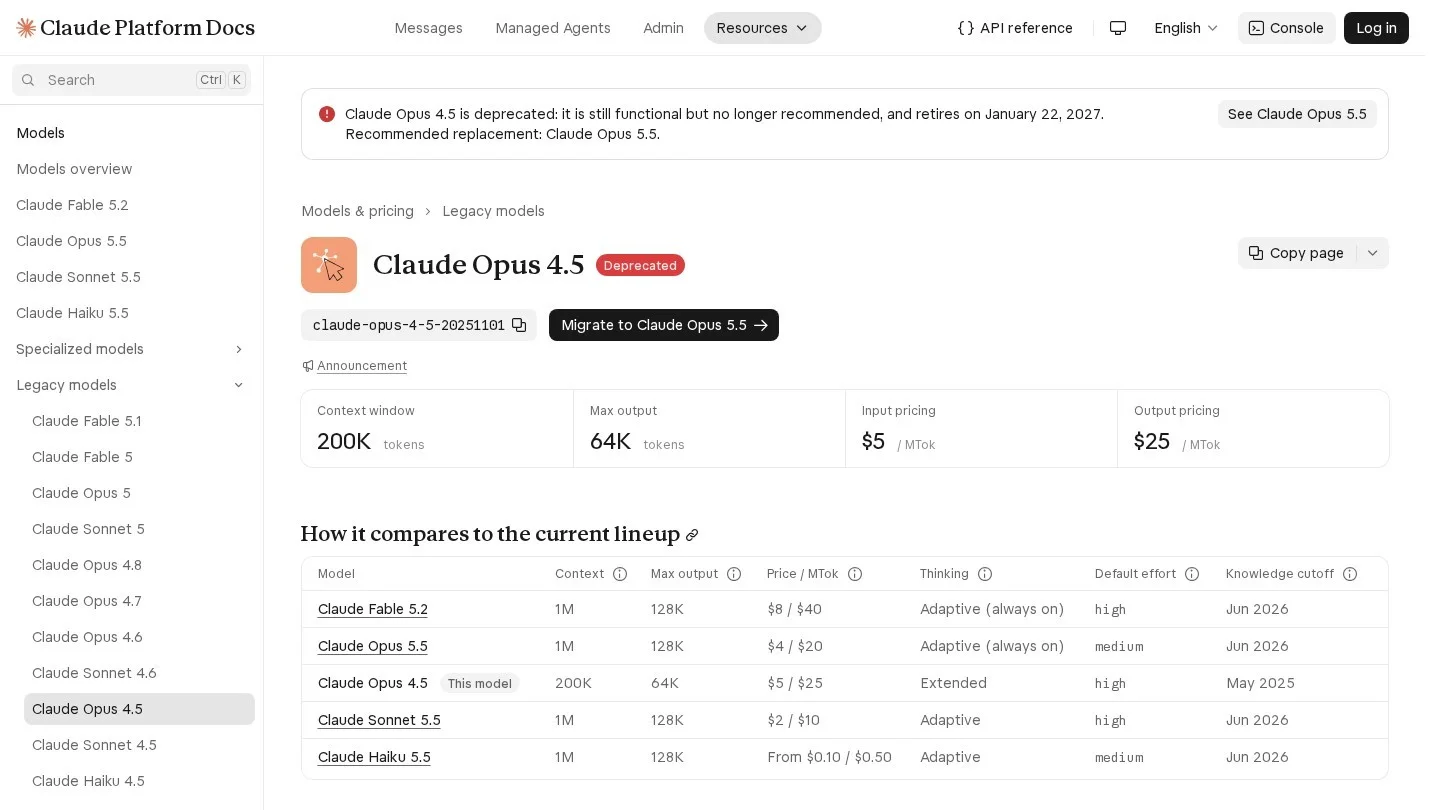
Anthropic marked its Claude Opus 4.5 model as deprecated on Nov. 23 and set it to retire on Jan. 22, which gives businesses that call it through the Claude API 60 days to move. The named replacement, Claude Opus 5.5, lists at $4 per million input tokens and $20 per million output tokens, against $5 and $25 for Opus 4.5. So the newer model is 20% cheaper on both lines.
The catch is that the same model now has two clocks. On Amazon Bedrock, Opus 4.5 also entered “Legacy” status on Nov. 23, but its end-of-life date is May 23, four months after Anthropic’s own cutoff. However, AWS warns that users who stay into the later part of that window should expect higher prices.
For a company that built a support bot, a coding agent or a document tool on Opus 4.5, that means a real choice. Move now to a cheaper model and retest, or buy time on a cloud platform and likely pay more for it. The dates, the price math and the rules that can catch out smaller teams are laid out in order.
The 2 Retirement Dates Side by Side
Opus 4.5 retires on Jan. 22 on Anthropic’s own API and on May 23 on Amazon Bedrock. Anthropic’s model page now says the model “is still functional but no longer recommended.” It names Claude Opus 5.5 as the recommended replacement and links to a migration guide.
| Milestone | Claude API (Anthropic) | Amazon Bedrock |
|---|---|---|
| Model released | Nov. 24 of last year | Same model, offered on Bedrock |
| Deprecated or moved to Legacy | Nov. 23 | Nov. 23 |
| Higher-price extended access begins | Not offered | Feb. 23 |
| Final day of service | Jan. 22 | May 23 |
By our count, Opus 4.5 will have been on sale for just under 14 months on Anthropic’s API when it retires. That is a short shelf life for software that many firms wired into customer-facing products. Also, the Bedrock dates come from the AWS model lifecycle page, which lists Feb. 23 as the start of what it calls public extended access.
What AWS’s Legacy Label Means in Practice
On Bedrock, a Legacy model still works for current users, but the rules tighten in three ways. First, new customers cannot use it at all. Second, AWS says existing customers “may lose access to Legacy models after 15 days of inactivity.” Third, you can no longer buy new Provisioned Throughput for it.
The price warning sits in the same rules. For models with end dates after Feb. 1 of this year, AWS says a Legacy model moves into public extended access after at least three months. During that stretch, “you should expect higher pricing, which will be set by the model provider.” AWS says it will tell customers about any price change before it happens.
Opus 4.5 is not alone on the list. AWS also moved Meta’s Llama 3 70B Instruct and Llama 3 8B Instruct to Legacy in its GovCloud (US-West) region on Nov. 9, with end dates of May 9. For a business that relies on any hosted model, the lesson is the same: the cloud provider’s date and the model maker’s date are not always the same day.
Read also: California Logged 17 Breach Notices in 7 Business Days. Most Breaches Were Months Old
The Price Math on Moving to Opus 5.5
Moving to Opus 5.5 lowers list prices by a fifth. Anthropic’s page shows Opus 4.5 at $5 per million input tokens and $25 per million output tokens, with cache reads at $0.50 per million. Opus 5.5 is listed at $4 and $20 for input and output.
Take a mid-size workload of 100 million input tokens and 20 million output tokens a month as an example. On Opus 4.5 that costs $500 for input and $500 for output, or $1,000 a month at list price. On Opus 5.5 the same volume costs $400 plus $400, or $800. That is our own calculation from the listed rates, and real bills will differ with caching, batch use and how many tokens the newer model uses for the same task.
That last point matters. A new model can write longer or shorter answers than the old one for the same prompt, so the token count, not just the rate, decides your bill. As a result, the only way to know your real cost is to run your own prompts through both models and compare.
Who Gets Caught Out by a 60-Day Window
Small teams with model names hard-coded into their apps are most at risk. A company that calls Opus 4.5 by its full model ID in a chatbot, an email triage tool or a retrieval-augmented generation (RAG) setup will need to change that ID, test the output and redeploy before Jan. 22.
The holiday calendar makes that tighter. Many firms freeze code changes in late December, so the useful window is shorter than 60 days. Also, agencies and freelancers who built tools for clients may not know which clients still run on Opus 4.5 until something breaks.
Bedrock users face a quieter trap. Because a Legacy model can drop off after 15 days without use, a seasonal job, such as a year-end report or a tax-season workflow, could lose access between runs. In that case, the business would find out on the day the job fails.
A Migration Plan for Business Owners
Owners should plan to be off Opus 4.5 well before Jan. 22, even if they run on Bedrock. A simple plan looks like this:
- List every app, script and vendor tool that calls Opus 4.5, including tools your agency or contractor built. Search your code and config files for the model ID.
- Run 20 to 50 of your real prompts through Opus 5.5 and compare answers, length and cost side by side with the old model.
- If you use Claude Code or another coding agent, check which model it is set to use in its settings.
- On Bedrock, keep any Legacy model you still need in light, regular use so the 15-day rule does not cut you off, and budget for a higher rate after Feb. 23.
- Ask any AI vendor you pay which model sits under its product and when it plans to switch. A software development partner should be able to answer that in one email.
Finally, write the next retirement into your plans now. If one top model lasted about 14 months on its maker’s API, the model you pick today may need the same swap next year. Building your app so the model name lives in one setting, not in dozens of files, turns the next move into a one-line change. For a wider view of how firms buy these tools, see our list of AI agent marketplaces.