Two out of three developers who use AI tools now pick Claude Code as their coding agent. That is the headline from the Stack Overflow 2026 Developer Survey, where Claude Code reached 66% against 59% for GitHub Copilot. The tool only left research preview in May of last year.
Money tells the same story. Claude Code passed $500 million in run-rate revenue by late summer last year. It hit $1 billion in November, and it was above $2.5 billion by February 2026. That makes it one of the fastest-growing developer tools on record.
This page collects the Claude Code adoption statistics that matter for developers, team leads and buyers. It covers revenue, survey usage, company size, enterprise use, how much code the agent writes and what a rollout costs.

Claude Code Adoption Statistics Timeline
Claude Code is the coding agent from Anthropic. It works with developers on end-to-end software work, from reading a codebase to writing and changing code.
Anthropic released it as a research preview in February of last year, next to Claude 3.7 Sonnet. Then it became generally available in May of last year. Since then, the public numbers have come in bursts, mostly tied to funding rounds and developer surveys.
So the first step is to line them up by date. The table puts each figure next to the period it covers.
| Date | Claude Code statistic | Type of figure |
|---|---|---|
| February, last year | Research preview launch with Claude 3.7 Sonnet | Anthropic launch post |
| May, last year | General availability | Anthropic |
| Early September, last year | Over $500 million run-rate revenue; usage up more than 10x in three months | Anthropic Series F post |
| November, last year | $1 billion run-rate revenue, about six months after general availability | Anthropic, Bun acquisition post |
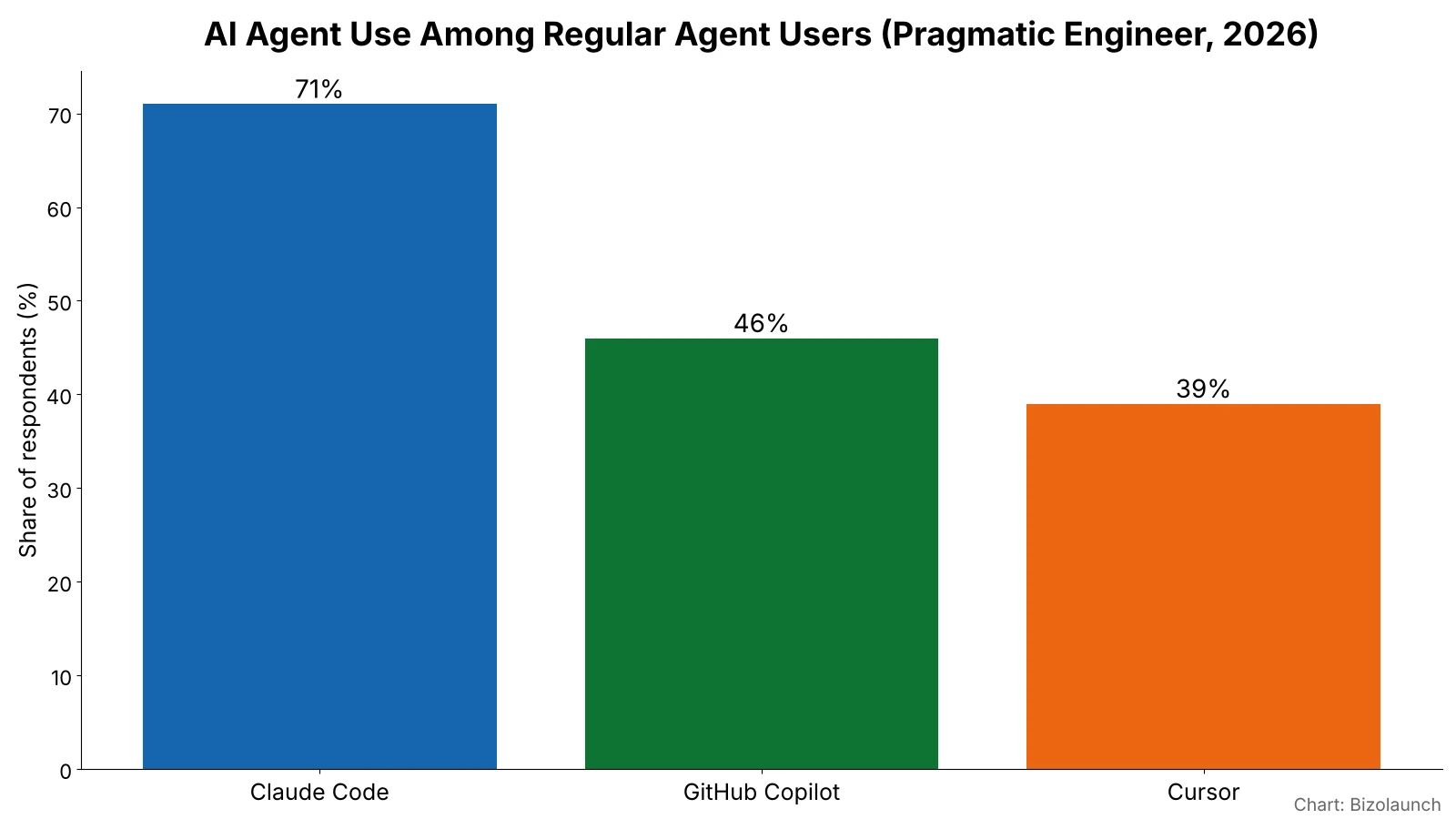
| Jan 27 to Feb 17, 2026 | 71% of regular AI agent users use Claude Code | The Pragmatic Engineer survey, 906 responses |
| February 12, 2026 | Over $2.5 billion run-rate revenue; weekly active users doubled since January 1 | Anthropic Series G post |
| February 2026 | About 4% of public GitHub commits written by Claude Code | Third-party estimate (SemiAnalysis) |
| May to July 2026 | 39% adoption at work | JetBrains Developer Ecosystem Survey 2026, 15,000+ developers |
| October 6, 2026 | 66% of AI users pick Claude Code as their agent | Stack Overflow 2026 Developer Survey, 30,000+ people |
| November 3, 2026 | Claude Code and Codex together at $24.0 billion of a $34.0 billion coding market | Menlo Ventures enterprise survey |
Claude Code Revenue Growth Statistics
Revenue is the cleanest adoption signal, because it counts people and companies who pay. Claude Code is part of paid Claude plans and the API, so its run-rate climbs with every new seat and every token.
The first figure came on September 2 of last year. Claude Code passed $500 million in run-rate revenue at the time of the Anthropic Series F round. Usage had grown more than 10x in the three months after the full launch.
Next came the $1 billion mark. Claude Code reached $1 billion in run-rate revenue in November of last year. That was about six months after it became available to the public. The milestone came out on December 3, together with the Bun acquisition. Bun is the JavaScript runtime that Anthropic bought to support Claude Code.
Then growth sped up again. By February 12, 2026, Claude Code run-rate revenue was over $2.5 billion. The figure had more than doubled since the start of 2026, in about six weeks. That number came with Anthropic’s $30 billion Series G.

What the revenue jumps mean in plain numbers
The growth rates are easier to judge when you put them side by side. From $500 million to $1 billion took about three months. From $1 billion to $2.5 billion took about three more.
That is a 5x rise in roughly six months. For comparison, Anthropic as a whole had a run-rate of $14 billion in February 2026. So Claude Code was close to 18% of company run-rate at that point. That share is our calculation from the two figures in the Series G post.
No separate Claude Code revenue figure has come out since February. However, its total run-rate kept climbing. It crossed $47 billion in May 2026, during the Series H round. Then it reached about $81 billion in October 2026, in the company’s IPO fact sheet.
How Many Developers Use Claude Code
Three large developer surveys in 2026 measured Claude Code use. Each one asks a different question, so the percentages do not match. Still, all three put Claude Code at or near the top.
| Survey | Sample and period | Claude Code figure | Comparison |
|---|---|---|---|
| Stack Overflow 2026 Developer Survey | 30,000+ people, seven weeks, results on October 6, 2026 | 66% of AI users name it as their agent | GitHub Copilot 59% |
| JetBrains Developer Ecosystem Survey 2026 | 15,000+ professional developers, May to July 2026 | 39% adoption at work | Called the de facto standard |
| The Pragmatic Engineer AI tooling survey | 906 responses, January 27 to February 17, 2026 | 71% of regular AI agent users | GitHub Copilot 46%, Cursor 39% |
Stack Overflow 2026 Developer Survey
The 2026 Stack Overflow survey had more than 30,000 people take part. Among AI users, 66% work in coding agents and 63% use chatbots. The agents of choice were Claude Code at 66% and GitHub Copilot at 59%.
Daily use is high too. Of respondents who use AI coding assistants or agents, 73% use them every day. Also, 31% spend four or more hours a day with AI tools. On model providers, Anthropic and OpenAI were neck and neck, with Google a distant third.
JetBrains Developer Ecosystem Survey 2026
JetBrains asked more than 15,000 professional developers worldwide, between May and July 2026. The answers were reweighted by region, job status and language. In JetBrains Research results, Claude Code had 39% adoption at work.
That number is lower than the Stack Overflow figure for a simple reason. JetBrains counts all professional developers. Stack Overflow counts people who already use AI tools.
The Pragmatic Engineer survey
The Pragmatic Engineer survey ran from January 27 to February 17, 2026. It had 906 responses. Among regular AI agent users, 71% use Claude Code. GitHub Copilot came next at 46%, then Cursor at 39%.
The same survey asked which tools developers love. Claude Code got 46%, and Claude models added another 11%. Cursor got 19% and GitHub Copilot 9%. So Claude Code is both the most used and the most liked agent in that group.
Read also: DeepSeek R1 Adoption Statistics: Who Uses It and How
Claude Code Adoption by Company Size and Seniority
Company size changes the picture. In the Pragmatic Engineer survey, 75% of the smallest companies and teams use Claude Code. At large companies, GitHub Copilot is still ahead. That fits how buying works: big firms often roll out Copilot through existing Microsoft and GitHub contracts.
Seniority matters as well. Directors and senior leaders love Claude Code at twice the rate of less senior engineers. Senior people often decide which tools a team buys. So this pattern helps explain the later rise in business seats.
The Anthropic usage data points the same way. In its Economic Index study from April of last year, startup work made up 32.9% of Claude Code conversations. Enterprise work was 23.8%. In other words, startups took up Claude Code first, and big companies followed.
For a closer look at the Copilot side of this split, see our GitHub Copilot business subscribers and revenue report.
Claude Code Use in Enterprises
Enterprise buying grew fast in early 2026. By February 12, business subscriptions to Claude Code had quadrupled since the start of the year. Enterprise use also made up over half of all Claude Code revenue.
Named customers include Netflix, Spotify, KPMG, L’Oreal and Salesforce. NASA engineers also used Claude Code to plan and write navigation commands for the Mars Perseverance rover. That example is in the November 2026 Anthropic IPO prospectus.
The wider spending data backs this up. The Menlo Ventures 2026 enterprise AI report surveyed nearly 400 US enterprise decision-makers in September 2026. Enterprise coding spend reached $34.0 billion, up 7.7x. Claude Code and OpenAI Codex together took $24.0 billion, or 70% of that market. Independent tools such as Cursor, Cognition and Factory grew 2.9x to $10.1 billion.

Menlo does not split the $24.0 billion between Claude Code and Codex. So no public figure gives Claude Code’s exact share of that market.
Anthropic customer counts behind Claude Code
Claude Code sales ride on Anthropic’s business base. These company-wide numbers show how many large buyers can add Claude Code seats.
- 300,000+ business customers in early September of last year.
- 500+ customers spending over $1 million a year in February 2026.
- 8 of the Fortune 10 were Claude customers in February 2026.
- 1,900+ customers with $1 million or more in trailing revenue at the end of September 2026.
- 11,900+ customers with $100,000 or more in trailing revenue in the same period.
These counts cover all Claude products, so they are context for Claude Code, not Claude Code totals.
How Developers Use Claude Code Day to Day
Claude Code is used more for handing off work than for chatting. In Anthropic’s April study of 500,000 coding interactions, 79% of Claude Code conversations were automation. On Claude.ai, the share was 49%.
Two more patterns came out of that study.
- Feedback loops: 35.8% of Claude Code interactions followed a loop where the developer runs the code, then sends errors back. On Claude.ai, it was 21.3%.
- Directive tasks: 43.8% of Claude Code interactions were full hand-offs with little back-and-forth. On Claude.ai, it was 27.5%.
The June 2026 Economic Index report added newer details. Claude Code sessions are more autonomous than chat or Cowork for 26 of 31 output types. Also, 54% of Claude Code sessions run on Opus, against 10% of chat and Cowork conversations. A median blog-writing Claude Code session needs a single human prompt, while the median chat version takes 13 rounds.
How Much Code Claude Code Writes
Adoption is one thing. Share of code written is another, and it is rising.
Public GitHub commits. In February 2026, Claude Code wrote about 4% of all public GitHub commits worldwide. That is a third-party estimate from SemiAnalysis, and it had doubled in one month.
Code written by agents. In the JetBrains 2026 data, about 32% of Claude Code users generate more than 80% of their code with agents. Codex users were higher at 42%. Across all professional developers, about 47% of code is fully agent-generated.
Anthropic’s own codebase. More than 90% of codebase contributions at Anthropic were written by Claude in September 2026, a figure from the Anthropic IPO fact sheet.
A worked example for a team lead
Say a team of 12 developers ships 600 commits a month. If the team matches the JetBrains average of 47% agent-written code, about 282 commits a month would come mostly from agents. At the 80% level of heavy users, that rises to 480. These are our illustrations from the survey averages, so real teams will vary.
Claude Code Pricing and the Cost of Adoption
Claude Code is included in paid Claude plans. The free plan does not include it. The prices come from the official Claude pricing page.
| Plan | Price | Claude Code included |
|---|---|---|
| Free | $0 | No |
| Pro | $20 a month, or $17 a month billed yearly ($200 up front) | Yes |
| Max | From $100 a month | Yes |
| Team, Standard seat | $25 a seat monthly, or $20 billed yearly | Yes |
| Team, Premium seat | $125 a seat monthly, or $100 billed yearly | Yes |
| Enterprise | $20 a seat a month, 20-seat minimum, plus usage at API rates | Yes |
Now the math for a real rollout. A team of 10 on Team Standard seats with yearly billing pays $20 x 10 x 12 = $2,400 a year. On Team Premium seats, the same team pays $100 x 10 x 12 = $12,000 a year. Monthly billing raises those totals to $3,000 and $15,000.
Enterprise works differently. A 20-seat minimum at $20 a seat is $400 a month, or $4,800 a year, before API usage. Usage is billed on top at API rates, so heavy agent use can cost far more than the seat fee.
Read also: Copy.ai Statistics: How It Grew and Who Uses It
Limits of Claude Code Adoption Figures
These statistics are useful, but each has a catch.
First, run-rate revenue is a snapshot of one month times twelve. It is not booked yearly revenue. Second, the surveys use different bases. The Stack Overflow 66% counts AI users, while the JetBrains 39% counts all professional developers. So the two numbers should not be compared directly.
Third, the 4% commit share is an outside estimate. It also covers public repositories only, and most company code is private. Finally, Anthropic has not published total Claude Code users or weekly active users. It only gave growth rates, such as weekly active users doubling between January 1 and February 12, 2026.
If your company is rolling out coding agents, set usage rules first. Our AI acceptable use policy guide covers the basics, such as what code and data staff may share. Teams that also run Copilot can compare results with our GitHub Copilot productivity statistics.
Claude Code Statistics Questions From Developers
How many developers use Claude Code?
Anthropic has not published a user count. In the Stack Overflow 2026 survey, 66% of AI users named Claude Code as their agent. In the JetBrains 2026 survey, Claude Code had 39% adoption at work among professional developers.
How much revenue does Claude Code make?
Claude Code had over $2.5 billion in run-rate revenue on February 12, 2026. It was at $1 billion in November of last year and over $500 million in early September of last year.
When did Claude Code launch?
Claude Code launched as a research preview in February of last year. It became generally available in May of last year.
Is Claude Code more popular than GitHub Copilot?
Among AI users in the Stack Overflow 2026 survey, yes: 66% for Claude Code and 59% for Copilot. In the Pragmatic Engineer survey, Claude Code led with 71% of agent users against 46%. However, Copilot is still ahead at large companies.
Do businesses use Claude Code?
Yes. Business subscriptions quadrupled in the first six weeks of 2026, and enterprise use was over half of Claude Code revenue by February. Netflix, Spotify, KPMG, L’Oreal and Salesforce are named customers.
Is Claude Code free?
No. Claude Code needs a paid plan. Pro starts at $17 a month with yearly billing, or $20 billed monthly.
For more on the company behind the tool, read our profile of Anthropic CEO Dario Amodei and our latest Anthropic news.