Suno AI vs Udio is a race between the two best-known AI song makers, and on user growth it is not close. Suno said nearly 100 million people had made music on it by November 19 of last year, up from 10 million in May 2024. On top of that, it raised over $400 million at a $5.4 billion valuation in June 2026.
Udio came out of closed beta later, in April 2024. Since then, it has spent most of a year rebuilding its app around deals with labels. In fact, both apps were sued by the major labels on the same day in June 2024. However, they settled in different ways, and Udio turned off downloads in October of last year while Suno kept selling plans with monthly download limits. As a result, the two apps you can sign up for today look far less alike than they did at launch.
Next, we compare launch dates, funding, user counts, the label lawsuits and deals, plan prices and credits, and tools. We also name a winner for each kind of user, and say who should skip each app. For Suno on its own, our Suno AI statistics page goes deeper on that one company.
Suno vs Udio Side by Side
Suno leads Udio on money raised, user counts and paid plans, while Udio has the closer tie to Universal. The table puts the main facts for both apps in one place, so you can see the gap at a glance.
| Item | Suno | Udio |
|---|---|---|
| Company name in court | Suno, Inc. | Uncharted Labs, Inc. |
| Early milestone | v3 model out on March 21, 2024 | Public launch on April 10, 2024 |
| Latest round | Over $400 million Series D, June 2026 | Seed round led by a16z, April 2024 |
| Latest valuation | $5.4 billion post-money | No public number |
| People who made music | Nearly 100 million (November, last year) | No public number |
| Label lawsuit court | District of Massachusetts | Southern District of New York |
| Label deals | Warner (November, last year), BMG (August 2026) | Universal (October, last year), Warner (November, last year) |
| Paid plans | Pro, Premier, Platinum | Standard, Pro |
| Downloads | 20, 60 or 120 a month on paid plans | Turned off on October 29 of last year |
When Each App Launched
Suno was live first, with a public blog post for a Valentine’s Day song feature on February 8, 2024 and its v3 model on March 21, 2024. So by the time Udio opened to everyone, Suno already had a few months of users and a newer model in their hands.
Udio launched on April 10, 2024, after a closed beta. The founders came from Google DeepMind, and at launch Udio could turn a genre, a topic and some lyrics into a mastered track in under 40 seconds. It also had a remix tool from day one, which let users edit a track with text and extend songs.
Suno then moved faster on devices. For example, it put out Suno for Mobile on July 1, 2024 and an Android app on December 5, 2024, followed by v4 in November 2024 and v6 on September 9, 2026.
Funding and Valuation Compared
Suno has raised far more money than Udio, with three public rounds since May 2024. Its value also more than doubled in about seven months. The first was $125 million on May 21, 2024, with Lightspeed Venture Partners, Nat Friedman and Daniel Gross, Matrix and Founder Collective among the backers.
Next came a $250 million Series C at a $2.45 billion post-money valuation on November 19 of last year. Menlo Ventures led it. NVentures, the venture arm of NVIDIA, joined too, along with Hallwood Media, Lightspeed and Matrix. Then on June 3, 2026, Suno said it had raised over $400 million in Series D funding at a $5.4 billion post-money valuation.

Udio has said much less about money. In April 2024, it raised a seed round led by Andreessen Horowitz. Instagram cofounder Mike Krieger and Oriol Vinyals of Google came in as angels and advisors. In addition, will.i.am, Common, Kevin Wall, Tay Keith and UnitedMasters took part, but Udio gave no dollar amount.
Read also: Runway AI vs Pika: User Adoption and Market Share
User Growth and Adoption Numbers
Suno is the clear leader on users. It went from 10 million people who had made music on it in May 2024 to nearly 100 million by November of last year. That is close to ten times as many in about 18 months. For more usage data over time, our post on Suno AI music generation usage statistics tracks more of these data points.

Suno has also pointed to app store reach. In its June 2026 Series D post, it said viral trends pushed the app to number one in the App Store’s Music category in dozens of countries. Its BMG post in August 2026 spoke of “millions of people in the Suno community,” though it gave no new total.
Udio’s growth signs are of a different kind. Instead of user totals, its posts point to paying users, such as the 1,000 bonus credits it gave all subscribers on October 29 of last year and the higher limit of 10 songs at once for Pro users. So if you are judging the two on reach alone, Suno is the only one with numbers you can compare over time.

Label Lawsuits and Licensing Deals
Both apps were sued on June 24, 2024, and both have since signed deals with major labels, but Udio settled with Universal first. The RIAA announced the two cases that day, with Sony Music Entertainment, UMG Recordings and Warner Records among the plaintiffs. The Suno case went to a federal court in Boston, and the Udio case went to one in New York.
In both cases, the labels said the apps copied their songs without asking, to train AI models. They asked the courts to stop the copying and to award damages for past use. They also said fair use did not cover it.
Udio’s Universal and Warner Settlements
Udio settled with Universal Music Group on October 30 of last year and with Warner Music Group on November 19 of last year. With the Universal deal, Udio downloads stopped right away. Udio would then go through a few months of change while it built new models. Also, a new app trained on licensed music is set to launch in 2026. It will come with a paid plan for making, playing and sharing songs.
The Warner deal “resolves the companies’ copyright litigation.” Neither label bought or took a stake in Udio. In the meantime, users keep v1, v1.5 and v1.5 Allegro, plus tools such as extend, remix and Styles. The terms for this period took effect on November 12 of last year.
Suno’s Warner, BMG and Distributor Deals
Suno announced its Warner Music Group partnership on November 25 of last year, in a post titled “A new chapter in music creation”. After that, it signed a global partnership with BMG on August 12, 2026, tied to its first music model built with the music business. Artists and songwriters can opt in. BMG will also join Suno’s In Session and Spark programs for new artists.
Suno also added a deal with Believe and TuneCore on September 8, 2026. Before that, it changed its download rules and terms on August 10, 2026. However, Suno and BMG gave no launch date for the licensed model, so check the Suno blog before you plan a release around it.
Plans, Prices and Credits
Suno sells four plans, from free up to Platinum at $120 a month. Every paid plan lets you use songs for business and has a monthly download cap. On November 27, 2026, Suno Pro cost $10 a month or $96 a year billed yearly, with 2,500 credits and 20 downloads a month.
Premier listed at $30 a month or $288 a year, with 10,000 credits and 60 downloads. Platinum listed at $120 a month or $1,200 a year, with 15,000 credits, 20,000 visual credits and 120 downloads. Meanwhile, the free plan gives 50 credits a day but no commercial rights and no monthly downloads. A Black Friday banner on the same day offered an extra 30% off annual plans.
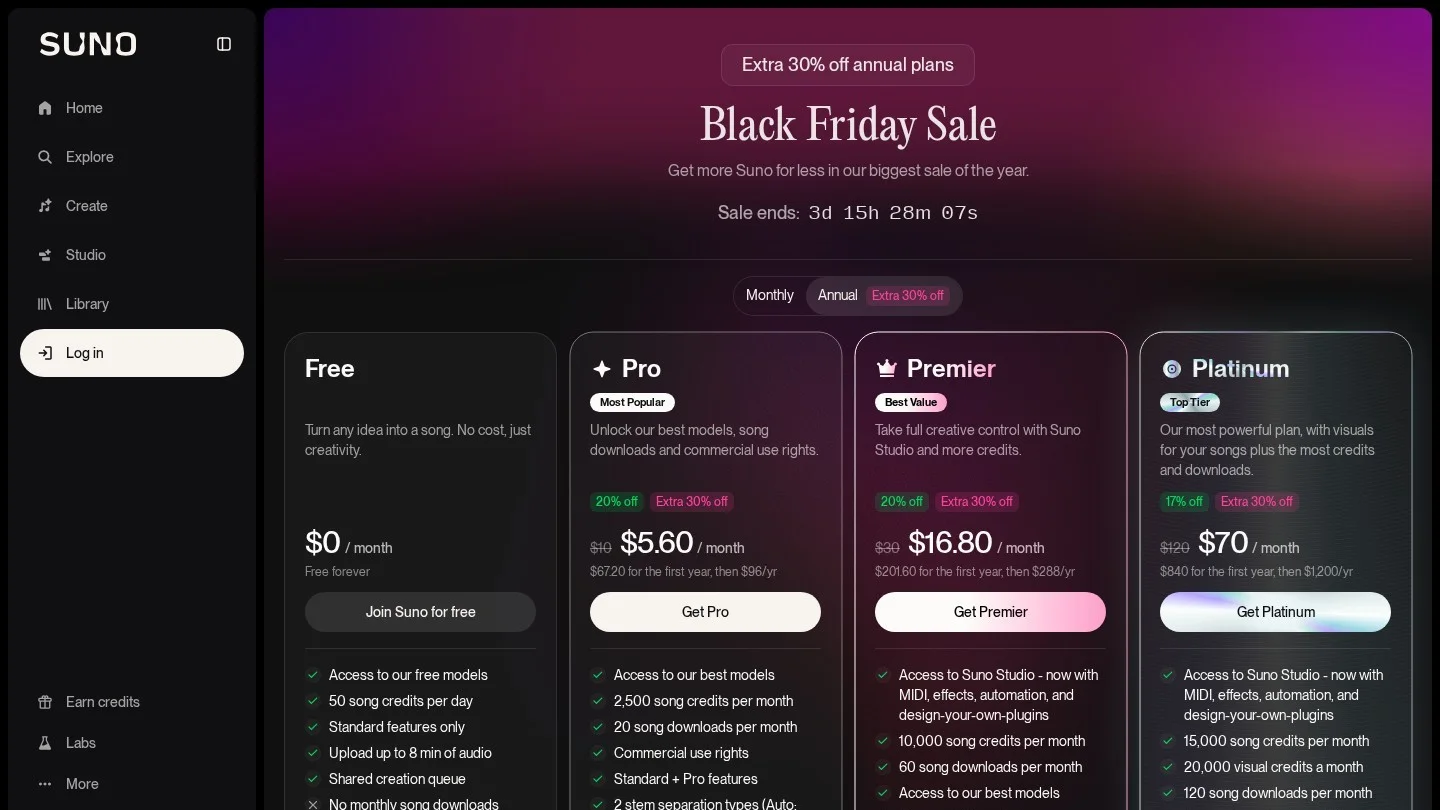
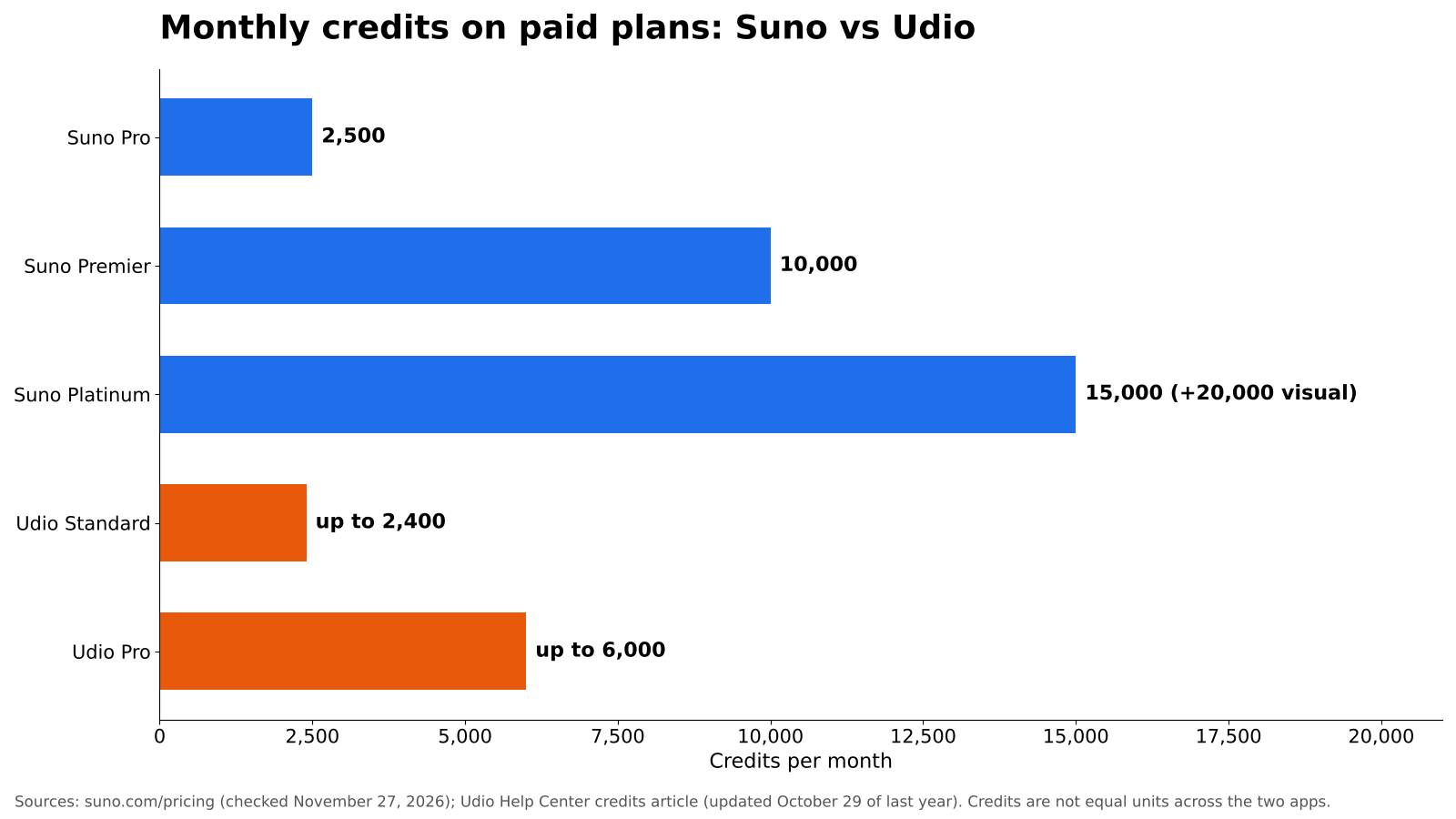
Udio’s plans work on credits too. Free users get 10 credits a day with a 100-credit monthly limit, up to 2,400 credits a month on Standard and up to 6,000 on Pro. In addition, Pro and Standard users got 1,200 extra credits during the transition. Keep in mind that a Suno credit and a Udio credit do not buy the same amount of music, so compare songs per month rather than raw credits.
Features Each App Offers Now
Suno now has more tools, from a full studio to video, while Udio’s new tools wait on its licensed app. For example, Suno added Studio 2.0 in August 2026, Speech in beta on October 1, MIDI to start songs on November 4 and Visuals on November 17, 2026. Voices, Custom Models, stem splits and editing come with Pro. Suno Studio comes with Premier, and the visual tools come with Platinum, which you can only buy on the web.
Udio’s current tools are the ones it had before the deals: its v1, v1.5 and v1.5 Allegro models, plus extend, remix and Styles. Songs can still be shared through udio.com links that people without an account can open. Next, Udio and Universal plan songs in an artist’s voice and style, with the artist’s okay, plus AI remixes, covers and mashups.
Read also: Grok Monthly Active Users, Downloads and Who Pays
Which App Wins for Which User
Suno wins for most people in late 2026, because it is the only one of the two that still lets paid users download songs and use them for business. It also has the bigger user base, the newer model in v6 and the studio tools that working creators need. However, Suno is not for anyone who wants music only from a model trained on licensed label songs today. Its first model built with the labels had no launch date in its BMG post.
Udio is the pick for fans who mainly want to make and share songs inside the app. It also makes sense if you want to be first in line for its licensed app with Universal and Warner. It is not for content creators, podcasters or small brands that need audio files for videos or ads, because downloads have been off since October 29 of last year.
If you are tracking the business side rather than making songs, Suno is also the company to watch. In fact, it shows how fast AI apps now raise money, a trend we cover in our look at technologies after AI. Teams that want to build their own music or audio tools can also compare partners in our list of AI software development companies.
Suno vs Udio FAQs
Is Suno Bigger Than Udio?
Yes, Suno is bigger on every public measure. It said nearly 100 million people had made music on it by November of last year, and it was valued at $5.4 billion in June 2026.
Can You Still Download Songs from Udio?
No, Udio turned off downloads on October 29 of last year as part of its deal with Universal. You can still share songs through udio.com links.
Did the Labels Settle with Both Apps?
Warner signed deals with both apps in November of last year, and Universal settled with Udio in October of last year. The first lawsuits were filed on June 24, 2024 by Sony, Universal and Warner labels.
How Much Does Suno Cost per Month?
Suno Pro listed at $10 a month on November 27, 2026, Premier at $30 and Platinum at $120. There is also a free plan with 50 credits a day.