Databricks is the top enterprise data platform right now for large firms that want data work and AI on one copy of their data. It passed a $7 billion revenue run-rate in August 2026, and it grew more than 80% year over year. Snowflake, its closest public rival, grew product revenue 37% in its July 2026 quarter. So on growth and AI tools, the Databricks enterprise data platform leads the pack.
That does not make it the right pick for every team. A small team that only runs SQL dashboards may pay less, and do less setup work, on BigQuery or Fabric.
Databricks Funding Hit a $190 Billion Valuation in August 2026
Databricks closed a $5 billion strategic round at a $190 billion valuation on 13 August 2026. Coatue led it. Blackstone, MGX and accounts advised by T. Rowe Price also joined. New names on the cap table include Sixth Street Growth, BOND, TPG, Point72 and Premji Invest.
That round came fast. In July 2026, Databricks signed a term sheet at a $188 billion value. A month later the close came in at $190 billion. Back in February 2026, the value was $134 billion.
So the price of the company rose by $56 billion in six months. For a sense of scale, compare it with the world’s largest private companies by revenue.
| Date | Round | New money | Valuation | Run-rate at the time |
|---|---|---|---|---|
| Sep last year | Series K | $1 billion | Over $100 billion | $4 billion |
| Dec last year | Series L | Over $4 billion | $134 billion | $4.8 billion |
| Feb 2026 | Series L close and debt | About $5 billion equity, $2 billion debt | $134 billion | $5.4 billion |
| Aug 2026 | Strategic round | $5 billion | $190 billion | Over $7 billion |
The February deal also added about $2 billion of debt room. JPMorgan Chase Bank led the credit lines, with Barclays, Citi, Goldman Sachs and Morgan Stanley. Microsoft and the Qatar Investment Authority bought equity in that close.
Revenue Run-Rate Grew From $4 Billion to $7 Billion in 11 Months
Run-rate is the current monthly revenue pace, times 12. It is not a full-year total. Still, the trend is plain. Databricks crossed $4 billion in its Q2 of last year and $7 billion in Q2 of this year.

Growth also sped up as the company got bigger. It was over 50% in September of last year. Then it rose to over 55%, then over 65%, then over 80% in August 2026. Most firms slow down as they grow. Databricks did the reverse.
Free cash flow was positive over the 12 months before each of these updates. Databricks gives no dollar figure for it, though.
Net Retention Stays Above 140%
Net retention measures how much more existing customers spend a year later. A figure of 140% means a group of customers paying $100 last year now pays $140. Databricks posted net retention above 140% in September of last year, December and February 2026. If the idea is new, our guide to net revenue retention covers the math.
Customers Paying Over $1 Million Passed 1,000
Large accounts tell you who trusts the platform with real budgets. These are the counts by update:
- Over $1 million a year: 650 or more in September of last year. Then over 700, over 800, and over 1,000 by August 2026.
- Over $10 million a year: over 70 in February 2026 and over 100 by August 2026.
- All customers: more than 20,000 organizations, including 70% of the Fortune 500.
Read also: HeyGen vs Synthesia: Enterprise Adoption Statistics
What the Databricks Enterprise Data Platform Includes
Databricks calls its product the Data Intelligence Platform. Under that name sit several tools. Each one is billed in the same unit, so you can mix them on one bill.
The lakehouse. Your data stays in cheap cloud object storage, in open formats like Delta Lake and Apache Iceberg. Then engines for SQL, Spark and AI read the same files. You do not copy data into a closed warehouse first. Databricks was founded in 2013 by the people who built Apache Spark, Delta Lake and MLflow.
Databricks SQL. This is the data warehouse part. It passed a $1 billion run-rate by December of last year, less than four years after general release. By August 2026 the lakehouse warehousing line passed $1.5 billion and grew over 100% a year.
Unity Catalog. It controls who can see each table, file, model and AI tool. Databricks made it open source in June 2024 under the Apache 2.0 license, at the Linux Foundation’s LF AI & Data group. It also works with the Iceberg REST Catalog API, so outside engines can read the same governed tables.
Lakebase. This is a Postgres database that runs on object storage, with compute split from storage. It launched last year. In June 2026, Databricks added LTAP, short for Lake Transactional/Analytical Processing. LTAP lets app traffic and analytics run on one copy of data, with no ETL in between. Lakebase passed a $100 million run-rate by August 2026, and it starts 12 million databases a day.
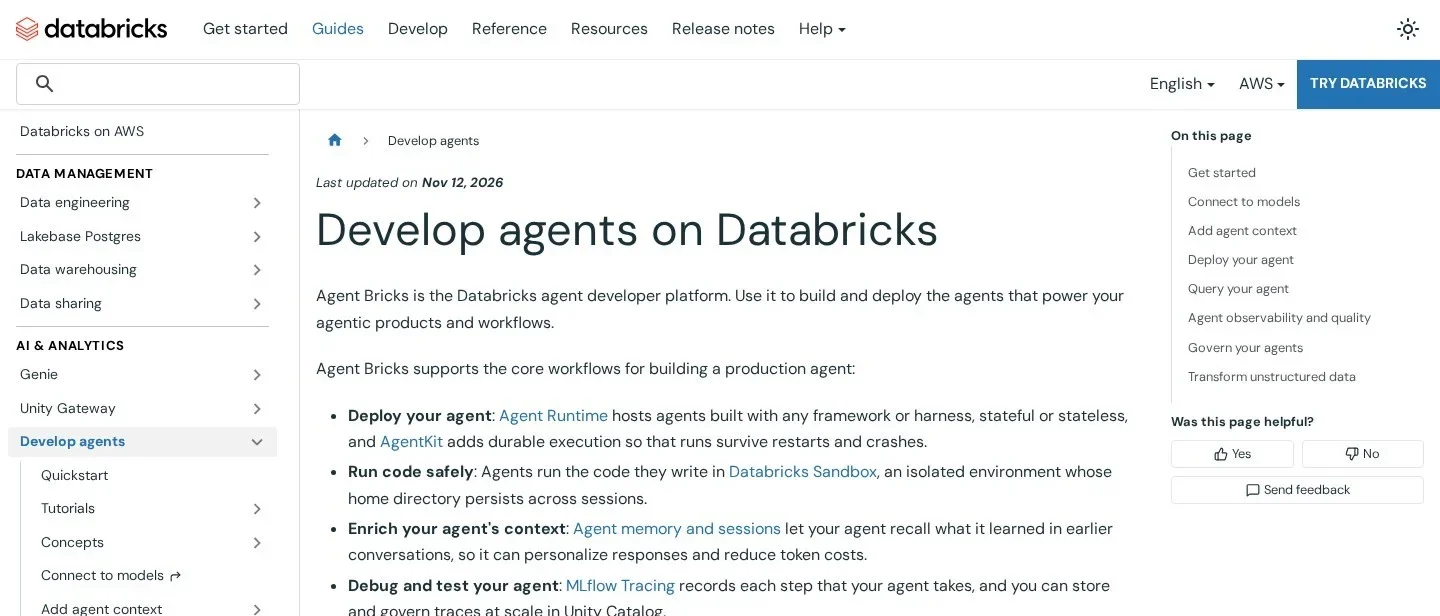
Agent Bricks and Mosaic AI. Agent Bricks is the agent builder. Agents can keep memory in Lakebase and call tools through MCP servers. MLflow tracing logs each step, and LLM judges score the output. The AI product line as a whole passed a $1.4 billion run-rate in February 2026.
Genie. Databricks put part of its February 2026 money into Genie and Lakebase. By August it was scaling both, along with Unity AI Gateway.
If you want to see these tools live, the yearly Data + AI Summit is where Databricks shows each new release.
DBU Pricing: How Databricks Charges You
Databricks bills in DBUs, short for Databricks Units. A DBU is a unit of compute. Each workload burns DBUs at its own rate, and you pay per second. Pay as you go has no up-front fee.
Two plans exist. The first one has no commitment. Committed use contracts give a discount if you promise a set spend, and the commitment can cover more than one cloud. On Azure, Microsoft bills Azure Databricks through your Azure account. Prepaying for one or three years there saves up to 37% over pay-as-you-go DBU prices.
The dollar price per DBU depends on the cloud, the region, the tier and the workload. So the most useful public number is how many DBUs a job burns. The serverless SQL warehouse sizes are a good example:
| SQL warehouse size | DBUs per hour | DBUs for 8 hours a day, 22 days |
|---|---|---|
| 2X-Small | 4 | 704 |
| X-Small | 6 | 1,056 |
| Small | 12 | 2,112 |
| Medium | 24 | 4,224 |
| Large | 40 | 7,040 |
| X-Large | 80 | 14,080 |
Take a Medium warehouse that runs during work hours only. That is 24 DBUs an hour, 8 hours a day, for 22 work days. The month comes to 4,224 DBUs. Multiply that by your contract rate per DBU to get the bill. Leave the same warehouse on all month and it burns 17,280 DBUs, about four times as much. So auto-stop settings matter more than the size you pick.
Other tools add their own rates. Lakebase autoscaling compute bills at 0.213 times its DBUs. Data quality monitoring counts double. CPU model serving uses 1 DBU per hour for each concurrent request.
To try it, the AWS Marketplace listing gives up to $400 in credits over a 14-day trial. A Free Edition for learning also exists, with fewer features.
How Databricks Compares With Snowflake, BigQuery, Fabric and AWS
Each rival is a fine product. The real gap is in how you pay and what else you get.
| Platform | Billing unit | Free start | Recent scale figure |
|---|---|---|---|
| Databricks | DBUs, per second | 14 days, up to $400 on AWS Marketplace | Over $7 billion run-rate, Aug 2026 |
| Snowflake | Credits, $2.00 each on Standard in AWS US East | Free sign-up | $1.49 billion product revenue in the July 2026 quarter |
| Google BigQuery | $6.25 per TiB scanned, or slot-hours | First 1 TiB of queries and 10 GiB of storage free each month | Not broken out by Google |
| Microsoft Fabric | Capacity units (F SKUs) | 60-day free trial | Over 40,000 paid customers, July 2026 |
| Amazon Redshift Serverless | $0.375 per RPU-hour, 4 RPU minimum | $300 credit for 90 days | Not broken out by AWS |
Snowflake
Snowflake is the nearest match on size. In its quarter to 31 July 2026, Snowflake had $1.49 billion in product revenue, up 37%. Net revenue retention was 126%. It had 828 customers paying over $1 million in the past 12 months. Snowflake expects $6.07 billion in product revenue for its fiscal year 2027.
So Databricks grows more than twice as fast, and its retention is higher. Still, the two count big customers differently. Databricks counts accounts with a run-rate over $1 million. Snowflake counts trailing 12-month product revenue. Snowflake bills in credits. On-demand Standard edition costs $2.00 per credit in AWS US East, and warehouses bill by the second with a one-minute minimum. It also stays simpler for teams that live in SQL and do not want to touch Spark.
Google BigQuery
BigQuery is serverless. You never size a cluster. On-demand queries cost $6.25 per TiB scanned in the US, and the first 1 TiB each month is free. A team that scans 10 TiB a month pays for 9 TiB, so $56.25 in compute. Editions with slot pricing start at $0.04 per slot-hour on Standard. For a Google Cloud shop with modest data, BigQuery is hard to beat on effort. Our post on how Google Cloud revenue doubled covers the wider business.
Microsoft Fabric
Fabric bundles data engineering, a warehouse and BI reports under one capacity price. Microsoft had over 40,000 paid Fabric customers in July 2026, up more than 60% in a year. A one- or three-year reservation saves about 41% over pay as you go. Firms that already run on Microsoft 365 and Azure often find Fabric easier to buy.
AWS
AWS sells Redshift as its warehouse. Redshift Serverless costs $0.375 per RPU-hour in US East, with a 4 RPU minimum and per-second billing. So a 4 RPU base for 8 hours a day over 22 work days costs $264 a month in compute, before storage. Managed storage is $0.024 per GB-month. Databricks also runs on AWS, so an AWS shop can use both.
Gartner Placed Databricks as a Leader
Gartner published its first Magic Quadrant for Data Lakehouse Platforms on 4 November 2026. Databricks is a Leader in it, placed highest for ability to execute. In the Cloud Operational Database Management Systems report of 12 November 2026, Databricks is the only Visionary.
Read also: Tonic AI Review: Safe Test Data for Software Teams
Who Should Skip Databricks
Databricks gives you a lot of control. That control has a cost in skills and in bill tracking. These buyers may do better elsewhere:
- SQL-only analytics teams. If you only run reports on a few terabytes, BigQuery or Snowflake needs less setup.
- Microsoft-first firms. If your staff already live in Microsoft 365 and Azure, Fabric gives one contract and one admin screen.
- Teams with no data engineers. Spark jobs, clusters and catalogs need someone who knows them.
- Buyers who need a fixed monthly price. DBU bills move with usage. Without auto-stop and budgets, costs can jump.
- Small startups on tight cash. BigQuery’s free monthly tier and Redshift’s $300 credit cost less to try.
Quick Answers Before You Book a Databricks Demo
Is Databricks a public company?
No. It is still private. Its last price was $190 billion in August 2026.
Who runs Databricks?
Ali Ghodsi is co-founder and CEO. The company is based at 1 Sansome Street in San Francisco and has more than 30 offices worldwide.
Can other engines read Databricks tables?
Yes. Unity Catalog supports the Iceberg REST Catalog API, so outside engines can read the same Iceberg tables.
Which clouds does it run on?
Databricks runs on AWS, Microsoft Azure and Google Cloud. On Azure, Microsoft sets the price and bills it.
Is the AI part extra?
Yes, in the sense that every AI tool burns its own DBUs. Model serving, AI Search and agent judges each have their own rates.