Suno AI music generation usage statistics measure how many songs people make with Suno, how many people make them and how those creators behave. The answer is that Suno runs at a huge scale. Users were making more than 7 million songs a day by the time of Suno’s latest funding round in June 2026. Also, over 100 million people had used Suno by February 2026.
To put that in context, Suno’s investor papers compare its output with Spotify. In those papers, Suno makes more music every two weeks than the whole Spotify catalog. At 7 million a day, that is about 81 songs every second and about 2.6 billion songs a year. Yet only a small share of users pay. Suno had 2 million paid subscribers in February 2026, about 2% of everyone who had ever used it.
The sections cover song output, user counts, the typical creator, what people make songs about and how often paying users come back. Then come the tools that shape how people create, the rules for publishing Suno songs to streaming services and who Suno is right for and who it is not. For revenue, plan prices and funding, see our main Suno AI statistics post.
Suno AI Music Generation Usage Statistics in 2026
Suno AI music generation usage statistics for 2026 show more than 7 million songs a day, over 100 million people who have used it and 2 million paying users.
| Usage measure | Figure | Date |
|---|---|---|
| Songs made per day | More than 7 million | June 2026 |
| People who have used Suno | Over 100 million | February 2026 |
| Paid subscribers | 2 million | February 2026 |
| Paid subscribers a few months earlier | About 1 million | November of last year |
| Weekly retention of paying users | 78% | November of last year |
| Lapsed users who come back each week | 350,000 | November of last year |
| Most common user | A man aged 25 to 34 | November of last year |
| Average time spent on one song | 20 minutes | November of last year |
How Many Songs Suno Users Make
Suno users make more than 7 million songs a day. Billboard got that figure from Suno’s fundraising papers, and Fortune repeated it on June 4, 2026, the day after Suno’s Series D.
The same 7 million figure first came out in late November of last year. At that point, the investor deck added a comparison. Suno makes more music every two weeks than the whole Spotify catalog, as SIX AM covered on November 25 of last year.
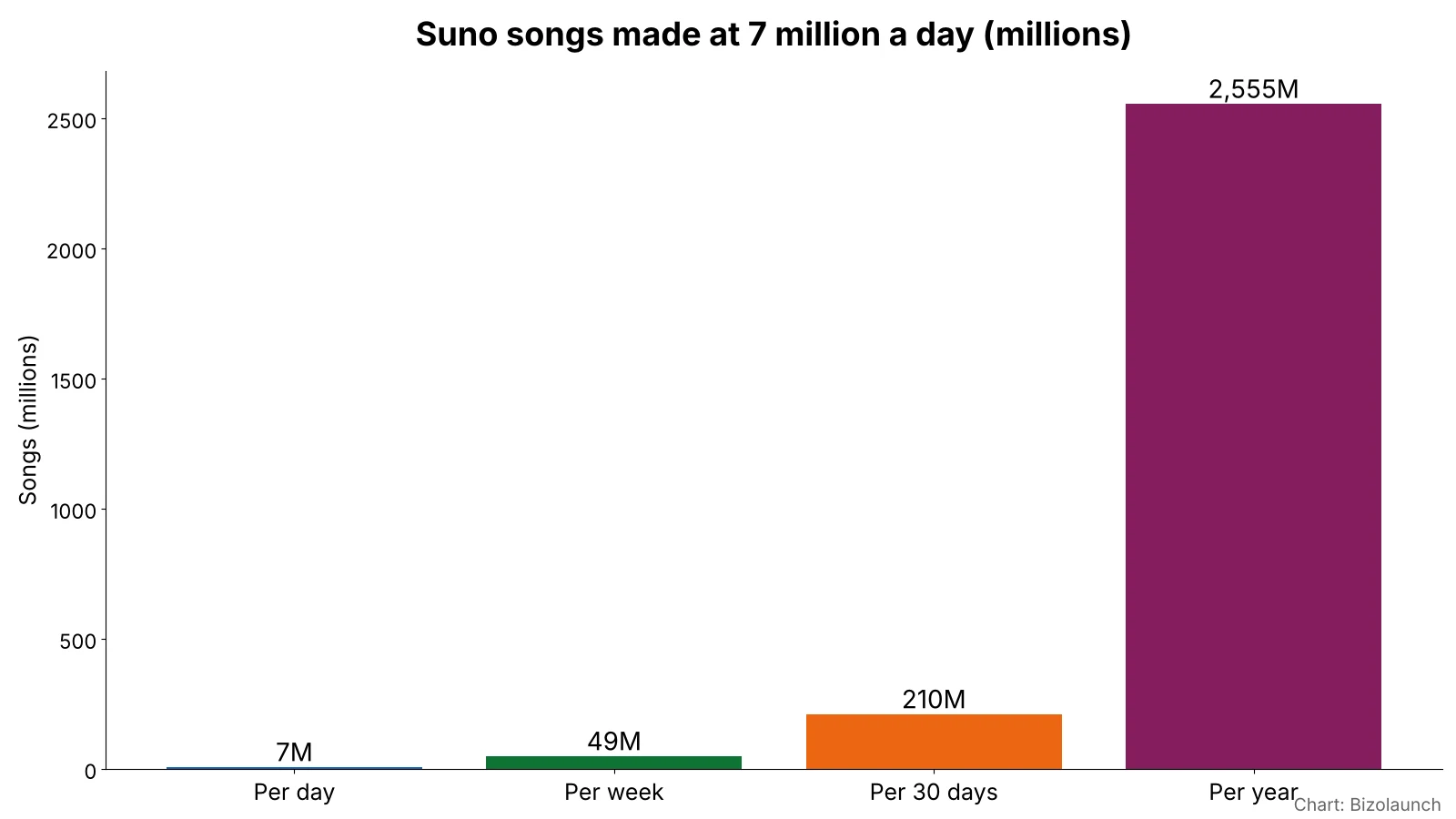
The math at that rate is simple. Seven million songs a day comes to 49 million a week and about 210 million every 30 days. Over a full year, it reaches about 2.56 billion songs.
| Time span | Songs at 7 million a day |
|---|---|
| One second | About 81 |
| One hour | About 292,000 |
| One day | 7 million |
| One week | 49 million |
| Two weeks | 98 million |
| 30 days | 210 million |
| One year | About 2.56 billion |
Most of these songs are never heard by more than a few people. For example, a song made for a friend’s birthday or a group chat joke may get played a handful of times. So the 7 million figure is about making music, and it tells you little about listening.
How Many People Use Suno
Over 100 million people have used Suno, a total that includes free and paid users. Suno passed that mark by February 2026, when it also had 2 million paid subscribers, as Contrary Research tracks.
The count grew quickly. When Suno raised its Series C in November of last year, nearly 100 million people had made music on it. At the same time, it had about 1 million paid subscribers. Three months later, the paid count had doubled to 2 million.

The 100 million figure counts everyone who ever tried Suno. So the number of people who make a song in a given month is lower.
In June 2026, Suno also reached No. 1 in the App Store’s Music category in dozens of countries. Suno named that ranking in its Series D post on June 3, 2026, after viral trends drove new users to the app.
Read also: Social Media Usage by Generation Statistics: The Age Gaps
How Suno Usage Grew Over Time
Suno usage grew from nearly 100 million people and about 1 million paying users in November of last year to 2 million paying users by February 2026. Song output held above 7 million a day through June 2026.
| When | Usage milestone | Business milestone |
|---|---|---|
| November of last year | Nearly 100M users, about 1M paid | Raised $250M at a $2.45B value |
| February 2026 | Over 100M users, 2M paid | $300M a year in revenue run rate |
| June 2026 | Over 7M songs a day, top music app in many lands | Raised over $400M at a $5.4B value |
| September 2026 | New songs can go to streaming apps | Deals with Believe and TuneCore |
| MIDI, Bridge and Visuals tools out | More tools for music pros |
Over those months, the paid share rose from about 1% to about 2% of all users. In other words, Suno doubled its paying base while its total user count grew only a little.
Who the Typical Suno Creator Is
The most common Suno user is a man aged 25 to 34. That user spends about 20 minutes on each song, from the first prompt to the version he keeps. Both details came from Suno’s own data in November of last year.
Twenty minutes is much longer than a single prompt takes. So most creators go through several rounds per song, for example new lyrics, a new style or a fresh take. As a result, the 7 million daily songs include many drafts that never get kept.
Paying users stick around. In November of last year, 78% of paying users came back each week. Also, about 350,000 people who had stopped using Suno came back each week.
What People Make Songs About on Suno
Most Suno songs are personal, made for a person, a joke or an event. In its June 2026 post, Suno named songs for birthdays, graduations and work events. It also named families who turn text threads, group chats and inside jokes into songs.
In the spring of 2026, turning a group chat into a song and posting it on TikTok became a trend. That trend helped push Suno to the top of the App Store music charts. Meanwhile, some uses are more serious. For instance, hospice patients have made songs to leave for loved ones. Therapists use song making with teens, and carers of people with dementia make songs with them.
That mix explains the scale. Most of the 7 million daily songs are one-off gifts and jokes. Fewer are tracks meant for streaming services.
Suno Tools That Shape How People Create
Suno has added a new creation tool almost every month in 2026. Before that, Suno Studio launched in September of last year for Premier users. Since then, the pace picked up.
| Date | Suno release | Kind of tool |
|---|---|---|
| February 6, 2026 | Studio 1.2 | Studio update |
| March 26, 2026 | v5.5 model | Music model |
| June 5, 2026 | Your Voice, Reimagined | Voice tool |
| June 11, 2026 | Better stem separation | Stem tool |
| August 13, 2026 | Studio 2.0 | Studio update |
| September 9, 2026 | v6 models | Music model |
| October 1, 2026 | Speech (beta) | Voice tool |
| October 29, 2026 | Chat | Studio helper |
| November 4, 2026 | Start songs with MIDI | Music app tool |
| November 13, 2026 | Suno Bridge | Link to music apps (DAWs) |
| November 17, 2026 | Visuals | Social media tool |
Two shifts show up in this list. First, more tools aim at serious music makers, such as MIDI, stems and a link to music apps on a computer. Second, Suno is adding ways to share songs on social media, such as Visuals.
So the typical creator is moving from one-click songs toward editing. For that work, our list of AI voiceover tools covers voice tools that pair with music apps.
Rules for Publishing Suno Songs to Streaming Services
Suno songs made with its new industry partner model can be sent to streaming services through Believe and TuneCore. Suno announced that deal on September 8, 2026. Through it, songs can reach Spotify, Apple Music, Amazon Music and YouTube.
However, there are limits. Suno uses audio watermarks, fingerprints and download limits to stop mass uploads to streaming services. The same rules apply to songs sent through Believe and TuneCore. Earlier in 2026, both firms had refused to take songs made with Suno’s older models.
Suno also changed its download policy and terms of service on August 10, 2026, two days before it announced a global deal with BMG. Earlier, on June 25, 2026, it opened Spark, a grant program for independent artists aged 18 and over.
For creators, the takeaway is practical. A Suno song made for fun is fine to share as a clip. On the other hand, a song meant for streaming needs the right model and has to go through an approved distributor.
Read also: Google Gemini Voice Usage Statistics and What They Show
Who Suno Is Right For and Who It Is Not
Suno is the best pick for people who want a finished song fast, such as a birthday track, a group chat joke or a demo of a lyric idea. The typical 20-minute session is enough to get a song worth keeping.
It is also a good tool for songwriters who want to test ideas. Stems, MIDI and the studio let them take a Suno draft into their own music app.
By contrast, Suno is not right for artists who want to release songs on every streaming service with no limits. Download limits and the partner model rules restrict that. Also, anyone who needs to be sure about rights should read the licensing and lawsuit section of our Suno statistics post first.
For other creative AI tools with published usage numbers, see our Canva AI usage statistics and AI in filmmaking statistics.
Suno Usage Questions From Music Makers
How long does it take to make a song on Suno?
The typical Suno user spends about 20 minutes on one song. That is time to try a few takes and fix the words before you pick one.
Is Suno the top music app on the App Store?
Suno hit No. 1 in the App Store’s Music chart in dozens of countries in June 2026. The chart moves each day, so it may not be on top today.
Can I start a Suno song from my own melody?
Yes. Since November 4, 2026, you can start a Suno song from a MIDI file.
Does Suno add visuals to songs?
Yes. Suno added Visuals on November 17, 2026. For how people use AI chat tools to write lyrics and ideas, see our AI chatbot usage statistics.