AI video generators are tools that turn text, images or a script into video. Many add an AI presenter, a cloned voice or fully made-up scenes. Usage statistics by industry show which kinds of businesses have moved past the test stage, from late last year through November 2026.
Ads and marketing lead. In January 2026, 84% of marketers who make video used AI in that work. Also, about half of US ad buyers already used generative AI (gen AI) to build video ads. Corporate training comes next, with 52% of learning and development (L&D) teams using AI for video. Film and TV use it mostly for effects and editing, while video platforms trail, with 59% running no AI video features at all.
The sections take each industry in turn: ads, marketing, training, film and TV, video platforms and games. After that come the big-company numbers, what viewers think and how to use the data.
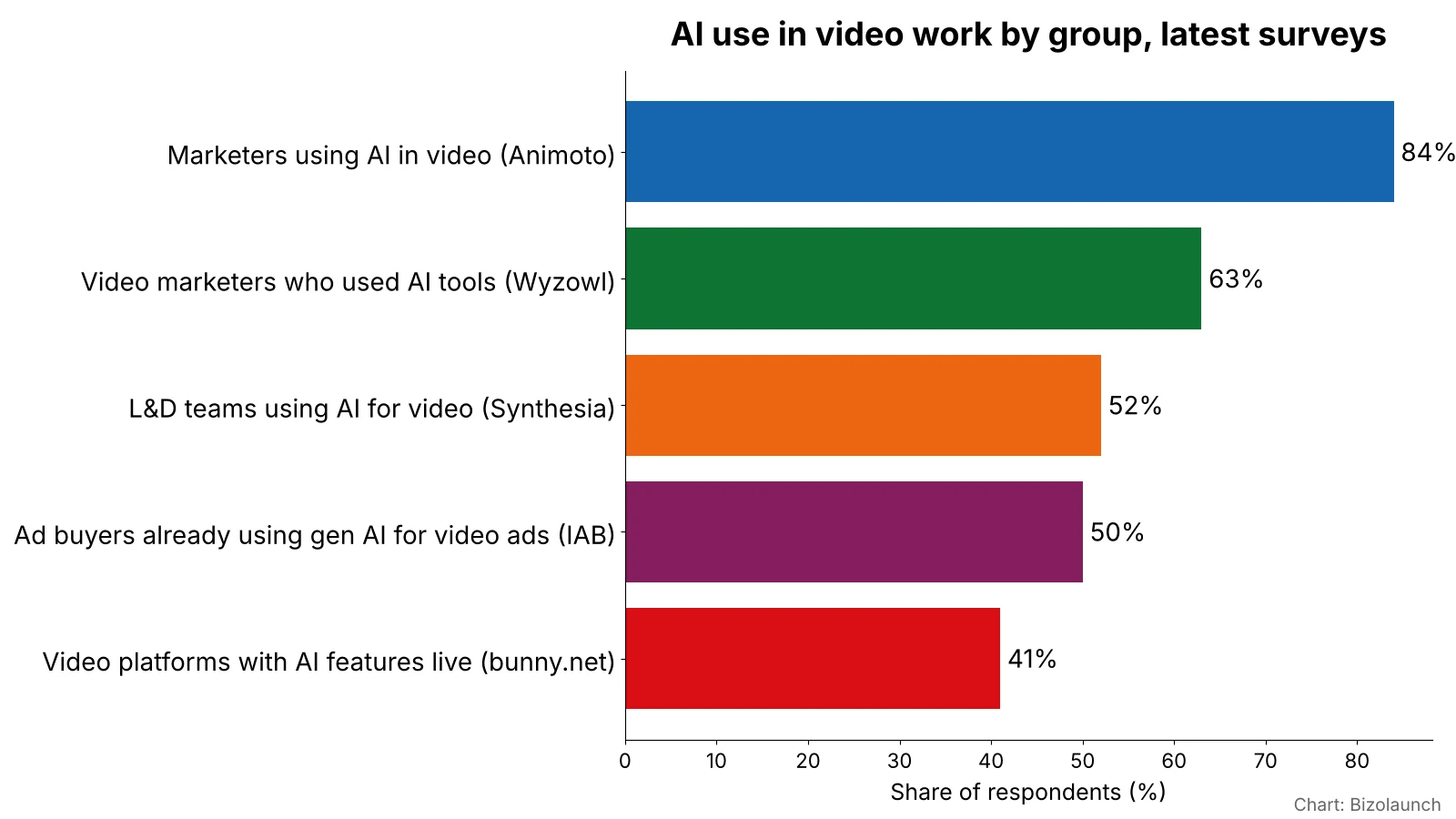
AI Video Usage by Industry in One Table
Each row is the latest dated figure for that sector. Every survey asked its own question, so the second column spells out what each figure counts.
| Industry | What was counted | Figure | When |
|---|---|---|---|
| Ads | US ad buyers who already build video ads with gen AI | About half | July of last year |
| Ads | Ad buyers who use or plan to use gen AI for video ads | 86% | July of last year |
| Marketing | Marketers who use AI to make video | 84% | January 2026 |
| Marketing | Video marketers who have used AI tools on video | 63%, up from 51% | Late last year |
| Training | L&D teams that use AI to make video | 52% | Fall of last year |
| Training | HR and L&D staff who want to make AI video | 90% | April 2026 |
| Film and TV | Netflix titles made with gen AI help this year | About 300 | July 2026 |
| Video platforms | Video firms with no AI video features live | 59% | $1Latest$2|
| Games | Game workers who use gen AI tools of any kind | 36% | January 2026 |
AI Video in Advertising
Ads have the most direct use for AI video. Ad teams need dozens of cuts of one spot for each audience, size and app, and that is the job these tools do best.
The Interactive Advertising Bureau (IAB) surveyed US ad buyers in July of last year. It found that 86% of buyers used or planned to use gen AI to build video ads. About half already used it. Buyers also expected gen AI to make 40% of all ads by 2026. In addition, small and mid-size brands moved faster than the biggest ones.
The top uses show what the tools do day to day:
- 42% used gen AI to make versions of an ad for each audience.
- 38% used it to change the look and style of an ad.
- 36% used it to match an ad to the content around it.
Next, the IAB ran a new survey from February 20 to March 13, 2026, and this time it asked about AI agents. In it, two in three buyers were testing or planning to use AI agents for video ad campaigns. Also, 50% planned to use agents to test and pick ad creative. The same report put US digital video ad spend above $80 billion in 2026, up 11% from the year before.
For ad teams, AI video wins for versions, resizes and fast A/B tests. However, it is not the right tool yet for a big TV spot, where the brand’s whole look rides on one film.
AI Video in Marketing
Marketing teams outside paid ads use AI video for product demos, social clips and sales emails. Two 2026 surveys put use well past half.
Animoto released its 2026 State of Video Report on January 21, 2026. It surveyed over 450 US shoppers and marketers in September of last year. Its marketers all worked at firms that had made a video in the prior three months. Among them:
- 84% already used AI to make video, and over 75% used it often.
- 63% found AI helped them come up with ideas, their top video problem.
- 55% found it cut editing time, and 55.2% used it to help write scripts.
- 90% planned to make more video in 2026.
- 90% felt that editing AI output by hand was a must.
By contrast, Wyzowl’s 2026 State of Video Marketing survey, run late last year with 266 people, put the share lower. In it, 63% of video marketers had used AI tools to make or edit videos, up from 51% a year before. Video itself is close to universal, since 91% of firms use it to market.
At larger firms, Kaltura surveyed 300 company leaders for a January 2026 report. Almost all of them, 99%, used AI somewhere, yet only 1% had it fully built into their work. Meanwhile, 69% saw rising demand for video.
So most marketers now use AI in video work, but mostly as a helper for ideas, scripts and edits. Videos made fully by AI are still the smaller share.
Read also: ElevenLabs Text-to-Speech Usage by Industry
AI Video in Corporate Training and HR
Training is where AI avatar video took hold first. A course often needs the same lesson in many languages, plus frequent updates, so a video built from a script beats a reshoot.
Synthesia’s AI in Learning and Development Report 2026 drew 421 answers from L&D staff in October and November of last year.
| AI use in L&D teams | Share of people surveyed |
|---|---|
| Use AI in some form | 87% |
| Use AI voice or text to speech | 63% |
| Use AI to make video | 52% |
| Use AI to translate | 38% |
| See security as a barrier | 58% |
| See accuracy as a barrier | 52% |
Interest reaches well past current users. Idomoo’s 2026 study of 500 US and UK business owners came out on April 16, 2026. It found 90% of HR and L&D staff keen to make AI video. Among them, 57% ranked personal AI video, made for one viewer at a time, as their top type.
For more on the avatar side of this market, see our AI avatar adoption statistics.
AI Video in Film and TV
Film and TV studios use AI video mostly behind the scenes, in effects and editing. Netflix has given the biggest public number so far.
By July 2026, Netflix had used gen AI in roughly 300 titles that year. Most of that work was done after filming. Three projects used it for complex scenes: Glory from India, Brasil 70: A Saga do Tri from Brazil and The American Experiment from the US.
The American Experiment, a five-part documentary, had 17 minutes of footage made with AI help. Co-CEO Ted Sarandos spoke about it on the July 16, 2026 earnings call. He put that work at twice as fast and at half the cost of the usual method.
So in film, AI video is a tool for effects and hard shots inside normal productions. Our AI in filmmaking statistics cover the wider film data.
AI Video on Streaming, Education and Creator Platforms
Firms that host and stream video have moved slower. In bunny.net’s Running Video survey of more than 500 video-first firms, reported on November 3, 2026, 59% had no AI video features live. The group took in streaming, education, company video and creator sites.
Among the firms that did use AI, nearly 40% ran just one AI feature. Transcripts and translation were among the most common. So for platforms, AI video so far means captions and dubbing more than made-up footage.
Generative AI in Game Development
Game makers sit at the other end. GDC’s 2026 State of the Game Industry survey of over 2,300 game workers found 36% using gen AI tools of any kind in their jobs. The share was 30% at game studios and 58% at publishing, support and marketing firms.
Views run against the tools, though. In the same survey, 52% felt gen AI was hurting the industry, up from 30% a year before. Artists were the most negative, with 64% of visual and tech artists feeling that way.
AI Video Use at the Largest Companies
The biggest firms cut across every industry, and two avatar tools now reach most of them. Synthesia was in use at over 90% of the Fortune 100 by January 2026, up from more than 70% in April of last year. HeyGen reached 85% of the Fortune 100 by June 2026.
In Europe, Synthesia counted 95% of Germany’s DAX 40 firms as customers in April 2026, including SAP and Merck KGaA. It had also tripled its number of contracts worth over $100,000 in the 12 months before that date.
Use is broad at the low end too. HeyGen passed 30 million users across 196 countries by June 2026, and they had made more than 118 million videos.
What Viewers Think of AI Video
Viewers notice AI video, and some trust it less. In Animoto’s survey, nearly 83% of shoppers had watched a video they thought was made by AI. Robotic gestures (67%), odd voices (55%) and a flat tone (51%) gave it away. Also, 36% felt an AI-made video would lower their view of the brand.
Interest is rising anyway. In Idomoo’s 2026 survey of 2,000 US and UK adults, interest in AI video rose from 65% to 74% in a year. Still, 75% wanted to know if a video was made with AI. Avatars split people too, since 50% called them friendly and 17% called them creepy.
A Worked Cost Example for a Training Team
Usage numbers matter most when you turn them into a budget. So take a training team that needs 40 lessons a year, each 3 minutes long, in 4 languages. That is 40 times 3 times 4, or 480 finished minutes.
On Synthesia’s Starter plan, billed yearly at $168, the credits cover about 150 extra minutes of video a year on top of the free allowance. So 480 minutes is more than three times what Starter covers, and this team would need a larger plan or a quote.
Now take a smaller job: 10 English lessons of 3 minutes each, or 30 minutes a year. Starter covers that with room to spare, at $168 a year, or about $5.60 per finished minute. So small teams can test AI video for the price of a few lunches, while multi-language training needs a real budget line.
Read also: ChatGPT Usage for Coding: Developer Statistics
How to Use These AI Video Statistics
The numbers point to a few plain choices for a business deciding where AI video fits.
- Use it for versions first. Ad and marketing teams get the most from resizes, language versions and audience cuts.
- Use avatars for training, not brand ads. Staff watching a lesson want to learn fast, while ad viewers punish anything that feels fake.
- Label AI video in public. With 75% of viewers wanting to know, a short note costs little.
- Plan a human edit pass. In Animoto’s survey, 90% of marketers saw hand editing as a must.
- Book the security review early. Security was the top barrier for L&D teams, at 58%.
To pick a tool, our list of the best AI tools for turning text into video compares prices and limits. For paid social, see our guide to AI tools for social media ads.
Questions About AI Video Adoption
What does an AI video generator cost?
Entry plans are cheap. HeyGen Creator costs $29 a month, or $24 a month billed yearly. Synthesia Starter costs $19 a month, or $14 a month billed yearly. Both price their top plans by quote.
Do small businesses use AI video generators?
Yes, and often faster than big brands. The IAB found small and mid-size advertisers taking up gen AI for video ahead of the largest firms.
Is AI video replacing in-house video teams?
So far, the opposite. In Animoto’s survey, 75% of marketers had hired their own video makers or built a team. Also, 60% found their in-house videos beat agency work.