Zapier AI adoption statistics track how firms use AI inside the Zapier automation platform and how fast AI agents spread at work. The short answer is that AI is now a normal part of automated work at big firms. In September 2026, 71% of large US firms in Zapier’s survey had AI agents live in production, up from 40% a year before. On top of that, the most active Zapier customers ran about 11 AI workflows each in the spring of 2026.
Zapier is a good lens for this, because its users connect AI models to more than 9,000 apps. So its numbers show what AI does once it leaves the chat window. For example, AI writes messages, pulls data into records and makes routing choices for teams. Zapier also runs its own staff on AI, and 97% of them used it at work by January 2026.
The sections cover agent use by team, what AI does inside workflows and the top use cases. After that come the rework and training gaps, spending plans, Zapier’s AI prices and who should and should not use it.
Zapier AI Adoption Statistics for 2026
Zapier AI adoption statistics for 2026 show agents in most large firms, AI in about one in five workflow steps and heavy use of AI inside Zapier itself.
| Measure | Figure | Date |
|---|---|---|
| Large US firms with AI agents in production | 71% | September 2026 |
| Large US firms using or testing AI agents | 88% | September 2026 |
| AI workflows run by a top Zapier AI customer | About 11 | April to June 2026 |
| Share of all workflow steps that are AI steps | 18% | April to June 2026 |
| AI-built workflows about lead handling | Nearly 30% | March 2026 |
| Zapier staff who use AI at work | 97% | January 2026 |
| Large firms that call AI skills an urgent need | 77% | March 2026 |
| AI tasks run on Zapier in total | Over 200 million | April of last year |
How Many Large Companies Use AI Agents
Most large US companies now use AI agents, and 71% run them in production. Zapier’s AI agents survey polled 513 US managers and executives at firms with 1,000 or more staff. It ran from September 16 to 21, 2026. In the same group, 88% were using or testing agents, up from 72% in October of last year.
At the same time, the share still stuck in pilots fell from 32% to 17%. In other words, firms moved past testing in about a year. Also, 90% of leaders expect to raise agent spending in the next 12 months, up from 84% the year before.
AI agent use by department
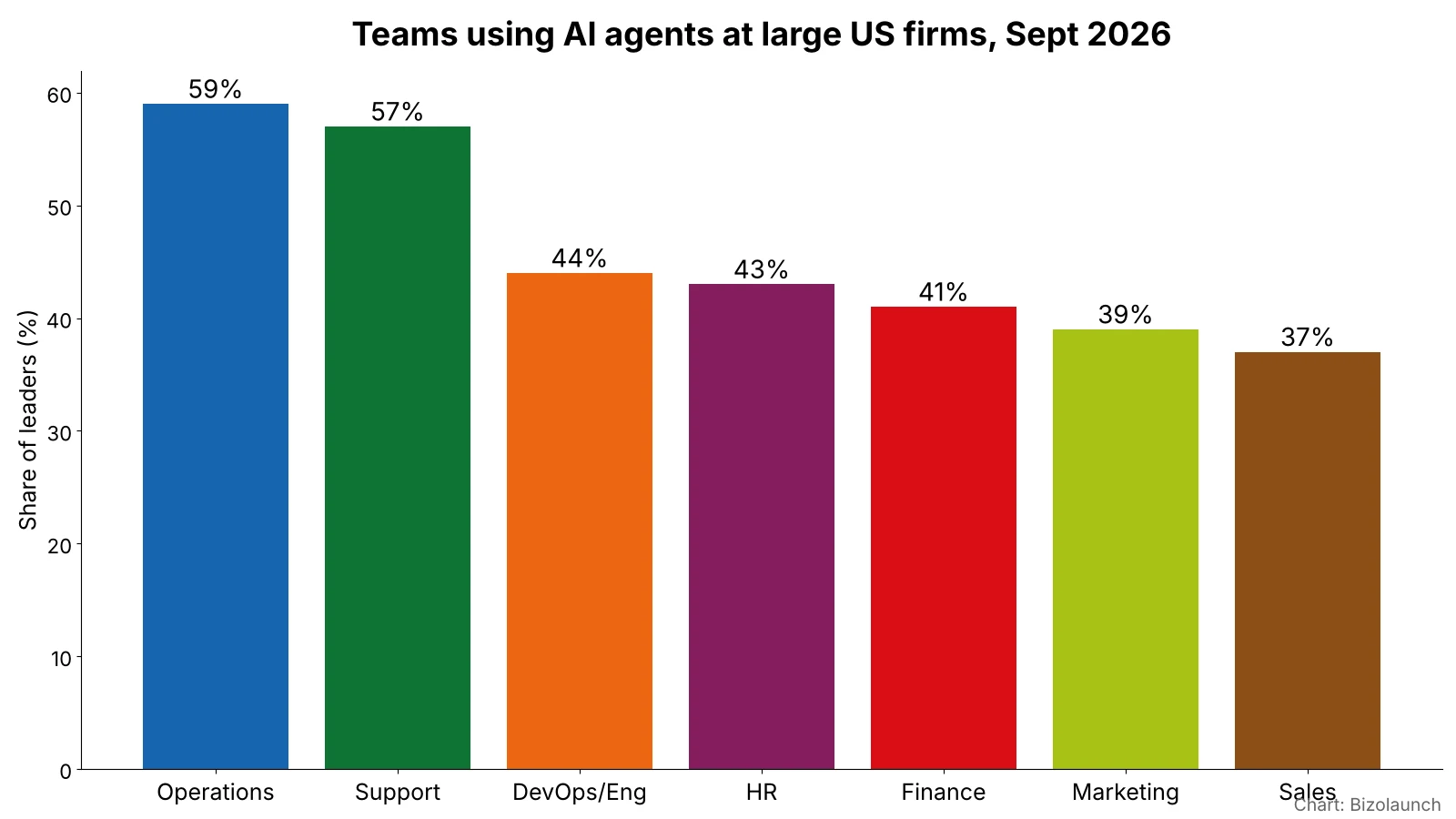
Operations is the team most likely to use AI agents, at 59% in 2026. However, finance grew the fastest, from 24% to 41%, a gain of 17 points.
| Department | Last year | 2026 | Change in points |
|---|---|---|---|
| Operations | 47% | 59% | +12 |
| Customer support | 49% | 57% | +8 |
| DevOps and engineering | 35% | 44% | +9 |
| HR | 30% | 43% | +13 |
| Finance | 24% | 41% | +17 |
| Marketing | 31% | 39% | +8 |
| Sales | 26% | 37% | +11 |
Every team grew by at least 8 points. So agents are no longer only a support desk tool.
How much work agents finish on their own
About 30% of leaders say their agents finish more than 60% of tasks with no human step. Then the link to workflows shows up. When over half of a firm’s agents sit inside wider automated workflows, 77% report that level of hands-off work. When half or fewer are linked, only 8% do.
As a result, the payback is quick for many. In fact, 46% say their most mature agent has paid for itself, or will within 12 months.
What holds back AI agent adoption
Risk is the top barrier to AI agent adoption, named by 27% of leaders in the September 2026 survey. That group pointed to data privacy, security and compliance. Next came accuracy and errors, at 24%. Even so, 90% of leaders reported at least one good outcome from their agents.
What AI Does Inside Zapier Workflows
AI inside Zapier workflows mostly writes messages and fills in records. Zapier’s AI Workflow Index tracked 1,500 mid-sized and large Zapier customers from April 15 to June 14, 2026. It then studied the top 25%, or 375 firms, by AI use.

In that group, the average firm ran 11 durable AI workflows, and the median was 6. A durable workflow ran in both 30-day windows and had at least one AI step. Also, AI workflows handled about 220 automated actions a month each, against 102 for workflows with no AI.
The four AI roles in workflows
Zapier splits AI work into four roles. The writer role, which Zapier calls Communicator, is the most common, and the decision role is the busiest per workflow.
| AI role | What the AI does | Share of AI workflows | Share of runs | Firms running it |
|---|---|---|---|---|
| Communicator | Writes for people | 53% | 38% | 84% |
| Clerk | Pulls out facts and updates records | 45% | 30% | 79% |
| Analyst | Makes a choice, such as a route or score | 14% | 44% | 45% |
| Coordinator | Creates tasks for teams | 13% | 4% | 26% |
Analyst workflows are few, yet they make up 44% of runs. That is because a routing or scoring step fires on every new lead or ticket. Also, 76% of Analyst runs happen outside office hours.
Most firms do not stop at one role. For instance, 80% of the top adopters run two or more roles, and 11% run all four. Firms took a median of 143 days to add a second role, but only 99 days to add a fourth.
Where AI workflows begin and end
Slack and Microsoft Teams are the most common place AI workflows begin and end. They trigger 17% of AI workflows and receive 38% of the output.
| App | Share that starts the workflow | Share that gets the output |
|---|---|---|
| Slack or Teams | 17% | 38% |
| Google Sheets | 4% | 21% |
| Gmail or email | 8% | 6% |
| Webhooks or API | 11% | Not in the top list |
| Notion | Not in the top list | 6% |
Step counts tell a similar story. AI steps are 18% of all steps, while branching and gating are 17% and messaging is 15%. So AI is one part of a workflow, and plain app actions still do most of the work.
Read also: DeepSeek R1 Adoption Statistics: Who Uses It and How
The Most Common AI Workflow Use Cases on Zapier
Lead management is the most common AI workflow use case on Zapier, at nearly 30% of AI workflows. Zapier studied 10,000 AI-powered workflows for a report in March 2026.
Within that set, nearly 30% of workflows pulled out, summed up or sorted information. Then about 20% replied to messages, and about 14% made or posted content. Because one workflow can do more than one job, these shares overlap.
Results firms report from AI workflows
Firms that publish results from Zapier AI workflows mostly report time saved on support and service. For instance, Rebrandly cut support tickets by 50%, and the Portland Trail Blazers cut the time spent reading guest feedback by 94%. Both appear in Zapier’s March 2026 report.
Earlier, in April of last year, the remote work firm Remote solved about 28% of its IT help tickets with no human step. That saved it about $500,000 in hiring costs. Also, Okta routes 13% of its Workforce Identity support escalations through a Zapier flow, which cuts about 10 minutes per ticket.
A typical lead flow is simple. For example, it reads a web form, scores the lead with AI and posts a short note to a sales channel. That single flow counts as lead handling and as a message reply. For agent tools built for sales and marketing, our AI agent marketing statistics cover the wider market.
AI Usage Inside Zapier the Company
Zapier’s own staff use AI at a very high rate, with 97% using it at work by January 2026. The push began in March 2023, when about 10% of staff used AI often, CEO Wade Foster explained on a Madrona podcast. After a one-week hackathon that month, use rose past 50%.
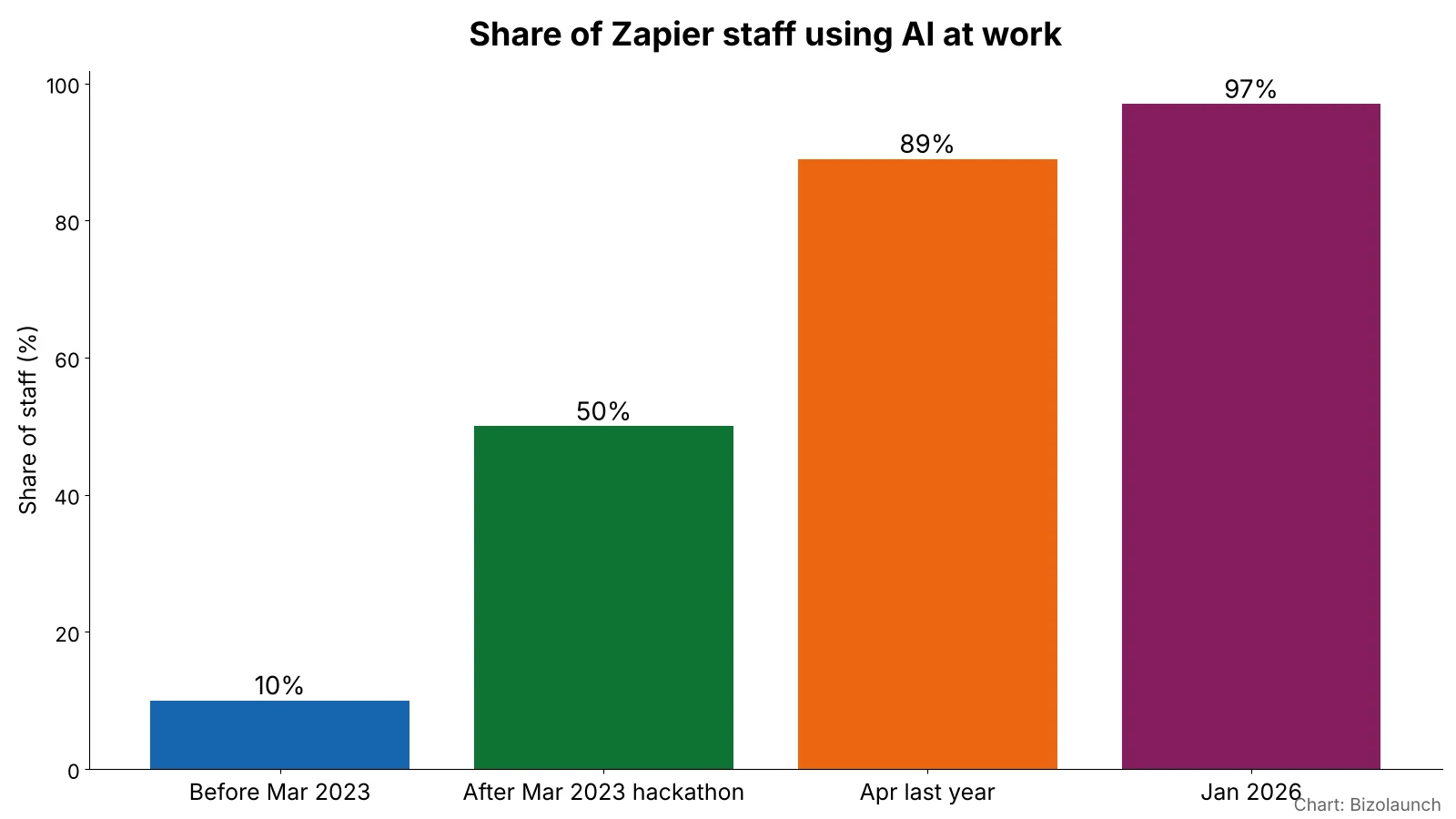
By April of last year, 89% of the company used AI. Then the rate reached 97% in the January 2026 update on how Zapier uses AI. Meanwhile, Zapier has about 800 staff and runs more AI agents than people, a point Foster made in April 2026.
Zapier has also held AI hackathons every four to six months since 2023. For instance, one content flow uses seven agents, with three for research and drafts and four for edits.
AI Task Volume on the Zapier Platform
Zapier had run over 200 million AI tasks by April of last year. At that point, AI and agent features ran more than 23 million times a month. Foster shared both numbers when Zapier relaunched as an AI orchestration platform.
Today, Zapier also sells Agents, Chatbots, Copilot and an MCP server. MCP links an outside AI assistant to actions in thousands of apps. So AI use on Zapier now runs through several products, and the 200 million figure covers only the period up to April of last year.
Rework and Training Gaps in AI Adoption
AI adoption still costs time in rework, and most firms do not train staff well enough. Zapier polled more than 1,100 US workers at firms with 250 or more staff on November 13 and 14 of last year. In that poll, 92% felt AI raised their output. Yet the same workers spent 4.5 hours a week on average fixing AI work.
Also, 74% had at least one bad result from weak AI output, as IT Brief covered in January 2026. For example, 28% had work rejected and 25% faced customer complaints. Finance staff had the highest rate of bad results, at 85%.
Training changes the picture. For instance, 94% of trained workers felt AI helped them, against 69% of untrained workers. However, training is patchy, as the March 2026 survey of 542 executives found.
| Team | Share with formal AI training |
|---|---|
| IT and engineering | 51% |
| Sales and marketing | 43% |
| HR | 40% |
| Legal | 36% |
In that survey, 94% of firms used AI in some way and 77% called AI skills urgent. Even so, only 7% put HR or learning teams in charge of AI training. For writing tools in particular, our AI writing tool adoption statistics by industry show which fields use them most.
AI Spending Plans of IT Leaders
Most IT leaders plan to spend heavily on AI and to protect that budget. Zapier polled 200 CIOs, CTOs and IT directors in the US, Canada and Europe for a report out on January 30, 2026. Of that group, 69% planned to spend $1 million or more on AI in the next year.
In addition, 74% expect AI budgets would be among the last they cut in a downturn. On staffing, 71% expect AI to reshape teams through moves or new hires, while 21% expect cuts. Also, 65% plan to hire AI automation specialists.
Zapier AI Pricing and Plan Limits
Zapier’s paid plans start at $19.99 a month for Professional and $69 a month for Team, with AI products priced on top. Zapier also offers a free plan with 100 tasks a month.
| Zapier product | Free plan | First paid level |
|---|---|---|
| Zaps (workflows) | 100 tasks a month | Professional from $19.99 a month, Team from $69 |
| Agents | 400 activities a month | Pro at $400 a year for 1,500 activities a month |
| Chatbots | 2 chatbots, 7-day history | Pro at $160 a year for 5 chatbots |
| MCP | All accounts | Uses plan tasks, free until noon ET on January 5, 2027 |
Yearly billing cuts the Zap plan price by 33%. In addition, Team accounts share one pool of agent activities.
Cost per workflow matters more as volume grows. In the AI Workflow Index cost model, a workflow with AI only in the steps that need judgment cost $0.135. By contrast, the same workflow cost $0.467 when every step used AI. That is a 71% cut. In the 24 test workflows, only 151 of 639 steps needed AI at all.
Read also: AI Chatbot Usage Statistics for the US and World
Who Should Use Zapier for AI Workflows and Who Should Not
Zapier is the best pick for operations, sales and support teams that need AI to act across many SaaS apps without code. Its 9,000-plus app links and Slack-first output match the way these teams already work.
By contrast, it is not the right tool for engineering teams that need custom models, private hosting or fine control over each prompt and token. Those teams often build agents in code or on a cloud platform. Also, firms deep in Microsoft 365 may get more from Copilot Studio, which our Copilot Studio alternatives guide compares.
For solo founders, the free plan’s 100 tasks and 400 agent activities are enough to test one lead or support flow. However, a busy flow can pass 100 tasks in a day, so budget for the Professional plan once it goes live. To sell this work as a service, read our guide to starting an AI automation agency for real estate. It shows how agencies price and package it.
Zapier AI Questions From Operations Teams
Is AI by Zapier the same as Zapier Agents?
No. AI by Zapier is an AI step you add to a Zap, much like a ChatGPT step. Zapier Agents are a different product. They have their own plan and their own monthly limit on activities.
How accurate is Zapier’s AI agents survey?
Zapier’s AI agents survey has a margin of error of about 4 points up or down. The data is not weighted. Every answer came from a manager or boss at a US firm with 1,000 or more staff that uses AI at work.
Do most AI workflows on Zapier begin with AI in them?
Yes. In the AI Workflow Index, 80% of AI workflows had an AI step from day one. Another 14% began as a copy of an old workflow. The last 6% took over from an old workflow with no AI.
Who runs Zapier’s AI surveys?
Centiment runs most of Zapier’s AI surveys, such as the agents, rework and skills polls. NewtonX found the 200 IT bosses for the January 2026 spend poll. For a sense of how people use AI chat tools outside of workflows, see our AI chatbot usage statistics.