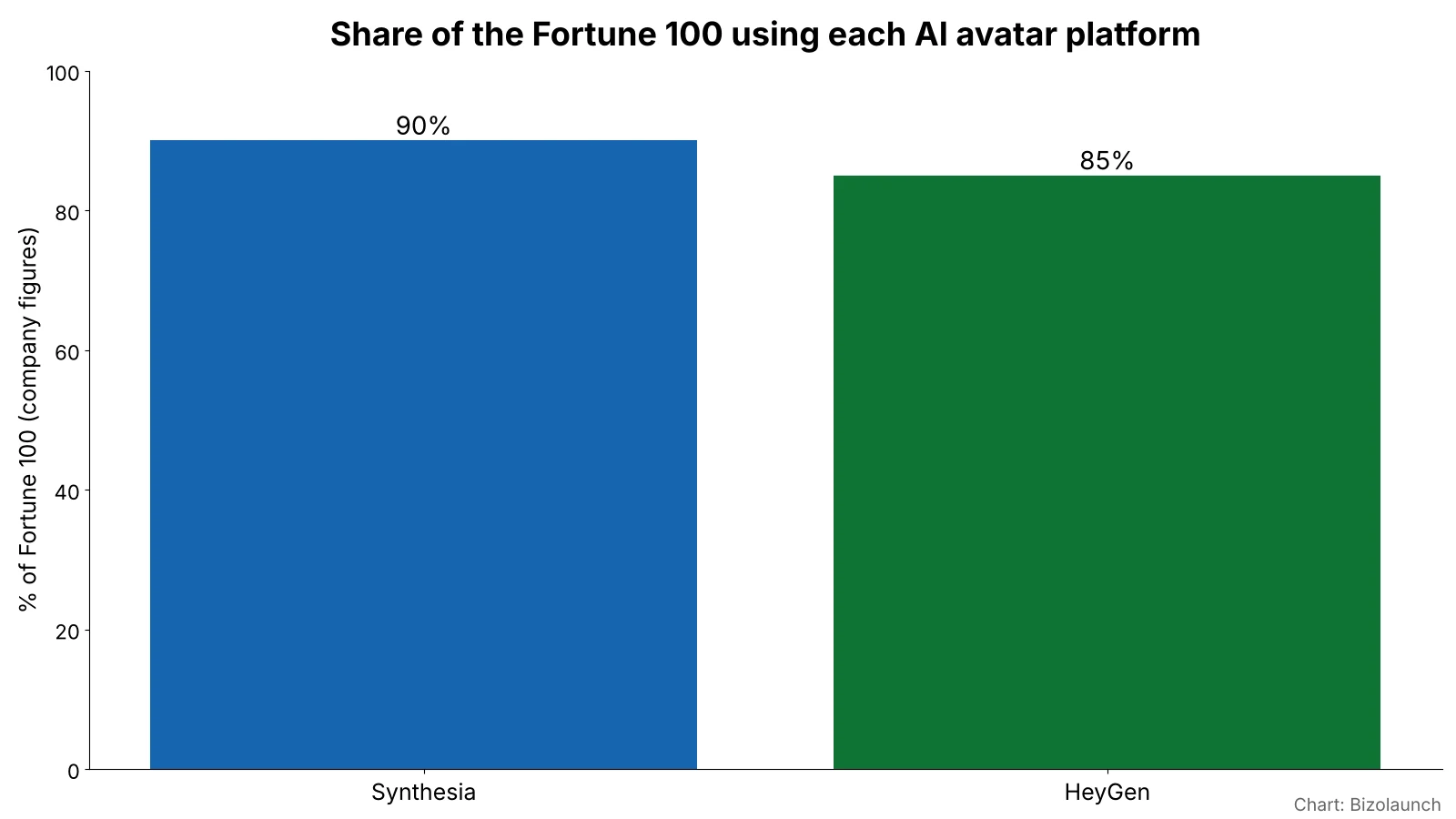
Over 90% of Fortune 100 companies used Synthesia, the AI avatar video platform, in January 2026. Its rival HeyGen is used by 85% of the Fortune 100. AI avatars have already moved past the test stage at the largest firms.
Marketing and training are where the adoption shows up. In a survey published in January 2026, 84% of marketers said they already use AI in video creation. In a Synthesia survey of learning and development (L&D) teams, 87% of respondents said they use AI, and 52% use it to create video.
Synthesia and HeyGen both sell avatar tools, so treat their figures as vendor numbers.
AI Avatar Adoption at a Glance by Source
Different sources measure different things. So we set them side by side first, with the date of each figure.
| Statistic | Figure | Source | Date |
|---|---|---|---|
| Fortune 100 using Synthesia | Over 90% | Synthesia announcement | January 26, 2026. |
| Fortune 100 using HeyGen | 85% | HeyGen announcement | June 25, 2026. |
| HeyGen annual recurring revenue | Over $200 million | HeyGen announcement | June 25, 2026. |
| HeyGen users | More than 30 million | HeyGen announcement | June 25, 2026. |
| Synthesia annual recurring revenue | Over $150 million | eWeek report | January 26, 2026. |
| Marketers using AI in video creation | 84% | Animoto survey | Released January 21, 2026. |
| L&D respondents using AI | 87% | Synthesia L&D survey | Fielded October and November last year. |
| L&D respondents using AI for video | 52% | Synthesia L&D survey | Fielded October and November last year. |
AI Avatar Platform Statistics: Synthesia and HeyGen
The two largest avatar platforms publish their own milestones. These are company figures, not audited counts. Still, they show how fast business demand has grown.
Synthesia
Synthesia raised a $200 million Series E at a $4 billion valuation on January 26, 2026. Google Ventures (GV) led the round. Over 90% of the Fortune 100 use Synthesia.
The company also lists these product and reach figures:
- 2 million+ users and 50,000+ teams on the platform.
- More than 230 stock avatars. Synthesia has between 230 and 240+ stock avatars.
- 140+ languages for avatar speech.
On revenue, eWeek reported that Synthesia went from $100 million in annual recurring revenue (ARR) in April to over $150 million. eWeek also said Synthesia has raised over $500 million since it launched in 2017.
Synthesia’s focus is workplace training. Its customers include SAP, Merck, Heineken, Zoom and Bosch, eWeek noted. Next, the company plans conversational AI agents that let employees ask questions and practise scenarios through role-play.
HeyGen
HeyGen announced on June 25, 2026 that it passed $200 million in ARR. It said it doubled to that level in eight months.
HeyGen shared these usage figures:
- More than 30 million users across 196 countries.
- More than 118 million videos created.
- 85% of the Fortune 100 as customers.
- 175+ languages and dialects. One HeyGen banner says 177+.
HeyGen named training, sales enablement and localisation as the main Fortune 100 uses. It also described creators using AI video for online courses and personal branding.
What the platform numbers mean together
- HeyGen revenue per user. $200 million ÷ 30 million users is about $6.67 a year. Many users are on free plans, so paying customers spend far more.
- HeyGen videos per user. 118 million videos ÷ 30 million users is about 3.9 videos each.
- HeyGen growth. Doubling to $200 million in eight months means ARR was about $100 million eight months earlier.
- Combined ARR. Synthesia’s $150 million plus and HeyGen’s $200 million plus come to at least $350 million. The dates differ by five months, so this is a rough floor.
Which AI avatar figures are independent
Vendor numbers and independent numbers deserve different weight. The table below sorts every figure by who produced it.
| Figure | Who measured it | How to treat it |
|---|---|---|
| Fortune 100 shares, users, ARR | Synthesia and HeyGen | Company claims, so expect a positive framing. |
| Synthesia ARR path | eWeek | News report on company figures. |
| 84% of marketers using AI in video | Animoto | Vendor survey of over 450 people. |
| 25% using AI in influencer work | Glossy+ Research | Trade press survey of 100+ marketers. |
| 87% of L&D teams using AI | Synthesia with Dr Philippa Hardman | Vendor survey with early adopter bias. |
| Test scores with an avatar tutor | University of Messina | Peer-reviewed study with 48 students. |
| Motivation with AI instructors | MIT Media Lab | University study with 134 people. |
In practice, quote vendor figures with the company name attached. Then pair them with at least one independent source when you make a business case.
Read also: DeepSeek R1 Adoption Statistics: Who Uses It and How
AI Avatars in Marketing: Adoption Statistics
Marketers have adopted AI video fast. However, AI avatars as brand faces remain a smaller, more careful step.
AI in video creation
Video platform Animoto released a report on January 21, 2026. Its survey of over 450 people was fielded in September last year.
- 84% of marketers said they already use AI in their video creation process.
- Nearly 83% of consumers said they had watched a video they suspected was AI-generated.
- 36% of consumers said an AI-generated video would lower their view of the brand.
- Over a third said they trust AI-generated content as much as human-made video.
Those numbers point both ways. Most marketers use AI somewhere in video work. Yet more than a third of viewers may think less of a brand if a video feels artificial.
AI in influencer marketing
Avatars as influencers have a much smaller following among brands. Glossy+ Research surveyed more than 100 marketers in the first quarter of 2026. It published the results on July 13, 2026.
- 25% of marketers use AI for influencer marketing.
- Among those, 75% use AI to analyse data, 63% to create content and 56% for outreach.
Glossy also cited an earlier World Federation of Advertisers study. It found 96% of brands had no plans to work with virtual influencers. That study dates from April last year, so treat it as an older benchmark.
Where avatars fit in a marketing plan
Put the survey data together, and a pattern appears. Marketers use avatar video most for internal, product and multilingual content. They use it far less as the public face of the brand.
That matches what HeyGen and Synthesia report. Both name training, sales enablement and localisation as top uses. Neither leads with ads or influencer content.
AI Avatars in Education and Workplace Training
Education is the second big use case. Most adoption so far sits in corporate learning, not schools.
Survey of learning and development teams
Synthesia’s AI in Learning and Development Report 2026 collected 421 responses. Dr Philippa Hardman worked on it with two Synthesia staff. The survey ran in October and November last year.
- 87% of respondents use AI in some form.
- 57% say their team actively uses AI today, while 30% run early pilots.
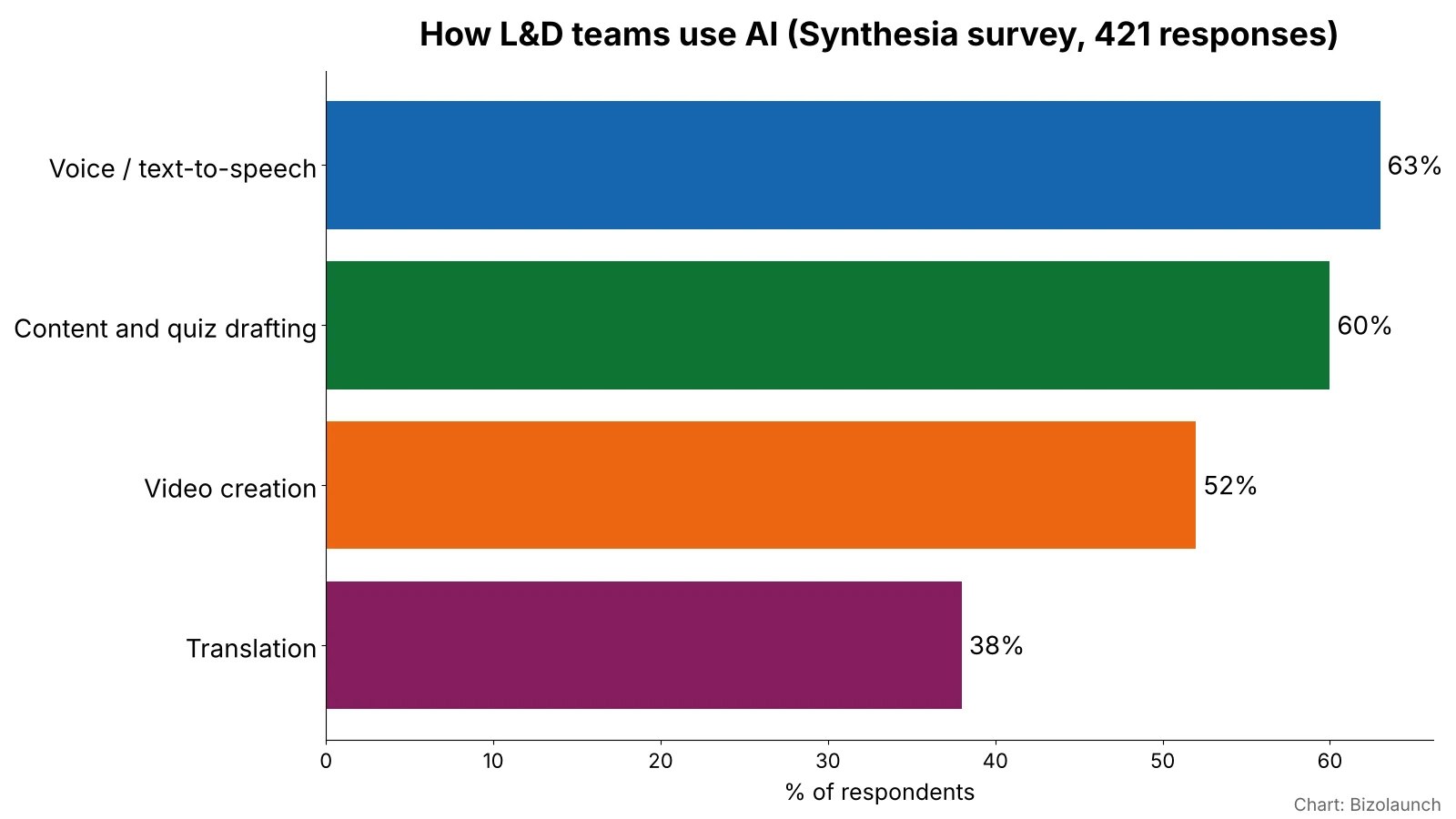
- 63% use AI voice generation or text-to-speech.
- 60% use AI to draft content and quizzes.
- 52% use AI for video creation.
- 38% use AI for translation and localisation.
- 88% report value through time saved on content creation.
The report flags its own limits. It notes an “early adopter bias,” because the survey went mainly to AI-forward networks. Nearly half of respondents work at organisations with 1,000+ employees. So the real share across all L&D teams is likely lower.
Barriers also show up in the data:
| Barrier to AI in L&D | Share of respondents |
|---|---|
| Security | 58% named it. |
| Accuracy | 52% named it. |
| Lack of internal expertise | 46% named it. |
| Budget approvals | 44% named it. |
| Legal restrictions | 41% named it. |
| Stakeholder resistance | 29% named it. |
A sponsored eLearning Industry article by a Synthesia author added more from the same survey. It said 49% of respondents are exploring AI tutors, and 43% are looking at AI coaching.
Company training examples
Customer stories give the scale of real projects. eWeek listed these from Synthesia’s case studies:
- PALFINGER made over 300 videos for 9,000 learners in five languages.
- Wise creates training content 20% faster.
- Mondelēz created 30,000 videos in a single year.
These are vendor case studies. Even so, they show where avatars save the most time: the same lesson repeated in many languages.
What Research Says About Learning With AI Avatars
Adoption numbers do not tell you if avatars teach well. Two studies give early answers.
Frontiers in Psychology study
Researchers at the University of Messina published a study on August 20, 2026. They compared a voice-enabled 3D AI avatar tutor with self-directed internet research. Both groups of university students studied basic AI and neural network topics.
- Sample: 48 students, 24 in each group.
- Knowledge: The avatar group scored 10.63 on average, against 8.92 for the internet group.
- Motivation: Motivation fell less in the avatar group, by 1.15 points on the scale versus 4.36.
- Mental effort: Cognitive load was about the same in both groups, at 3.08 and 3.18.

The authors call the results preliminary. The sample was small and from one national background. In addition, the design could not show which avatar feature caused the gain.
MIT Media Lab study
An earlier MIT Media Lab project tested AI-generated instructors with 134 participants. The instructor’s face was either a well-known public figure or an unknown generated face. The voice, gestures and lesson stayed the same.
Liking the instructor did not change test scores in a meaningful way. However, it did lift motivation and positive feelings about learning. The researchers recommended AI instructors as a supplement to human teachers, not a replacement.
How to Use These AI Avatar Statistics
Numbers only help if you apply them to a decision. Here are the steps for marketing and training teams.
- Begin with training or product explainers. Both platforms name training and enablement as their top uses, and L&D teams report 88% value from time saved.
- Use avatars for many languages. PALFINGER’s five-language rollout shows where the savings grow fastest.
- Label AI video in public ads. With 36% of consumers saying AI video could lower their view of a brand, open disclosure lowers the risk.
- Plan for security and accuracy reviews. These were the top two barriers in the L&D survey.
- Measure learning, not just output. The Frontiers study tested knowledge scores. Run a short quiz before and after your avatar lessons.
A worked cost example for a training team
Say an L&D team needs 40 short training videos, each in 4 languages. That is 160 videos. With a human presenter, each language version needs a new shoot or dub. With an avatar tool, the team edits a script and regenerates each version.
If AI saves just 20% of production time, as Wise reported, a project that would take 100 hours drops to 80 hours. That is our own example using Wise’s figure. Your saving depends on the tool, your review steps and your languages.
For more on AI tools in business, see our AI agent marketing statistics and AI in filmmaking statistics. If you produce ads, our guide to AI tools for social media ads covers creative tools. Teams setting rules for staff can also use our AI acceptable use policy guide.
Read also: AI Agent Marketing Statistics: Who Uses Agents and How
AI Avatar Adoption: Questions Readers Ask
How many companies use AI avatars?
More than 90% of the Fortune 100 use Synthesia, and 85% use HeyGen.
How many people use HeyGen?
HeyGen said on June 25, 2026, that it has more than 30 million users across 196 countries. They have created more than 118 million videos.
Are AI avatars used in schools?
Corporate training leads adoption so far, and classroom research is still early. A study of 48 university students found higher test scores with an AI avatar tutor than with self-directed internet research.
Do consumers trust AI avatar videos?
Views are split. In Animoto’s survey, 36% of consumers said AI-generated video would lower their view of a brand. Over a third said they trust it as much as human-made video.
What do companies use AI avatars for?
Training is the main use. HeyGen’s Fortune 100 clients use it for training, sales enablement and localisation. Synthesia focuses on workforce training and upskilling.
How fast is AI avatar adoption growing?
Revenue at the two biggest platforms gives the best signal. HeyGen said it doubled its ARR to $200 million in eight months. Synthesia grew from $100 million to over $150 million in ARR, eWeek reported. Both are company-based figures, so read them as growth at the top vendors, not the whole market.