Google’s introductory price for its Gemini 4 Argon model on Vertex AI ends on Nov. 30, and from Dec. 1 every listed Argon rate doubles, with standard input going from $2.00 to $4.00 per million tokens. Output rises from $10.00 to $20.00 per million tokens on the same day. A second step follows a month later, when the cheaper Gemini 3.6, 3.7 and 3.8 Flash models also double their prices on Jan. 1.
That matters for any small team that wired Argon into a chatbot, a support inbox or an internal tool during the launch discount. Nothing in the code has to change for the bill to double. Also, a billing rule that took effect on Nov. 13 means some failed long requests now cost money too.
The good news is that Google still sells far cheaper models. So the real decision this week is which jobs truly need Argon, and which can move to a lighter model before the new rates kick in.
The New Argon Rates
Every Gemini 4 Argon price on Google’s Vertex AI pricing page doubles on Dec. 1, including cached input and regional endpoints. The intro rates were promotional, offered as 50% credits back on net spend, so the Dec. 1 prices are the list prices without that credit. The table shows the global rates per million tokens, plus the higher rates for regional, or non-global, endpoints.
| Argon Rate per Million Tokens | Through Nov. 30 | From Dec. 1 |
|---|---|---|
| Global input | $2.00 | $4.00 |
| Global cached input | $0.10 | $0.20 |
| Global output | $10.00 | $20.00 |
| Regional input | $2.20 | $4.40 |
| Regional output | $11.00 | $22.00 |
The page lists two more Argon rate tiers, and both double as well. One goes from $3.60 to $7.20 for input and from $18.00 to $36.00 for output, while the other moves from $1.00 to $2.00 for input and from $5.00 to $10.00 for output. In addition, a separate Argon Cyber Permissive version never had a promo and is listed at the Dec. 1 rates.
The Fine Print on Failed Requests
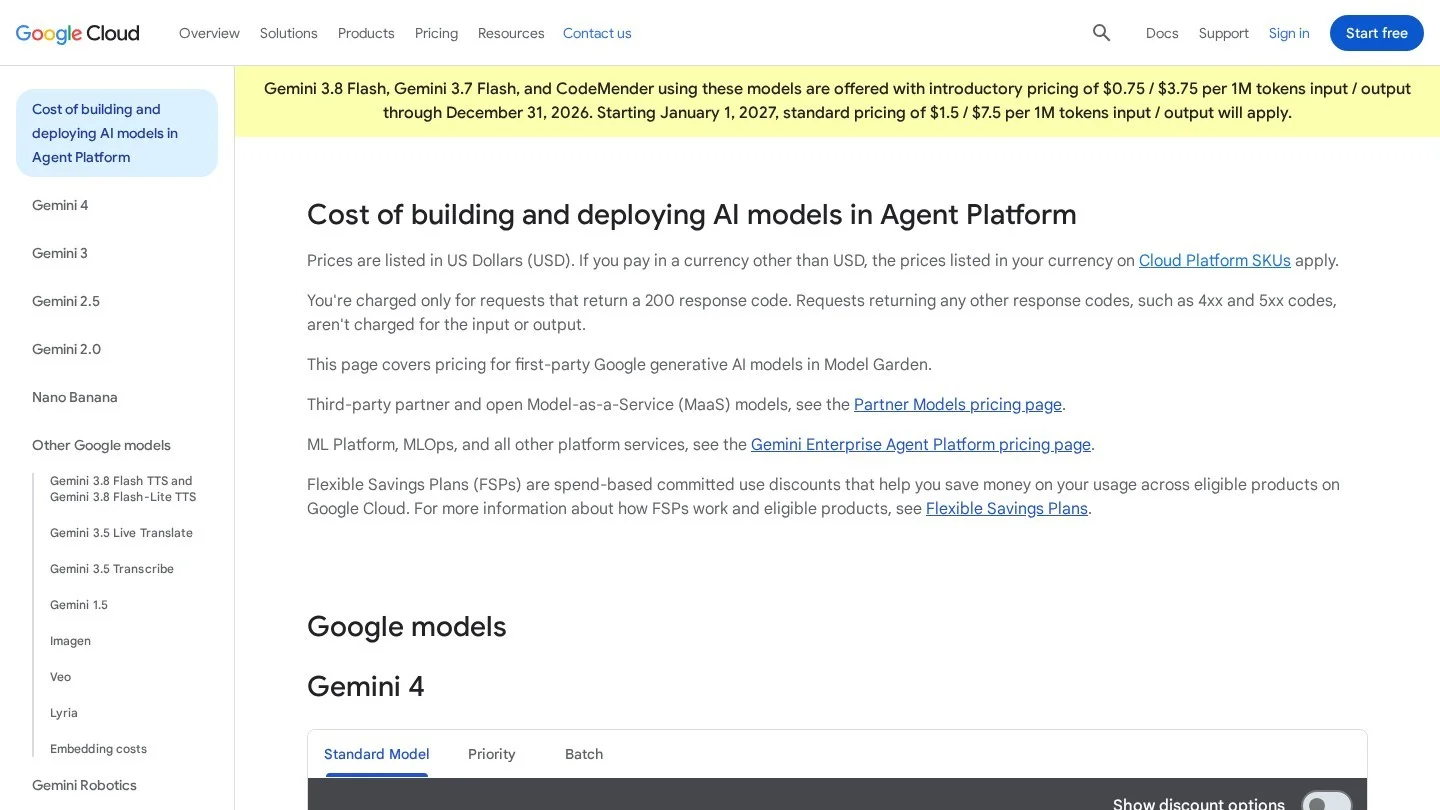
Failed requests can now show up on your bill. Gemini 4 can write replies as long as 1 million tokens, and since Nov. 13, any completion over 32,000 tokens is billed even if the request fails because of a client or server timeout. Normally, Google charges only for requests that return a success code.
So a tool that asks Argon for very long reports, then times out on a slow connection, can pay for output nobody received. At $20.00 per million output tokens, one failed 100,000-token reply would cost about $2.00 in our math, and a retry loop can repeat that several times.
Read also: Gemini 4 Neon Is Google’s New Model for Code
January Brings a Second Increase
The Gemini 3.6, 3.7 and 3.8 Flash models keep their intro pricing through Dec. 31 and then double on Jan. 1. Global input goes from $0.75 to $1.50 per million tokens, and output from $3.75 to $7.50. Batch and flex rates for those models run at half the standard price, rising from $0.375 to $0.75 for input.
Older and smaller models stay much cheaper. For example, Gemini 3.5 Flash-Lite lists at $0.30 for input and $2.50 for output, and Gemini 2.5 Flash-Lite at $0.10 and $0.40. However, Google’s Gemini API model notes say access to the 2.5 models is limited to users who have used them before, and they point new projects to 3.5 Flash-Lite or 3.8 Flash.
The middle of the lineup also shifts. Gemini 3.1 Pro Preview lists at $2.00 per million input tokens and $12.00 for output on prompts up to 200,000 tokens, which was the same input price as Argon during its promo. From Dec. 1, Argon input costs twice that. As a result, teams that moved from 3.1 Pro to Argon for its launch price now pay more for the same traffic, unless Argon’s answers save them work somewhere else.
Location adds one more layer. Since July 1, Gemini 3 and later models have used separate pricing for regional endpoints, and those rates run 10% above the global ones. So a business that keeps data in a set region for privacy reasons will pay $4.40 for Argon input from Dec. 1, not $4.00.
What a Monthly Bill Looks Like Now
A sample workload makes the jump easy to see. Take a small support bot that sends 100 million input tokens and gets back 20 million output tokens a month. Our math uses the global standard rates and leaves out caching, batch discounts and taxes.
| Model | Monthly Cost Now | Monthly Cost After Increase |
|---|---|---|
| Gemini 4 Argon | $400 | $800 from Dec. 1 |
| Gemini 3.8 Flash | $150 | $300 from Jan. 1 |
| Gemini 3.5 Flash-Lite | $80 | No change listed |
In other words, the same job costs ten times as much on Argon as on 3.5 Flash-Lite after Dec. 1. For many routine tasks, such as sorting tickets or drafting short replies, that gap is hard to justify.
Steps for Teams Building on Gemini
Teams that build on Gemini should check their usage before Dec. 1, because the new rates apply to every token from that day on. These steps keep the bill in check.
- Pull your token use by model from the Google Cloud billing report and multiply it by the new rates, so the December invoice is not a surprise.
- Route simple jobs to a Flash or Flash-Lite model and keep Argon for the hard ones. A retrieval-augmented generation setup often lets a smaller model answer well from your own documents.
- Use cached input for long, repeated prompts, since cached tokens cost a twentieth of normal input.
- Cap output length and set sane timeouts, so failed replies over 32,000 tokens do not run up charges.
- Set a budget alert in Google Cloud before Jan. 1, when the Flash price step lands.
If your startup is budgeting AI costs for next year, our startup runway calculator can show how a doubled API bill changes your cash runway. For context on how teams use these tools, see our ChatGPT coding statistics and Claude Code adoption statistics, and our list of Microsoft Copilot Studio alternatives for teams that want a no-code agent builder instead.