Attackers exploited a flaw in Optimizely Web Experimentation on November 16, 2026 and planted malicious JavaScript on the websites of 178 organisations. The infected brands include the BBC, CNN, Zoom, Salesforce, IKEA and HSBC. Visitors to those sites received code that swapped cryptocurrency wallet addresses, skimmed payment card details and stole cookies.
Optimizely confirmed the incident early on November 17. The company has fixed the flaw and removed the injected code from affected projects. All infected files were clean within 19 hours of the first injection.
How the Optimizely Supply Chain Attack Worked
Optimizely Web Experimentation is an A/B testing tool. Each customer adds one script tag to its website, and that tag loads a JavaScript snippet from the Optimizely CDN at cdn.optimizely.com. Marketing teams use it to test changes to pages on live traffic.
Each snippet can carry an optional field called Project JavaScript. Customers use it for custom code that runs on every page of the site. That field is where the attacker struck.
The attacker wrote malicious code into the Project JavaScript of many customer projects. Nothing else in each snippet changed. So the files still came from a trusted Optimizely domain, and browsers had no reason to block them. In fact, Optimizely’s own sites, including www.optimizely.com and login.optimizely.com, served the infected code too.

This was not a CDN cache attack. The Optimizely CDN served exactly the files it was given. How the attacker got write access to so many projects is still unknown. The entry point was a vulnerability in the product, which is now patched.
The injected loaders came in three forms. Some were a plain script tag. Others hid the same address with base64 encoding. A third kind carried a full copy of the payload inside the snippet. That last form matters, because blocking the attacker’s domain alone would not stop it.
What the Malicious Code Did to Visitors
The payload was a multi-purpose kit. The attacker rebuilt it 26 times during the day and added features as the hours went on.
- Crypto address swapping. The code replaced wallet addresses for Bitcoin, Ethereum, TRON, Solana and other coins with the attacker’s own. It did this in page text, in forms, in the clipboard and in outgoing requests.
- Card skimming. From 13:43 UTC, the code captured card numbers, expiry dates and CVV codes typed into forms. Cards entered inside hosted payment frames were out of its reach.
- Cookie and screenshot theft. On pages that mentioned wallets or payments, the code sent the page address, readable cookies and a screenshot of the page to the attacker.
- iPhone and iPad targeting. On Apple mobile devices, the code loaded pages linked to the Coruna and DarkSword iOS exploit kits. Hudson Rock found links to that exploit infrastructure. However, no successful iPhone break-in has been shown so far.
The known crypto haul is small. Attacker wallets received about $7,150 in total by November 17. The number of stolen card numbers and cookies is unknown.
Optimizely Attack Timeline
All times are UTC. The attack ran for less than one day on Optimizely, but the same actor had been active for two months.
| Date and time | Event |
|---|---|
| September 17 | The same actor’s injector first appears on Turkish websites |
| November 13 to 16 | An earlier wave uses scripts from Kissmetrics, StorifyMe and Minute Media |
| November 16, 04:21 | First Optimizely injection, in the BBC snippet |
| November 16, 11:20 | The Zoom snippet is modified |
| November 16, 13:43 | Card skimming is added to the payload |
| November 16, 19:24 to 19:59 | A scan finds 186 of 1,611 Optimizely snippets infected |
| November 16, about 20:40 | Mass clean-up of infected snippets begins |
| November 16, 21:52 | One infected snippet remains, belonging to TalkTalk |
| November 16, 23:11 | All infected Optimizely files are clean |
| November 17, 00:37 | The attacker’s main server domain is suspended |
| November 17, 01:02 | Optimizely posts its incident notice |
The final count is 188 infected snippets belonging to 178 organisations. That count comes from a scan of 1,611 snippets, so the real total is likely higher.
Read also: StepSecurity Series A Brings $20M to Stop Bad Code
Which Websites and Sectors Were Hit
Big consumer brands make up most of the list. Named victims include Zoom, the BBC, CNN, Salesforce, GitLab, IKEA and HSBC in several regions. Equifax, Air France-KLM, Ledger, Peacock and Paychex are on the list too. So are ASOS, Fox News, Invisalign, Virgin Media, Starbucks Canada and Change.org.
Banks and finance firms were hit hardest. That matters, because those are the sites where people type card numbers and move money.
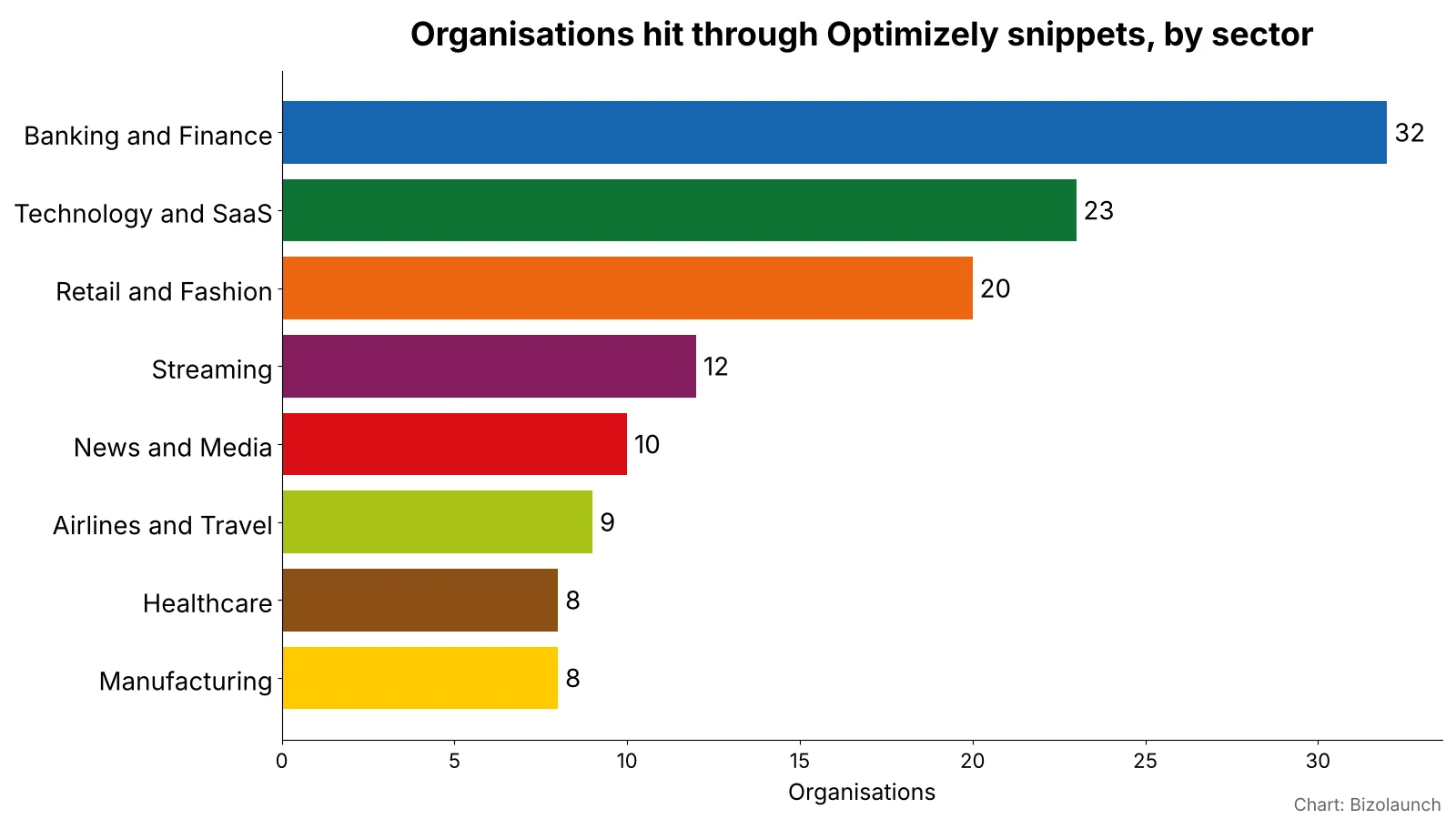
Smaller groups were hit too. Telecoms had 7 organisations affected, and crypto, insurance and property firms had 6 each. Gambling, nonprofit and professional services sites also appear on the list.
Some brands serve the Optimizely snippet from their own domain, such as opt.scheels.com. Those sites were hit too, so a first-party address gave no protection.
Why A/B Testing Scripts Make Easy Targets
Testing tools have three traits that attackers like. First, they run on every page, often including login and checkout pages. Second, they can read and change anything on the page, because changing pages is their job. Third, they let users publish custom code without a normal software release.
That last point is the weak spot. In many companies, the marketing team owns the testing account. A change made there goes live in minutes, with no code review by engineers. So one account, or one flaw in the vendor’s platform, can reach the live site of hundreds of brands at once.
The Optimizely case puts a number on that risk. One attacker touched 188 snippets in a single day. Each snippet then ran on every visit to that brand’s site.
Why Content Security Policy Made the Difference
A Content Security Policy (CSP) is a browser rule set that tells a page which scripts may run and where data may be sent. It was the one defense that worked for some sites.
Among the affected hosts studied, 68 had no CSP at all. Another 50 had a policy that still let the payload run and send data out. A further 17 let the code run but blocked it from sending stolen data, thanks to a tight connect-src rule. Only 24 had a policy that blocked the payload entirely.
Two common CSP settings let the attack through. The ‘unsafe-eval’ setting allowed the inline copy of the payload to run. The ‘strict-dynamic’ setting let trusted scripts load new scripts, which is how the loader pulled in the malware.
The lesson goes beyond Optimizely. Any third-party script with write access to your pages is part of your attack surface. Analytics tags, chat widgets and A/B testing tools all fall into that group.
What Website Owners Should Do Now
If your site uses Optimizely Web Experimentation, act on these steps today:
- Search your projects. Check every Project JavaScript field and all experiment custom code. Look for the domain 1688360.cc, for atob( calls and for any script you do not recognise.
- Review access. List every user and integration with write access to your Optimizely account. Remove anyone who does not need it, then rotate credentials.
- Treat card entries as exposed. Any card details typed into your forms on November 16 may be compromised. Talk to your payment provider about next steps.
- Rotate tokens. Session tokens or secrets stored in cookies without the HttpOnly flag could have been read. Rotate them.
- Tighten your CSP. Set a strict connect-src rule, avoid ‘unsafe-eval’ and turn on CSP reporting so you see blocked scripts.
- Plan customer notice. Depending on your sector and region, you may need to tell affected customers. Check with your legal team.
For smaller businesses, the same thinking applies to every plugin and tag on the site. Our small business cybersecurity checklist covers the basics. Also, ask what script monitoring is included before you sign a support deal, as our website maintenance packages comparison explains.
Lessons for Any Business That Uses Marketing Tags
Most small and mid-sized sites do not use Optimizely. Still, nearly all of them load outside scripts for analytics, ads, chat or reviews. The same risk applies to each one.
A few habits cut that risk a lot:
- Keep a tag inventory. Write down every outside script on the site, who owns it and which pages it runs on.
- Limit publish rights. Only a small number of people should be able to push custom code through a tag or testing tool. Turn on two-factor sign-in for all of them.
- Keep tags off payment pages. A checkout page needs very few outside scripts. Each one you remove is one fewer way in.
- Use hosted payment fields. Card fields inside a hosted payment frame were out of reach of this skimmer. Many payment providers offer them.
- Watch for script changes. Set alerts for new or changed scripts on login and checkout pages, so a change like this one surfaces within hours.
Read also: BILL Take-Private Deal Puts the Firm in TPG Hands
What Visitors and Customers Should Do
Most people who visited an affected site on November 16 will not have lost anything. Still, a few checks are sensible:
- Update iOS. Apple device owners should update to iOS 18.7.3 or later, or to iOS 26.3 or later.
- Check crypto transfers. Compare every wallet address you pasted that day with the one you meant to use. Our guide to crypto address whitelisting explains how to lock withdrawals to approved addresses.
- Watch card statements. Look for small test charges first, since fraudsters often try a card with a tiny amount.
What Happens Next After the Optimizely Breach
Optimizely has secured the affected user accounts. It has also added protections to stop unauthorized code from being delivered. In its words, “We’ve fixed the vulnerability and removed the injected code from affected projects.”
Several questions are still open:
- The entry point. How the attacker got in is still unknown, and so is the total number of affected Optimizely customers.
- The other vendors. Kissmetrics, StorifyMe and Minute Media scripts carried a smaller loader from November 13. How the code got into those scripts is still unclear.
- Card and data losses. Victim companies will learn the scale of card theft as fraud reports come in over the coming weeks.
- Repeat risk. This is the second Optimizely security incident this year. In February, the company disclosed a separate breach that began with a voice phishing call.
The attacker’s domains are now suspended, and the wallets were emptied early on November 17. For site owners, the safest assumption is that the same playbook will be tried on other tag vendors.