A crypto airdrop is a free batch of tokens sent to many wallets at once, often after a hard fork or as a promo. In the US, crypto airdrops are taxed as ordinary income at their dollar value at the moment you gain dominion and control over the tokens. That value then becomes your cost basis. So when you later sell or swap the tokens, you owe tax on any gain or claim a loss on any drop.
The sections cover when the tax clock starts, which dollar value to use, which forms to file and one sample airdrop followed from receipt to sale.

How Crypto Airdrops Are Taxed in the US Under Rev. Rul. 2019-24
Crypto airdrops are taxed in the US as gross income, “ordinary in character,” under section 61 of the tax code, as set out in IRS Revenue Ruling 2019-24 from October 2019. The ruling is the IRS’s main word on airdrops. It defines an airdrop as “a means of distributing units of a cryptocurrency to the distributed ledger addresses of multiple taxpayers.”
The ruling looks at airdrops that follow a hard fork, and it gives two answers. A hard fork with no airdrop of new coins creates no income. However, a hard fork followed by an airdrop that you receive creates ordinary income.
The IRS digital asset FAQ puts the same rule in plainer words. If you get new digital assets after a hard fork, you have ordinary income equal to their fair market value when received. Still, the FAQ has no separate question on airdrops that don’t follow a fork, so for promotional or claim-style drops, ask a tax professional how these rules apply to you.

When an Airdrop Becomes Taxable: Dominion and Control
An airdrop becomes taxable at the first moment you can move or sell the tokens, which the IRS calls dominion and control. You have it when you “can transfer, sell, exchange, or otherwise dispose of” the digital assets. That moment sets both the tax year and the value.
Often, that is the moment the airdrop lands on the ledger. For example, in the ruling’s main case the taxpayer can sell the new coins right away, so the income is measured when the airdrop “is recorded on the distributed ledger.”
Sometimes there is a delay, though. The ruling also covers coins held on an exchange that can’t yet handle the new token. In that case, you can’t exercise dominion and control when the airdrop is recorded. Instead, you are treated as receiving the tokens later, once you can transfer or sell them, so the date and the price both move to that later point.
Read also: Form 141 for Crypto TDS: How P2P Buyers Pay the 1% From 2026
How to Value Airdropped Tokens in US Dollars
Airdropped tokens are valued at their fair market value in US dollars at your dominion and control moment. The FAQ measures digital asset income “in U.S. dollars, when received.” In practice, you multiply the price per token by the number of tokens you got.
Also, save proof of that price right away. For example, take a screenshot of the price on the exchange or data source you used, with the date and time showing. The IRS expects you to keep records that back up the values on your return, and a price rebuilt a year later from memory is weak support.
Cost Basis and Holding Period for Airdropped Tokens
The cost basis of airdropped tokens equals “the amount you included in income” on your federal return. For instance, a taxpayer who receives 25 units of a new coin worth $50 in total reports $50 of income and gets a $50 basis.
Next, the holding period starts on the day after you acquired the digital assets. If you hold the tokens for one year or less before selling, any gain or loss is short-term. If you hold them longer, it is long-term.
Basis matters here because it stops you from paying tax twice. You already paid income tax on the airdrop value, so only the change in value after that point counts as a capital gain or loss.
Worked Example: Tax on a Sample Airdrop From Receipt to Sale
A sample airdrop of 400 XYZ tokens at $1.25 creates $500 of ordinary income and a $500 basis. XYZ is a made-up token, and every number in the table is a sample figure. Say the 400 tokens land in your self-custody wallet on March 3, and you can move them right away.
| Step (sample numbers) | Calculation | Result |
|---|---|---|
| Airdrop income on March 3 | 400 tokens x $1.25 | $500 of ordinary income |
| Cost basis | Equal to the income reported | $500 total, or $1.25 per token |
| Holding period starts | Day after receipt | March 4 |
| Case A: sell all 400 on November 20 of the same year at $2.00 | $800 proceeds − $500 basis | $300 short-term capital gain |
| Case B: sell all 400 two years later at $0.40 | $160 proceeds − $500 basis | $340 long-term capital loss |
| Case C: sell 100 tokens and keep 300 | Basis on the sold part is 100 x $1.25 = $125 | Gain or loss is proceeds minus $125 |
Case B shows the trap. You still reported $500 of income in the year of the airdrop, even though the tokens later fell. The drop only shows up as a loss in the year you sell. On top of that, the IRS limits how much capital loss you can deduct, so the income tax can outweigh what the tokens finally sell for.
Now change one fact. Say the XYZ tokens sat on an exchange that only let you withdraw them on May 10, when XYZ traded at $0.90. In that case, your dominion and control moment is May 10, so your income is 400 x $0.90 = $360, and your basis is $360.
Where to Report Airdrop Income and Sales on Your Tax Return
Airdrop income goes on Form 1040 and Schedule 1, and the later sale goes on Form 8949 and Schedule D. Each step lands on a different part of your return.
The Digital Asset Question on Form 1040
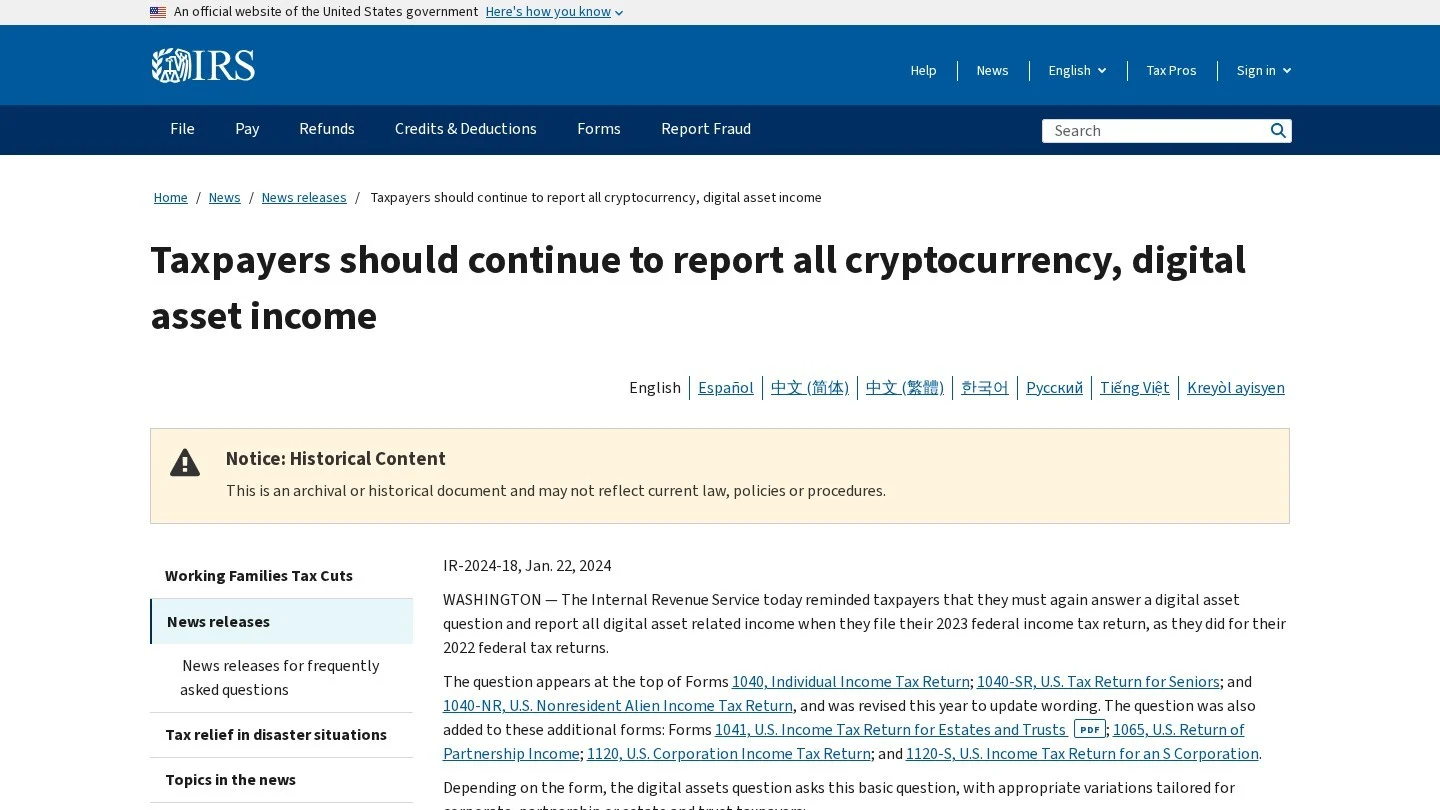
A hard-fork airdrop means checking “Yes” on the digital asset question at the top of Form 1040, 1040-SR or 1040-NR. That question asks if, during the year, you received a digital asset “as a reward, award or payment for property or services,” or sold, exchanged or otherwise disposed of one. Getting new digital assets from a hard fork counts as a “Yes” case. For other airdrops, confirm the answer with your preparer.
Schedule 1 for Airdrop Income
Airdrop income itself goes on Schedule 1 of Form 1040, the form for extra income, which covers ordinary income from digital assets. Checking “Yes” on the digital asset question doesn’t replace this step.
Form 8949 and Schedule D for Airdrop Sales
A later sale or swap of airdropped tokens goes on Form 8949, and the totals carry to Schedule D. Form 8949 is generally required unless your broker gives you a Form 1099-DA with both gross proceeds and basis. Also, you owe tax on a gain even when no broker reports it to you. For what that broker form shows, see our guide to Form 1099-DA for crypto.
Read also: UK Crypto Regulation 2027: What Will Change for You
Records to Keep for Each Crypto Airdrop
For each crypto airdrop, keep five records that back up your income, basis and sales. The IRS asks you to keep records that support your return, including receipts, sales and fair market values.
- The token name, the number of tokens and the wallet or exchange address that received them.
- The date and time you could first move or sell them, with the transaction hash.
- The US dollar price at that moment and a screenshot of the price source.
- The income you reported and the basis per token.
- Every later sale or swap, with the date, proceeds and fees.
Then store the file with your other crypto papers. Our guide to crypto inheritance planning shows how to leave those records where your family can find them. Also, never connect your wallet to an airdrop claim site you can’t verify; our hardware wallet check and crypto address whitelisting guides cover the basics.
Crypto Airdrop Tax FAQs
Are Airdrops Taxable if I Never Sell Them?
Yes, a hard-fork airdrop is taxable even if you never sell it. Under Rev. Rul. 2019-24, you have ordinary income once you receive the tokens with dominion and control, and selling is a separate taxable event that comes later.
Is an Airdrop Ordinary Income or a Capital Gain?
An airdrop is both ordinary income and a capital gain, at different times. The value when you receive the tokens is ordinary income, while any change in value after that is a capital gain or loss when you sell.
Do I Owe Tax on a Hard Fork if No New Coins Arrive?
No, you owe no tax on a hard fork if no new coins arrive. Under both the ruling and the IRS FAQ, a hard fork with no new digital assets received creates no taxable income.
What Does Dominion and Control Mean for Crypto?
Dominion and control means you can transfer, sell, exchange or otherwise dispose of the tokens. So if an exchange holds them and won’t let you move them yet, you don’t have dominion and control until it does.
Should I Talk to a Tax Professional About Airdrops?
Yes, talk to a tax professional about claim-based drops, tokens with no open market price or large amounts. The IRS rules above are general, and they are not tax advice for your own case, so get help before you file.