Three months out is the latest you should start preparing for a trade show. Six months is better. Late planning costs real money. Freight that misses a deadline, rush graphics and services ordered after the discount date all cost more. So this checklist runs in time order, from the first planning meeting to the follow-up emails a week after the show closes.
Shows are busy again, too. The US exhibition industry is forecast to grow 2.1% this year (IAEE’s latest CEIR Index). More exhibitors means more competition for the same visitors.
Set Your Trade Show Goals First (6 Months Out)
Every later choice depends on why you are going. So write down one main goal before you book anything.
- Pick one primary goal. For example, 150 qualified leads, 20 booked demos or 5 distributor meetings.
- Decide how you will count a lead. A badge scan is not a lead. Agree on what is, such as a named need and a buying timeline.
- Set a budget. Include space, booth build, freight, travel, staff time and promotion.
- Check the show’s audience data. Ask the organizer for past attendee titles and industries.
- Confirm the dates and hours. Note move-in, show days and move-out separately.
If you go to the same show each year, ask the organizer about rebooking on site. Returning exhibitors sometimes get early pick of booth locations.
Read the Exhibitor Service Kit Twice
Once you book space, the organizer sends an exhibitor service kit, sometimes called the exhibitor manual. It holds every deadline, rule and order form. So read it the day it arrives, then again with your team.
A pre-show checklist shared by the Montana Department of Agriculture shows how much one kit can cover. Its list runs to nearly 40 items. They include booth rental, labor, carpet, graphics, material handling, rigging, electrical, internet, cleaning, security and lead retrieval. It also tells exhibitors to check the service manual for every deadline.
Pull these dates into one shared calendar:
- Discount deadline for booth services such as carpet, furniture and electrical.
- Show directory deadline for your listing and logo.
- Advance warehouse window for freight.
- Badge registration deadline for your staff.
- Booth design approval if you have a custom or island booth.
- Hotel block cutoff.
Also watch for forms that are easy to miss. The Montana checklist includes a certificate of liability insurance and a form for outside contractors. It also covers an open flame form, a health permit and a tax form. Any one of them can hold up your move-in.
Plan a Booth That Meets the Display Rules
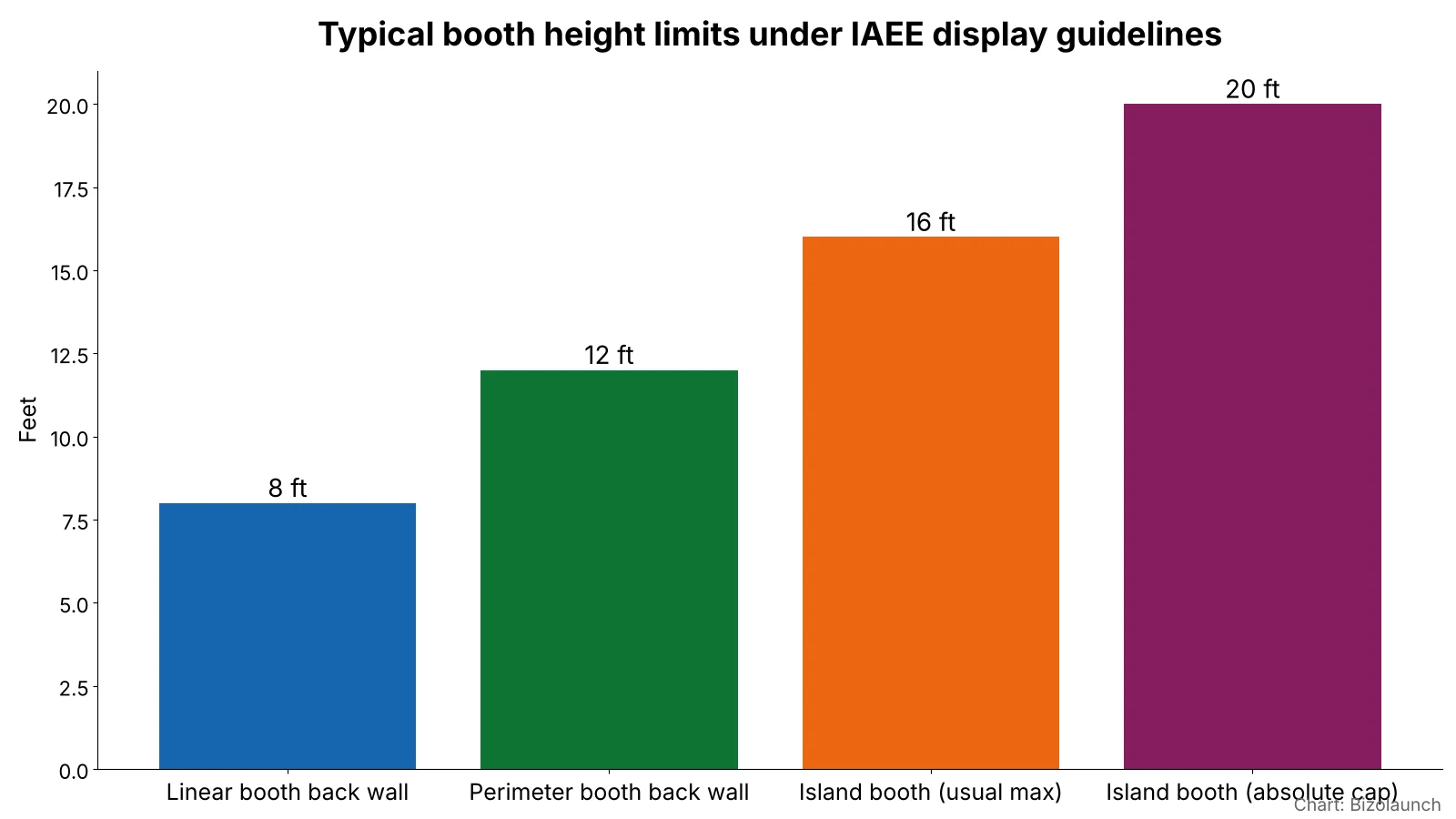
Booth rules limit how tall and how solid your display can be. Many US shows follow the IAEE Guidelines for Display Rules and Regulations. Break them, and the show crew can make you change your booth on move-in day.
| Booth type | Typical size | Height rules |
|---|---|---|
| Linear (in-line) | 10 ft by 10 ft | 8 ft back wall, only in the rear half; 4 ft toward the aisle |
| Corner | Linear booth on a corner | Same as linear, with two open sides |
| Perimeter | Backs onto an outside wall | Back wall usually up to 12 ft |
| Peninsula backing two linear booths | Varies | Back wall limited to 4 ft within 5 ft of each aisle |
| Island | 20 ft by 20 ft or larger | Usually up to 16 ft, 20 ft cap including lighting and truss |
These come from the IAEE display guidelines as one show shared them with exhibitors. Island booths have one more rule: the design must keep 50% see-through visibility from all four aisles.
Now plan the booth itself:
- Keep one message on the back wall. Visitors walk past in a few seconds. Say what you do in under ten words.
- Put your logo high, above head height, so people can see it over the crowd.
- Leave open floor space. A table across the front blocks people from stepping in.
- Plan power early. Screens, lights and chargers all need electrical orders.
- Order graphics with time to spare, and check print proofs against your booth size.
Read also: Instagram Captions for Trade Shows: 150 Booth-Ready Lines
Ship Freight Before the Deadline (6 to 8 Weeks Out)
Freight is where many exhibitors overspend. You usually have two choices: ship to the advance warehouse or ship direct to the show site.
Shoptalk Spring shows how this works in practice. For its March 2027 show in Las Vegas, the advance warehouse opens on 10 February and closes on 10 March. Freight arriving after 10 March carries an extra 30% late surcharge. Direct shipments to Mandalay Bay are not accepted before 1 pm on 20 March. And every carrier must first check in at a separate marshalling yard.
Shoptalk’s freight rules hold other points worth copying into your plan:
- Label every box with the official freight label, and use a separate label for hanging signs.
- Send certified weight tickets with every shipment.
- Expect limits. The warehouse refuses uncrated freight, COD shipments, hazardous goods and refrigerated freight.
- Know what material handling covers. It is a one-time charge for moving freight from the dock to your booth and back, including storing empty crates.
- Ship small boxes separately. Brochures can go to the venue’s business center, but you must pick them up yourself.
So book the advance warehouse when you can. It costs less stress than hoping a truck reaches the show dock on time. Also save empty-container labels, because you will need them to get your crates back.
Promote Your Booth Before the Show (4 Weeks Out)
Many visitors plan part of their route before they arrive. So give them a reason to put your booth on it.
- Email your customer list with your booth number and a reason to visit.
- Book meetings in advance. A calendar link in every sales email fills your best time slots.
- Post on social media using the show’s official hashtag.
- Send a short news release if you are launching something. Our guide on writing a press release covers the format.
- Track every link. Add UTM tags with our UTM builder so you know which invitations worked.
Train the Booth Staff (2 Weeks Out)
Your staff are the booth. A good display with a bored team still fails. So brief everyone in person before the show.
Cover these points in the briefing:
- The goal and what counts as a qualified lead.
- A 20-second opener. Our elevator pitch guide helps each person write one.
- Three qualifying questions, such as role, current problem and timeline.
- The shift schedule. Keep shifts to a few hours, because energy drops fast on a show floor.
- Booth rules for staff. No phones while visitors wait, no eating in the booth and no huddling in groups.
Also set up lead capture early. Lead retrieval usually appears as an order item in the service kit, with its own deadline. Test the app or scanner before you leave the office.
Pack the Show Kit (1 Week Out)
Small things go missing at every show. So pack one kit you can carry yourself.
- Extension cords, power strips and phone chargers.
- Tape, scissors, zip ties and a small tool kit.
- Business cards and printed price sheets.
- Copies of every order confirmation and your freight paperwork.
- A printed copy of your insurance certificate.
- Water, snacks and comfortable shoes.
- A QR code on a stand that links to your demo page. You can make one with our QR code generator.
If you travel to the show, our business travel checklist covers the trip itself.
Work the Floor During the Show
The show days go fast. So run each day with a short routine.
- Hold a 10-minute huddle each morning to review the lead count and any changes.
- Write notes on every lead within minutes, while you still remember the talk.
- Walk the floor once a day to see what competitors and partners show.
- Sort hot leads nightly so sales can call the most urgent ones during the show.
Read also: A Virtual Event Planning Checklist to Get It Right
Follow Up Within 48 Hours After the Show
Leads cool off fast once the show closes. So send follow-ups within two days, while visitors still remember you.
- Sort leads into hot, warm and cold.
- Call hot leads first. Our sales call script examples can help your team open those calls.
- Send personal emails to warm leads that mention your talk at the booth.
- Add cold leads to a nurture email series.
- Count results against the goal you set six months earlier.
- Hold a debrief within a week. Write down what to change next time, while it is fresh.
Track the leads through to closed sales. A show that looked quiet can still pay off months later, and only your records will show it.
Exhibitor Questions About Trade Show Prep
How far in advance should you prepare for a trade show? Six months gives you time for good booth space and early-bird prices. Three months is the practical minimum.
What is an exhibitor service kit? It is the organizer’s manual of deadlines, rules and order forms for booth services, freight and badges.
What is the advance warehouse? It is a site that takes your freight before the show and delivers it to your booth at move-in. At Shoptalk Spring, freight that misses the deadline pays a 30% late surcharge.
How tall can a 10 by 10 booth be? Under the IAEE guidelines, a linear booth back wall is generally limited to 8 feet. Anything in the front half must stay under 4 feet.
So which item will you start on today? Open your exhibitor kit and copy every deadline into your calendar. That single task prevents most of the costly surprises.