AI in primary education statistics measure how often primary teachers and pupils use tools like ChatGPT, and how schools set rules for them. The short answer is that primary teachers now use AI a lot, but young pupils use it less in class and learn less about it. In England, 47% of primary teachers in the NEU used AI for lesson planning in February 2026, up from 28% a year before. In the US, by contrast, only 18% of elementary teachers used AI tools in the 2023-24 school year, against 34% of secondary teachers.
Pupils are catching up, mostly at home. For example, 81% of US children aged 9 to 12 used or talked with AI in March 2026. Yet only 8% of US educators reported AI literacy lessons for pupils in pre-K to grade 3.
Rules and training lag behind both groups. Nearly half of NEU members in England work in schools with no AI policy at all. Also, 85% of primary teachers in a New Zealand survey wanted more AI training.
The sections that follow cover primary teachers in England and the US, then pupils’ own use, then lessons, rules, training and concerns.
Primary Teachers’ Use of AI in England
Most primary teachers in England now use AI for at least one task. In a February 2026 NEU survey, 61% of primary teachers used AI to make resources. Also, 47% used it for lesson planning and 40% for admin tasks. Only 5% used it for marking.
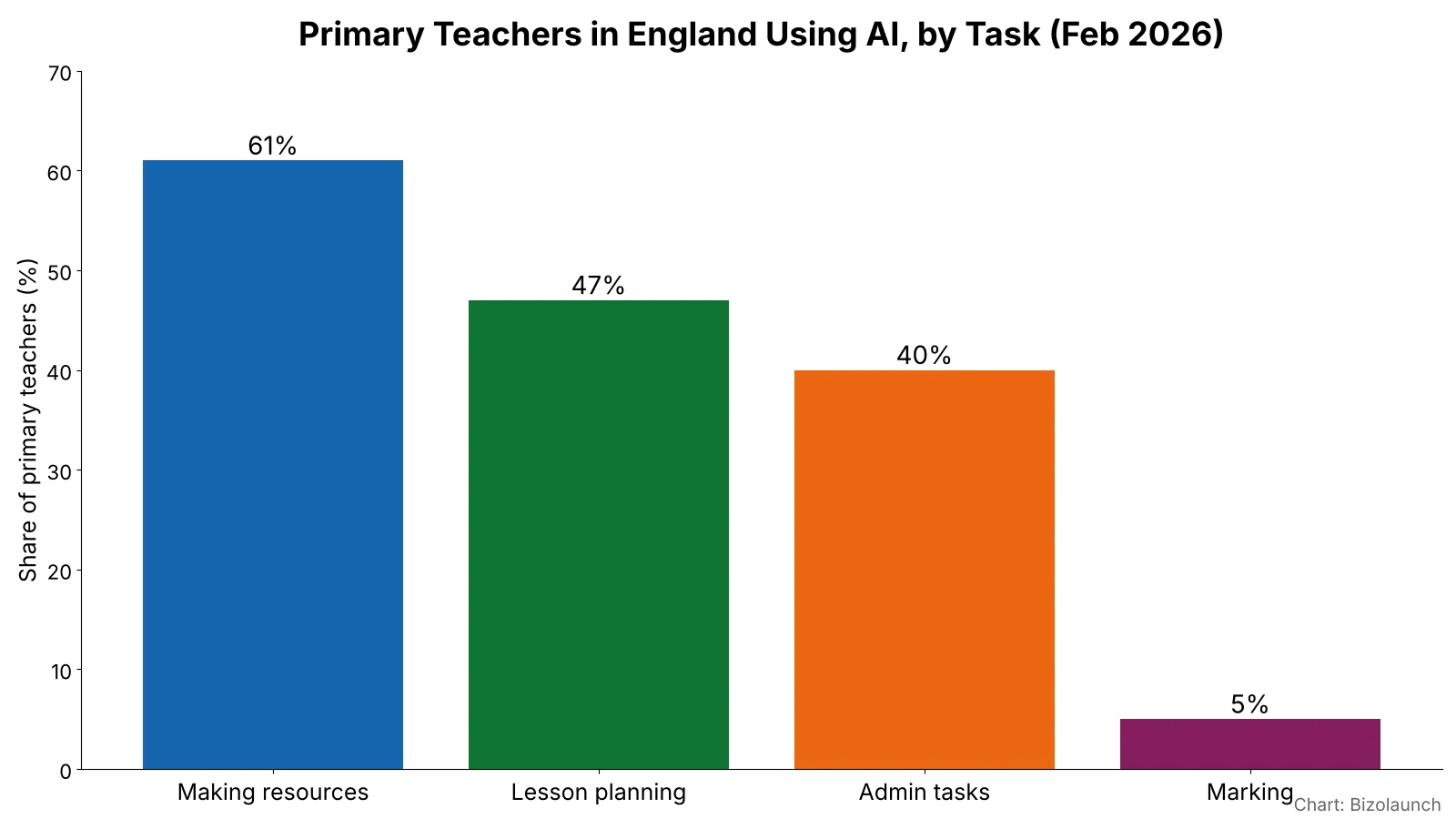
The NEU State of Education survey ran from 5 to 16 February 2026 and polled teacher members in English state schools. Across all phases, 76% of staff used AI tools in their day-to-day work, up from 53% a year earlier. Primary lesson planning rose fastest, from 28% to 47% in one year. By comparison, secondary lesson planning only went from 26% to 34%.
Teacher Tapp data points the same way. Teacher Tapp ran its survey in November and December of last year. Primary teachers who had tried AI used it most for lesson planning (61%), report writing (55%) and making images (55%). Secondary teachers, on the other hand, leaned on AI for quizzes and tests. Also, teachers of KS2 (ages 7 to 11) had the lowest rate of non-use of any group, at just 8%.
| Survey | Group | Date | Figure |
|---|---|---|---|
| NEU State of Education | Primary teachers, England | Feb 2026 | 47% plan lessons with AI |
| NEU State of Education | Primary teachers, England | Feb 2026 | 61% make resources with AI |
| NEU State of Education | Primary teachers, England | Feb 2026 | 5% mark with AI |
| Teacher Tapp | KS2 teachers, England | Nov to Dec, last year | 8% have never used AI |
| Teacher Tapp | Primary teachers who used AI | Nov to Dec, last year | 55% write reports with AI |
So primary teachers use AI mainly for the paperwork side of the job. Marking, by contrast, stays almost untouched in primary schools.
How fast weekly use grew among UK teachers
Weekly AI use among all UK teachers doubled in one year, from 26% to 52%. That jump showed up in a YouGov poll of 1,033 UK teachers for Bett, covered by Tes on 27 August 2026. However, this figure covers every phase, so it is not a primary-only number.
The time gains are modest so far. Among AI users in the same poll, 51% felt AI eased their workload. Even so, 55% still worked the same hours as before.
Elementary Teachers’ Use of AI in the US
US elementary teachers use AI far less than their secondary peers. In the 2023-24 school year, 18% of elementary teachers used AI tools for planning or teaching, against 34% of secondary teachers.

RAND surveyed 9,126 public school teachers of English, math and science in spring 2024 for that split. RAND published the uneven adoption report last year. Across the whole sample, 25% of teachers used AI, and only 4% used it for planning every week.
Elementary education teachers sat at the bottom of the subject list too. For example, 39% of English teachers and 37% of science teachers used AI, while math teachers came in at 21%. Teachers in low-poverty schools also used AI more (30%) than those in the poorest schools (23%).
An earlier RAND study gives the starting point. In fall 2023, 18% of K-12 teachers used AI for teaching, and middle and high school teachers were more likely to be users. So the elementary gap has been there from the start.
Why the K-12 figures are higher now
Newer US surveys cover all grades, and they show much higher use. For instance, 61% of US teachers used AI at least a little last year. The EdWeek Research Center count was 32% the year before. Also, about six in 10 K-12 teachers used AI for work in the Walton Family Foundation and Gallup research.
These are K-12 figures, though, so they mix teachers of first graders with high school teachers. The RAND 18% figure, by contrast, covers elementary teachers alone.
How Children Aged 9 to 12 Use AI
Most children of upper primary age already use AI. In March 2026, 81% of US children aged 9 to 12 used or talked with AI, and 17% did so every day.

Common Sense Media ran the census on AI use by tweens and teens for the first time this year. SSRS surveyed 1,204 US children aged 9 to 17 from 18 to 26 March 2026. Children aged 8 and under were not in the sample.
For school, 39% of 9- to 12-year-olds who use AI turn to it for schoolwork at least weekly, and 12% do so every day. Also, 58% of children in this age group have used an AI chatbot. Teens use AI more often. For example, 29% of 13- to 17-year-olds use AI daily, against 17% of the younger group.
| Measure | Children aged 9 to 12 | All ages 9 to 17 |
|---|---|---|
| Use or interact with AI | 81% | 86% |
| Use AI every day | 17% | 24% |
| Have used AI chatbots | 58% | 67% |
| AI users who use it for schoolwork weekly | 39% | 48% |
| AI users who use it for schoolwork daily | 12% | 21% |
UK and New Zealand data on younger pupils
In the UK, 56% of children aged 8 to 17 use AI, in Ofcom research from May 2026. Also, 11% of that age group have used AI as someone to talk to. That range runs from upper primary to the end of school.
New Zealand has a primary-only study. The NZCER survey of Years 5 to 8 heard from 147 pupils and 266 teachers. More than half of the pupils had used generative AI, though weekly users were a minority. Pupils also used AI more at home than in class, mostly to draw images, chat, fix writing and get homework ideas.
For more on how adults use the same chatbots, see our AI chatbot usage statistics.
Read also: Painting Contractor Marketing Statistics: How a Pro Gets Hired
AI Literacy Lessons in Primary Grades
Very few young pupils get AI lessons. Only 8% of US educators reported AI literacy lessons for pupils in pre-K to grade 3. That survey ran in December of last year and January 2026.
The share climbs with age. For grades 4 and 5, nearly 4 in 10 educators reported AI literacy lessons. For grades 6 to 8, the figure jumps to 73%, and for high school it is nearly 8 in 10. The EdWeek Research Center polled 499 teachers, principals and district leaders in that survey.
| Grade band | Educators saying students get AI literacy lessons |
|---|---|
| Pre-K to grade 3 | 8% |
| Grades 4 to 5 | Nearly 4 in 10 |
| Grades 6 to 8 | 73% |
| High school | Nearly 8 in 10 |
Part of the reason is the age limits on tools. In its 2023 guidance, UNESCO asked governments to consider an age limit of 13 for AI tools in the classroom.
Australia gives a school chatbot to pupils from Year 5
New South Wales opens a school AI tool to upper primary pupils. From Term 4 of last year, all NSW public school students in Years 5 to 12 got access to NSWEduChat. That rollout followed a trial in 50 schools, and a teacher version had reached all schools earlier.
AI Policies in Primary Schools
Primary schools are the least likely to have an AI policy. In the February 2026 NEU survey, 49% of members worked in a school with no AI policy for staff or students. Primary schools had the fewest policies of any phase.
Also, 66% of NEU members reported no school policy on how pupils use AI. Only 31% had a policy that covered both staff and students.
US guidance looks thin as well. Gallup polled 2,069 K-12 public school teachers from 9 February to 2 March 2026. Of those, 34% had no guidance at all on AI for any of 10 teaching tasks. Only 18% had formal guidance on at least one task, while 48% had informal guidance only. Gallup found guidance did not vary much by grade level.
If you write a school AI policy, a plain workplace policy can be a useful model. Our guide to an AI acceptable use policy covers the sections most policies need.
Training for Primary Teachers on AI
Most primary teachers want more AI training than they get. In the NZCER survey of Years 5 to 8 teachers, 85% wanted more training in generative AI tools. Also, fewer than half felt sure about teaching pupils to use AI well.
US training is growing, but it still misses many teachers. In the EdWeek Research Center count from September to November of last year, 50% of teachers had at least one AI training session. In early 2024, that figure was just 29%.
Teachers in other countries show a similar split. In the OECD TALIS survey of 2024, about 38% of lower secondary teachers had AI in their training over the past year. However, that figure covers lower secondary teachers only, not primary.
| Source | Group | Date | Training figure |
|---|---|---|---|
| NZCER | Primary teachers, Years 5 to 8, New Zealand | Published last year | 85% want more AI training |
| EdWeek Research Center | K-12 teachers, US | Sept to Nov, last year | 50% had at least one AI session |
| EdWeek Research Center | K-12 teachers, US | Jan to Mar 2024 | 29% had at least one AI session |
| OECD TALIS via Education International | Lower secondary teachers, OECD | 2024 | About 38% had AI in their training |
For teachers who want to build skills on their own, our guide on how to write AI prompts covers prompt basics that also work for lesson planning.
Primary Teachers’ Worries About AI
Primary teachers worry less than secondary teachers that AI hurts pupils’ thinking. In February 2026, 28% of NEU primary teachers agreed that pupils’ critical thinking had declined because of AI, against 66% of secondary teachers.
Primary teachers were also cool on AI tutors. When asked about the government plan for AI tutoring for poorer pupils, only 14% of NEU members agreed with it. In fact, 49% opposed the plan, and 36% had no view.
Among teachers in the Teacher Tapp survey who did not use AI at all, the top worries were:
- Wrong answers. 56% of non-users doubted the reliability of what AI tells them.
- Cheating. 46% worried about plagiarism and pupils passing off AI work as their own.
- Over-reliance. 46% feared pupils would lean on AI too much.
- No time saved. 35% had to check every output, so AI saved them no time.
- Data protection. 24% worried about pupil data.
These worries are for all teachers who do not use AI, not for primary teachers alone. Still, they match what primary pupils told NZCER researchers, since many felt that using AI was a bit like cheating.
Read also: AI Agent Marketing Statistics: Who Uses Agents and How
What the Numbers Mean for Primary Schools
The numbers point to three gaps that primary leaders can act on. First, teachers use AI for planning and reports far more than schools have rules for. Second, children aged 9 to 12 use AI at home far more than they learn about it in class. Third, training trails demand in every country with data.
For school leaders, the most useful steps are plain ones:
- Write a short AI policy. Cover what staff may use, what pupils may use and how pupil data is kept safe.
- Pick approved tools. NSW chose one state-run chatbot, which made rules and data checks simpler.
- Teach AI basics from Year 5. Most pupils aged 9 to 12 already use AI, so lessons on checking answers fit there.
- Train staff on planning and reports first. These are the tasks primary teachers already use AI for most.
Quiz-making is another common task. Our list of online quiz tools for teachers covers apps that teachers can pair with AI.
Quick Answers on AI Use in Primary Schools
How many primary teachers use AI?
Most primary teachers in England use AI for some part of their work. In February 2026, 47% of NEU primary teachers used it for lesson planning. Also, only 8% of KS2 teachers in Teacher Tapp’s late survey of last year had never used AI. In the US, the latest elementary split is 18%, from the 2023-24 school year.
At what age do children start using AI?
Many children use AI by age 9. In March 2026, 81% of US kids aged 9 to 12 used or talked with AI. Kids under 9 were not part of that survey.
Do primary pupils use AI for homework?
Yes, many do. In March 2026, 39% of US children aged 9 to 12 who use AI used it for schoolwork at least once a week. In New Zealand, Years 5 to 8 pupils also named homework ideas as one of their main uses.
Is ChatGPT allowed in primary schools?
ChatGPT is mostly not used by young pupils in class. UNESCO asked governments to think about a minimum age of 13 for AI tools in class. Instead, NSW gives pupils from Year 5 a school-run chatbot of its own.
For a wider view of how young people use apps and platforms, see our social media usage by generation figures.