Google had 91.05% of the worldwide search engine market in October 2026, on StatCounter’s count. That is about half a point lower than the 91.61% it had in February 2024. In between, the share fell under 90% for three months at the end of 2024. It slipped under the line again in September 2026, to 89.94%.
So yes, Google’s share has dropped. But the drop is small, and it has gone up and down. AI search plays a part, though it is not the only cause. The bigger change is in how people use Google itself.
Google Search Market Share by Month
Google’s share has stayed close to 90% for the last three years. These StatCounter figures cover all devices, worldwide:
| Month | Google share | What happened |
|---|---|---|
| February 2024 | 91.61% | Normal level before the dip |
| October 2024 | 89.34% | First month under 90% since 2015 |
| November 2024 | 89.99% | Still just under 90% |
| December 2024 | 89.73% | Third month in a row under 90% |
| February last year | 90.15% | Back above 90% |
| August 2026 | 91.1% | Higher than early last year |
| September 2026 | 89.94% | Under 90% again |
| October 2026 | 91.05% | Back to 91% |
The last time Google stayed under 90% for three months was early 2015. At that time, it had 89.62% in January, 89.47% in February and 89.52% in March.

Note that the chart axis starts at 85%. On a full 0 to 100 scale, the bars would look almost the same. That tells you how small the moves are.
Desktop and mobile tell two stories
On phones, Google is close to a monopoly. It had 95.68% of mobile search in September 2026. Yandex came second with 1.21%, and Bing had just 0.69%.
Desktop is a different market. In September 2026, Google had 78.12% of desktop search and Bing had 14.62%. A month earlier, in August, Google had 86.05% and Bing had 8.84%. So desktop numbers can swing several points in one month.
| Search engine | All devices (Oct 2026) | Desktop (Sep 2026) | Mobile (Sep 2026) |
|---|---|---|---|
| 91.05% | 78.12% | 95.68% | |
| Bing | 4.8% | 14.62% | 0.69% |
| Yahoo! | 1.18% | 3.35% | 0.45% |
| Yandex | 1.14% | 1.51% | 1.21% |
| DuckDuckGo | 0.64% | 0.94% | 0.64% |
| Baidu | 0.42% | 0.37% | 0.48% |
Bing is the main winner from Google’s small losses. It went from 3.32% of all search in February 2024 to 4.8% in October 2026. Most of Bing’s share comes from desktop, where it is the default search engine in Windows and the Edge browser.
What StatCounter Actually Measures
This part matters for reading the headline. StatCounter does not count searches. Instead, it counts visits that reach websites from a search engine. Its data comes from over 3 billion page views a month on sites that use its tracker.
That has two effects. First, a search in ChatGPT or Perplexity is not counted as a search engine visit. Those tools fall in a separate AI chatbot group. Second, if someone asks Google a question and gets the answer from an AI Overview, there may be no click at all. In that case, nothing gets counted.
So a fall in Google’s share does not always mean people moved to another search engine. It can also mean Google sent fewer clicks out, or that Bing sent more.
Read also: Runway AI vs Pika: User Adoption and Market Share
How Big AI Search Is Next to Google
AI chatbots are growing fast. Even so, they send very little traffic to websites. In October 2026, search engines drove 91.47% of referral visits worldwide. Social media drove 8.39%. AI chatbots drove just 0.14%.
Within that small AI slice, ChatGPT is still first. Its lead is shrinking, though. In April last year, it had 84.21% of AI chatbot referrals. By October 2026, it was down to 51.58%.
| AI chatbot | Share of AI chatbot referrals (Oct 2026) |
|---|---|
| ChatGPT | 51.58% |
| Google Gemini | 28.86% |
| Perplexity | 15.04% |
| Claude | 2.30% |
| Microsoft Copilot | 2.18% |
| DeepSeek | 0.05% |
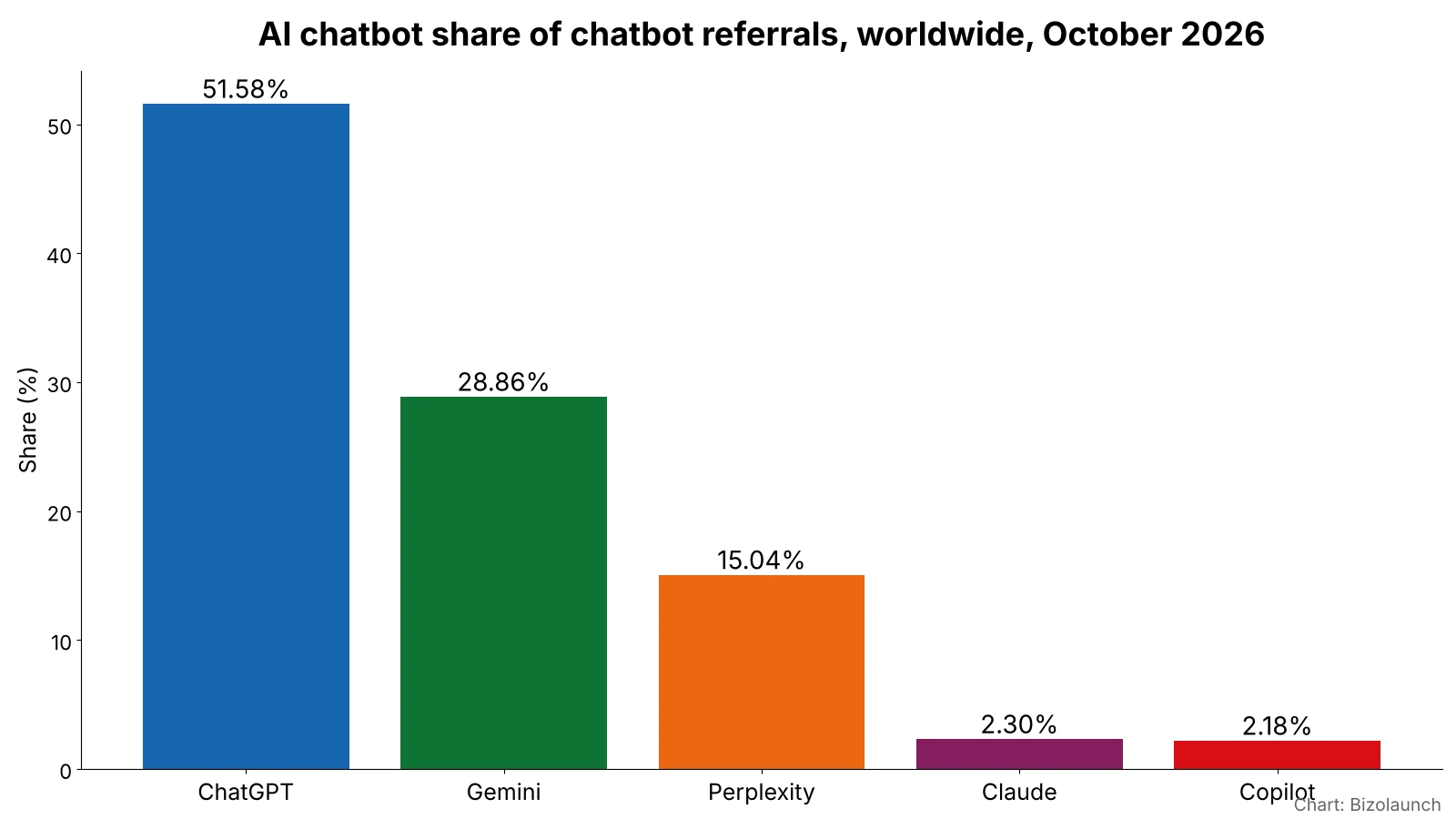
Gemini is the fastest climber. It had 2.31% of AI chatbot referrals in April last year. It passed Perplexity in March 2026 and reached 28.86% by October. Since Gemini is a Google product, some of the AI growth still ends up with Google.
User numbers for the AI tools
ChatGPT passed 900 million weekly users in February 2026. That is a huge audience. However, many of those people use it for writing, coding and study, not only for search.
Google’s own AI products are just as big. AI Mode in Google Search passed one billion monthly users in May 2026. Its query volume has more than doubled every quarter since launch. The average AI Mode search is about three times as long as a classic Google query. In October 2026, the Gemini app also passed one billion users.
So the AI search shift is real. But much of it is happening inside Google, not away from it.
Google Search Revenue Is Still Growing
If AI search were draining Google, revenue would show it. So far, it does not. Alphabet released its third quarter 2026 results on October 28, 2026.
| Alphabet Q3 figure | Q3 last year | Q3 2026 | Change |
|---|---|---|---|
| Total revenue | $102.35 billion | $127.58 billion | Up 25% |
| Google Search and other | $56.57 billion | $63.35 billion | Up 12% |
| YouTube ads | $10.26 billion | $11.21 billion | Up about 9% |
| Google Cloud | $15.16 billion | $30.71 billion | Up 103% |
Search and other still brings in about half of Alphabet’s revenue. It grew 12% in a year. In addition, Google’s year-over-year query growth is at its highest level in five years. Sundar Pichai credits AI features for that growth, and that includes commercial queries, the searches that carry ads.
One detail is easy to miss. Search grew 12%, while Alphabet as a whole grew 25%. Cloud did most of the heavy lifting. For more on that side, see our report on how Google Cloud revenue doubled.
Did AI Search Cause the Drop?
Partly. The causes are mixed, and AI search is only one of them:
- Bing on desktop. Bing’s desktop share swings a lot and has climbed. Bing is the default in Windows and Edge, and Copilot runs on it. Much of Google’s dip shows up on desktop, where Bing gains.
- Fewer clicks from Google itself. AI Overviews and AI Mode answer questions on the results page. In a Pew Research Center study of 900 US adults, people clicked a regular result on 8% of visits when an AI summary showed. Without a summary, they clicked 15% of the time.
- AI chatbots outside Google. ChatGPT, Perplexity and Claude take some questions that used to go to Google. Still, their referrals are tiny, at 0.14% of all referral traffic.
In that study, run in March last year, AI summaries showed on 18% of Google searches. Users clicked a link inside the summary on just 1% of visits. And 26% of visits with a summary ended the browsing session. Without a summary, the figure was 16%.
So the bigger story is not that people left Google. It is that Google sends fewer people to other websites.
What This Means for Businesses and SEO
For most businesses, Google is still the place to win. It holds over 91% of search traffic, and 95.68% on mobile. Dropping Google SEO because of AI chat would be a mistake.
Still, a few things should change in your plan:
- Track Bing on desktop. Bing had 14.62% of desktop search worldwide in September 2026, so it matters if your buyers work on Windows PCs. Set up Bing Webmaster Tools and check how your pages show there.
- Write for AI answers. AI Overviews, AI Mode and ChatGPT pull short, direct answers from pages. Put the answer in the first lines of a section, use plain headings and add real numbers. Our list of SEO tips to get cited by AI search covers this step by step.
- Expect fewer clicks per ranking. A top spot may bring less traffic than it did two years ago. So measure leads and sales from search, not only visits.
- Watch Gemini and ChatGPT referrals. Add AI chatbots as a traffic source in your analytics. They are small today, but Gemini’s share has grown more than tenfold since April last year.
- Build a brand people search for. People who already know your name search for it directly. Those searches still send clicks.
The tools people use are also shifting within the AI group. For the usage numbers behind that, read our ChatGPT vs Perplexity search usage statistics.
Read also: Google Office Addresses Around the World
What to Watch Next
Three numbers will show where this goes. First, watch if Google’s monthly share stays under 90% for more than one month again. Second, watch Bing’s desktop share, since that is where Google loses the most ground. Third, watch the AI chatbot share of total referrals. Right now it is 0.14%. If it climbs past 1%, AI search will be taking real traffic away from search engines.
Alphabet’s next results will cover the fourth quarter of 2026. The Search and other line will show if AI Mode keeps growing revenue as well as queries.
For now, the headline holds only in part. Google’s share did drop, and AI search is one reason. Yet Google still handles about nine in ten search visits, and its search revenue keeps rising.